


Site Predominant Period Based on H/V Spectral Ratio Method and Its Relationship with Seismic Motion Parameters
-
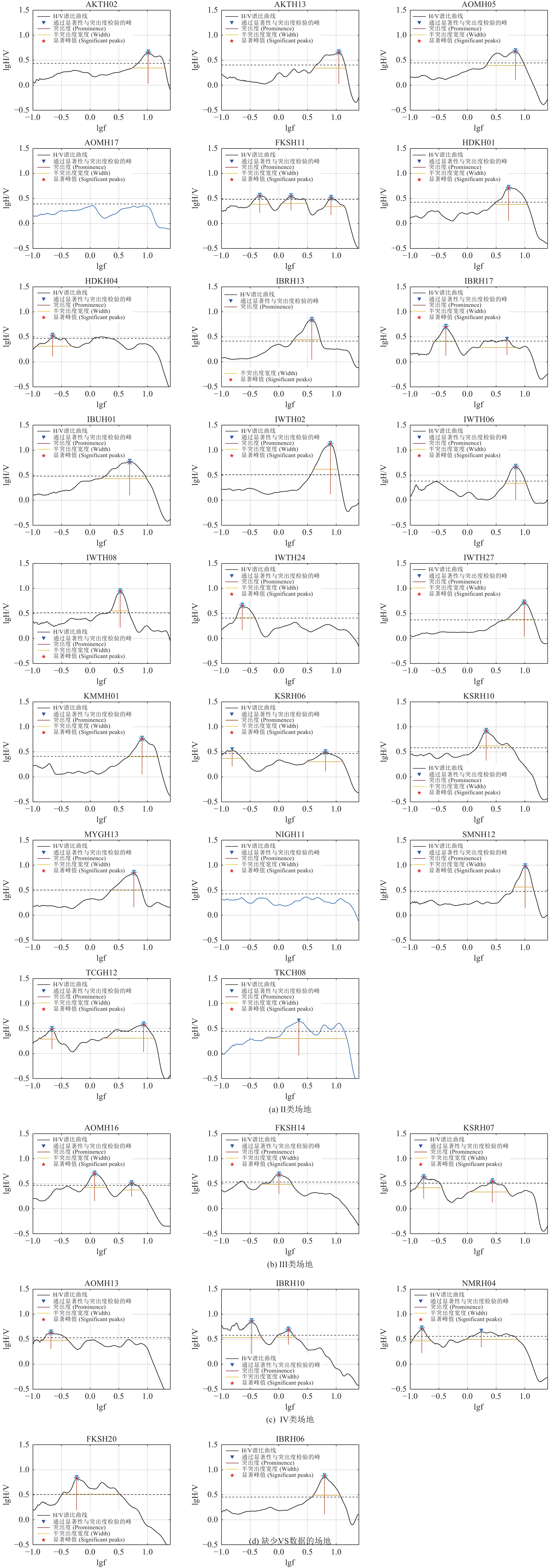
摘要: 局部场地条件是影响地震动特征以及震害分布的关键性因素,而场地周期值被用于表征场地条件对地震动特性的影响,并应用于场地类别划分。本文探讨了基于地震动记录的水平与竖向傅里叶谱比(H/V谱比)法用于场地周期确定的有效性,利用日本KiK-net台网中31个台站的强震动记录计算其H/V谱比曲线,分析了场地卓越周期与场地地震动峰值加速度(PGA)、震级和震中距等参数的关系。结果表明,不同类别场地的谱比曲线特征差异显著,H/V谱比法能有效识别场地的卓越周期;在中远场地震动条件下,H/V谱比曲线形态稳定,受震级和震中距影响较小,展示了H/V谱比法识别场地卓越周期的可靠性;场地卓越周期随PGA增大向更大值偏移,体现了土体的非线性反应效应。考虑土体非线性影响,提出了基于地震动强度的场地卓越周期动态修正方法。研究结果可供基于场地周期值进的场地类别划分方法考虑场地土非线性影响提供参考。Abstract: Local site conditions are critical factors affecting the ground motion characteristics and the distribution of earthquake damage. Site period values are used to characterize the influence of site conditions on ground motion properties and are applied in site classification. To address these issues, this paper investigated the effectiveness of the horizontal-to-vertical Fourier spectrum ratio (H/V spectral ratio) method based on strong motion records in determining and classifying site periods, and calculated the H/V ratio curves by utilizing strong motion records from 31 stations in Japan's KiK-net seismic network, and analyzed the relationship between site predominant period and peak ground acceleration (PGA), earthquake magnitude, and epicentral distance. Results indicate that (1) the H/V spectral ratio method effectively identifies the site predominant period, with significant differences in spectral ratio curve characteristics across site categories. (2) Under mid-to-long-distance seismic motion conditions, the H/V spectral ratio curve exhibits stable morphology with minimal influence from earthquake magnitude and epicentral distance, validating the method's reliability. (3) Site predominant periods shift toward bigger values with increasing PGA, reflecting soil nonlinear response. Considering the nonlinear effect of soil, a dynamic correction method for the site predominant period based on ground motion intensity is proposed. The research results can provide a reference for site classification methods based on site period values to take into account the nonlinear influence of site soil.
-
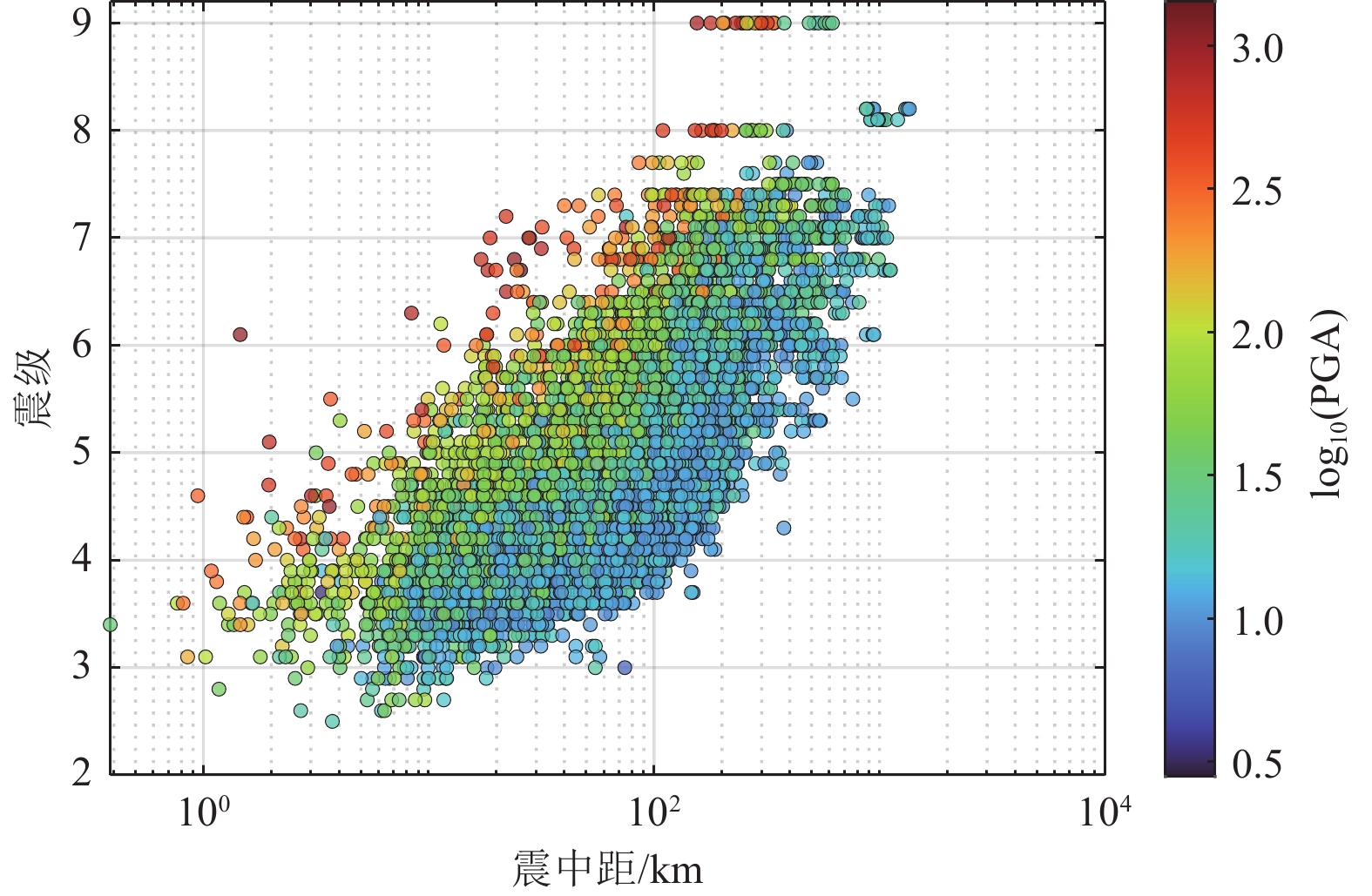
图 1 所选取记录的峰值加速度PGA随震级M和震中距的分布
Figure 1. Distribution of the PGAs with earthquake magnitude M and epicentral distance for the selected records
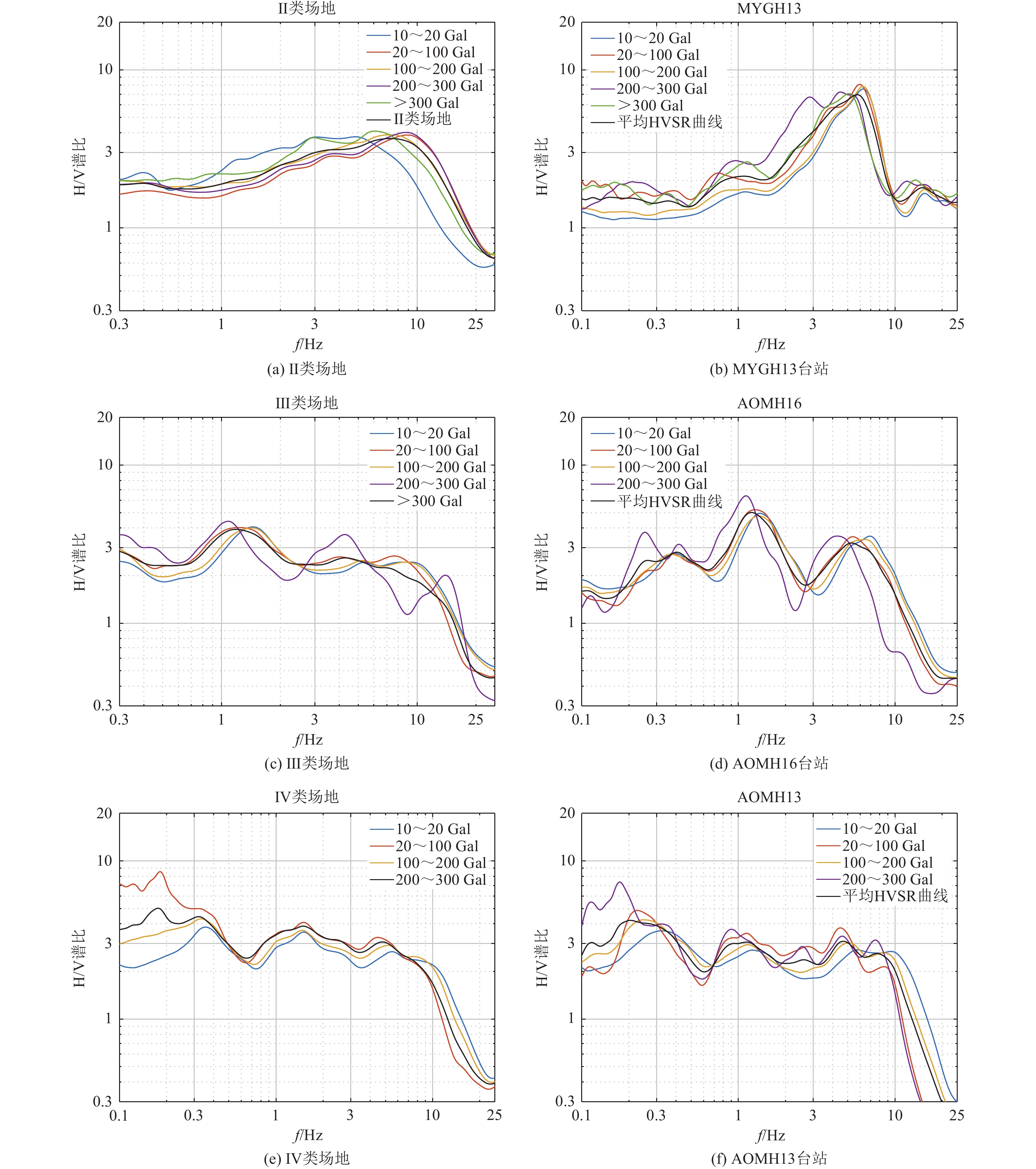
图 3 不同场地不同PGA分档下的H/V谱比均值
Figure 3. Mean H/V spectral ratios under different playing surfaces and PGA classifications
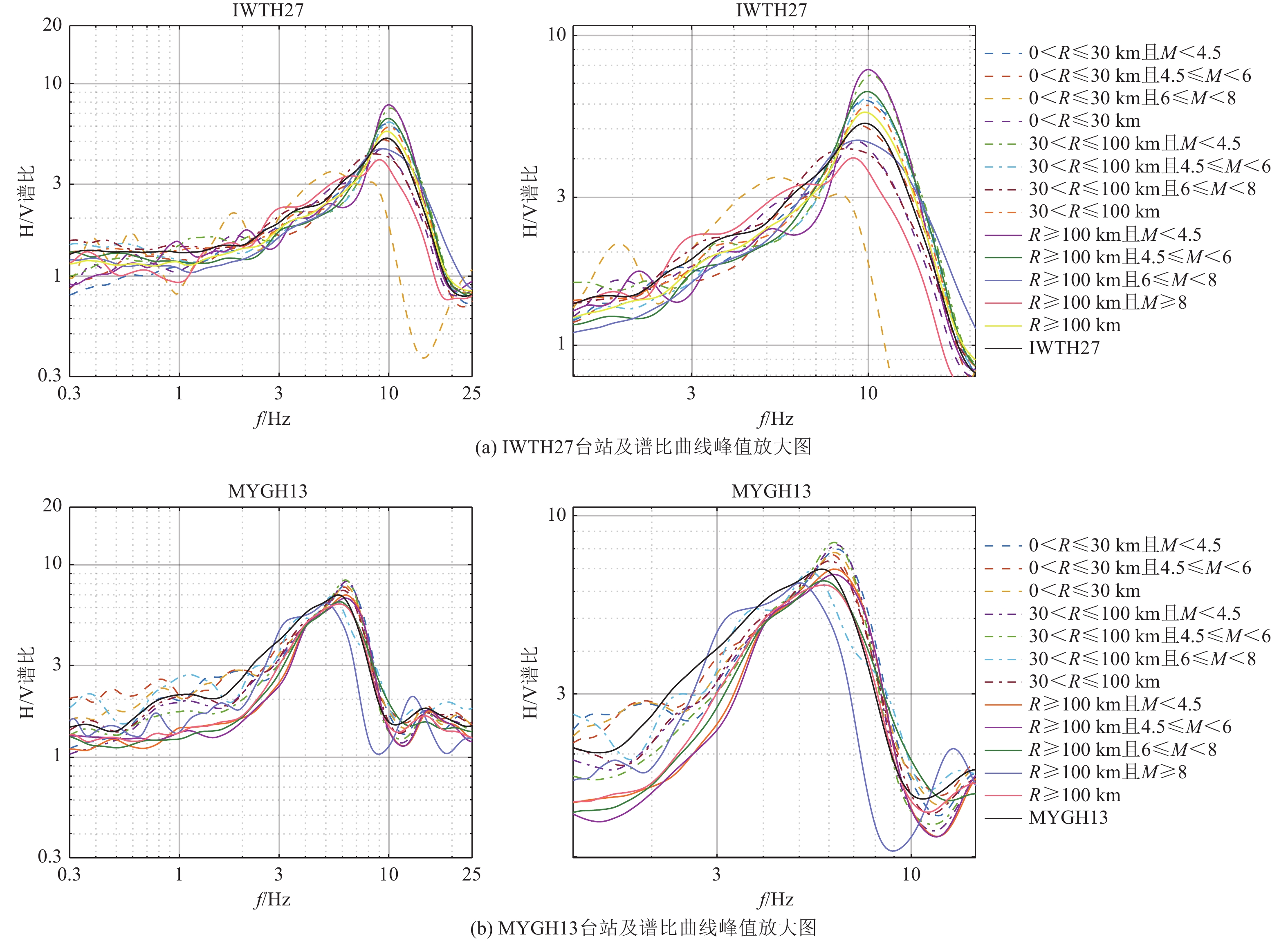
图 4 台站震级、震中距分档下的H/V谱比均值
Figure 4. The mean value of H/V spectrum ratio under the station magnitude and epicenter distance

图 5 场地卓越周期Tg与不同分档PGA、震级、震中距的散点分布
Figure 5. Scatter plot of site excellence period Tg versus different PGA bands, magnitude, and epicenter distance
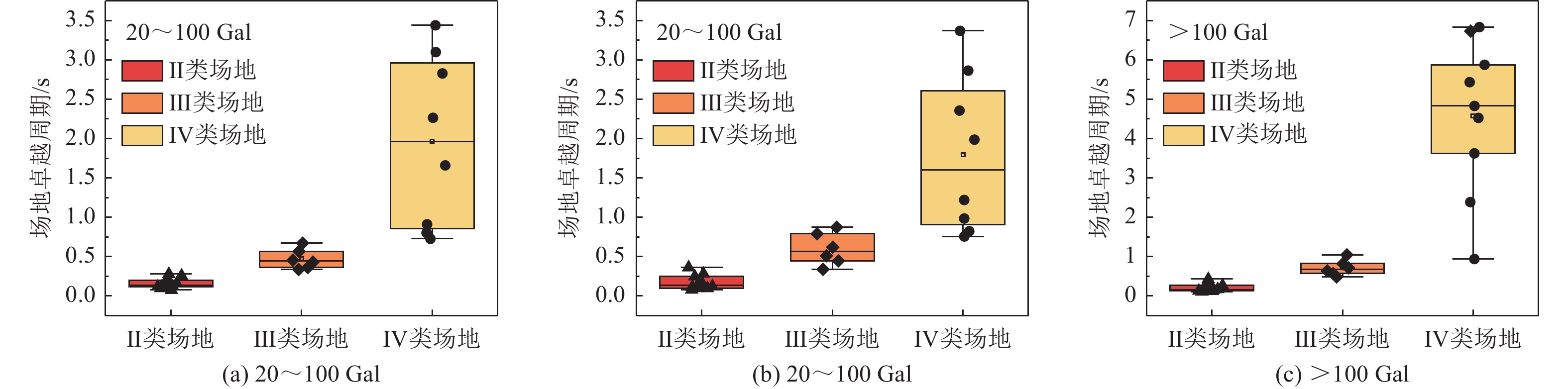
图 6 不同PGA强度各类别的的实测卓越周期分布箱线图
Figure 6. Box plot of measured excellent cycle Tg distribution for different PGA strength categories
表 1 GB 50011—2010《建筑抗震设计规范》中的场地分类方法
Table 1. Site classification method in GB 50011—2010《Code for seismic design of buildings》
岩石的剪切波速或土的等效剪切波速/(m·s−1) 覆盖层厚度/m Ⅰ0 Ⅰ1 Ⅱ Ⅲ Ⅳ 800<VS 0 — — — — 500<VS≤800 — 0 — — — 250<VSe20≤500 — <5 ≥5 — — 150<VSe20≤250 — <3 3~50 >50 — VSe20≤150 — <3 3~15 15~80 >80 注:表中VS表示岩石的剪切波速,VSe20表示土层计算深度内的等效剪切波速,计算深度取覆盖层厚度和20 m中的较小值。  下载: 导出CSV
表 2 所选取台站的地理信息和场地类别
Table 2. Geographical Information and Site Categories of Selected Stations
编号 台站代码 纬度/(°N) 经度/(°E) 覆盖层厚度/m VSe,20/(m·s−1) 中国场地类别 场地基本
周期TB/s日本场地
类别H/V谱比卓越
周期TP/s1 AKTH02 39.6634 140.5721 5.2 250 Ⅱ 0.083 SC Ⅰ 0.097 2 AKTH13 39.9819 140.4072 4 130 Ⅱ 0.151 SC Ⅰ 0.090 3 AOMH05 40.8564 141.1033 26 204 Ⅱ 0.483 SC Ⅲ 0.246 4 AOMH13 40.5794 141.4451 118 139 Ⅳ 2.146 SC Ⅳ 4.830 5 AOMH16 40.4624 141.0923 64 196 Ⅲ 1.252 SC Ⅳ 0.839 6 AOMH17 40.4624 141.3374 8 196 Ⅱ 0.317 SC Ⅱ — 7 FKSH11 37.2006 140.3386 34 235 Ⅱ 0.564 SC Ⅲ 2.149 8 FKSH14 37.0264 140.9702 52 219 Ⅲ 0.822 SC Ⅳ 0.944 9 FKSH20 37.4911 140.9871 60 地表4 m范围
波速值缺失— — SC Ⅳ 1.721 10 HDKH01 42.7031 142.2296 16 264 Ⅱ 0.319 SC Ⅱ 0.192 11 HDKH04 42.5126 142.0381 26 210 Ⅱ 1.035 SC Ⅳ 4.524 12 IBRH06 36.8809 140.6545 14.2 地表14.2 m范围
波速值缺失地表14.2 m范围
波速值缺失— SC Ⅰ 0.160 13 IBRH10 36.1112 139.9889 190 110 Ⅳ 4.177 SC Ⅳ 2.979 14 IBRH13 36.7955 140.575 24 287 Ⅱ 0.384 SC Ⅱ 0.266 15 IBRH17 36.0864 140.314 235 272 Ⅱ 3.231 SC Ⅳ 2.386 16 IBUH01 42.8739 141.8191 20 248 Ⅱ 0.619 SC Ⅳ 0.205 17 IWTH02 39.825 141.3826 19 294 Ⅱ 0.258 SC Ⅱ 0.126 18 IWTH06 40.2611 141.1709 6 160 Ⅱ 0.289 SC Ⅱ 0.144 19 IWTH08 40.2686 141.7831 20 238 Ⅱ 0.418 SC Ⅲ 0.299 20 IWTH24 39.1979 141.0118 10 447 Ⅱ 1.146 SC Ⅳ 4.351 21 IWTH27 39.0307 141.532 4 150 Ⅱ 0.107 SC Ⅰ 0.102 22 KMMH01 33.109 130.695 10 329 Ⅱ 0.121 SC Ⅰ 0.125 23 KSRH06 43.22 144.4285 30 279 Ⅱ 1.947 SC Ⅳ 6.438 24 KSRH07 43.1359 144.3274 82 160 Ⅲ 2.148 SC Ⅳ 5.799 25 KSRH10 43.2084 145.1168 36 185 Ⅱ 0.644 SC Ⅳ 0.472 26 MYGH13 38.699 141.418 5 250 Ⅱ 0.184 SC Ⅰ 0.173 27 NIGH11 37.1728 138.744 56 363 Ⅱ 1.405 SC Ⅳ — 28 NMRH04 43.3978 145.1224 186 142 Ⅳ 2.990 SC Ⅳ 6.272 29 SMNH12 35.1634 132.8558 4 120 Ⅱ 0.133 SC Ⅰ 0.099 30 TCGH12 36.6959 139.9842 50 305 Ⅱ 0.742 SC Ⅳ 4.644 31 TKCH08 42.4865 143.152 36 311 Ⅱ 0.674 SC Ⅳ 0.448
下载: 导出CSV
表 3 场地卓越周期的经验值和标准
Table 3. Experience points and standards for the excellence cycle in venues
规范及手册 场地类别及周期范围 参考的场地类别
划分规范场地分类指标及修正 I II Ⅲ Ⅳ 《岩土工程试验监测手册》
(林宗元,2005)— 0.1<TP≤0.4 0.4<TP≤0.8 TP>0.8 GB 50011—2010
《建筑抗震设计规范》20 m土层等效剪切波速Vse、覆盖层厚度。Ⅱ类场地与Ⅲ类场地覆盖层厚度界限分别为15 m和50 m。
下载: 导出CSV
表 4 不同地震动强度下场地卓越周期的取值范围
Table 4. Value range of predominant periods for different ground motion intensity
地震动强度 Ⅰ类场地 Ⅱ类场地 Ⅲ类场地 Ⅳ类场地 10~20 Gal TP <0.1 s 0.1 s≤TP <0.4 s 0.4 s≤TP<0.8 s TP≥0.8 s 20~100 Gal TP <0.08 s 0.08 s≤TP <0.441 s 0.441 s≤TP<0.876 s TP≥0.876 s >100 Gal TP <0.08 s 0.08 s≤TP<0.483 s 0.483 s≤TP <0.965 s TP≥0.965 s 综合 TP <0.08 s 0.08 s≤TP<0.45 s 0.45 s≤TP <0.9 s TP≥0.9 s
下载: 导出CSV
-
薄景山, 李秀领, 李山有, 2003. 场地条件对地震动影响研究的若干进展. 世界地震工程, 19(2): 11−15.Bo J. S., Li X. L., Li S. Y., 2003. Some progress of study on the effect of site conditions on ground motion. World Earthquake Engineering, 19(2): 11−15. (in Chinese) 迟明杰, 李小军, 陈学良等, 2021. 场地划分中存在的问题及建议. 地震学报, 43(6): 787−803.Chi M. J., Li X. J., Chen X. L., et al., 2021. Problems and suggestions on site classification. Acta Seismologica Sinica, 43(6): 787−803. (in Chinese) 冀昆, 2014. 基于H/V谱比法的场地特征研究. 哈尔滨: 中国地震局工程力学研究所.Ji K., 2014. Estimation on site characteristic based on H/V spectral method. Harbin: Institute of engineering Machanics, China Earthquake Adminstration. (in Chinese) 李小军, 彭青, 刘文忠, 2001a. 设计地震动参数确定中的场地影响考虑. 世界地震工程, 17(4): 34−41. doi: 10.3969/j.issn.1007-6069.2001.04.006Li X. J., Pen Q., Liu W. Z., 2001a. Consideration of site effects for determination of design earthquake ground motion parameters. World Information on Earthquake Engineering, 17(4): 34−41. (in Chinese) doi: 10.3969/j.issn.1007-6069.2001.04.006 李小军, 彭青, 2001b. 不同类别场地地震动参数的计算分析. 地震工程与工程振动, 21(1): 29−36.Li X. J., Pen Q., 2001b. Calculation and analysis of earthquake ground motion parameters for different site categories. Earthquake Engineering and Engineering Vibration, 21(1): 29−36. (in Chinese) 李小军, 2013. 地震动参数区划图场地条件影响调整. 岩土工程学报, 35(S2): 21−29.Li X. J., 2013. Adjustment of seismic ground motion parameters considering site effects in seismic zonation map. Chinese Journal of Geotechnical Engineering, 35(S2): 21−29. (in Chinese) 李小军, 李娜, 王巨科等, 2021. 场地地震动水平/竖向谱比与地表/基底谱比差异及修正水平/竖向谱比法研究. 震灾防御技术, 16(1): 81−90.Li X. J., Li N., Wang J. K., et al., 2021. Difference between horizontal-to-vertical spectral ratio and surface-to-bedrock spectral ratio of strong-motion and modified horizontal-to-vertical spectral ratio method. Technology for Earthquake Disaster Prevention, 16(1): 81−90. (in Chinese) 李小军, 钱玉, 荣棉水, 等, 2024. 基于地震动反应谱与傅里叶谱确定场地卓越频率的差异性. 震灾防御技术, 19(3): 421−435.Li X. J., Qian Y., Rong M. S., et al., 2024. Difference analysis of site dominant frequencies obtained from response spectra and Fourier spectra of earthquake motion. Seismic Disaster Prevention Technology, 19(3): 421−435. (in Chinese) 林宗元, 2005. 岩土工程试验监测手册. 北京: 中国建筑工业出版社. 刘琨, 卢育霞, 李倩, 2012. 复杂地形条件对强地震动特征的影响. 世界地震工程, 28(4): 80−88.Liu K., Lu Y. X., Li Q., 2012. Influence of complicated topography conditions on strong ground motion characteristics. World Earthquake Engineering, 28(4): 80−88. (in Chinese) 齐文浩, 薄景山, 2007. 土层地震反应等效线性化方法综述. 世界地震工程, 23(4): 221−226.Qi W. H., Bo J. S., 2007. Summarization on equivalent linear method of seismic responses for soil layers. World Earthquake Engineering, 23(4): 221−226. (in Chinese) 任叶飞, 刘也, 张鹏, 等, 2023. 基于聚类分析的我国工程场地分类方案优化研究. 建筑结构学报, 44(11): 226−235.Ren Y. F., Liu Y., Zhang P., et al., 2023. Research on optimization of site classification scheme in Chinese seismic code based on clustering analysis. Journal of Architectural Structure, 44(11): 226−235. (in Chinese) 王竞, 王世元, 宴金旭等, 2002. 中外场地分类研究现状及其应用讨论. 世界地震工程, 38(3): 236−245.Wang J., Wang S. Y., Yan J. X., et al., 2002. Research progress and application on site classification in the world. World Earthquake Engineering, 38(3): 236−245. (in Chinese) 王伟, 刘必灯, 刘培玄等, 2016. 基于台阵记录的局部场地条件地震动效应分析. 地震学报, 38(2): 307−317.Wang W., Liu B. D., Liu P. X., et al., 2016. Analyses on the effect of the local site conditions on the strong motion based on the array records. Acta Seismologica Sinica, 38(2): 307−317. (in Chinese) 温卫平, 陈树培, 白克生等, 2022. 含软弱土层的二维沉积盆地非线性地震反应分析. 地震工程与工程振动, 42(4): 133−141.Wen W. P., Chen S. P., Bai K. S., et al., 2022. Nonlinear seismic response analysis of two-dimensional sedimentary basin with weak interlayer. Earthquake Engineering and Engineering Dynamics, 42(4): 133−141. (in Chinese) 徐扬, 赵晋泉, 李小军等, 2008. 基于汶川地震远场强震动记录的厚覆盖土层对长周期地震动影响分析. 震灾防御技术, 3(4): 345−351.Xu Y., Zhao J. Q., Li X. J., et al., 2008. Study on effect of thick sedimentary layers on long-period ground motion from far-field strong motion records of Wenchun Earthquake. Technology for Earthquake Disaster Prevention, 3(4): 345−351. (in Chinese) 姚鑫鑫, 任叶飞, 温瑞智, 2017. 汶川地震强余震场地非线性反应. 地震地磁观测与研究, 38(2): 104−111.Yao X. X., Ren Y. F., Wen R. Z., 2017. Identification of the nonlinear site response during the Wenchuan aftershocks. Seismological and Geomagnetic Observation and Research, 38(2): 104−111. (in Chinese) 袁丽侠, 2003. 场地土对地震波的放大效应. 世界地震工程, 19(1): 113−120.Yuan L. X., 2003. The amplifying effect of ground soil to earthquake wave. World Earthquake Engineering, 19(1): 113−120. (in Chinese) 袁一凡, 2008. 四川汶川8.0级地震损失评估. 地震工程与工程振动, 28(5): 10−19.Yuan Y. F., 2008. Loss assessment of Wenchuan earthquake. Journal of Earthquake Engineering and Engineering Vibration, 28(5): 10−19. (in Chinese) 战吉艳, 陈国兴, 刘建达等, 2013. 远场大地震作用下大尺度深软场地的非线性地震效应分析. 岩土力学, 34(11): 3229−3238.Zhan J. Y., Chen G. X., Liu J. D., et al., 2013. Analysis of nonlinear seismic effects of large-scale deep soft site under far-field large earthquake. Rock and Soil Mechanics, 34(11): 3229−3238. (in Chinese) 章小龙, 李小军, 周正华等, 2018. 武都盆地效应三维有限元数值模拟. 振动工程学报, 31(5): 811−820.Zhang X. L., Li X. J., Zhou Z. H., et al., 2018. Three-dimensional simulations of seismic-wave propagation in the Wudu basin with realistic topography based upon the finite-element method. Journal of Vibration Engineering, 31(5): 811−820. (in Chinese) 周锡元, 樊水荣, 苏经宇, 1999. 场地分类和设计反应谱的特征周期−−《建筑抗震设计规范》修订简介(八). 工程抗震, (4): 3−8. Beresnev I. A., Wen K. L., 1996. Nonlinear soil response−a reality?. Bulletin of the Seismological Society of America, 86(6): 1964−1978. Kuramoto H., 2006. Seismic design codes for buildings in Japan. Journal of Disaster Research, 1(3): 341−356. Li X. J., Zhou Z. H., Yu H. Y., et al., 2008. Strong motion observations and recordings from the great Wenchuan Earthquake. Earthquake Engineering and Engineering Vibration, 7(3): 235−246. Li X. J., Li N., Rong M. S., et al., 2022. Novel evaluation method for site effect on earthquake ground motion based on modified horizontal to vertical spectral ratio. Frontiers in Earth Science, 10: 938514. Lee C. T., Cheng C. T., Liao C. W., et al., 2001. Site classification of Taiwan free-field strong-motion stations. Bulletin of the Seismological Society of America, 91(5): 1283−1297. Liu H. X., Housner G. W., Xie L. L, et al., 2002. The great Tangshan earthquake of 1976. English Edition. California Institute of Technology. Earthquake Engineering Research Laboratory. (2019-10-03) [2026-02-14]. https://doi.org/10.7907/AFEE-X539 Nakamura Y., 1989. A method for dynamic characteristics estimation of subsurface using microtremor on the ground surface. Quarterly Report of RTRI, 30(1): 25−33. Oth A., Bindi D., Parolai S., et al., 2011. Spectral analysis of K-NET and KiK-net data in Japan, Part II: on attenuation characteristics, source spectra, and site response of borehole and surface stations. Bulletin of the Seismological Society of America, 101(2): 667−687. Seed H. B., Idriss I. M., 1970. Soil moduli and damping factors for dynamic response analysis. Berkeley: Earthquake Engineering Research Center, University of California. Wen K. L., Bersenev I. A., Yeh Y. T., 1994. Nonlinear soil amplification inferred from downhole strong seismic motion data. Geophysical Research Letters, 21(24): 2625−2628. Wen R. Z., Ren Y. F., Zhou Z. H., et al., 2010. Preliminary site classification of free-field strong motion stations based on Wenchuan earthquake records. Earthquake Science, 23(1): 101−110. Wen R. Z., Ren Y. F., Shi D. C., 2011. Improved HVSR site classification method for free-field strong motion stations validated with Wenchuan aftershock recordings. Earthquake Engineering and Engineering Vibration, 10(3): 325−337. Yamazaki F., Ansary M. A., 1997. Horizontal-to-vertical spectrum ratio of earthquake ground motion for site characterization. Earthquake Engineering & Structural Dynamics, 26(7): 671−689. Zare M., Bard P. Y., Ghafory-Ashtiany M., 1999. Site characterizations for the Iranian strong motion network. Soil Dynamics and Earthquake Engineering, 18(2): 101−123. Zhang, X. L., Peng X. B., Li X. J., et al., 2020. Seismic effects of a small sedimentary basin in the eastern Tibetan Plateau based on numerical simulation and ground motion records from aftershocks of the 2008 MW7.9 Wenchuan, China earthquake. Journal of Asian Earth Sciences, 192: 104257. Zhao J. X., Irikura K., Zhang J., 2006. An empirical site-classification method for strong-motion stations in Japan using H/V response ratio. Bulletin of the Seismological Society of America, 96(3): 914−925. -

 点击查看大图
计量
- 文章访问数: 16
- HTML全文浏览量: 13
- PDF下载量: 0
- 被引次数: 0
