


Conceptual Design of the Earthquake Disaster-Chain Observation Experimental Platform in the China Seismic Experimental Site: An Integrated Observation–Experiment–Simulation–Early Warning Framework
-
摘要: 地震灾害链(指地震触发并串联多种次生灾害的链式致灾过程)是导致重特大地震灾害损失显著放大的主要致灾形态,具有多灾种耦合、跨圈层作用和跨尺度演化等典型特征。受限于以单一灾害为核心的研究范式与监测技术体系,当前对地震灾害链孕育环境、链生机理及放大效应的系统认知仍显不足,难以有效支撑风险评估与防御决策。为突破上述瓶颈,本文面向地震灾害链重大科学问题,构思并设计了地震灾害链观测实验平台,并将其纳入“十四五”国家重大科技基础设施“中国地震科学实验场”总体布局,作为重要组成部分获批建设。该平台选取灾害链高风险区域为典型实验区,聚焦“地震-滑坡-堵江-溃决洪水”、“地震与降雨复合崩塌、滑坡、山洪、泥石流”和“地震-冰崩”等典型灾害链类型,以及地震-近地表岩体强度弱化等关键链生物理过程,构建野外多尺度综合观测、物理模拟实验与数值模拟及综合应用相融合的“观测—实验—模拟—预警”一体化研究体系。该平台通过多尺度、多参量(地震动、形变、水文气象等)、多要素与多灾种协同设计,为揭示地震灾害链演化机制、发展风险评估与监测预警技术提供实验基础,并有望在地震灾害防御技术体系完善与综合风险治理中发挥重要作用。Abstract: Earthquake disaster chains, defined as cascading hazard processes in which an earthquake triggers and links multiple secondary hazards, are a dominant mechanism underlying the substantial amplification of losses in major and catastrophic seismic events. These chains are characterized by multi-hazard coupling, cross-sphere interactions among the lithosphere, hydrosphere, cryosphere, and atmosphere, and cross-scale evolution. However, constrained by conventional single-hazard research paradigms and monitoring systems designed primarily for isolated events, current understanding of the formation conditions, chain-generation mechanisms, and loss-amplification effects of earthquake disaster chains remains limited. This limitation restricts effective support for risk assessment and disaster prevention decision-making. To address these challenges, this study conceptualizes and designs an observational experimental platform for earthquake disaster chains. The platform has been incorporated into the overall framework of the China Seismic Experimental Site, a national major science and technology infrastructure project under the 14th Five-Year Plan, and has been officially approved for construction as a key component. It selects high-risk disaster-chain regions as representative experimental sites and focuses on typical cascading scenarios, including earthquake–landslide–river blockage–outburst flood chains, earthquake–rainfall compound events that induce collapses, landslides, flash floods, and debris flows, and earthquake–ice avalanche chains. It also addresses key physical processes such as seismic-shaking-induced degradation of near-surface rock mass strength. The platform establishes an integrated research framework that combines multi-scale field observation, physical simulation experiments, numerical modeling, and application demonstration within a unified observation–experiment–simulation–early-warning system. Through coordinated multi-scale, multi-parameter, multi-element, and multi-hazard design involving variables such as ground motion, deformation, and hydrometeorological conditions, the platform aims to provide an experimental foundation for revealing the evolutionary mechanisms of earthquake disaster chains and advancing risk assessment, monitoring, and early-warning technologies. It is expected to contribute to strengthening seismic disaster prevention systems and promoting integrated risk governance.
-
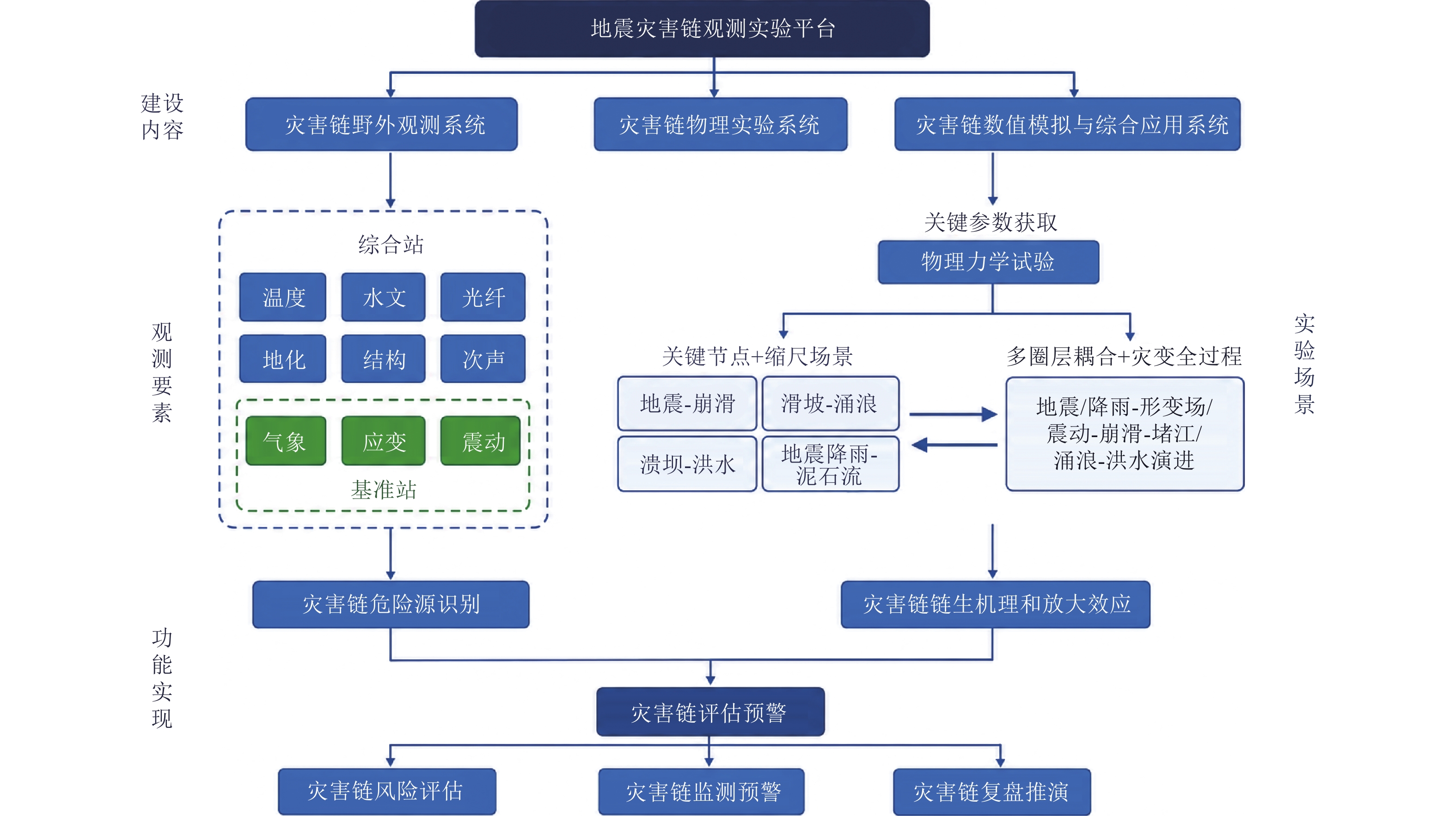
图 1 地震灾害链观测实验平台功能结构图
Figure 1. Functional architecture of the earthquake disaster-chain observation experimental platform

图 2 地震灾害链野外观测系统斜坡体观测台阵站点布局示意图
Figure 2. Schematic layout of slope observation array stations in the earthquake disaster-chain field observation system
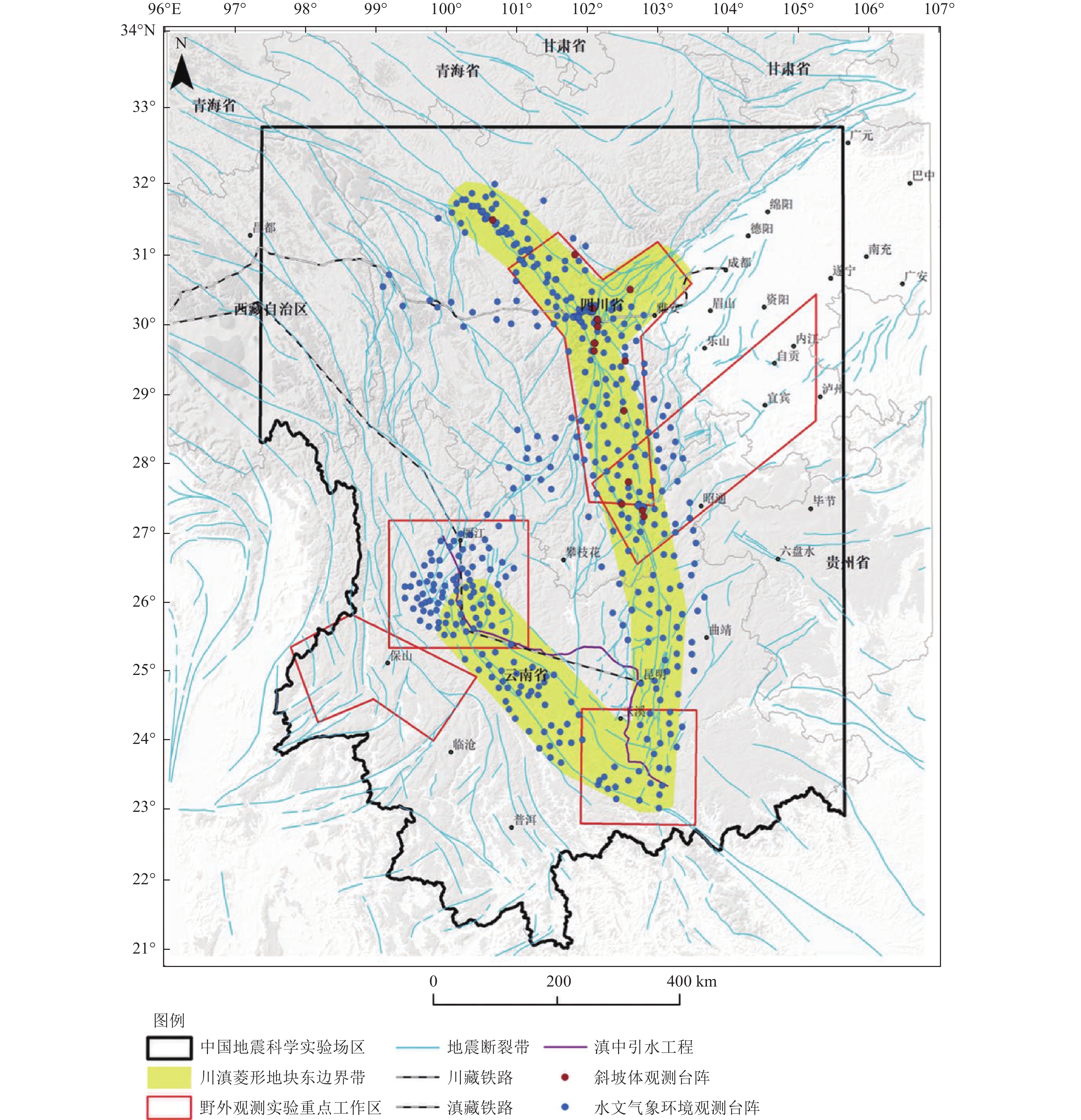
图 3 地震灾害链野外观测系统台阵布局示意图
Figure 3. Schematic layout of observation arrays in the earthquake disaster-chain field observation system
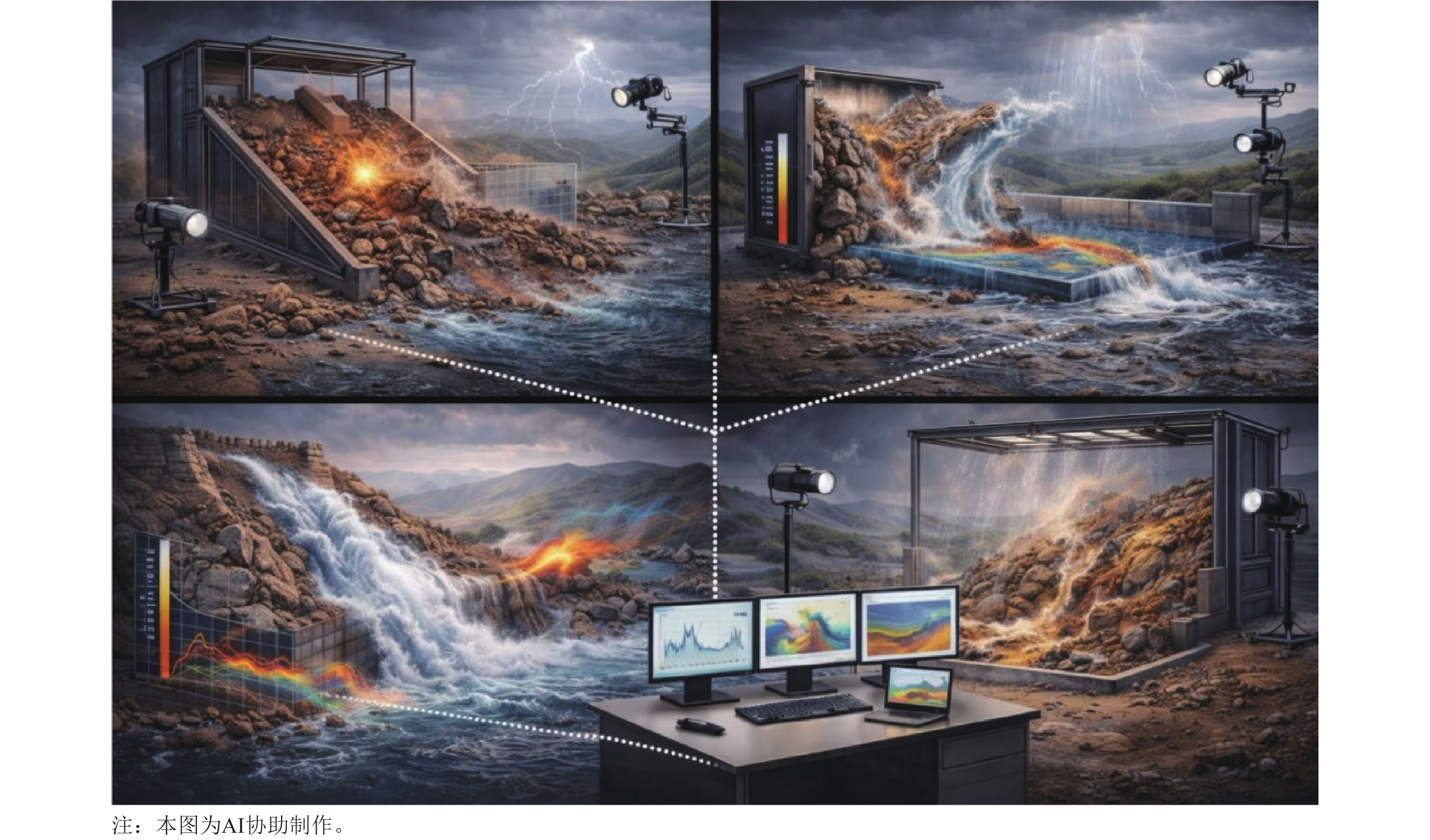
图 4 地震灾害链物理实验系统示意图
Figure 4. Schematic diagram of the physical experimental system for earthquake disaster chains
-
常隆庆, 1938. 四川叠溪地震调查记. 地质论评, 3(3): 251−291. doi: 10.16509/j.georeview.1938.03.003 崔鹏, 韩用顺, 陈晓清, 2009. 汶川地震堰塞湖分布规律与风险评估. 四川大学学报(工程科学版), 41(3): 35−42. doi: 10.15961/j.jsuese.2009.03.024Cui P., Han Y. S., Chen X. Q., 2009. Distribution and risk analysis of dammed lakes reduced by Wenchuan earthquake. Journal of Sichuan University (Engineering Science Edition), 41(3): 35−42. (in Chinese) doi: 10.15961/j.jsuese.2009.03.024 崔鹏, 庄建琦, 陈兴长等, 2010. 汶川地震区震后泥石流活动特征与防治对策. 四川大学学报(工程科学版), 42(5): 10−19.Cui P., Zhuang J. Q., Chen X. C., et al., 2010. Characteristics and countermeasures of debris flow in Wenchuan area after the earthquake. Journal of Sichuan University (Engineering Science Edition), 42(5): 10−19. (in Chinese) 崔鹏, 2014. 中国山地灾害研究进展与未来应关注的科学问题. 地理科学进展, 33(2): 145−152.Cui P., 2014. Progress and prospects in research on mountain hazards in China. Progress in Geography, 33(2): 145−152. (in Chinese) 邓起东, 张培震, 冉勇康等, 2002. 中国活动构造基本特征. 中国科学(D辑), 32(12): 1020−1030.Deng Q. D., Zhang P. Z., Ran Y. K., et al., 2003. Basic characteristics of active tectonics of China. Science in China Series D: Earth Sciences, 46(4): 356−372. (in Chinese) 黄润秋, 2009. 汶川8.0级地震触发崩滑灾害机制及其地质力学模式. 岩石力学与工程学报, 28(6): 1239−1249.Huang R. Q., 2009. Mechanism and geomechanical modes of landslide hazards triggered by Wenchuan 8.0 earthquake. Chinese Journal of Rock Mechanics and Engineering, 28(6): 1239−1249. (in Chinese) 黄润秋, 2011. 汶川地震地质灾害后效应分析. 工程地质学报, 19(2): 145−151. doi: 10.3969/j.issn.1004-9665.2011.02.001Huang R. Q., 2011. After effect of geohazards induced by the Wenchuan earthquake. Journal of Engineering Geology, 19(2): 145−151. (in Chinese) doi: 10.3969/j.issn.1004-9665.2011.02.001 欧阳朝军, 王东坡, 龚文平等, 2025. 自然灾害预警体系建设. 中国科学基金, 39(6): 905−917.Ouyang C. J., Wang D. P., Gong W. P., et al., 2025. Construction of natural disaster early warning system. Bulletin of National Natural Science Foundation of China, 39(6): 905−917. (in Chinese) 彭建兵, 2025. 自然灾害防治体系现代化: 从被动应对到主动防控的范式转型. 中国科学基金, 39(6): 863. doi: 10.3724/BNSFC-2025.12.03.0001Peng J. B., 2025. Modernization of the natural disaster prevention and control system: a paradigm shift from passive response to proactive prevention. Bulletin of National Natural Science Foundation of China, 39(6): 863. (in Chinese) doi: 10.3724/BNSFC-2025.12.03.0001 彭建兵, 崔鹏, 王会军等, 2025. 自然灾害防治体系建设构想. 中国科学基金, 39(6): 864−871. doi: 10.3724/BNSFC-2025-0053Peng J. B., Cui P., Wang H. J., et al., 2025. Conceptual framework for the construction of a natural disaster prevention and mitigation system. Bulletin of National Natural Science Foundation of China, 39(6): 864−871. (in Chinese) doi: 10.3724/BNSFC-2025-0053 钱海涛, 张力方, 修立伟等, 2014. 中国地震地质灾害的主要类型与分布特征. 水文地质工程地质, 41(1): 119−127. doi: 10.16030/j.cnki.issn.1000-3665.2014.01.014Qian H. T., Zhang L. F., Xiu L. W., et al., 2014. Types and distribution characteristics of earthquake induced geological disasters in China. Hydrogeology & Engineering Geology, 41(1): 119−127. (in Chinese) doi: 10.16030/j.cnki.issn.1000-3665.2014.01.014 邵志刚, 王武星, 刘琦等, 2025. 中国陆区未来10年地震危险性预测与地震风险评估研究. 地震, 45(3): 193−218. doi: 10.12196/j.issn.1000-3274.2025.03.013Shao Z. G., Wang W. X., Liu Q., et al., 2025. Study on the prediction of seismic hazard and seismic risk assessment for the next 10 years in the Chinese mainland. Earthquake, 45(3): 193−218. (in Chinese) doi: 10.12196/j.issn.1000-3274.2025.03.013 四川省地震局, 1983. 一九三三年叠溪地震. 成都: 四川科学技术出版社. 田华俊, 常晁瑜, 杨顺等, 2025. 积石山6.2级地震诱发中川乡流滑运动特征数值分析. 震灾防御技术, 20(3): 585−598. doi: 10.11899/zzfy20240182Tian H. J., Chang C. Y., Yang S., et al., 2025. Numerical analysis of the characteristics of Zhongchuan township flow-slip motion induced by the Jishishan MS6.2 earthquake. Technology for Earthquake Disaster Prevention, 20(3): 585−598. (in Chinese) doi: 10.11899/zzfy20240182 王笃国, 刘志成, 高玮, 2024. 基于AHP的地震地质灾害危险性综合评价方法研究. 震灾防御技术, 19(2): 306−313. doi: 10.11899/zzfy20240210Wang D. G., Liu Z. C., Gao W., 2024. Study on AHP-based comprehensive evaluation method of earthquake-induced geological hazard. Technology for Earthquake Disaster Prevention, 19(2): 306−313. (in Chinese) doi: 10.11899/zzfy20240210 王杰, 许冲, 谢卓娟等, 2025. 基于可靠优化策略的四川省概率地震滑坡危险性评价与分区. 震灾防御技术, 20(4): 870−886. doi: 10.11899/zzfy20240241Wang J., Xu C., Xie Z. J., et al., 2025. A probabilistic assessment and zoning of seismic landslide hazards in Sichuan province using a reliable optimization strategy. Technology for Earthquake Disaster Prevention, 20(4): 870−886. (in Chinese) doi: 10.11899/zzfy20240241 魏本勇, 2018. 中国地震监测预警预报体系现状概述. 中国减灾, (15): 20−21. 吴忠良, 丁志峰, 张晓东等, 2021a. 中国地震科学实验场: 历史与未来. 地球与行星物理论评, 52(2): 234−238. doi: 10.19975/j.dqyxx.2020-023Wu Z. L., Ding Z. F., Zhang X. D., et al., 2021a. China seismic experimental site: retrospective and prospective. Reviews of Geophysics and Planetary Physics, 52(2): 234−238. (in Chinese) doi: 10.19975/j.dqyxx.2020-023 吴忠良, 李茜, 张晓东等, 2021b. 中国地震科学实验场: 起步与尝试. 地球与行星物理论评, 52(6): 675−678. doi: 10.19975/j.dqyxx.2021-012Wu Z. L., Li Q., Zhang X. D., et al., 2021b. China seismic experimental site (CSES): start and trial. Reviews of Geophysics and Planetary Physics, 52(6): 675−678. (in Chinese) doi: 10.19975/j.dqyxx.2021-012 吴忠良, 王龙, 车时等, 2021c. 中国地震科学实验场: 认识与实践. 地球与行星物理论评, 52(3): 348−352. doi: 10.19975/j.dqyxx.2021-010Wu Z. L., Wang L., Che S., et al., 2021c. China seismic experimental site (CSES): planning and test. Reviews of Geophysics and Planetary Physics, 52(3): 348−352. (in Chinese) doi: 10.19975/j.dqyxx.2021-010 吴忠良, 王龙, 李丽等, 2021d. 中国地震科学实验场: 地震预测与系统设计. 地球与行星物理论评, 52(6): 679−683.Wu Z. L., Wang L., Li L., et al., 2021d. China seismic experimental site (CSES): earthquake forecast and system design. Reviews of Geophysics and Planetary Physics, 52(6): 679−683. (in Chinese) 肖子亢, 许冲, 李宏等, 2025. 地质灾害物理仿真实验发展现状及趋势分析. 地质科技通报, 44(4): 23−47. doi: 10.19509/j.cnki.dzkq.tb20240454Xiao Z. K., Xu C., Li H., et al., 2025. Development status and trend analysis of physical simulation experiments for geological hazards. Bulletin of Geological Science and Technology, 44(4): 23−47. (in Chinese) doi: 10.19509/j.cnki.dzkq.tb20240454 新华社, 2021. 中华人民共和国国民经济和社会发展第十四个五年规划和2035年远景目标纲要. (2021-03-13)[2026-01-26]. https://www.gov.cn/xinwen/2021-03/13/content_5592681.htm. 许冲, 戴福初, 徐锡伟, 2010. 汶川地震滑坡灾害研究综述. 地质论评, 56(6): 860−874. doi: 10.16509/j.georeview.2010.06.017Xu C., Dai F. C., Xu X. W., 2010. Wenchuan earthquake-induced landslides: an overview. Geological Review, 56(6): 860−874. (in Chinese) doi: 10.16509/j.georeview.2010.06.017 许冲, 2018. 环境地球科学之滑坡地震地质学. 工程地质学报, 26(1): 207−222. doi: 10.13544/j.cnki.jeg.2018.01.022Xu C., 2018. Landslide seismology geology: a sub-discipline of environmental earth sciences. Journal of Engineering Geology, 26(1): 207−222. (in Chinese) doi: 10.13544/j.cnki.jeg.2018.01.022 许冲, 徐锡伟, 周本刚等, 2019. 同震滑坡发生概率研究−−新一代地震滑坡危险性模型. 工程地质学报, 27(5): 1122−1130. doi: 10.13544/j.cnki.jeg.2019084Xu C., Xu X. W., Zhou B. G., et al., 2019. Probability of coseismic landslides: A new generation of earthquake-triggered landslide hazard model. Journal of Engineering Geology, 27(5): 1122−1130. (in Chinese) doi: 10.13544/j.cnki.jeg.2019084 许冲, 高明星, 薛智文等, 2025a. 专栏评论: 高新技术赋能地震与地质灾害防治研究进展. 地质科技通报, 44(4): 16−22. doi: 10.19509/j.cnki.dzkq.tb20250004Xu C., Gao M. X., Xue Z. W., et al., 2025a. Column review: advancements in earthquake and geological disaster mitigation empowered by advanced technologies. Bulletin of Geological Science and Technology, 44(4): 16−22. (in Chinese) doi: 10.19509/j.cnki.dzkq.tb20250004 许冲, 黄雨, 孙萍等, 2025b. 自然灾害评估技术体系. 中国科学基金, 39(6): 918−929. doi: 10.3724/BNSFC-2025-0036Xu C., Huang Y., Sun P., et al., 2025b. Natural hazard assessment technology framework. Bulletin of National Natural Science Foundation of China, 39(6): 918−929. (in Chinese) doi: 10.3724/BNSFC-2025-0036 许强, 李为乐, 董秀军等, 2017. 四川茂县叠溪镇新磨村滑坡特征与成因机制初步研究. 岩石力学与工程学报, 36(11): 2612−2628.Xu Q., Li W. L., Dong X. J., et al., 2017. The Xinmocun landslide on June 24, 2017 in Maoxian, Sichuan: characteristics and failure mechanism. Chinese Journal of Rock Mechanics and Engineering, 36(11): 2612−2628. (in Chinese) 许强, 朱鸿鹄, 朱星等, 2025. 自然灾害监测技术体系. 中国科学基金, 39(6): 893−904.Xu Q., Zhu H. H., Zhu X., et al., 2025. The monitoring technology system of natural disaster. Bulletin of National Natural Science Foundation of China, 39(6): 893−904. (in Chinese) 徐锡伟, 吴熙彦, 于贵华等, 2017. 中国大陆高震级地震危险区判定的地震地质学标志及其应用. 地震地质, 39(2): 219−275.Xu X. W., Wu X. Y., Yu G. H., et al., 2017. Seismo-geological signatures for identifying M≥7.0 earthquake risk areas and their premilimary application in mainland China. Seismology and Geology, 39(2): 219−275. (in Chinese) 殷跃平, 2008. 汶川八级地震地质灾害研究. 工程地质学报, 16(4): 433−444.Yin Y. P., 2008. Researches on the geo-hazards triggered by Wenchuan earthquake, Sichuan. Journal of Engineering Geology, 16(4): 433−444. (in Chinese) 张会平, 张培震, 2025. 强震风险预测面临的挑战与对策. 中国科学基金, 39(6): 968−974. doi: 10.3724/BNSFC-2025-0039Zhang H. P., Zhang P. Z., 2025. Challenges and countermeasures in strong earthquake risk forecasting. Bulletin of National Natural Science Foundation of China, 39(6): 968−974. (in Chinese) doi: 10.3724/BNSFC-2025-0039 张培震, 邓起东, 张国民等, 2003. 中国大陆的强震活动与活动地块. 中国科学(D辑), 33(S1): 12−20.Zhang P. Z., Deng Q. D., Zhang G. M., et al., 2003. Active tectonic blocks and strong earthquakes in the continent of China. Science in China Series D: Earth Sciences, 46(S2): 13−24. (in Chinese) 张永双, 李长冬, 张帆宇等, 2025. 自然灾害基础理论体系研究现状与展望. 中国科学基金, 39(6): 872−879.Zhang Y. S., Li C. D., Zhang F. Y., et al., 2025. The progress and prospects of the basic theoretical system on natural disasters. Bulletin of National Natural Science Foundation of China, 39(6): 872−879. (in Chinese) AghaKouchak A. , Huning L. S. , Chiang F. , et al. , 2018. How do natural hazards cascade to cause disasters? Nature, 561(7724): 458−460. Dai F. C., Lee C. F., Deng J. H., et al., 2005. The 1786 earthquake-triggered landslide dam and subsequent dam-break flood on the Dadu River, southwestern China. Geomorphology, 65(3-4): 205−221. doi: 10.1016/j.geomorph.2004.08.011 Fan X. M., Scaringi G., Korup O., et al., 2019. Earthquake-induced chains of geologic hazards: patterns, mechanisms, and impacts. Reviews of Geophysics, 57(2): 421−503. doi: 10.1029/2018RG000626 Gallina V., Torresan S., Critto A., et al., 2016. A review of multi-risk methodologies for natural hazards: consequences and challenges for a climate change impact assessment. Journal of Environmental Management, 168: 123−132. doi: 10.1016/j.jenvman.2015.11.011 Ghaffarian S., Shafapourtehrany M., Lagap U., et al., 2025. Earthquake-based multi-hazard resilience assessment: a case study of Istanbul, Turkey (neighborhood level). npj Natural Hazards, 2(1): 15. doi: 10.1038/s44304-025-00065-8 Gill J. C., Malamud B. D., 2014. Reviewing and visualizing the interactions of natural hazards. Reviews of Geophysics, 52(4): 680−722. doi: 10.1002/2013RG000445 He X. L., Chen Z. N., Yang Q., et al., 2025. Advances in earthquake and cascading disasters. Natural Hazards Research, 5(2): 421−431. doi: 10.1016/j.nhres.2025.01.010 Huang D., Li Y. Q., Song Y. X., et al., 2019. Insights into the catastrophic Xinmo rock avalanche in Maoxian County, China: combined effects of historical earthquakes and landslide amplification. Engineering Geology, 258: 105158. doi: 10.1016/j.enggeo.2019.105158 Iverson R. M., 1997. The physics of debris flows. Reviews of Geophysics, 35(3): 245−296. doi: 10.1029/97RG00426 Jiang H. C., Mao X., Xu H. Y., et al., 2014. Provenance and earthquake signature of the last deglacial Xinmocun lacustrine sediments at Diexi, East Tibet. Geomorphology, 204: 518−531. doi: 10.1016/j.geomorph.2013.08.032 Kappes M. S., Keiler M., von Elverfeldt K., et al., 2012. Challenges of analyzing multi-hazard risk: a review. Natural Hazards, 64(2): 1925−1958. doi: 10.1007/s11069-012-0294-2 Li Z. H., Wang D., Fan X. M., et al., 2025. Multi-stage sliding of the giant Mogangling paleo-landslide on the East Margin of the Tibetan Plateau revealed by integrated engineering geophysical methods. Landslides, 22(9): 3117−3132. doi: 10.1007/s10346-025-02527-6 Masson-Delmotte V. , Zhai P. M. , Pirani A. , et al. , 2021. Climate change 2021: the physical science basis. Cambridge: Cambridge University Press. McGlade J. , Bankoff G. , Abrahams J. , et al. , 2019. Global assessment report on disaster risk reduction 2019. Geneva: UN Office for Disaster Risk Reduction. Pescaroli G., Alexander D., 2015. A definition of cascading disasters and cascading effects: going beyond the “toppling dominos” metaphor. GRF Davos Planet@Risk, 3(1): 58−67. Pescaroli G., Alexander D., 2018. Understanding compound, interconnected, interacting, and cascading risks: a holistic framework. Risk analysis, 38(11): 2245−2257. doi: 10.1111/risa.13128 Tang C., Zhu J., Qi X., et al., 2011. Landslides induced by the Wenchuan earthquake and the subsequent strong rainfall event: a case study in the Beichuan area of China. Engineering Geology, 122(1-2): 22−33. doi: 10.1016/j.enggeo.2011.03.013 Tang C. X., Van Westen C. J., Tanyas H., et al., 2016. Analysing post-earthquake landslide activity using multi-temporal landslide inventories near the epicentral area of the 2008 Wenchuan earthquake. Natural Hazards and Earth System Sciences, 16(12): 2641−2655. doi: 10.5194/nhess-16-2641-2016 Xu C., Xu X. W., Yao X., et al., 2014. Three (nearly) complete inventories of landslides triggered by the May 12, 2008 Wenchuan MW7.9 earthquake of China and their spatial distribution statistical analysis. Landslides, 11(3): 441−461. doi: 10.1007/s10346-013-0404-6 Xu C., Xu X. W., Shyu J. B. H., 2015. Database and spatial distribution of landslides triggered by the Lushan, China MW6.6 earthquake of 20 April 2013. Geomorphology, 248: 77−92. doi: 10.1016/j.geomorph.2015.07.002 Xu X. W., Xu C., 2021. Natural Hazards Research: an eternal subject of human survival and development. Natural Hazards Research, 1(1): 1−3. doi: 10.1016/j.nhres.2020.12.003 Zhao B., Wang Y. S., Wu J. F., et al., 2021. The Mogangling giant landslide triggered by the 1786 Moxi M7.75 earthquake, China. Natural Hazards, 106(1): 459−485. doi: 10.1007/s11069-020-04471-1 Zuccaro G., De Gregorio D., 2013. Time and space dependency in impact damage evaluation of a sub-Plinian eruption at Mount Vesuvius. Natural Hazards, 68(3): 1399−1423. doi: 10.1007/s11069-013-0571-8 -

 下载:
下载:

 点击查看大图
计量
- 文章访问数: 231
- HTML全文浏览量: 79
- PDF下载量: 116
- 被引次数: 0
