


Seismic Dynamic Response and Critical Displacement for Instability of Loess Landslide
-
摘要: 黄土地震滑坡是我国西北黄土高原地区常见且危害极大的地震地质灾害之一。考虑其地震动力响应建立失稳临界位移判据是同震滑坡识别和地震滑坡预警的关键。本文以典型黄土斜坡为原型,采用振动台模型试验(几何相似比1∶10),输入0.05~0.6 g不同幅值的卧龙波与El Centro波,以PGA、Arias强度的放大系数为强度参数指标,揭示水平地震作用下模型斜坡的地震动响应规律;结合坡体宏观变形以及加速度与陀螺仪倾角的微观监测数据,分析了斜坡地震变形破坏过程,构建黄土斜坡地震震裂山体和失稳滑动的临界位移判据。结果表明:随输入地震波幅值自0.05~0.2 g小幅值、0.2~0.4 g中等幅值、0.4~0.6 g高幅值的增大,坡体地震动PGA和Arias强度放大系数呈现波动增大的非线性变化特征;整体上坡体地震动放大系数随着斜坡高度的增大而增大,Arias强度放大效应强于PGA,坡体上部最大放大系数分别达2.1和1.8;坡体表面放大系数略高于坡体内部,但小于潜在滑移面附近地震放大系数;斜坡地震动响应受输入地震波主导频率与场地卓越频率耦合作用控制,二者接近时放大效应更为显著。地震动作用下黄土滑坡为“震裂—滑动”的破坏模式,模型斜坡在台面输入0.3 g卧龙波时坡体上部出现微裂隙,0.4~0.5 g时斜坡表面裂纹逐步由细小短裂缝扩展为竖向贯穿的深裂缝,对应震裂山体临界位移为0.2~3.5 cm;0.6 g地震波作用下裂缝贯通滑坡并沿黄土和泥岩接触面滑动,对应滑坡失稳临界位移9.85 cm,相应未考虑地震动地形放大效应计算所得黄土斜坡震裂山体临界位移区间为0~1.35 cm,地震滑坡的临界位移为4 cm。研究成果有望提升同震滑坡的识别精度和危险性评估定量化水平。Abstract: Loess seismic landslides are among the most common and destructive earthquake-induced geological hazards in the Loess Plateau of northwestern China. Considering their dynamic seismic response, establishing a critical displacement criterion for instability is essential for co-seismic landslide identification and earthquake-induced landslide early warning. In this study, a typical loess slope was selected as the prototype, and a shaking-table model test was conducted with a geometric similarity ratio of 1:10. Wolong ground motions and El Centro waves with amplitudes ranging from 0.05 to 0.6 g were applied as input motions. The peak ground acceleration (PGA) and Arias intensity amplification coefficients were used as intensity parameters to characterize the ground-motion response of the model slope under horizontal seismic excitation. By integrating macroscopic deformation observations, acceleration records, and gyroscope-based inclination measurements, we analyzed the seismic deformation and failure process of the slope and established critical displacement criteria for earthquake-induced cracking and unstable sliding of loess slopes. The results show that, as the input ground-motion amplitude increased from low amplitude, 0.05–0.2 g, to moderate amplitude, 0.2–0.4 g, and high amplitude, 0.4–0.6 g, the PGA and Arias intensity amplification coefficients exhibited nonlinear fluctuations with an overall increasing trend. The ground-motion amplification coefficient increased with slope height, and the amplification effect of Arias intensity was stronger than that of PGA. The maximum amplification coefficients in the upper part of the slope were 2.1 and 1.8, respectively. The amplification coefficient at the slope surface was slightly higher than that inside the slope, but lower than that near the potential slip surface. The ground-motion response of the slope was controlled by the coupling between the dominant frequency of the input seismic wave and the predominant frequency of the site, with stronger amplification occurring when the two frequencies were close. The seismic failure mode of the loess slope was characterized as “cracking–sliding.” When the model slope was subjected to a 0.3 g Wolong wave, microcracks appeared in the upper part of the slope. Under 0.4–0.5 g excitation, surface cracks gradually developed from short, small cracks into deep, vertically penetrating cracks, corresponding to a critical cracking displacement of 0.2–3.5 cm. Under 0.6 g excitation, the cracks propagated through the landslide body, and sliding occurred along the loess–mudstone contact surface, corresponding to a critical instability displacement of 9.85 cm. Without considering the topographic amplification effect of ground motion, the calculated critical displacement range for earthquake-induced cracking of the loess slope was 0–1.35 cm, and the critical displacement for seismic landslide instability was 4 cm. These findings can improve the accuracy of co-seismic landslide identification and enhance the quantitative assessment of seismic landslide risk.
-
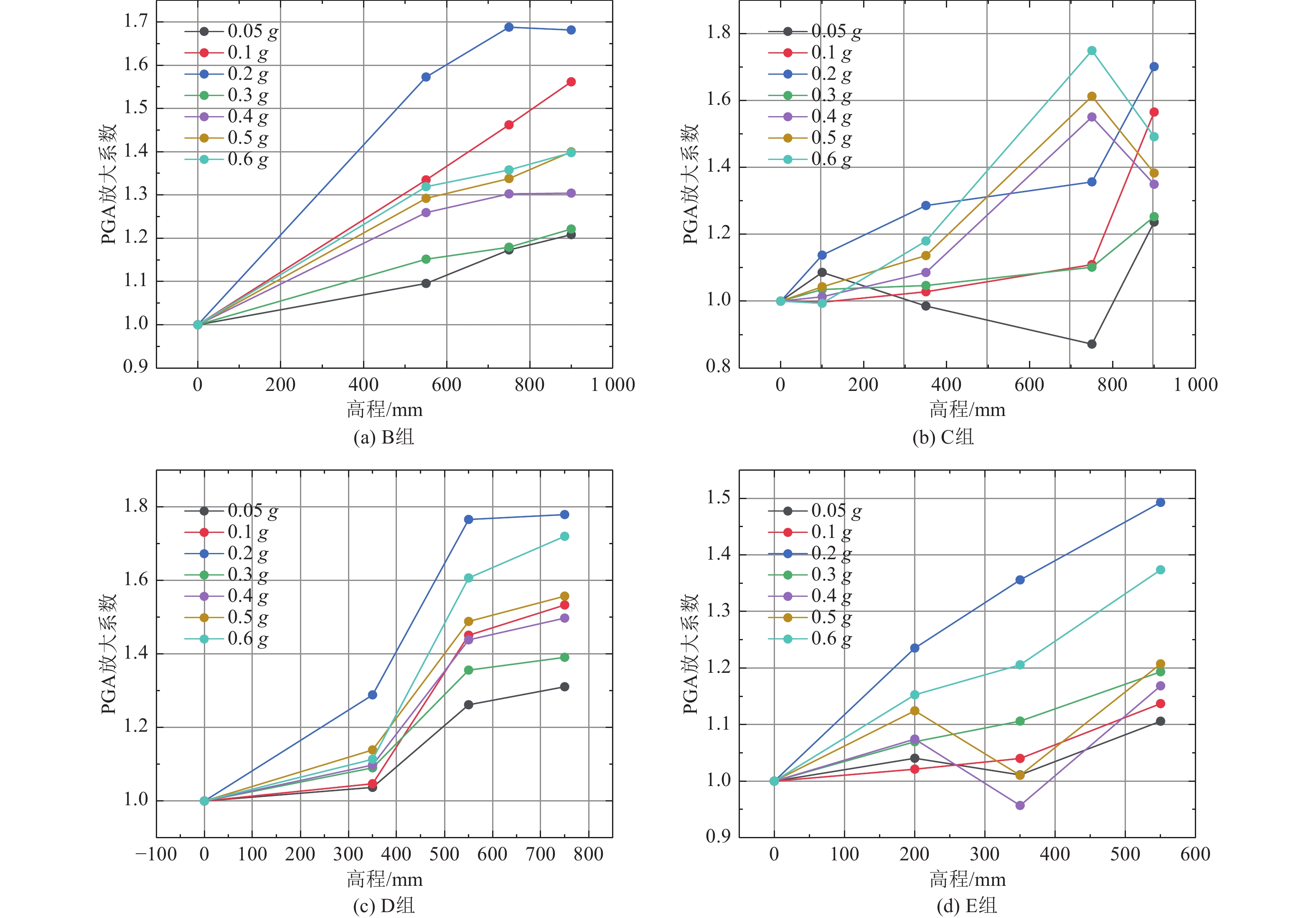
图 5 斜坡竖直方向PGA放大系数变化曲线
Figure 5. Variation curve of the PGA amplification factor in the vertical direction of the slope
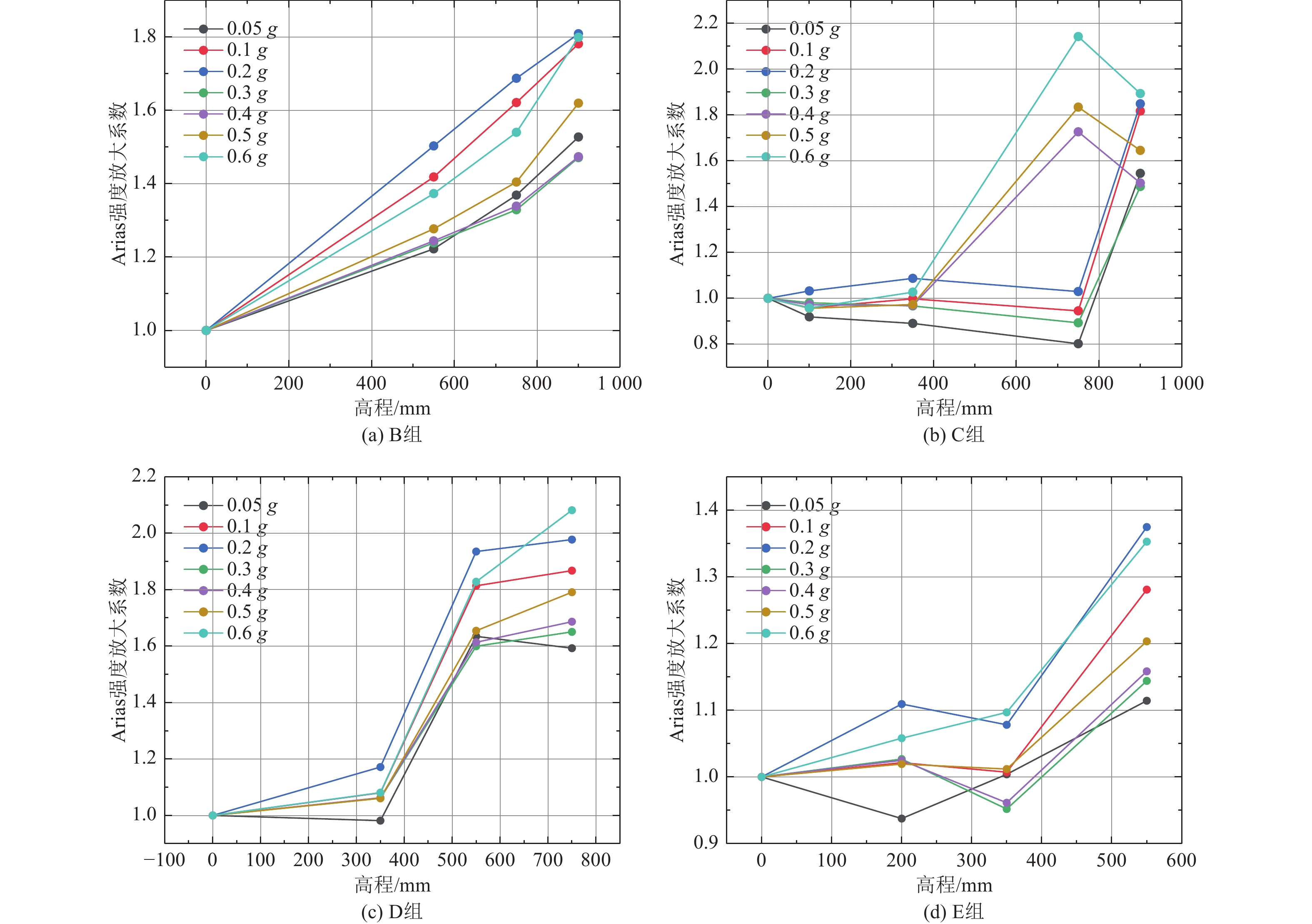
图 6 斜坡竖直方向Arias强度放大系数变化曲线
Figure 6. Variation curve of the Arias intensity amplification factor in the vertical direction of the slope
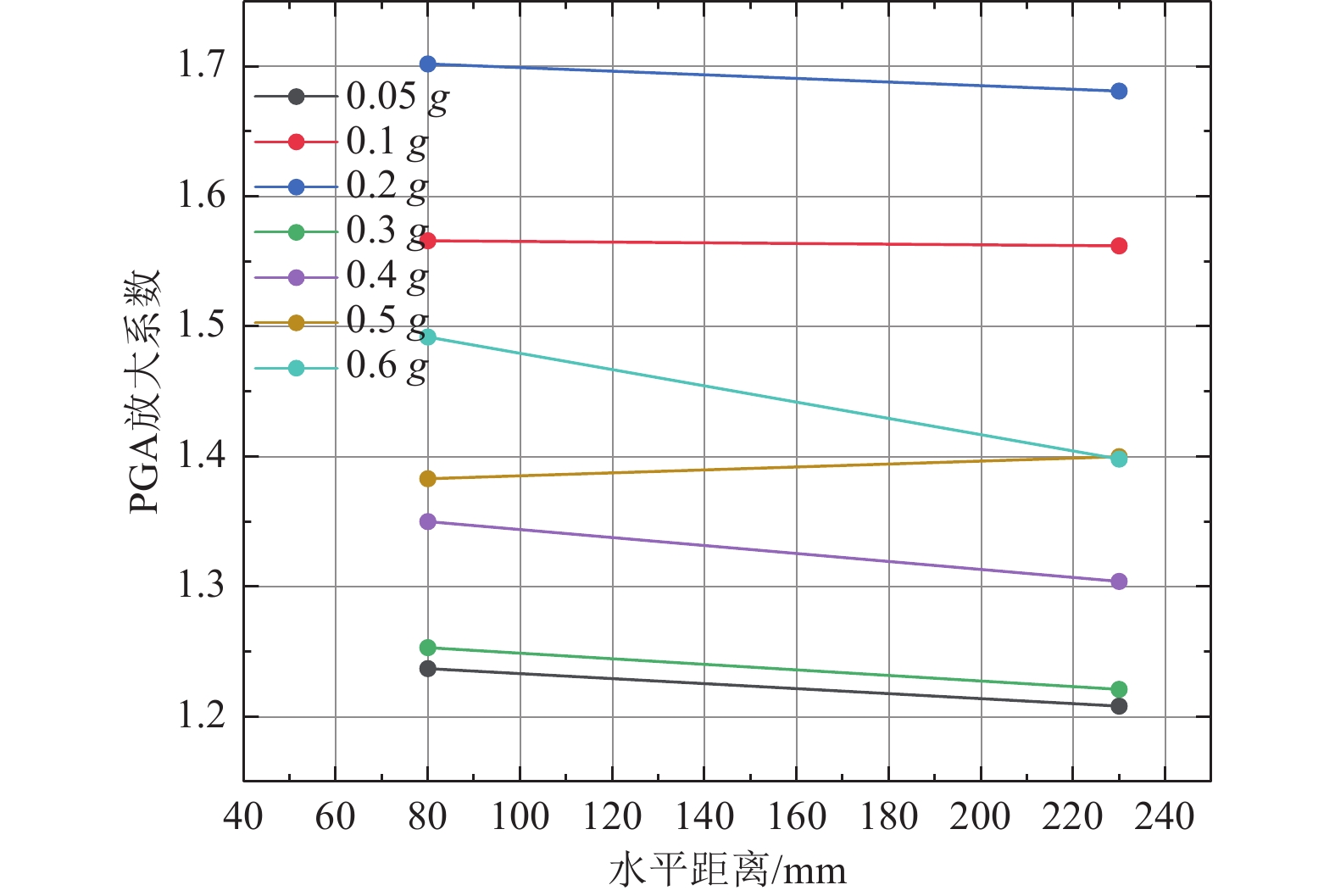
图 7 斜坡C5~B3水平方向PGA放大系数变化曲线
Figure 7. Variation curve of the PGA amplification factor in the horizontal direction along the slope from C5 to B3
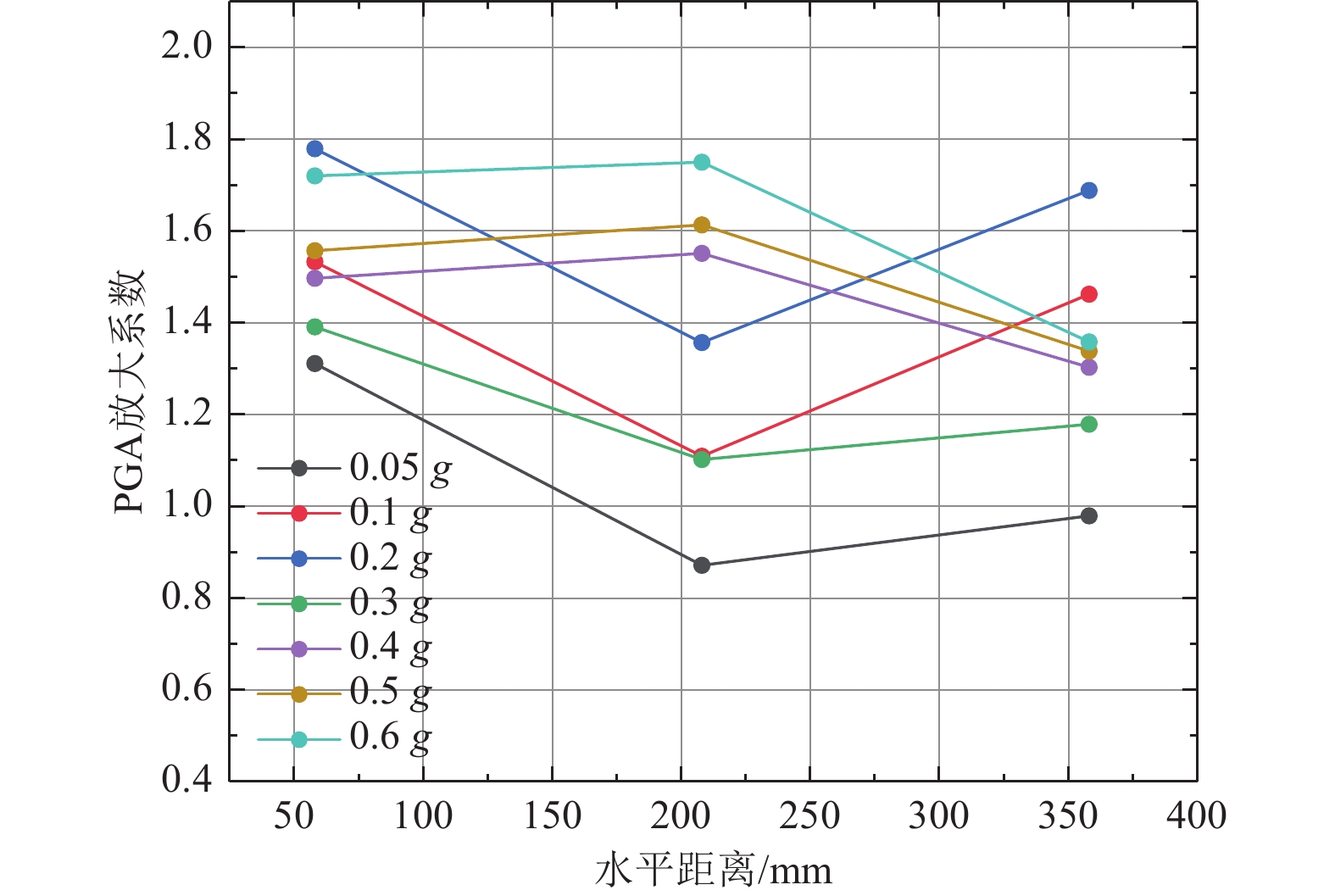
图 8 斜坡D3~B2水平方向PGA放大系数变化曲线
Figure 8. Variation curve of the PGA amplification factor in the horizontal direction along the slope from D3 to B2
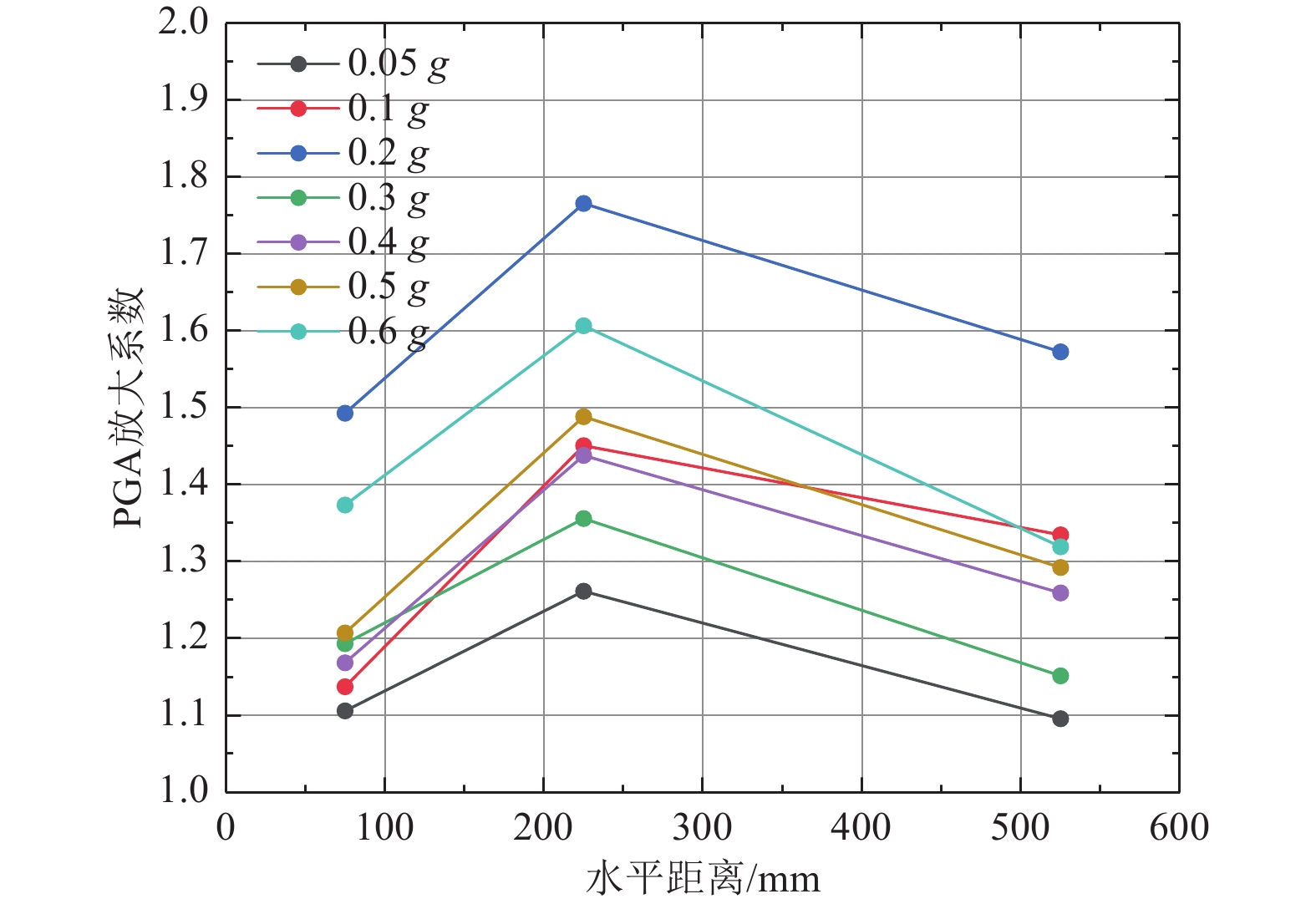
图 9 斜坡E3~B1水平方向PGA放大系数变化曲线
Figure 9. Variation curve of the PGA amplification factor in the horizontal direction along the slope from E3 to B1
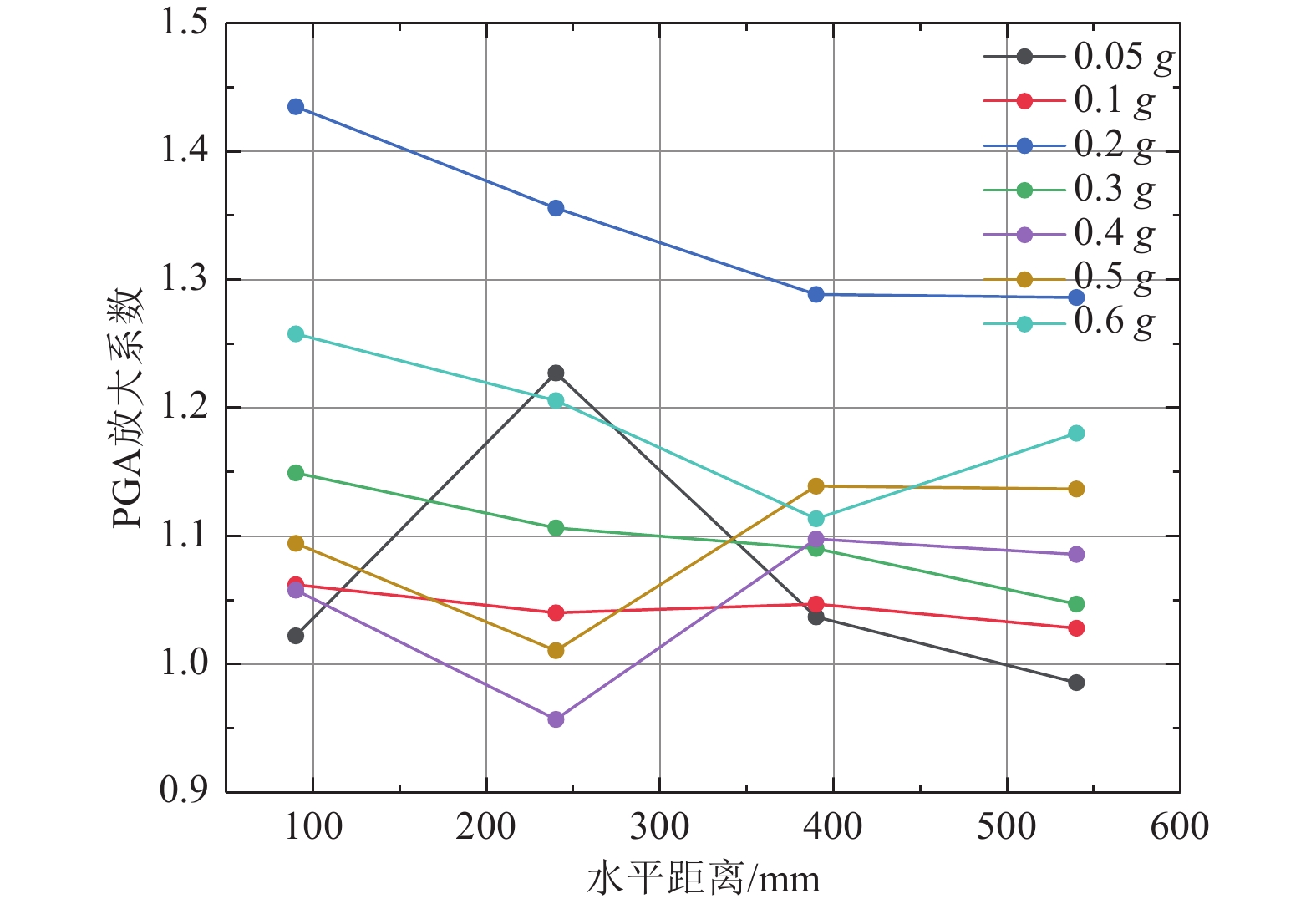
图 10 斜坡F1~C2水平方向PGA放大系数变化曲线
Figure 10. Variation curve of the PGA amplification factor in the horizontal direction along the slope from F1 to C2
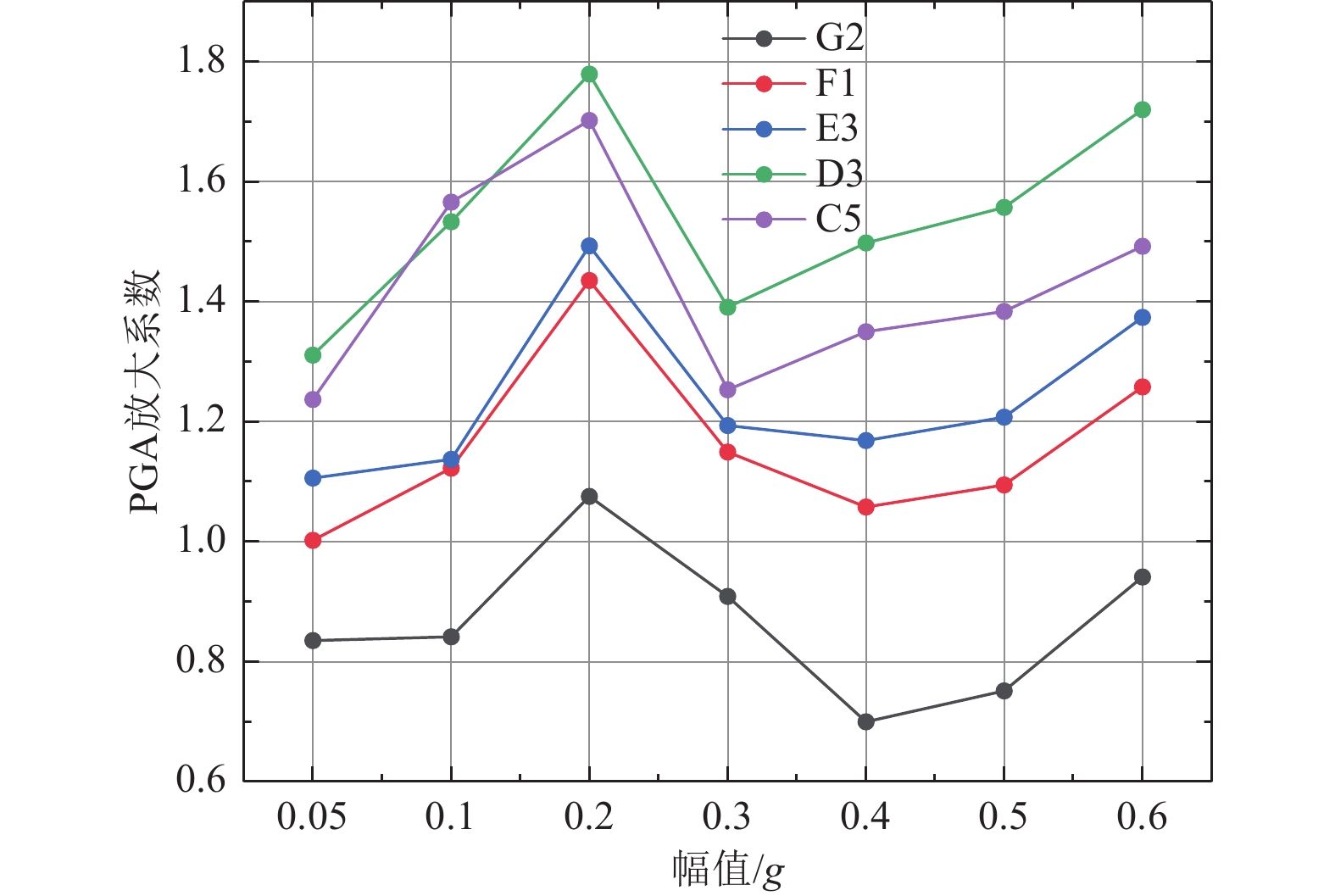
图 11 输入不同峰值条件下坡面监测点PGA放大系数变化曲线
Figure 11. Variation curve of the PGA amplification factor at slope-surface monitoring points under different input peak values
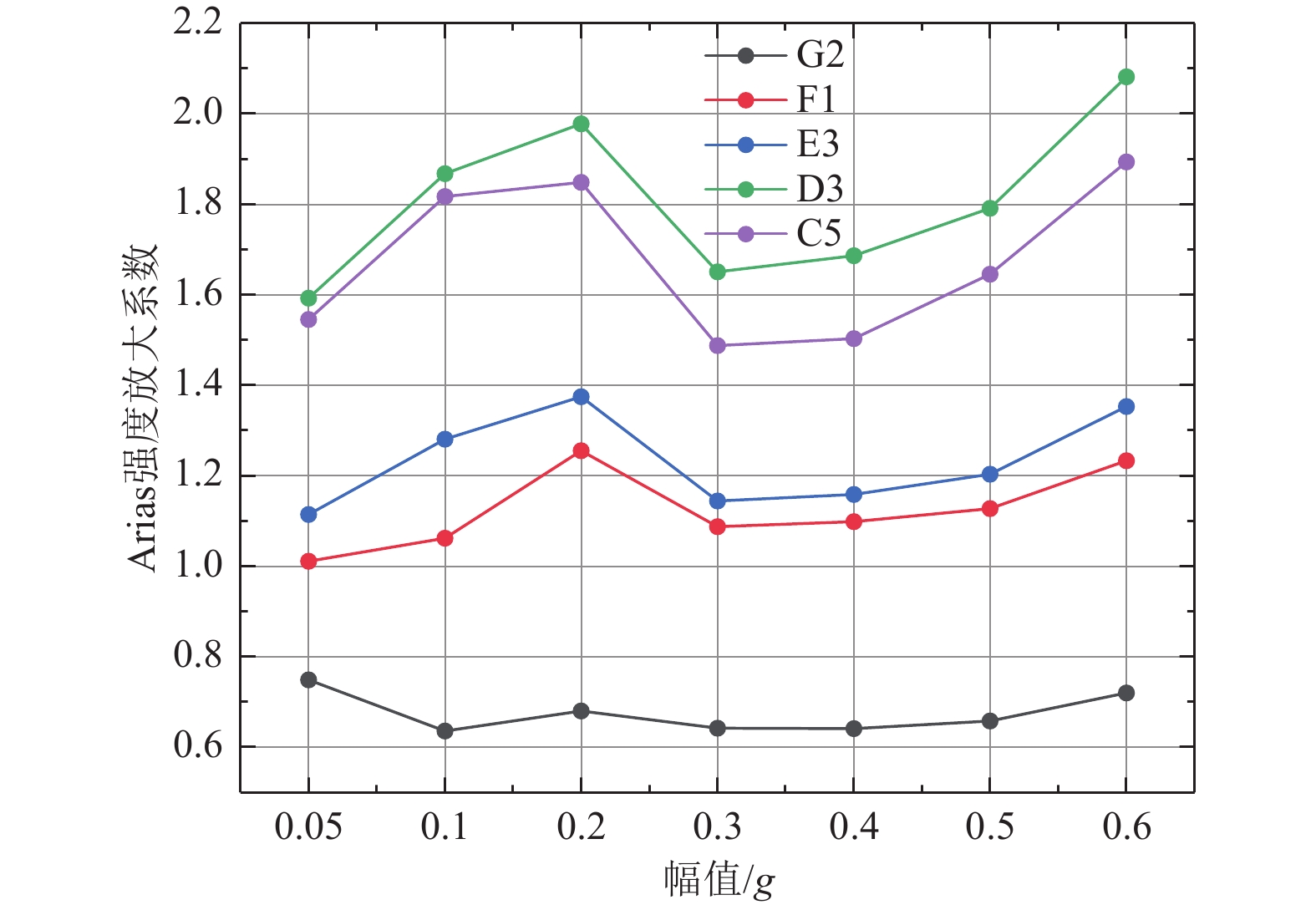
图 12 输入不同峰值条件下沿坡面监测点Arias强度放大系数变化曲线
Figure 12. Variation curve of the Arias intensity amplification factor at monitoring points along the slope surface under different input peak values
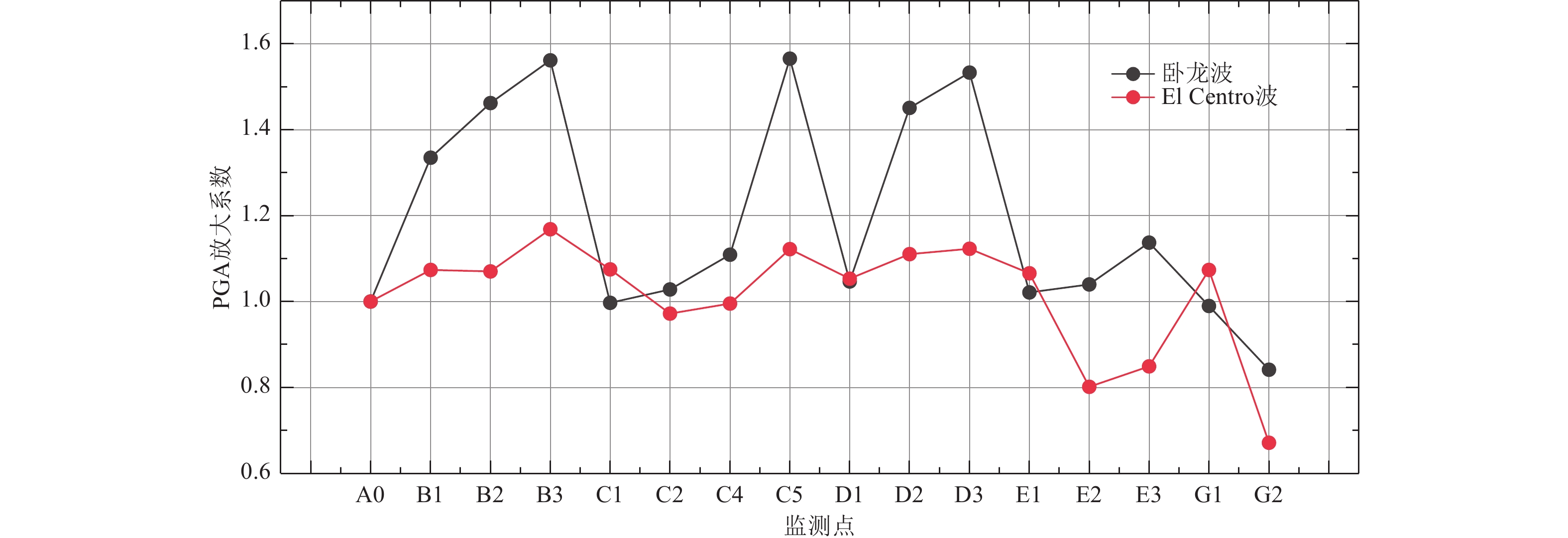
图 13 不同波形下所有监测点PGA对比
Figure 13. PGA comparison for all monitoring points under different waveforms
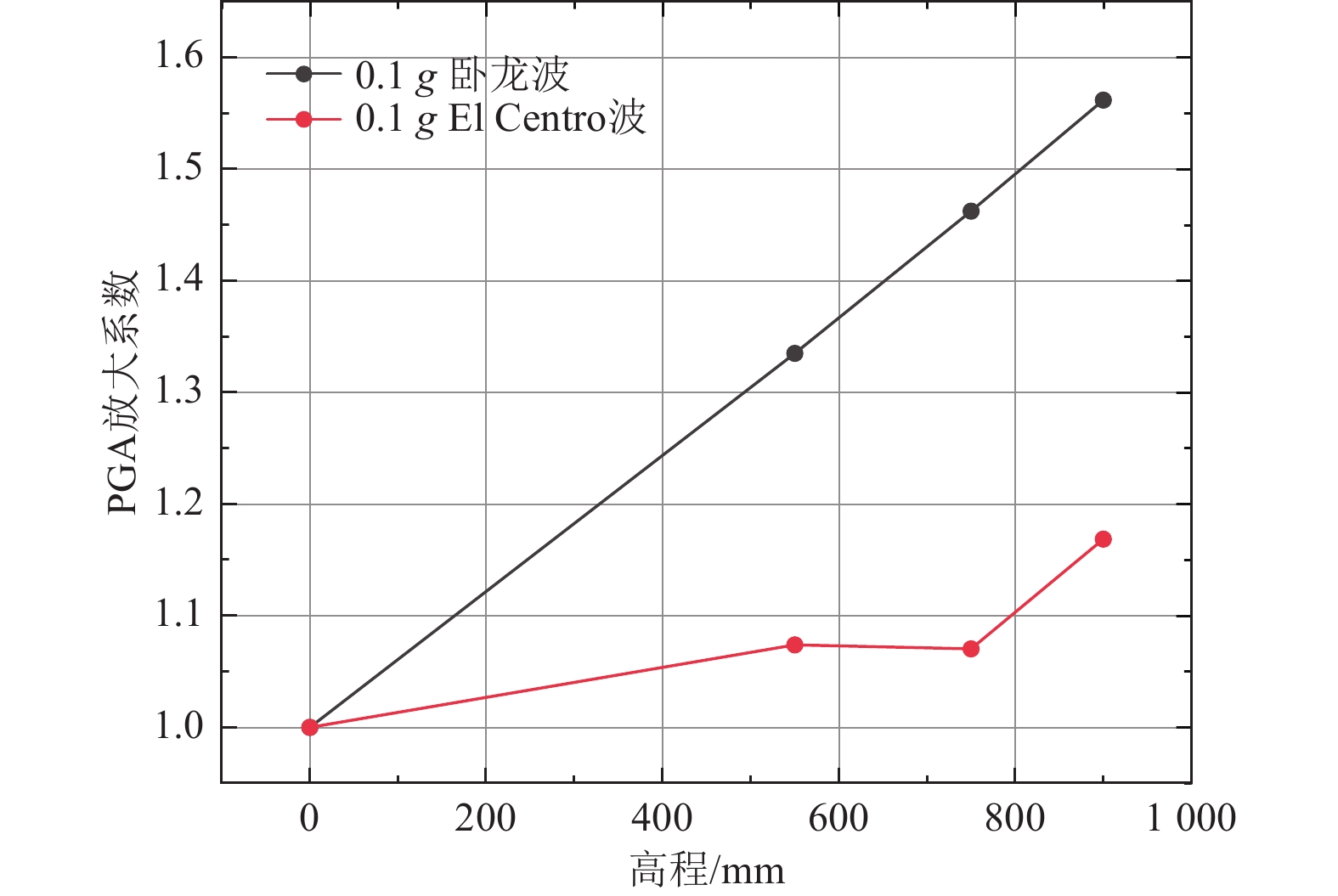
图 14 黄土层内B组不同波形下PGA放大系数比较
Figure 14. Comparison of the PGA amplification factor for different waveforms
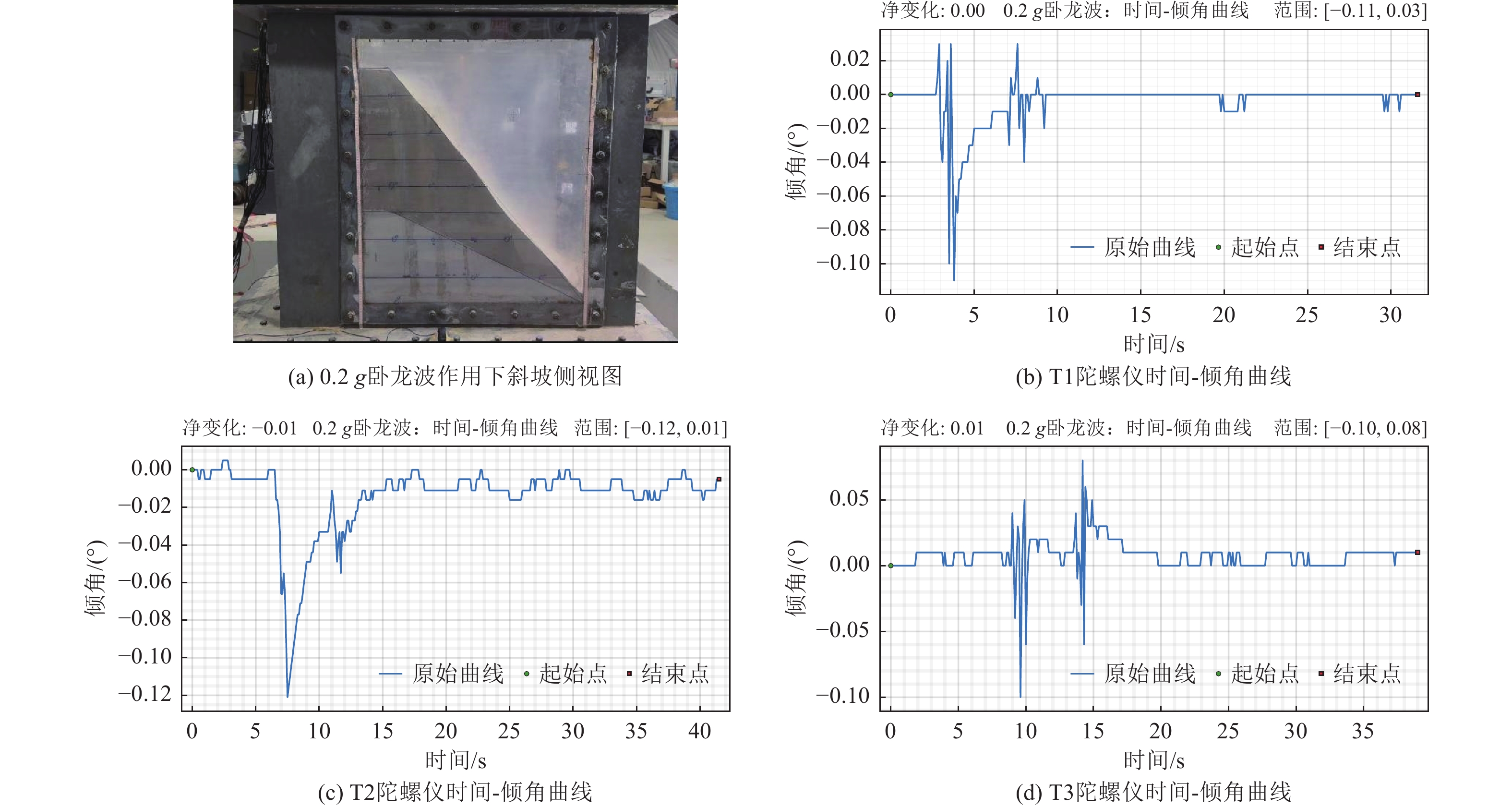
图 15 0.2 g卧龙波作用下斜坡变形迹象与陀螺仪倾角变换曲线
Figure 15. Slope deformation signs and gyroscope angular transformation curveunder the 0.2 g Wolong ground motion
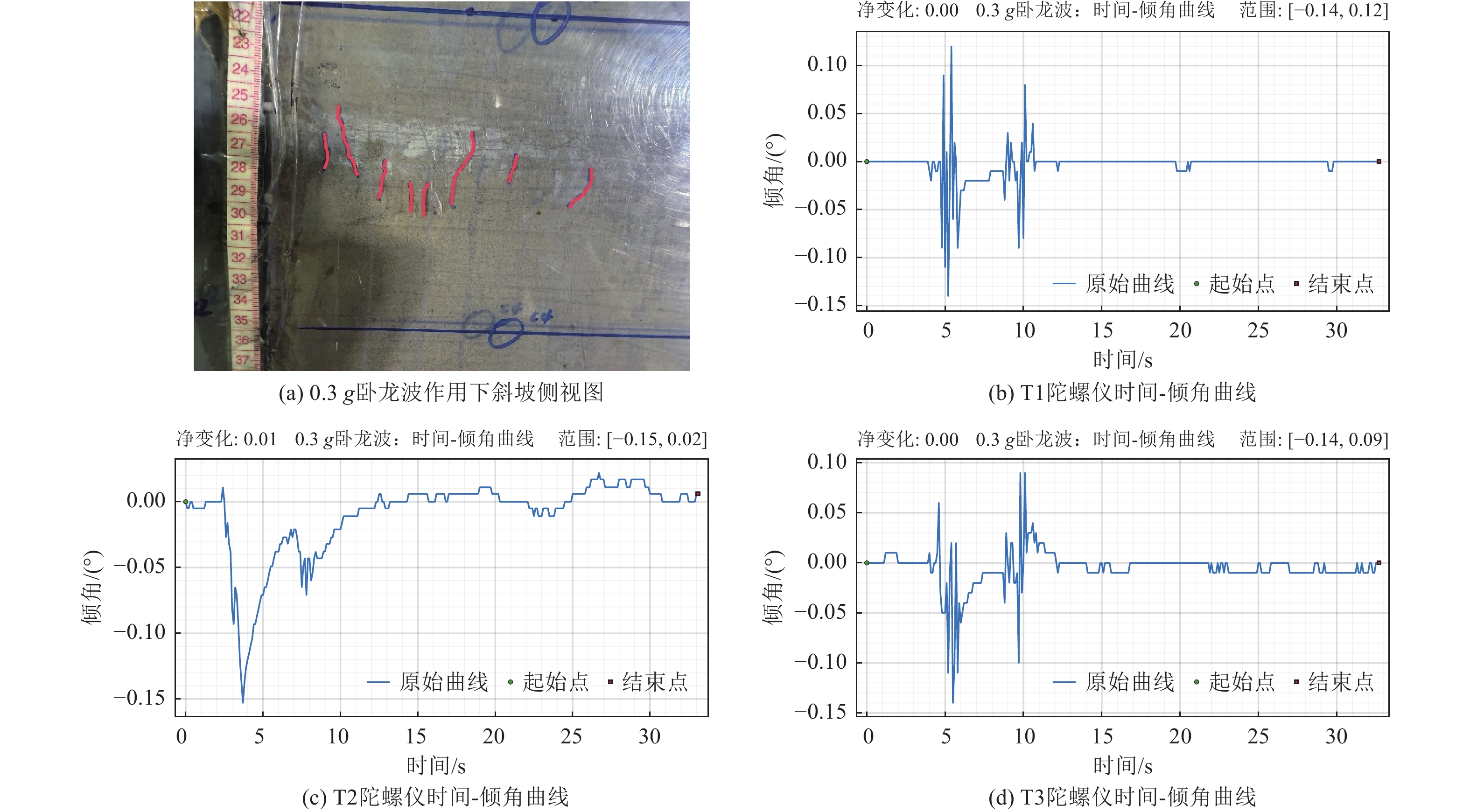
图 16 0.3 g卧龙波作用下斜坡变形迹象与陀螺仪倾角变换曲线
Figure 16. Slope deformation signs and gyroscope angular transformation curve under 0.3 g Wolong wave action
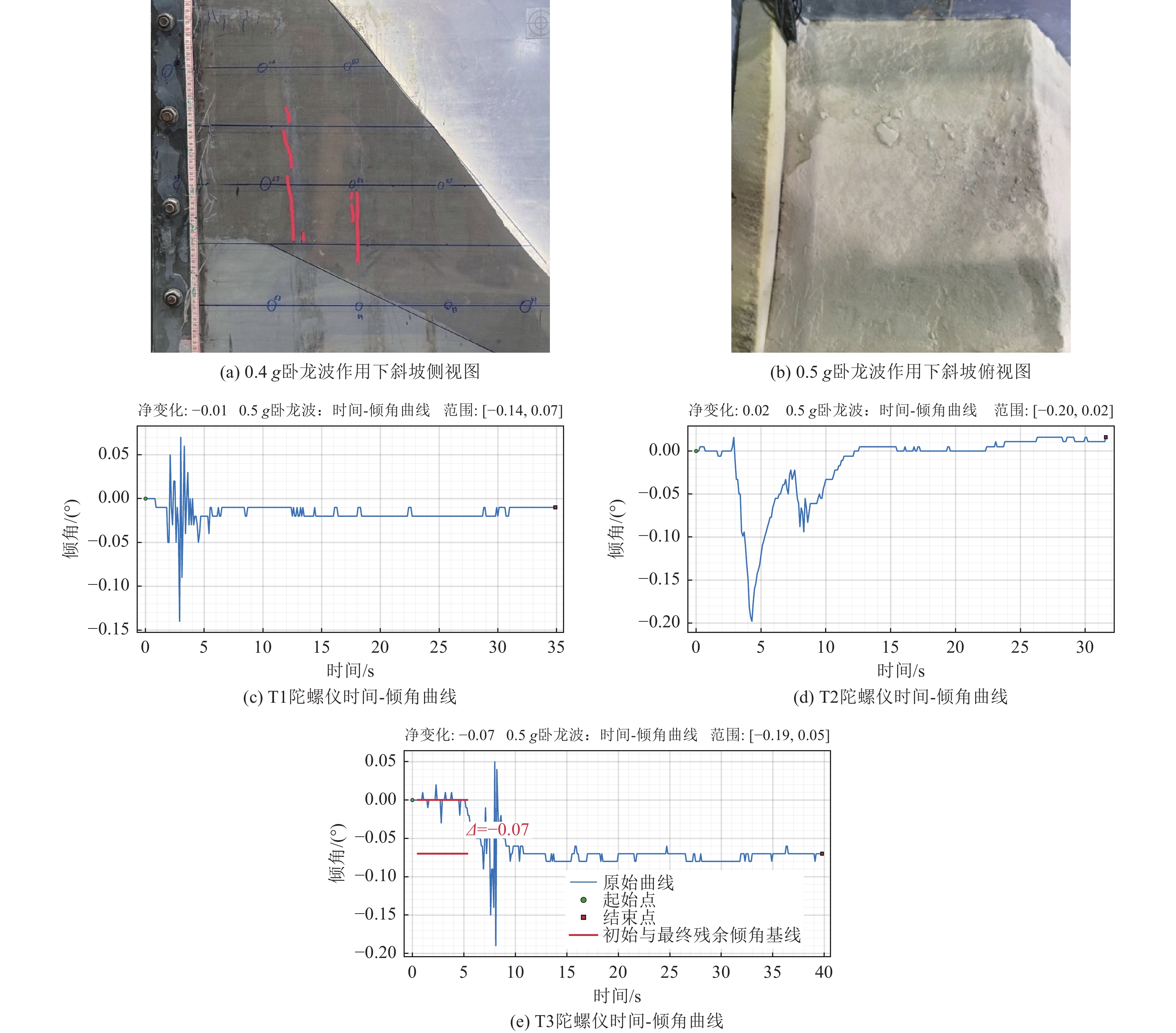
图 17 0.4 ~0.5 g卧龙波作用下斜坡变形迹象与陀螺仪倾角变换曲线
Figure 17. Slope deformation signs and gyroscope angular transformation curve under 0.4~0.5 g Wolong wave action
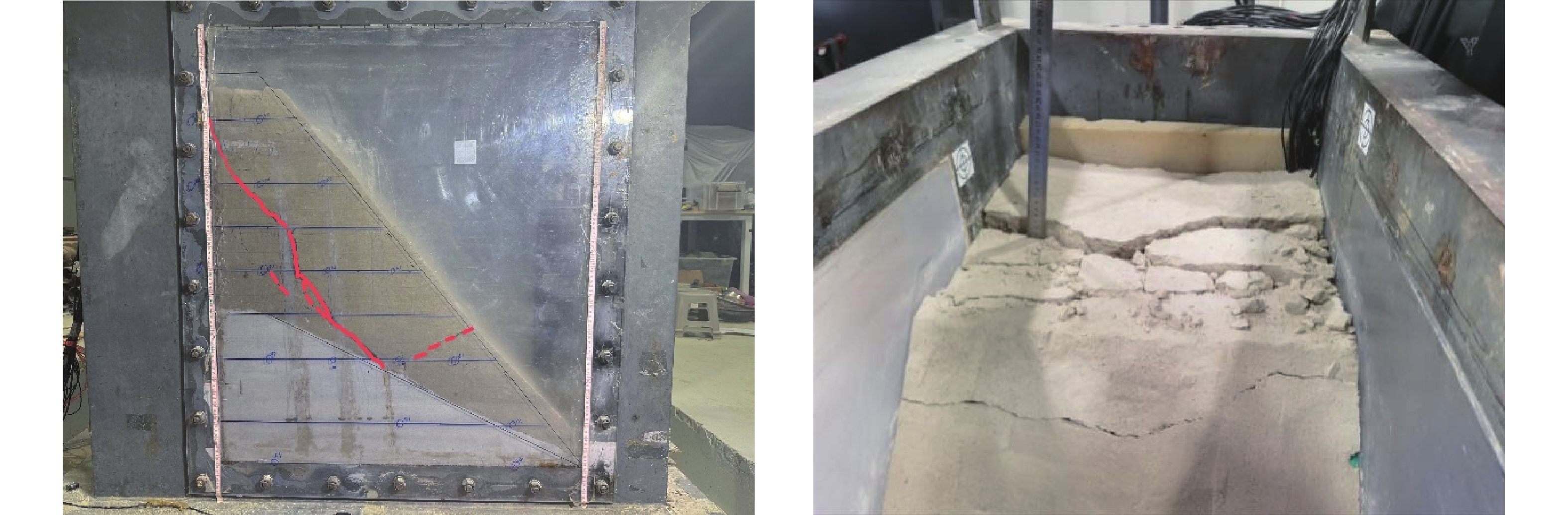
图 18 0.6 g卧龙波作用下斜坡变形迹象
Figure 18. Slope deformation indicators under 0.6 g Wolong wave action
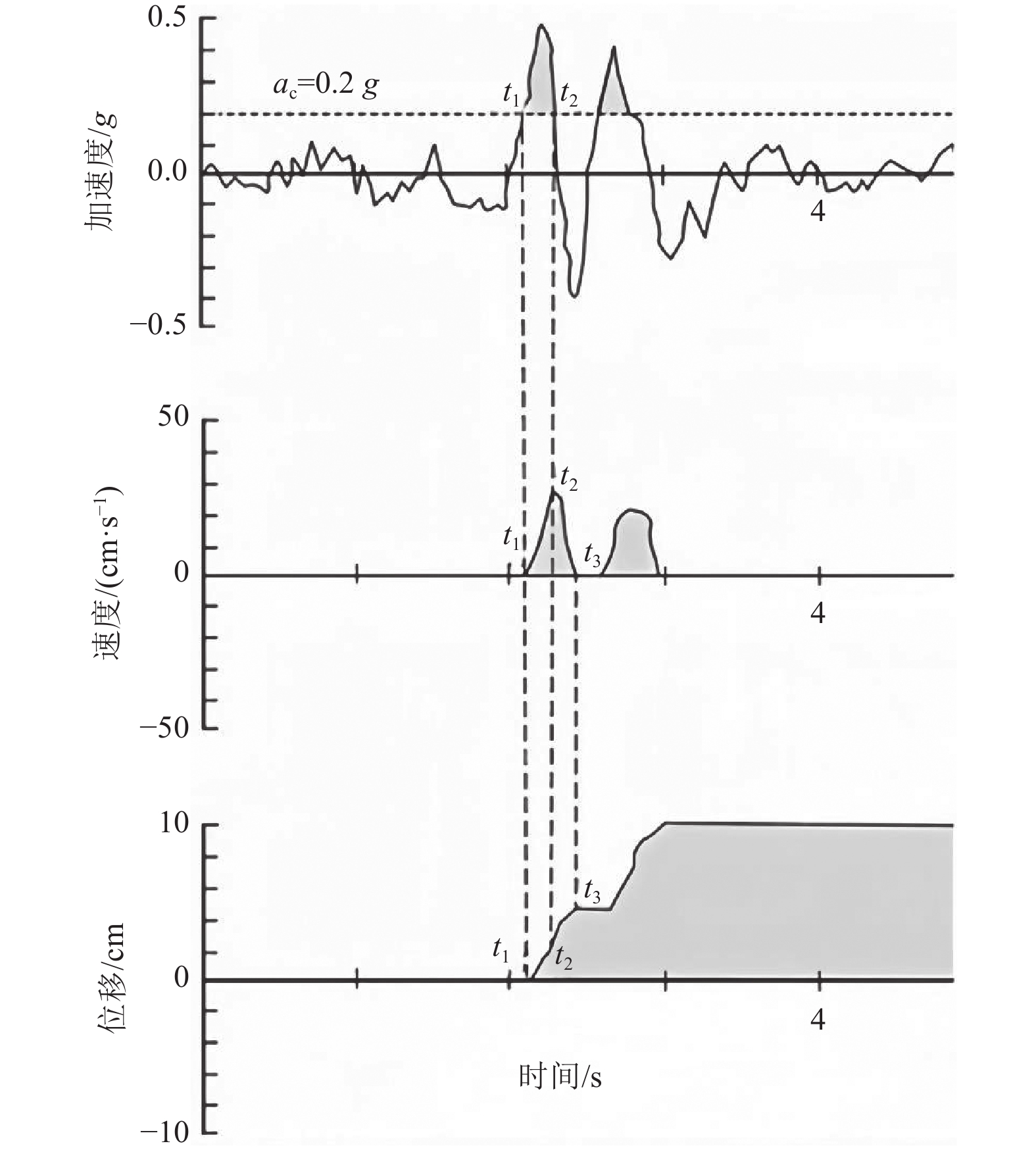
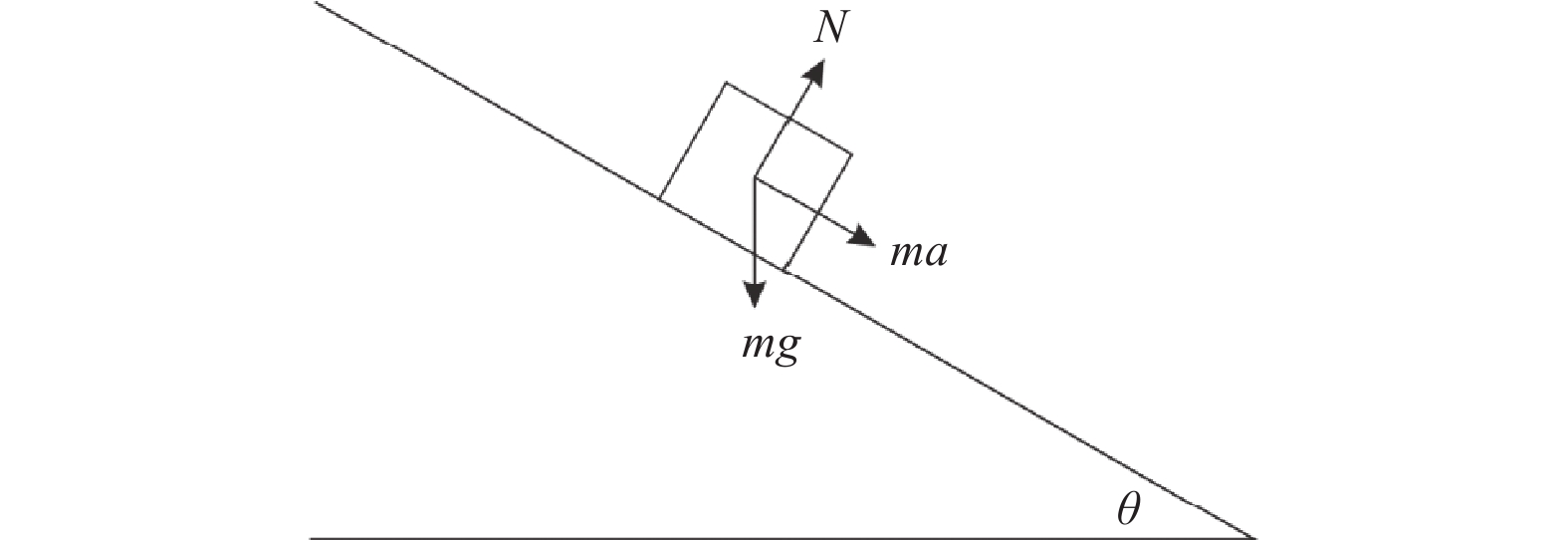
图 21 Newmark累积位移计算原理(黄健航等,2025)
Figure 21. Principle of Newmark cumulative displacement calculation(Huang et al,2025)
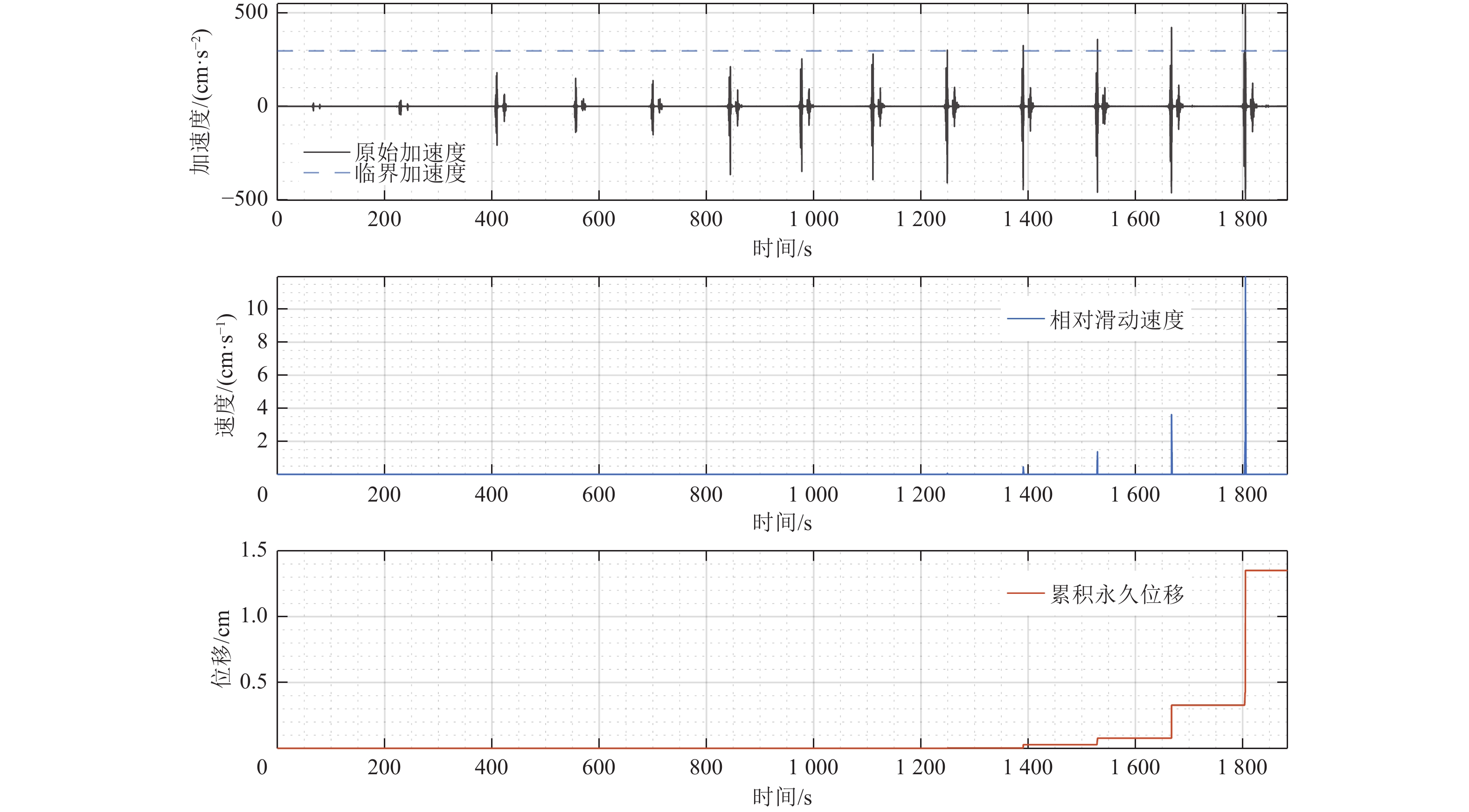
图 22 斜坡裂缝贯通时临界位移(未考虑地形效应)
Figure 22. Critical displacement at the moment of slope crack coalescence (excluding topographic effects)
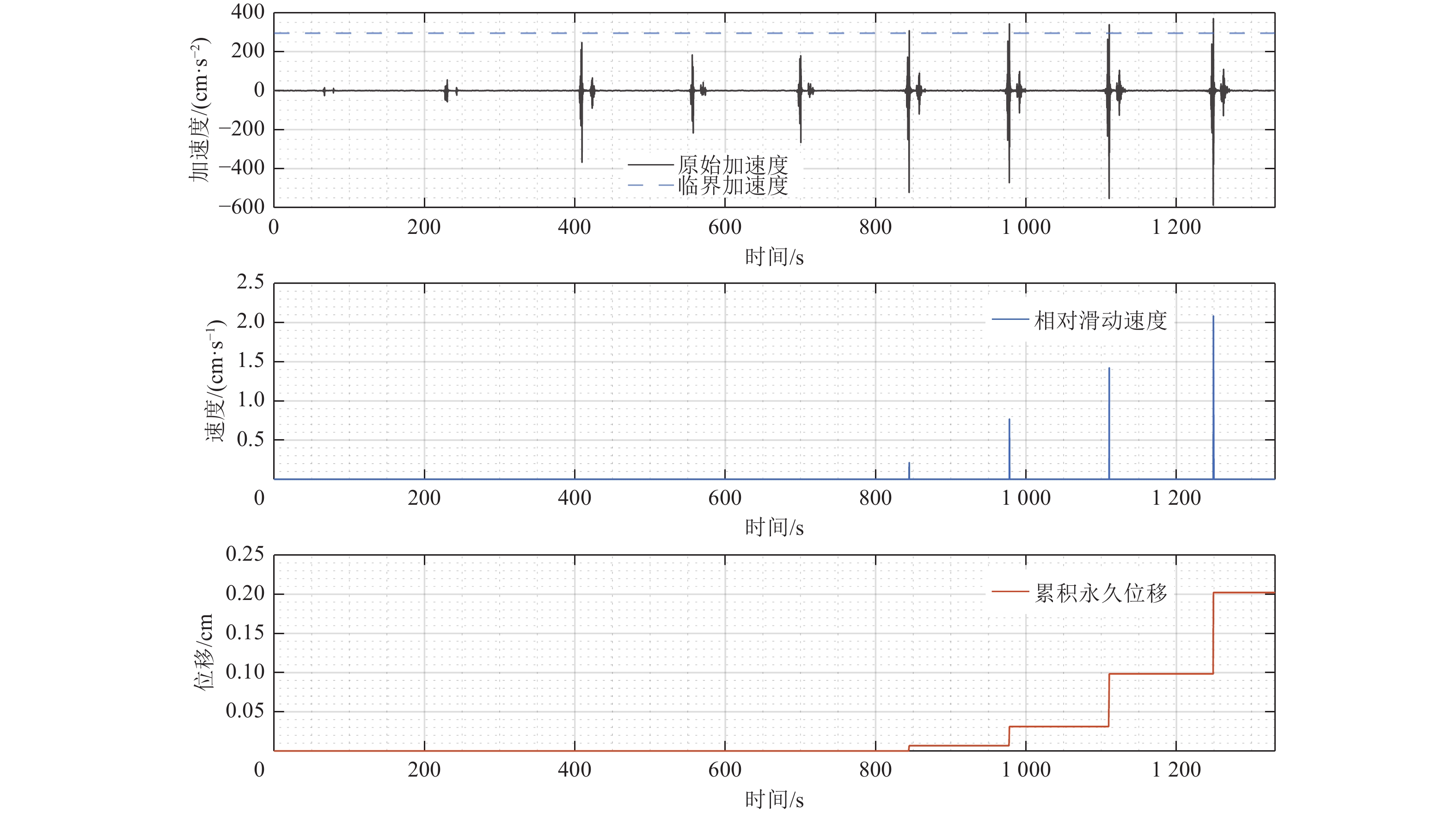
图 23 裂缝产生时临界位移(考虑地形效应)
Figure 23. Critical displacement for crack initiation (considering topographic effects)
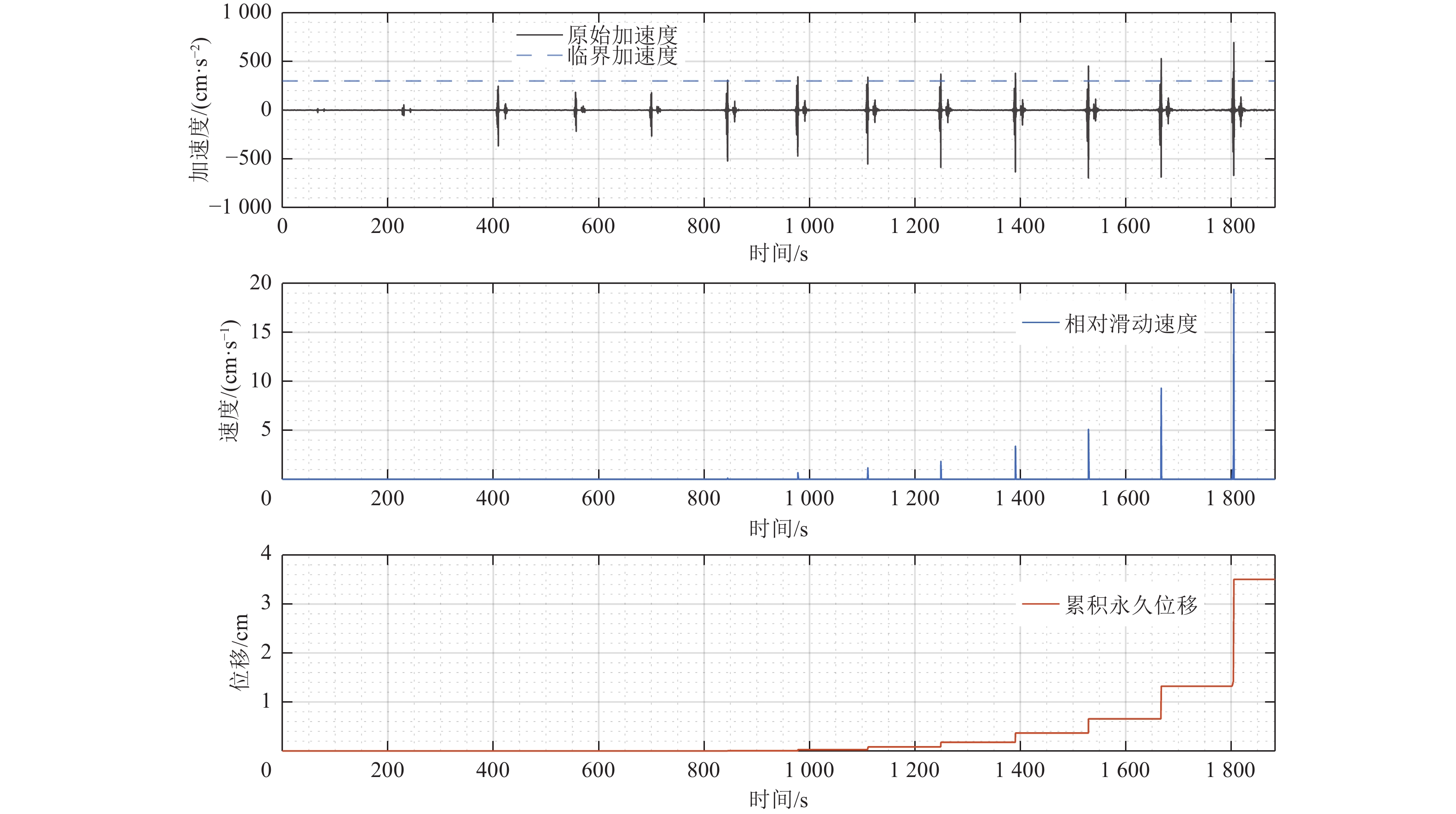
图 24 裂缝贯通时临界位移(考虑地形效应)
Figure 24. Critical displacement for crack coalescence (considering topographic effects)
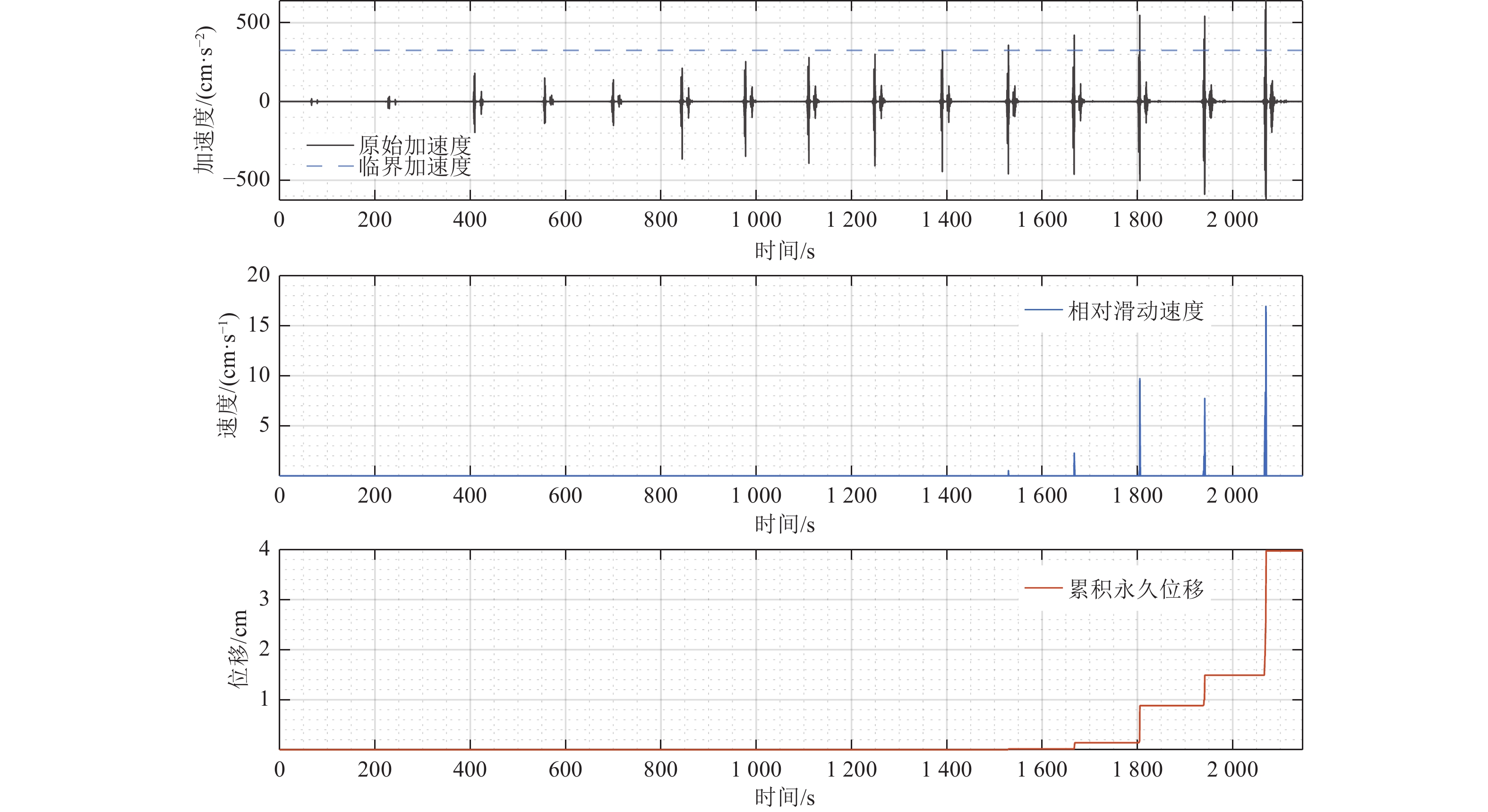
图 25 斜坡滑动时临界位移(未考虑地形效应)
Figure 25. Critical displacement for slope sliding (excluding topographic effects)
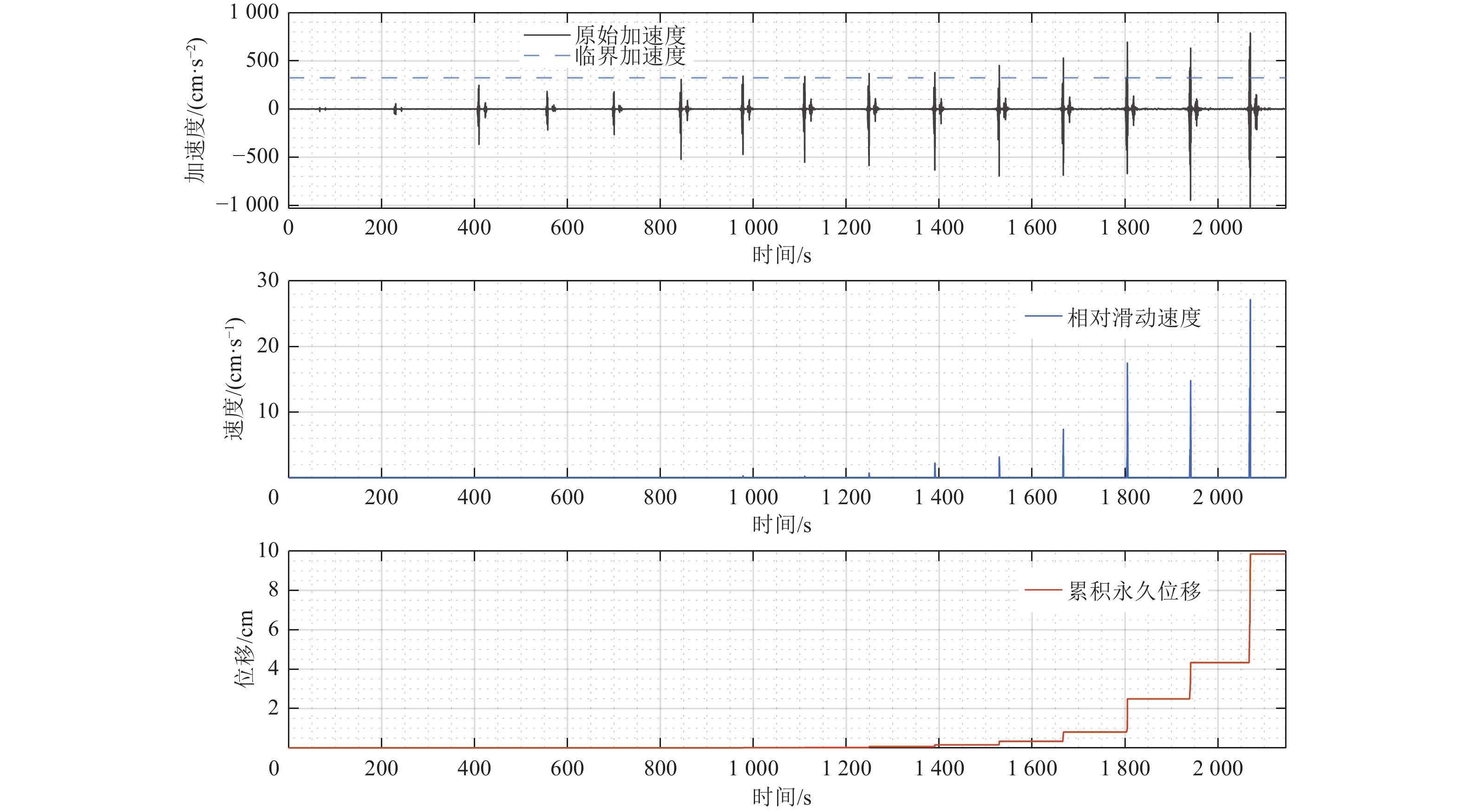
图 26 斜坡滑动时临界位移(考虑地形效应)
Figure 26. Critical displacement for slope sliding (considering topographic effects)
表 1 原型斜坡物理力学参数
Table 1. Physical and mechanical parameters of prototype slope
土层名称 土层密度ρ/(g·cm−3) 弹性模量E/MPa 泊松比μ 内摩擦角φ/(°) 黏聚力c/kPa 黄土 1.35 23 0.3 23 30 泥岩 2.0 623 0.3 34.2 680  下载: 导出CSV
表 2 振动台模型试验相似关系
Table 2. Similarity relationships for the shaking table model test
物理量 量纲 相似律 相似比(模型/原型) 备注 坡高H L CH 1/10 控制量 土体密度ρ ML−3 Cρ 1 控制量 重力加速度g LT−2 Cg 1 控制量 土体重度γ ML−2T−2 Cγ=CρCg 1 — 坡度θ — 1 1 — 含水率w — 1 1 — 土体黏聚力c ML−1T−2 Cc=CρCgCH 1/10 — 土体内摩擦角φ — 1 1 — 土体弹性模量E ML−1T−2 CE=CρCgCH 1/10 — 土体泊松比μ — 1 1 — 地震加速度a LT−2 Ca=Cg 1 — 地震荷载主频f T−1 Cf=CH−0.5Cg0.5 100.5 — 持续时间ts T $C_{t_{\mathrm{s}}} $=CH0.5Cg−0.5 (1/10)0.5 —
下载: 导出CSV
表 3 相似材料的物理力学参数
Table 3. Physico-mechanical parameters of similar material
土层名称 土层密度ρ/(g·cm−3) 泊松比μ 内摩擦角φ/(°) 黏聚力c/kPa 黄土 1.35 0.3 23° 3 泥岩 2.0 0.3 34.2 110
下载: 导出CSV
表 4 振动台试验加载工况
Table 4. Loading conditions for the shaking table test
工况 水平向加载波形 振幅/g 备注 1 白噪声 0.05 — 2 卧龙波 0.05 — 3 白噪声 0.05 — 4 卧龙波 0.1 — 5 白噪声 0.05 — 6 El Centro波 0.1 — 7 白噪声 0.05 — 8 卧龙波 0.2 — 9 白噪声 0.05 — 10 卧龙波 0.3 裂缝产生 11 白噪声 0.05 — 12 卧龙波 0.4 裂缝扩展 13 白噪声 0.05 — 14 卧龙波 0.5 裂缝贯通 15 白噪声 0.05 — 16 卧龙波 0.6 斜坡破坏
下载: 导出CSV
表 5 地震波频带比例
Table 5. Proportion of seismic wave frequency bands
地震波类型 频带范围/Hz B1频率占比/% B2频率占比/% B3频率占比/% 白噪声 0~3.125 3.26 3.13 4.73 3.125~6.25 23.34 23.74 31.39 6.25~9.375 21.77 23.00 16.37 9.375~12.5 33.14 32.16 37.64 12.5~15.625 0.02 0.02 0.02 15.625~18.75 0.27 0.26 0.31 18.75~21.875 13.86 15.64 7.30 21.875~25 2.07 2.07 2.23 卧龙波 0~3.125 1.36 1.25 1.14 3.125~6.25 11.09 9.62 9.81 6.25~9.375 61.65 63.43 59.63 9.375~12.5 10.30 9.10 9.04 12.5~15.625 3.08 3.62 6.49 15.625~18.75 2.56 2.58 3.00 18.75~21.875 6.47 7.43 6.66 21.875~25 3.48 2.95 4.22 El Centro波 0~3.125 15.15 13.84 12.93 3.125~6.25 23.10 21.43 20.65 6.25~9.375 19.57 21.95 20.36 9.375~12.5 17.13 16.29 15.72 12.5~15.625 3.38 3.05 5.40 15.625~18.75 4.19 3.81 5.53 18.75~21.875 12.17 15.28 13.45 21.875~25 5.32 4.43 5.97
下载: 导出CSV
-
薄景山, 段玉石, 常晁瑜等, 2019. 斜坡地震稳定性研究的若干问题. 自然灾害学报, 28(1): 1−8.Bo J. S., Duan Y. S., Chang C. Y., et al., 2019. Some problems of study on slope stability under earthquake. Journal of Natural Disasters, 28(1): 1−8. (in Chinese) 陈苏, 傅磊, 丁毅等, 2025. 强震动地震学与人工智能: 进展与展望. 震灾防御技术, 20(4): 697−716.Chen S., Fu L., Ding Y., et al., 2025. Strong-motion seismology and artificial intelligence: progress and prospects. Technology for Earthquake Disaster Prevention, 20(4): 697−716. (in Chinese) 陈晓利, 袁仁茂, 庾露, 2013. Newmark方法在芦山地震诱发滑坡分布预测研究中的应用. 地震地质, 35(3): 661−670. doi: 10.3969/j.issn.0253-4967.2013.03.019Chen X. L., Yuan R. M., Yu L., 2013. Applying the Newmark’s model to the assessment of earthquake-triggered landslides during the Lushan earthquake. Seismology and Geology, 35(3): 661−670. (in Chinese) doi: 10.3969/j.issn.0253-4967.2013.03.019 陈晓利, 单新建, 张凌等, 2019. 地震诱发滑坡的快速评估方法研究: 以2017年MS7.0级九寨沟地震为例. 地学前缘, 26(2): 312−320. doi: 10.13745/j.esf.sf.2018.9.11Chen X. L., Shan X. J., Zhang L., et al., 2019. Quick assessment of earthquake-triggered landslide hazards: a case study of the 2017 MS 7.0 Jiuzhaigou earthquake. Earth Science Frontiers, 26(2): 312−320. (in Chinese) doi: 10.13745/j.esf.sf.2018.9.11 邓其宁, 崔玉龙, 王炯超等, 2025. 三维边坡稳定性计算的ChatGPT辅助编程方法. 岩土力学, 46(S1): 322−334.Deng Q. N., Cui Y. L., Wang J. C., et al., 2025. ChatGPT-assisted programming approach for three-dimensional slope stability calculation. Rock and Soil Mechanics, 46(S1): 322−334. (in Chinese) 丁彦慧, 王余庆, 孙进忠等, 2000. 地震崩滑预测方法及其工程应用研究. 工程地质学报, 8(4): 475−480.Ding Y. H., Wang Y. Q., Sun J. Z., et al., 2000. Research on the method for prediction of earthquake-induced landslides and its application to engineering projects. Journal of Engineering Geology, 8(4): 475−480. (in Chinese) 韩晶晶, 2016. 基于小波包变换的地震动非平稳特性研究. 沈阳: 沈阳工业大学. Han J. J. , 2016. Seismicity non-stationary characteristics study based on wavelet packet transform. Shenyang: Shenyang University of Technology. (in Chinese). 侯玮华, 董杉, 张奇华等, 2024. 地震荷载下唐家山滑坡动力响应特征及破坏机理研究. 甘肃科学学报, 36(4): 1−8, 25.Hou W. H., Dong S., Zhang Q. H., et al., 2024. Research on dynamic response characteristics and failure mechanism of Tangjiashan landslide under seismic load. Journal of Gansu Sciences, 36(4): 1−8,25. (in Chinese) 黄栋, 乔建平, 张小刚等, 2017. 堆积层斜坡地震动地形效应试验研究. 岩石力学与工程学报, 36(3): 578−598.Huang D., Qiao J. P., Zhang X. G., et al., 2017. Experimental research of the topographic effects of slopes in earthquake. Chinese Journal of Rock Mechanics and Engineering, 36(3): 587−598. (in Chinese) 黄健航, 刘甲美, 王涛, 2025. Newmark位移预测模型改进及同震滑坡危险性评估研究. 震灾防御技术, 20(3): 564−584. doi: 10.11899/zzfy20250039Huang J. H., Liu J. M., Wang T., 2025. Improvement of the Newmark displacement model and coseismic landslides hazard assessment. Technology for Earthquake Disaster Prevention, 20(3): 564−584. (in Chinese) doi: 10.11899/zzfy20250039 刘爱娟, 崔玉龙, 刘铁新, 2021. 考虑动态临界加速度的地震边坡永久位移预测模型研究. 地震工程学报, 43(2): 445−452. doi: 10.3969/j.issn.1000-0844.2021.02.445Liu A. J., Cui Y. L., Liu T. X., 2021. A prediction model for permanent displacement of seismic slopes considering dynamic critical acceleration. China Earthquake Engineering Journal, 43(2): 445−452. (in Chinese) doi: 10.3969/j.issn.1000-0844.2021.02.445 刘汉香, 许强, 范宣梅, 2012. 地震动参数对斜坡加速度动力响应规律的影响. 地震工程与工程振动, 32(2): 41−47.Liu H. X., Xu Q., Fan X. M., 2012. Effects of seismic parameters on acceleration responses of slopes. Journal of Earthquake Engineering and Engineering Vibration, 32(2): 41−47. (in Chinese) 刘汉香, 许强, 王龙等, 2014. 地震波频率对岩质斜坡加速度动力响应规律的影响. 岩石力学与工程学报, 33(1): 125−133.Liu H. X., Xu Q., Wang L., et al., 2014. Effect of frequency of seismic wave on acceleration response of rock slopes. Chinese Journal of Rock Mechanics and Engineering, 33(1): 125−133. (in Chinese) 刘甲美, 王涛, 石菊松等, 2018. 基于不同位移预测模型的地震滑坡危险性评估研究−−以天水地区为例. 地质力学学报, 24(1): 87−95.Liu J. M., Wang T., Shi J. S., et al., 2018. The influence of different newmark displacement models on seismic landslide hazard assessment: a case study of Tianshui area, China. Journal of Geomechanics, 24(1): 87−95. (in Chinese) 吕艳, 董颖, 冯希杰等, 2014. 1556年陕西关中华县特大地震地质灾害遗迹发育特征. 工程地质学报, 22(2): 300−308. doi: 10.3969/j.issn.1004-9665.2014.02.021Lü Y., Dong Y., Feng X. J., et al., 2014. Characteristics of geological relics due to 1556 Huaxian great earthquake in Guanzhong area of Shaanxi Province, China. Journal of Engineering Geology, 22(2): 300−308. (in Chinese) doi: 10.3969/j.issn.1004-9665.2014.02.021 邵霄怡, 许冲, 马思远等, 2025. 地震触发滑坡应急评估方法实践−−以2022年四川泸定6.8级地震为例. 灾害学, 40(4): 71−76. doi: 10.3969/j.issn.1000-811X.2025.04.011Shao X. Y., Xu C., Ma S. Y., et al., 2025. Practice of emergency assessment methods for earthquake-triggered landslides: a case study of the 2022 MS6.8 Luding earthquake. Journal of Catastrophology, 40(4): 71−76. (in Chinese) doi: 10.3969/j.issn.1000-811X.2025.04.011 王会娟, 王平, 李旭东等, 2021. 地震诱发低角度黄土-泥岩滑坡动力响应及变形分析. 地震工程学报, 43(6): 1409−1418.Wang H. J., Wang P., Li X. D., et al., 2021. Dynamic response and deformation analysis of low-angle loess-mudstone landslides induced by earthquake. China Earthquake Engineering Journal, 43(6): 1409−1418. (in Chinese) 王兰民, 蒲小武, 陈金昌, 2019. 黄土高原地震诱发滑坡分布特征与灾害风险. 城市与减灾, (3): 33−40.Wang L. M., Pu X. W., Chen J. C., 2019. Distribution feature and disaster risk of earthquake-induced landslide in Loess Plateau. City and Disaster Reduction, (3): 33−40. (in Chinese) 王涛, 吴树仁, 石菊松等, 2013. 基于简化Newmark位移模型的区域地震滑坡危险性快速评估−−以汶川MS8.0级地震为例. 工程地质学报, 21(1): 16−24. doi: 10.3969/j.issn.1004-9665.2013.01.003Wang T., Wu S. R., Shi J. S., et al., 2013. Case study on rapid assessment of regional seismic landslide hazard based on simplified Newmark displacement model: Wenchuan MS 8.0 earthquake. Journal of Engineering Geology, 21(1): 16−24. (in Chinese) doi: 10.3969/j.issn.1004-9665.2013.01.003 王秀英, 聂高众, 王松, 2011. 汶川地震诱发滑坡的地震动加速度评判标准. 地震学报, 33(1): 82−90. doi: 10.3969/j.issn.0253-3782.2011.01.007Wang X. Y., Nie G. Z., Wang S., 2011. Ground motion acceleration criterion for judging landslide induced by the 2008 Wenchuan earthquake. Acta Seismologica Sinica, 33(1): 82−90. (in Chinese) doi: 10.3969/j.issn.0253-3782.2011.01.007 王雅丽, 王平, 王会娟等, 2025. 耦合统计与机器学习模型的黄土地震滑坡危险性评价. 地震工程学报, 47(4): 864−875, 900.Wang Y. L., Wang P., Wang H. J., et al., 2025. Hazard assessment of seismic loess landslides using coupled statistical and machine learning models. China Earthquake Engineering Journal, 47(4): 864−875,900. (in Chinese) 吴多华, 刘亚群, 李海波等, 2020. 地震荷载作用下顺层岩体边坡动力放大效应和破坏机制的振动台试验研究. 岩石力学与工程学报, 39(10): 1945−1956. doi: 10.13722/j.cnki.jrme.2020.0033Wu D. H., Liu Y. Q., Li H. B., et al., 2020. Shaking table tests on dynamic amplification and failure mechanism of layered rock slopes under seismic actions. Chinese Journal of Rock Mechanics and Engineering, 39(10): 1945−1956. (in Chinese) doi: 10.13722/j.cnki.jrme.2020.0033 吴多华, 柳洪源, 张健等, 2025. 基于临界位移的顺层岩质边坡地震安全评价方法. 振动与冲击, 44(22): 327−334.Wu D. H., Liu H. Y., Zhang J., et al., 2025. Seismic safety evaluation methods for layered rock slopes based on the critical displacement. Journal of Vibration and Shock, 44(22): 327−334. (in Chinese) 肖子亢, 许冲, 李宏等, 2025. 地质灾害物理仿真实验发展现状及趋势分析. 地质科技通报, 44(4): 23−47.Xiao Z. K., Xu C., Li H., et al., 2025. Development status and trend analysis of physical simulation experiments for geological hazards. Bulletin of Geological Science and Technology, 44(4): 23−47. (in Chinese) 许冲, 高明星, 薛智文等, 2025. 专栏评论: 高新技术赋能地震与地质灾害防治研究进展. 地质科技通报, 44(4): 16−22. doi: 10.19509/j.cnki.dzkq.tb20250004Xu C., Gao M. X., Xue Z. W., et al., 2025. Column Review: advancements in earthquake and geological disaster mitigation empowered by advanced technologies. Bulletin of Geological Science and Technology, 44(4): 16−22. (in Chinese) doi: 10.19509/j.cnki.dzkq.tb20250004 许强, 刘汉香, 邹威等, 2010. 斜坡加速度动力响应特性的大型振动台试验研究. 岩石力学与工程学报, 29(12): 2420−2428.Xu Q., Liu H. X., Zou W., et al., 2010. Large-scale shaking table test study of acceleration dynamic responses characteristics of slopes. Chinese Journal of Rock Mechanics and Engineering, 29(12): 2420−2428. (in Chinese) 闫东晗, 薄景山, 李孝波等, 2019. 海原特大地震红土川滑坡拟静力强度折减法模拟分析. 科学技术与工程, 19(28): 50−55.Yan D. H., Bo J. S., Li X. B., et al., 2019. Simulation analysis of Hongtuchuan landslide in Haiyuan earthquake quasi-static strength reduction method. Science Technology and Engineering, 19(28): 50−55. (in Chinese) 杨兵, 孙明祥, 王润民等, 2018a. 土体含水率对边坡动力破坏模式及动力响应影响的振动台试验研究. 岩土工程学报, 40(4): 759−766, 725. doi: 10.11779/CJGE201804021Yang B., Sun M. X., Wang R. M., et al., 2018a. Shaking table tests on influences of water content of soils on dynamic failure modes and dynamic responses of slopes. Chinese Journal of Geotechnical Engineering, 40(4): 759−766,725. (in Chinese) doi: 10.11779/CJGE201804021 杨兵, 杨翔, 杨涛等, 2018b. 地震荷载作用下震裂–溃滑型边坡破坏过程及动力响应振动台模型试验研究. 岩石力学与工程学报, 37(S1): 3279−3290. doi: 10.13722/j.cnki.jrme.2016.1256Yang B., Yang X., Yang T., et al., 2018b. Shaking table model test on dynamic response and failure process of shatter-burst sliding slope under earthquake load. Chinese Journal of Rock Mechanics and Engineering, 37(S1): 3279−3290. (in Chinese) doi: 10.13722/j.cnki.jrme.2016.1256 杨国香, 伍法权, 董金玉等, 2012. 地震作用下岩质边坡动力响应特性及变形破坏机制研究. 岩石力学与工程学报, 31(4): 696−702. doi: 10.3969/j.issn.1000-6915.2012.04.007Yang G. X., Wu F. Q., Dong J. Y., et al., 2012. Study of dynamic response characters and failure mechanism of rock slope under earthquake. Chinese Journal of Rock Mechanics and Engineering, 31(4): 696−702. (in Chinese) doi: 10.3969/j.issn.1000-6915.2012.04.007 张丹, 吴志坚, 梁庆国等, 2019. 黄土斜坡坡面位移和加速度响应特性的振动台试验研究. 土木工程学报, 52(S2): 162−169. doi: 10.15951/j.tmgcxb.2019.s2.023Zhang D., Wu Z. J., Liang Q. G., et al., 2019. Shaking table test study of displacement and acceleration response characteristics of loess slope surface. China Civil Engineering Journal, 52(S2): 162−169. (in Chinese) doi: 10.15951/j.tmgcxb.2019.s2.023 赵海军, 马凤山, 李志清等, 2022. 基于Newmark模型的概率地震滑坡危险性模型参数优化与应用: 以鲁甸地震区为例. 地球科学, 47(12): 4401−4416.Zhao H. J., Ma F. S., Li Z. Q., et al., 2022. Optimization of parameters and application of probabilistic seismic landslide hazard analysis model based on Newmark displacement model: a case study in Ludian earthquake area. Earth Science, 47(12): 4401−4416. (in Chinese) Chen X. L., Liu C. G., Wang M. M., 2019. A method for quick assessment of earthquake-triggered landslide hazards: a case study of the Mw 6.1 2014 Ludian, China earthquake. Bulletin of Engineering Geology and the Environment, 78(4): 2449−2458. doi: 10.1007/s10064-018-1313-7 Converse A. M. , Brady A. G. , 1992. BAP: basic strong-motion accelerogram processing software version 1.0. Menlo Park: United States Department of the Interior, U. S. Geological Survey. Dunham A. M., Kiser E., Kargel J. S., et al., 2022. Topographic control on ground motions and landslides from the 2015 Gorkha earthquake. Geophysical Research Letters, 49(10): e2022GL098582. doi: 10.1029/2022GL098582 Fan X. M., Juang C. H., Wasowski J., et al., 2018. What we have learned from the 2008 Wenchuan earthquake and its aftermath: a decade of research and challenges. Engineering Geology, 241: 25−32. doi: 10.1016/j.enggeo.2018.05.004 Foulser-Piggott R., Stafford P. J., 2012. A predictive model for Arias intensity at multiple sites and consideration of spatial correlations. Earthquake Engineering & Structural Dynamics, 41(3): 431−451. doi: 10.1002/eqe.1137 Godt J., Sener B., Verdin K., et al., 2008. Rapid assessment of earthquake-induced landsliding. In: Proceedings of the First World Landslide Forum, 4: 219−222. doi: 10.3990/1.9789036547055 Huang Q. B., Jia X. N., Peng J. B., et al., 2019. Seismic response of loess-mudstone slope with bedding fault zone. Soil Dynamics and Earthquake Engineering, 123: 371−380. doi: 10.1016/j.soildyn.2019.05.009 Jibson R. W. , 1985. Landslides caused by the 1811–12 New Madrid earthquakes. Palo Alto: Stanford University. Jibson R. W., Keefer D. K., 1993. Analysis of the seismic origin of landslides: examples from the New Madrid seismic zone. GSA Bulletin, 105(4): 521−536. doi: 10.1130/0016-7606(1993)105<0521:aotsoo>2.3.co;2 Jibson R. W., Harp E. L., Michael J. A., 2000. A method for producing digital probabilistic seismic landslide hazard maps. Engineering Geology, 58(3-4): 271−289. doi: 10.1016/S0013-7952(00)00039-9 Keefer D. K. , Wilson R. C. , 1989. Predicting earthquake-induced landslides, with emphasis on arid and semi-arid environments. Landslides in a Semi-arid Environment, 2(PART 1): 118−149. Li C., Su L. J., 2021. Influence of critical acceleration model on assessments of potential earthquake-induced landslide hazards in Shimian County, Sichuan Province, China. Landslides, 18(5): 1659−1674. doi: 10.1007/s10346-020-01578-1 Li C. H., Guo C. B., Zhang X. J., et al., 2023. Rapid evaluation of earthquake-induced landslides by PGA and Arias intensity model: insights from the Luding MS6.8 earthquake, Tibetan Plateau. Frontiers in Earth Science, 11: 1324773. doi: 10.3389/feart.2023.1324773 Liu J. M., Shi J. S., Wang T., et al., 2018. Seismic landslide hazard assessment in the Tianshui area, China, based on scenario earthquakes. Bulletin of Engineering Geology and the Environment, 77(3): 1263−1272. doi: 10.1007/s10064-016-0998-8 Nakajima S., Watanabe K., Shinoda M., et al., 2016. Consideration on evaluation of seismic slope stability based on shaking table model test. Japanese Geotechnical Society Special Publication, 2(26): 957−962. doi: 10.3208/jgssp.jpn-100 Newmark N. M., 1965. Effects of earthquakes on dams and embankments. Géotechnique, 15(2): 139−160. doi: 10.1680/geot.1965.15.2.139 Qi S. W., He J. X., Zhan Z. F., 2022. A single surface slope effects on seismic response based on shaking table test and numerical simulation. Engineering Geology, 306: 106762. doi: 10.1016/j.enggeo.2022.106762 Stafford P. J., Berrill J. B., Pettinga J. R., 2009. New predictive equations for Arias intensity from crustal earthquakes in New Zealand. Journal of Seismology, 13(1): 31−52. doi: 10.1007/s10950-008-9114-2 Townsend K. F., Gallen S. F., Clark M. K., 2020. Quantifying near-surface rock strength on a regional scale from hillslope stability models. Journal of Geophysical Research: Earth Surface, 125(7): e2020JF005665. doi: 10.1029/2020JF005665 Villaverde R. , 1986. Investigation on the cause of numerous upper floor failures during the 1985 Mexico City earthquake. USA: Directorate for Engineering, Division of Civil, Mechanical, and Manufacturing. Wieczorek G. F. , Wilson R. C. , Harp E. L. , 1985. Map showing slope stability during earthquakes in San Mateo County, California. San Mateo County: U. S. Geological Survey. Yang C. M. , Hsu C. H. , Dong J. J. , 2017. Critical displacement of earthquake-triggered catastrophic landslides. In: Mikoš M. , Casagli N. , Yin Y. P. , et al. , eds. , Advancing Culture of Living with Landslides. Cham: Springer, 37−46. Zahrah T. F., Hall W. J., 1984. Earthquake energy absorption in SDOF structures. Journal of Structural Engineering, 110(8): 1757−1772. doi: 10.1061/(ASCE)0733-9445(1984)110:8(1757) Zang M. D., Qi S. W., Zou Y., et al., 2020. An improved method of Newmark analysis for mapping hazards of coseismic landslides. Natural Hazards and Earth System Sciences, 20(3): 713−726. doi: 10.5194/nhess-20-713-2020 Zhou J. X., Zhu C. Y., Zheng J. M., et al., 2002. Landslide disaster in the loess area of China. Journal of Forestry Research, 13(2): 157−161. -

 点击查看大图
计量
- 文章访问数: 283
- HTML全文浏览量: 226
- PDF下载量: 217
- 被引次数: 0
