


Analysis on Seismic Intensity Measures for Underground Structures Based on the PCA Method
-
摘要: 地震动强度指标(IM)蕴含丰富的地震动特性信息,是连接地震危险性与结构响应的重要参数指标,选择与结构响应相关性较高的地震动强度指标参数,可以有效提高结构地震响应评估结果的准确性。本文以地铁地下结构抗震评估为目标,针对某II类场地地下结构响应评估中地震动强度指标选取开展了系统研究。首先,收集近场速度脉冲型地震动记录、远场类谐和地震动记录、普通地震动记录各20条,对地铁车站-隧道-场地地震响应进行数值模拟,然后采用主成分分析法(PCA)对12种地震动强度指标进行分析,并对地震动强度指标与结构响应之间的相关性进行探讨。结果表明,在利用单一强度指标表征地下结构地震响应方面,近场速度脉冲型地震动以峰值速度(PGV)和Housner谱强度(SI)两种速度型指标相关性最强,远场类谐和地震动以谱相关型指标SI相关性最强,普通地震动以峰值加速度(PGA)和Arias强度(AI)两种加速度型指标相关性最强;三类地震动可以分别组成为如下综合强度指标,近场速度脉冲型地震动: $ \ln {I}_{\text{p}}=0.36\ln {V}_{\max }+0.09\ln {C}_{\text{AV}} $;远场类谐和型地震动: $ \ln {I}_{\text{p}}=0.50\ln {I}_{\text{H}}+0.05\ln {A}_{\text{rms}} $;普通地震动: $ \ln {I}_{\text{p}}= 0.79\ln {a}_{\max }+ $$ 0.02\ln {I}_{\text{H}} $。相较于单一地震动强度指标,地震动综合强度指标更适用于本案例场地地铁地下结构抗震性能评估。Abstract: The seismic intensity measures (IM) contain rich information about seismic motion characteristics and serve as crucial parameters linking seismic hazard to structural response. Selecting the IM with high correlation to structural response can significantly improve the accuracy of evaluating structural seismic response. With the objective of seismic assessment for subway underground structures, this study conducted a systematic investigation into the selection of IMs for evaluating the response of underground structures in a Class II sites. Twenty near-field velocity pulse-like ground motion records, twenty far-field harmonic-like ground motion records, and twenty ordinary ground motion records were collected. Numerical simulations were conducted on the seismic response of station-tunnel-site. The principal component analysis (PCA) was applied to analyze 12 IMs, and the correlation between IMs and structural response was explored. The results indicate that, in characterizing the seismic response of underground structures, PGV and SI are the preferred IMs for near-field velocity pulse-like ground motionsSI is the preferred IM for far-field harmonic-like ground motions, and PGA and AI are the preferred IMs for ordinary ground motions; For the three types of ground motions, three composite IMs were proposed respectively: $ \ln {\boldsymbol{I}}_{\text{p}}=0.36\ln {\boldsymbol{V}}_{\max }+0.09\ln {\boldsymbol{C}}_{\text{AV}} $is for near-field velocity pulse-like ground motions, $ \ln {\boldsymbol{I}}_{\text{p}}=0.50\ln {\boldsymbol{I}}_{\text{H}}+0.05\ln {\boldsymbol{A}}_{\text{rms}} $ is for far-field harmonic-like ground motions, and $ \ln {\boldsymbol{I}}_{\text{p}}=0.79\ln {\boldsymbol{a}}_{\max }+0.02\ln {\boldsymbol{I}}_{\text{H}} $ is for ordinary ground motions. Compared to single parameter IMs, the composite seismicintensitymeasures are more suitable for assessing the seismic performance of underground structures in the case.
-
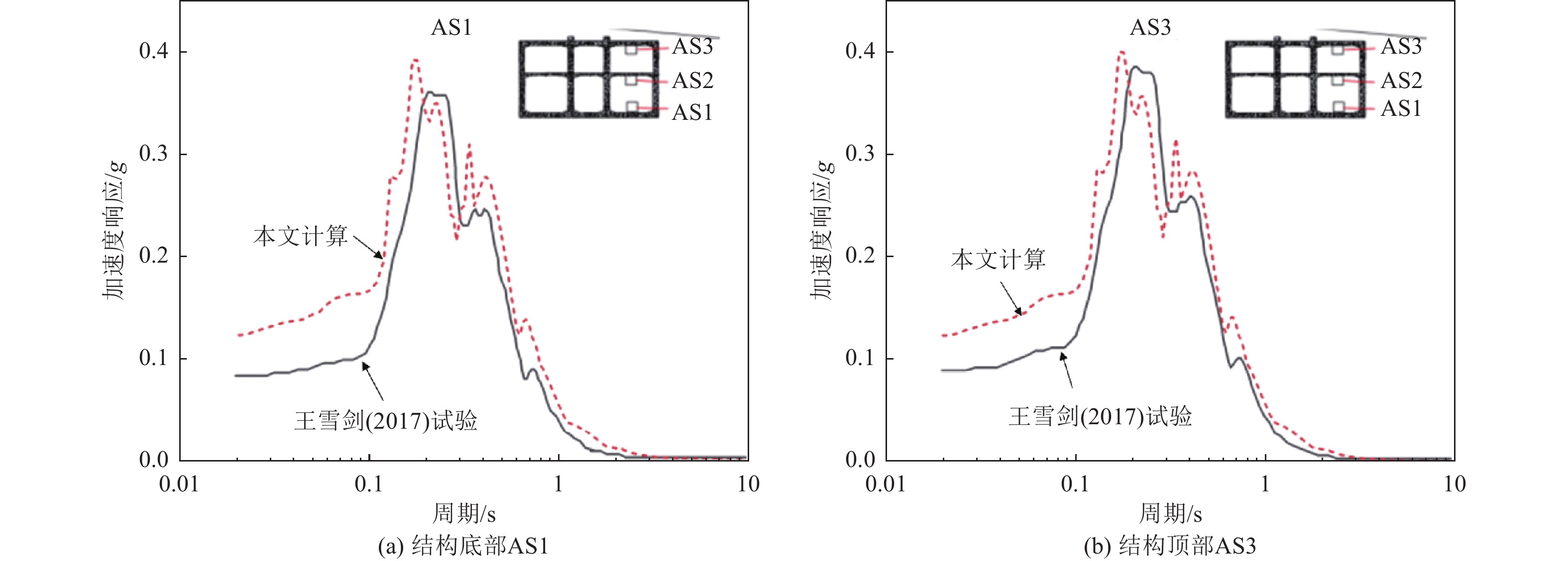
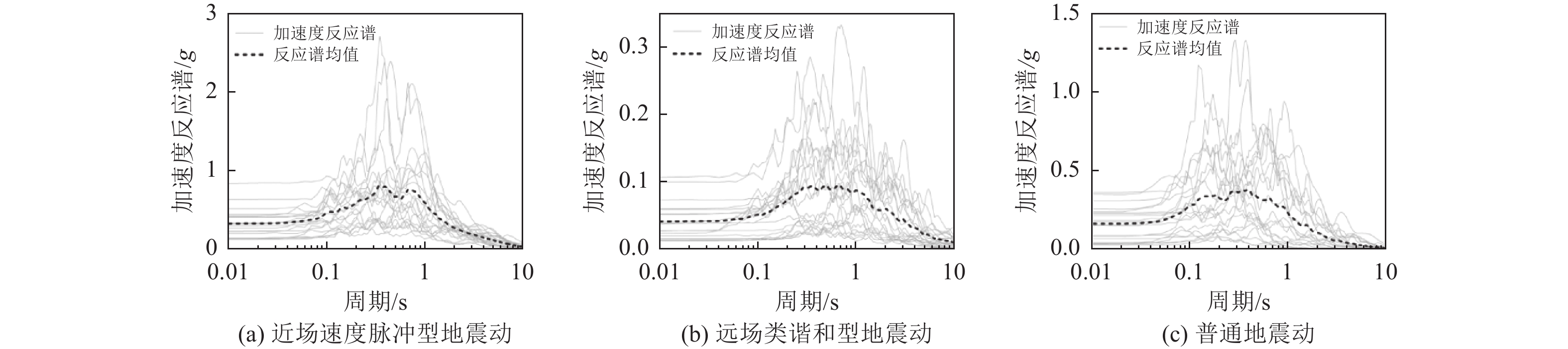
图 4 车站结构底部与顶部加速度反应谱对比
Figure 4. Acceleration response spectra of the bottom and top of the shaker experiment station structure
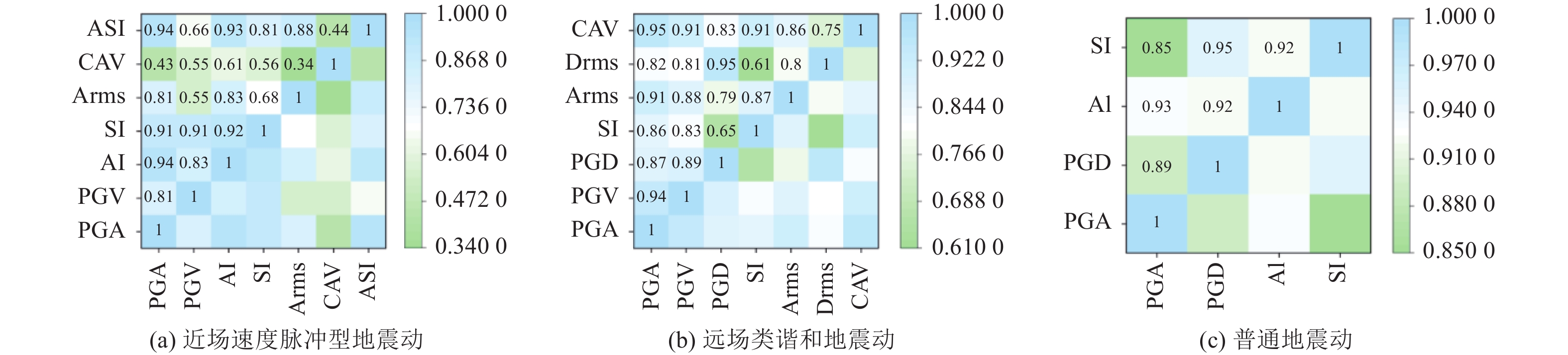
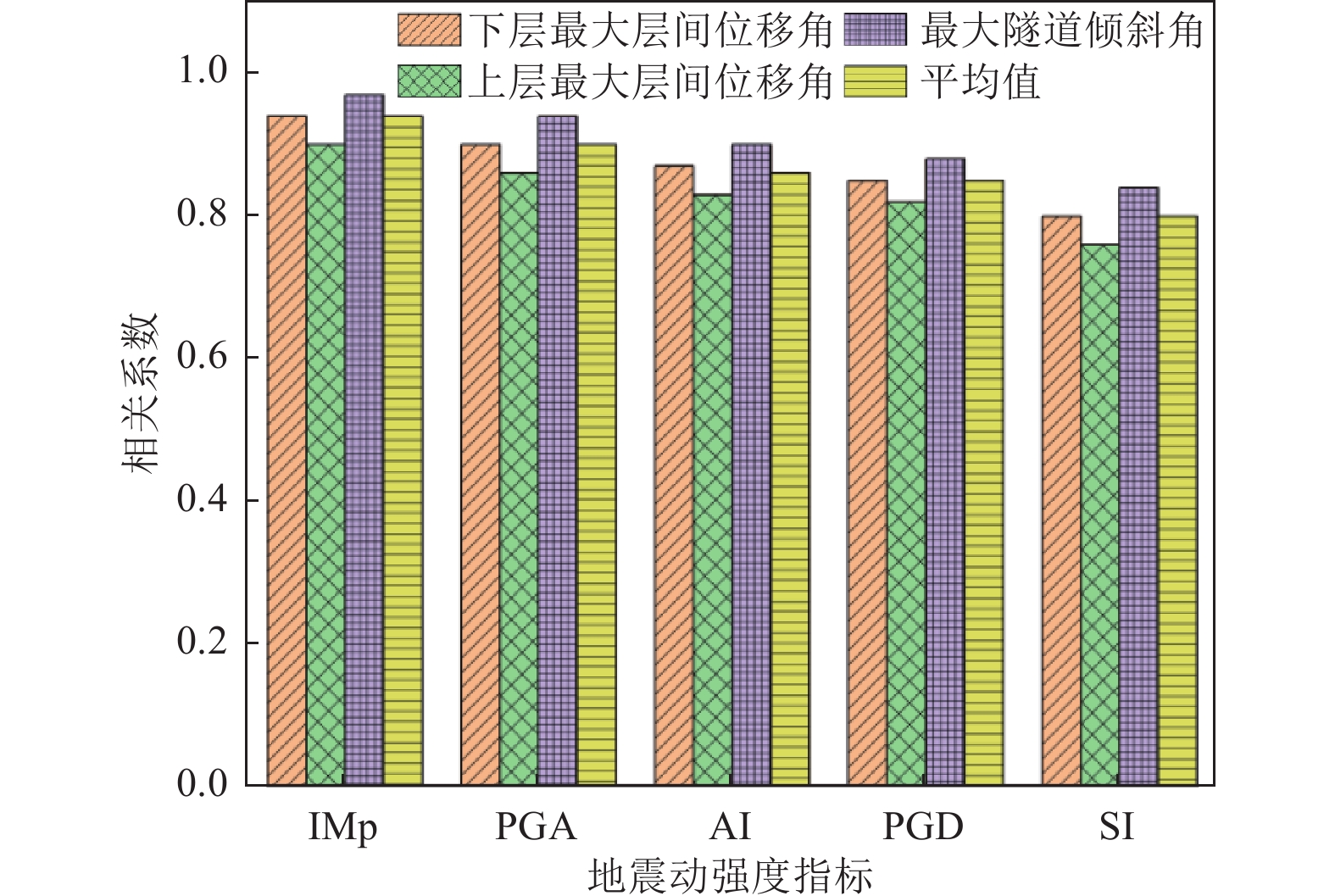
图 6 所选地震动强度指标的相关系数
Figure 6. Correlation coefficients of the selected seismic intensity indicators
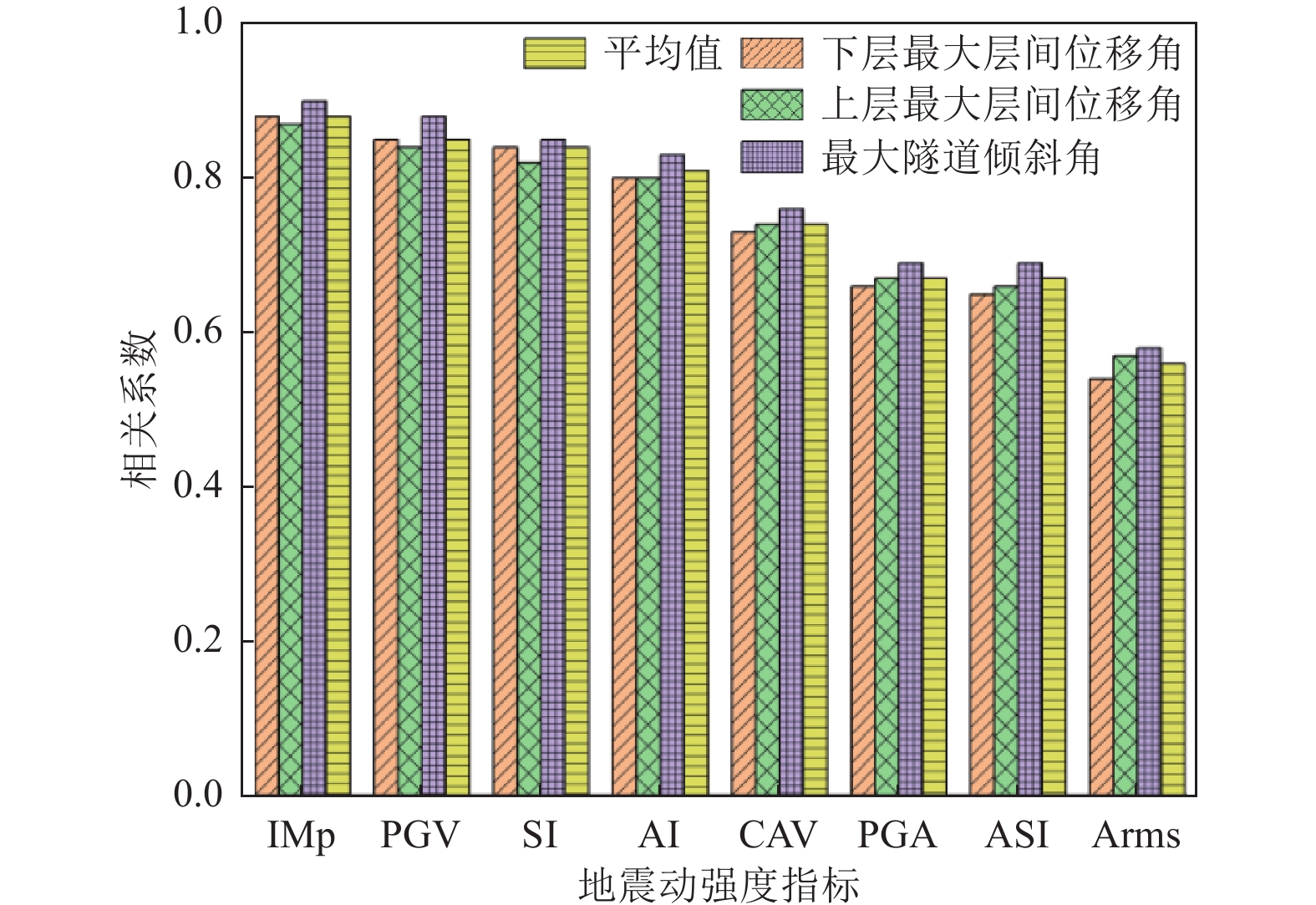
图 7 近场速度脉冲型相关性对比
Figure 7. Correlation comparison chart for near-field velocity pulse type
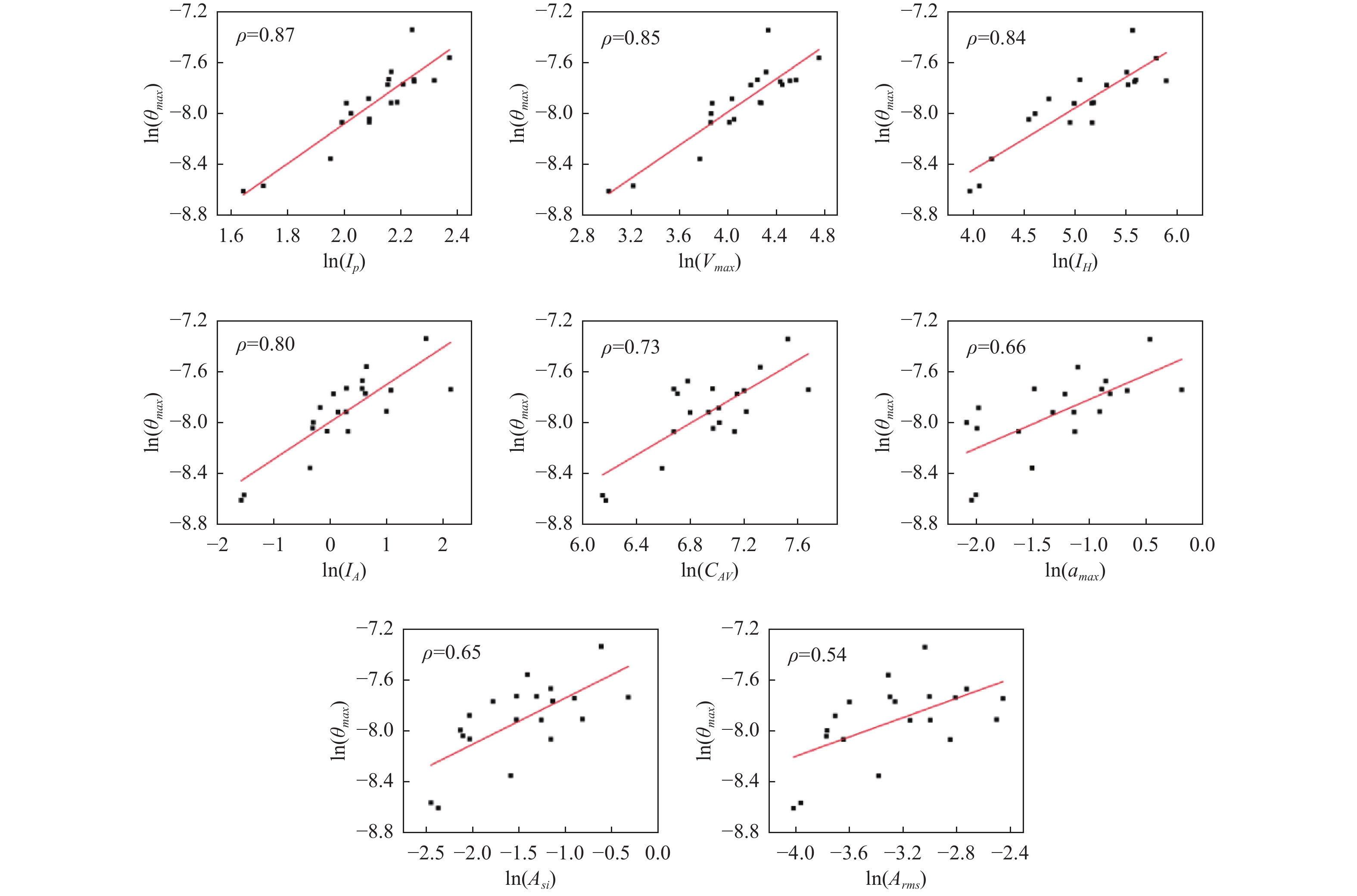
图 8 中柱下层最大层间位移角与各IM指标的对数线性回归
Figure 8. Log-linear regression of the maximum interlayer displacement angle in the lower part of the middle column on each IM index
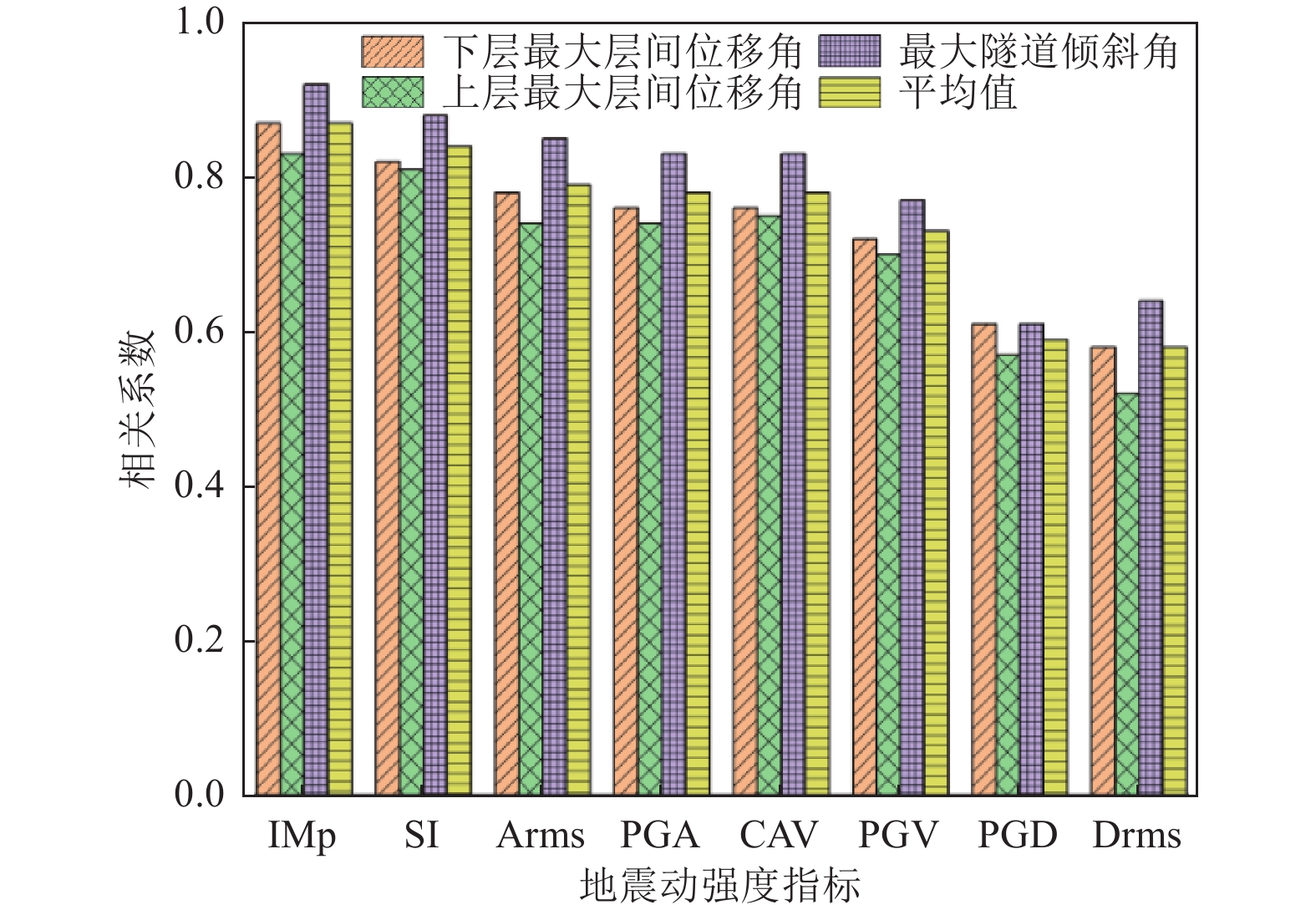
图 9 远场类谐和型相关性对比
Figure 9. Correlation comparison chart for far-field quasi-harmonic type
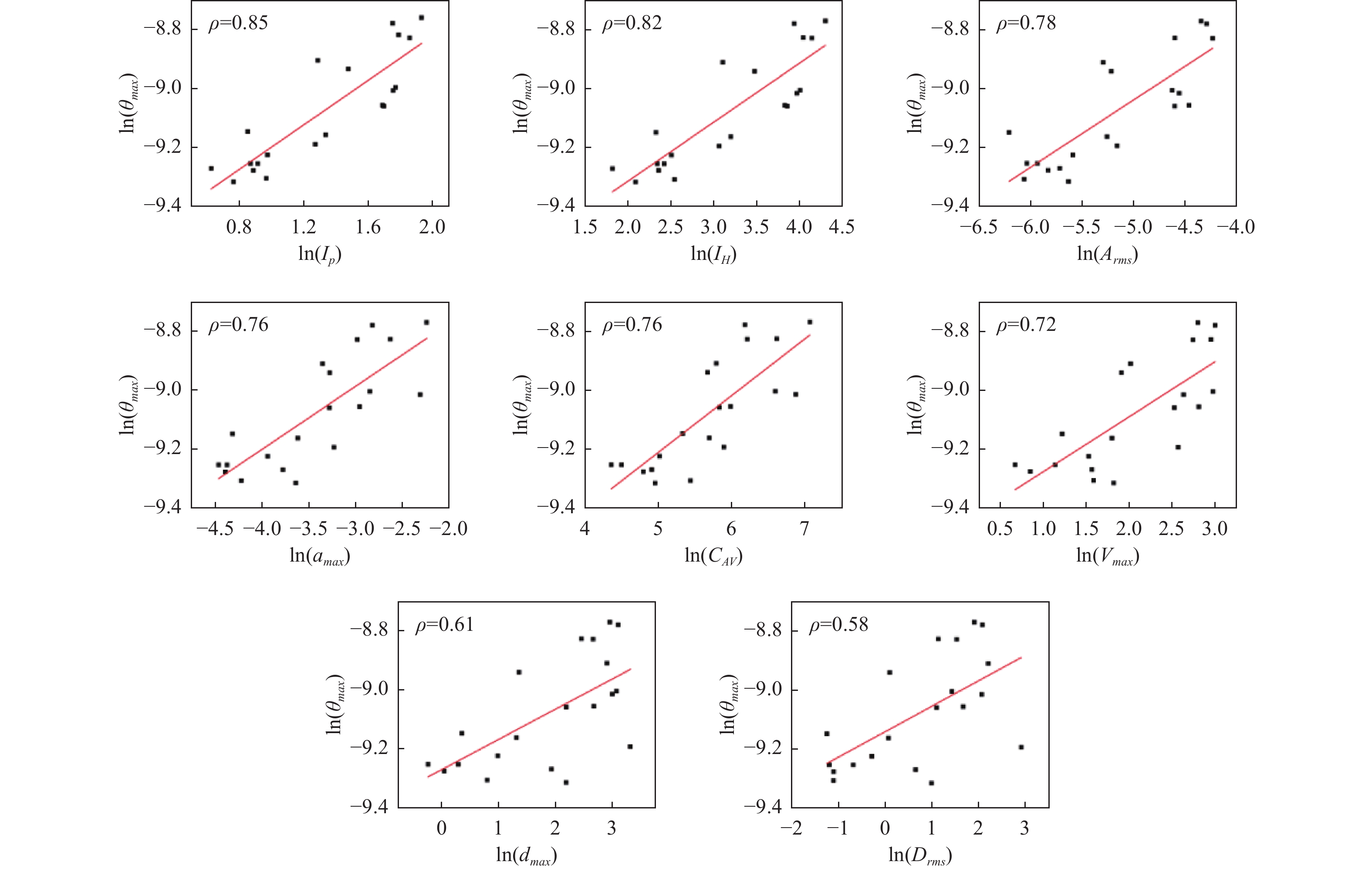
图 10 中柱下层最大层间位移角与各IM指标的对数线性回归
Figure 10. Log-linear regression of the maximum interlayer displacement angle in the lower part of the middle column on each IM index
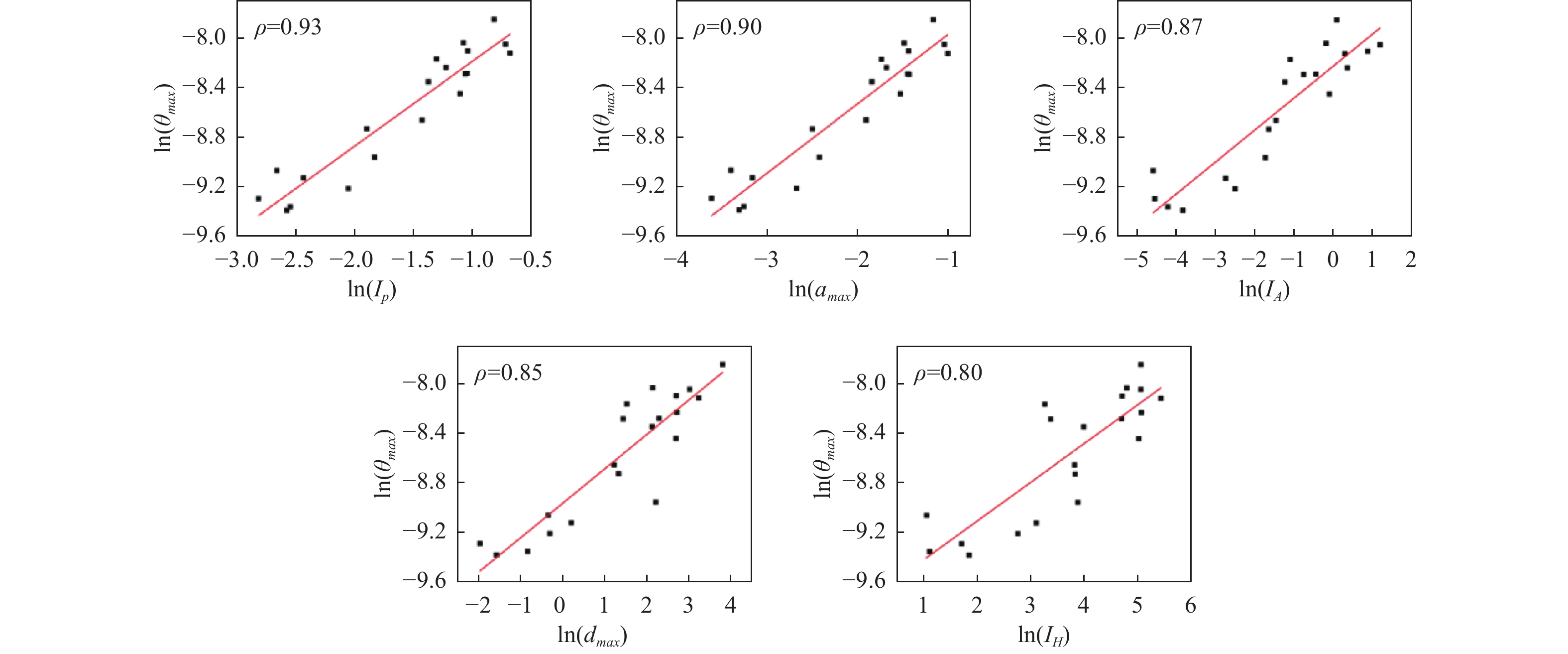
图 12 中柱下层最大层间位移角与各IM指标的对数线性回归
Figure 12. Log-linear regression of the maximum interlayer displacement angle in the lower part of the middle column on each IM index
表 1 地震动强度指标(韩俊艳等,2026)
Table 1. Seismic intensity measures(Han et al.,2026)
地震动强度指标名称 符号 定义 单位 指标类型 峰值加速度(PGA) amax $ \text{max}|\boldsymbol{a}(\boldsymbol{t})| $ m/s2 加速度型 Arias强度(AI) IA $ \dfrac{\boldsymbol{\text{π} }}{2\boldsymbol{g}}\displaystyle\int\nolimits_{0}^{{\boldsymbol{T}}_{\text{d}}}\,[\boldsymbol{a}(\boldsymbol{t}){]}^{2}\text{d}\boldsymbol{t} $ m/s 均值方根加速度(Arms) Arms $ \sqrt{\dfrac{1}{{T}_{d}}\displaystyle\int\nolimits_{0}^{{T}_{d}}{[a\left(t\right)]}^{2}\text{d}t} $ m/s2 加速度谱强度(ASI) Asi $ \displaystyle\int\nolimits_{0.1}^{0.5}\,\,{S}_{\text{a}}(T,\xi =\left.0.05\right)\text{d}T $ m/s 累计绝对速度(CAV) CAV $ \displaystyle\int\nolimits_{0}^{{T}_{\text{d}}}\,|a(t)|\text{d}t $ m/s 峰值速度(PGV) Vmax $ \text{max}|\nu (t)| $ m/s 速度型 均值方根速度(Vrms) Vrms $ \sqrt{\dfrac{1}{{T}_{d}}\displaystyle\int\nolimits_{0}^{{T}_{d}}{[v\left(t\right)]}^{2}\text{d}t} $ m/s 速度谱强度(VSI) Vsi $ \displaystyle\int\nolimits_{0.1}^{0.5}\,\,{S}_{\text{v}}(T,\xi \text{=0.05)d}T $ m/s Housner谱强度(SI) IH $ \dfrac{\text{π} }{2 g}\displaystyle\int\nolimits_{0.1}^{2.5}\,\,{S}_{\text{v}}(T,\xi \text{=0.05)d}T $ m/s 峰值位移(PGD) dmax $ \text{max}|d(t)| $ m 位移型 均值方根位移(Drms) Drms $ \sqrt{\dfrac{1}{{T}_{\text{d}}}\displaystyle\int\nolimits_{0}^{{T}_{\text{d}}}\,\,[d(t){]}^{2}\text{d}t} $ m 速度/加速度(PGV/PGA) R amax/Vmax s —  下载: 导出CSV
表 2 土层材料参数
Table 2. Soil material parameters
土层 土类 土层深度/m 密度/(kg·m3) 剪切波速/(m·s−1) 泊松比 黏聚力/kPa 内摩擦角/(°) 1 填土 0~5.8 1 800 177.4 0.3 5 10 2 粉土 5.8~8.5 1 935 227.8 0.325 39 23 3 粉砂 8.5~11.5 1 980 310.8 0.26 1 40 4 中砂 11.5~16.5 1 940 323.8 0.24 1 40 5 粉质黏土 16.5~23.1 1 960 269.8 0.295 42 24 6 砂土 23.1~28.5 2 075 398.0 0.22 1 40 7 粉质黏土 28.5~45.5 1 946 328.3 0.3 55 12
下载: 导出CSV
表 3 混凝土材料参数
Table 3. Concrete material parameters
混凝土标号 密度/(kg·m−3) 弹性模量/MPa 泊松比 轴心受压强度/MPa 轴心受拉强度/MPa C40 2 400 32 500 0.2 39.5 2.94
下载: 导出CSV
表 4 地震动震级及断层距
Table 4. Earthquake intensity and fault distance
编号 近场速度脉冲型地震动 远场类谐和型地震动 普通地震动 震级 断层距/km 震级 断层距/km 震级 断层距/km 1 6.7 5.9 7.2 366.03 6.69 21.36 2 6.7 5.9 7.2 366.03 6.69 21.36 3 6.9 1 7.51 207.81 6.69 39.91 4 6.9 1 7.51 207.81 6.69 39.91 5 7.5 4.8 7.62 66.64 6.9 17.85 6 7.5 4.8 7.62 66.64 6.9 17.85 7 7.6 19.8 7.62 92.81 6.9 19.15 8 7.6 19.8 7.62 92.81 6.9 19.15 9 7.6 19.9 7.14 188.7 7.51 15.37 10 7.6 19.9 7.14 188.7 7.51 15.37 11 7.1 6.6 7.13 123.79 6.5 102.15 12 7.1 6.6 7.13 123.79 6.5 102.15 13 6.5 12.9 6.63 222.42 6.53 22.03 14 6.5 12.9 6.63 222.42 6.53 22.03 15 7.9 2.7 7.2 57.95 6.61 173.16 16 7.9 2.7 7.2 57.95 6.61 173.16 17 6.9 5 7.3 144.9 6.93 41.86 18 6.9 5 7.3 144.9 6.93 41.86 19 7.3 34.9 7.3 157.41 7.28 148.07 20 7.3 34.9 7.3 157.41 7.28 148.07
下载: 导出CSV
表 5 前两个主成分的方差贡献率及载荷(近场速度脉冲型地震动)
Table 5. Variance contribution rate and loadings of the first two principal components (near-field velocity pulse-type like seismic ground motions)
主成分及方差贡献率 强度指标 PGA PGV AI SI Arms CAV ASI 第一主成分(76.58%) 0.35 0.47 0.24 0.36 0.38 0.46 0.34 第二主成分(13.24%) −0.30 0.22 −0.01 0.00 −0.55 0.68 −0.30
下载: 导出CSV
表 6 前两个主成分的方差贡献率及载荷(远场类谐和型地震动)
Table 6. Variance contribution rate and loadings of the first two principal components (far-field harmonic-like ground motions)
主成分及方差贡献率 强度指标 PGA PGV PGD SI Arms Drms CAV 第一主成分(87.32%) 0.35 0.47 0.24 0.36 0.38 0.46 0.34 第二主成分(9.35%) −0.30 0.22 −0.01 0.00 −0.55 0.68 −0.30
下载: 导出CSV
表 7 前两个主成分的方差贡献率及载荷(普通地震动)
Table 7. Variance contribution rate and loadings of the first two principal components (ordinary ground motions)
主成分及方差贡献率 强度指标 PGA PGD AI SI 第一主成分(95.20%) 0.83 0.37 0.35 0.44 第二主成分(3.22%) −0.63 0.30 0.12 0.71
下载: 导出CSV
-
成羽, 2018. 长周期地震动频谱特性与长周期地震动作用下高层建筑结构抗震性能研究. 西安: 西安建筑科技大学.Cheng Y., 2018. Study on spectrum characterization of long-period ground motions and seismic performance of high-rise building structures subjected to long-period earthquake records. Xi'an: Xi'an University of Architecture and Technology. (in Chinese) 代汝林, 李忠芳, 王姣, 2012. 基于ABAQUS的初始地应力平衡方法研究. 重庆工商大学学报(自然科学版), 29(9): 76−81. doi: 10.3969/j.issn.1672-058X.2012.09.016Dai R. L., Li Z. F., Wang J., 2012. Research on initial geo-stress balance method based on ABAQUS. Journal of Chongqing Technology and Business University (Natural Sciences Edition), 29(9): 76−81. (in Chinese) doi: 10.3969/j.issn.1672-058X.2012.09.016 杜修力, 蒋家卫, 许紫刚等, 2019. 浅埋矩形框架地铁车站结构抗震性能指标标定研究. 土木工程学报, 52(10): 111−119, 128. doi: 10.15951/j.tmgcxb.2019.10.009Du X. L., Jiang J. W., Xu Z. G., et al., 2019. Study on quantification of seismic performance index for rectangular frame subway station structure. China Civil Engineering Journal, 52(10): 111−119,128. (in Chinese) doi: 10.15951/j.tmgcxb.2019.10.009 韩俊艳, 毕延松, 许成顺等, 2026. 秩和比法在地铁车站结构地震动强度指标优选中的应用研究. 振动工程学报, 39(1): 268−278. doi: 10.16385/j.cnki.issn.1004-4523.202401057Han J. Y., Bi Y. S., Xu C. S., et al., 2026. The application of rank-sum ratio method in optimization of seismic intensity measures for subway station structures. Journal of Vibration Engineering, 39(1): 268−278. (in Chinese) doi: 10.16385/j.cnki.issn.1004-4523.202401057 胡进军, 刘亦恒, 刘巴黎, 2024. 面向抗倒塌地震动强度指标选取的特征选择算法性能评估. 地震工程与工程振动, 44(6): 1−11. doi: 10.13197/j.eeed.2024.0601Hu J. J., Liu Y. H., Liu B. L., 2024. Performance evaluation of feature selection algorithm for selection of collapse estimated ground motion intensity measures. Earthquake Engineering and Engineering Dynamics, 44(6): 1−11. (in Chinese) doi: 10.13197/j.eeed.2024.0601 姜立君, 2024. 不同边界条件下枢纽地铁车站抗震易损性分析. 成都: 西华大学.Jiang L. J., 2024. Seismic vulnerability analysis of hub subway stations under different boundary condition. Chengdu: Xihua University. (in Chinese) 来庆辉, 胡进军, 谢礼立等, 2020. 脉冲型地震动潜在破坏势参数的相关性分析. 世界地震工程, 36(1): 35−43.Lai Q. H., Hu J. J., Xie L. L., et al., 2020. Correlation analysison potential damage parameters of pulse-like ground motion. World Earthquake Engineering, 36(1): 35−43. (in Chinese) 李雪红, 王文科, 吴迪等, 2014. 长周期地震动的特性分析及界定方法研究. 振动工程学报, 27(5): 685−692. doi: 10.3969/j.issn.1004-4523.2014.05.006Li X. H., Wang W. K., Wu D., et al., 2014. The bounded method and characteristics analysis for long-period ground motions. Journal of Vibration Engineering, 27(5): 685−692. (in Chinese) doi: 10.3969/j.issn.1004-4523.2014.05.006 刘亭亭, 于晓辉, 吕大刚, 2018. 地震动多元强度参数主成分与结构损伤的相关性分析. 工程力学, 35(8): 122−129, 137. doi: 10.6052/j.issn.1000-4750.2017.04.0289Liu T. T., Yu X. H., Lv D. G., 2018. Analysis of correlation between principal components of multivariate earthquake intensity measures and structural damage. Engineering Mechanics, 35(8): 122−129,137. (in Chinese) doi: 10.6052/j.issn.1000-4750.2017.04.0289 楼梦麟, 潘旦光, 范立础, 2003. 土层地震反应分析中侧向人工边界的影响. 同济大学学报(自然科学版), 31(7): 757−761. doi: 10.3321/j.issn:0253-374X.2003.07.001Lou M. L., Pan D. G., Fan L. C., 2003. Effect of vertical artificial boundary on seismic response of soil layer. Journal of Tongji University (Natural Science), 31(7): 757−761. (in Chinese) doi: 10.3321/j.issn:0253-374X.2003.07.001 沈艳, 2022. 地震动参数对土坡动力响应的影响规律. 石家庄: 河北地质大学.Shen Y., 2022. Effects of ground motion parameters on soil slope dynamic response. Shijiazhuang: Hebei GEO University. (in Chinese) 王伟, 张磊, 汪俊诚, 2023. 近断层地震动作用下隧道响应的强度指标研究. 交通节能与环保, 19(3): 188−194. doi: 10.3969/j.issn.1673-6478.2023.03.034Wang W., Zhang L., Wang J. C., 2023. Study on intensity measures for the response of tunnel to near-fault seismic. Transport Energy Conservation & Environmental Protection, 19(3): 188−194. (in Chinese) doi: 10.3969/j.issn.1673-6478.2023.03.034 王雪剑, 2017. 微倾斜地基中地铁地下结构振动台试验及其动力变形特性研究. 南京: 南京工业大学.Wang X. J., 2017. Shaking table test and dynamic deformation characteristics of metro underground structures in slightly inclined ground. Nanjing: Nanjing Tech University. (in Chinese) 魏圣明, 2021. 强震作用下浅埋地铁车站结构倒塌破坏机理研究. 徐州: 中国矿业大学.Wei S. M., 2021. Study on the collapse mechanism of the shallow buried subway station under the intense earthquake. Xuzhou: China University of Mining and Technology. (in Chinese) 钟紫蓝, 申轶尧, 甄立斌等, 2020. 地震动强度参数与地铁车站结构动力响应指标分析. 岩土工程学报, 42(3): 486−494. doi: 10.11779/CJGE202003010Zhong Z. L., Shen Y. Y., Zhen L. B., et al., 2020. Ground motion intensity measures and dynamic response indexes of metro station structures. Chinese Journal of Geotechnical Engineering, 42(3): 486−494. (in Chinese) doi: 10.11779/CJGE202003010 钟紫蓝, 严智豪, 史跃波等, 2021. 基于IDA方法的地铁车站结构抗震性能评价. 北京工业大学学报, 47(7): 680−690. doi: 10.11936/bjutxb2021030011Zhong Z. L., Yan Z. H., Shi Y. B., et al., 2021. Seismic performance evaluation of station structures based on IDA method. Journal of Beijing University of Technology, 47(7): 680−690. (in Chinese) doi: 10.11936/bjutxb2021030011 Chen Z. Y., Yu W., Zhu H. H., et al., 2023. Ranking method of the severest input ground motion for underground structures based on composite ground motion intensity measures. Soil Dynamics and Earthquake Engineering, 168: 107828. doi: 10.1016/j.soildyn.2023.107828 Croux C., Dehon C., 2010. Influence functions of the spearman and kendall correlation measures. Statistical Methods & Applications, 19(4): 497−515. doi: 10.1007/s10260-010-0142-z Jolliffe I T., 1986. Principal component analysis. New York: Springer-Verlag. Lee L. K., Harrison H. B., 1970. Structure and foundation interaction theory. Journal of the Structural Division, 96(2): 177−197. Liu C., Peng Z. H., Pan L. F., et al., 2020. Influence of Tunnel Boring Machine (TBM) advance on adjacent tunnel during Ultra-Rapid Underground Pass (URUP) tunneling: a case study and numerical investigation. Applied Sciences, 10(11): 3746. doi: 10.3390/app10113746 Padgett J. E., Nielson B. G., Desroches R., 2008. Selection of optimal intensity measures in probabilistic seismic demand models of highway bridge portfolios. Earthquake Engineering & Structural Dynamics, 37(5): 711−725. doi: 10.1002/eqe.782 Pearson K., 1920. Notes on the history of correlation. Biometrika, 13(1): 25−45. doi: 10.1093/biomet/13.1.25 Shen Y. Y., Zhong Z. L., Li L. Y., et al., 2023. Seismic response of soil-shield tunnel systems in sandwiched liquefiable soil deposits. Tunnelling and Underground Space Technology, 140: 105322. doi: 10.1016/j.tust.2023.105322 Shen Y. Y., El Naggar M. H., Zhang D. M., et al., 2025. Fuzzy-based method for seismic soil structure interaction and performance evaluation of subway stations. Soil Dynamics and Earthquake Engineering, 191: 109225. doi: 10.1016/j.soildyn.2025.109225 -

 点击查看大图
计量
- 文章访问数: 56
- HTML全文浏览量: 2
- PDF下载量: 129
- 被引次数: 0
