


Detection of Repeating Earthquakes and Spatial Segmentation of Slip Rates Along the Longmenshan Fault Zone
-
摘要: 基于龙门山断裂带附近的固定台站2007—2023年记录的走时和波形资料,应用地震精定位、地震空间位置聚类、波形互相关识别,破裂面重叠状态检测等方法,建立了包含空间位置重合、波形相似性以及破裂面几何一致性的三重约束条件,识别出龙门山断裂带24组重复地震,共计87次事件,占初始事件总数的0.14%。根据重复地震的复发间隔计算断裂带深部滑动速率,结果显示:(1)龙门山断裂带重复地震分布2.0~20.2 km深度范围,滑动速率为1.0~14.3 mm·a−1,误差为0.1~3.9 mm·a−1。(2)龙门山断裂带的滑动速率呈现明显的随深度递增趋势,深部平均滑动速率约是浅部的2倍,反映了深浅部变形的解耦特征。(3)龙门山断裂带的滑动速率沿走向上呈现明显的分段性,南段(泸定–芦山)滑动速率平均值为4.4 mm∙a−1;中南段(芦山-茂县)为2.3 mm∙a−1;中北段(茂县-平武)为4.1 mm∙a−1;北段(平武-青川)为2.4 mm∙a−1。南段和中北段的滑动速率显著高于其他段落,其中中北段的最大滑动速率达到(14.3±3.9) mm·a−1,为全断裂带最高值。这种走向上的分段差异可能反映了南段和中北段具有更强烈的应力积累、更显著的断层闭锁效应,指示了这2个段落未来发生强震的危险性相对更高。Abstract: Based on the travel time and waveform data recorded by permanent stations near the Longmen Shan fault zone (LMSFZ) between 2007 and 2023, this study detected 24 repeating earthquake sequences (87 events in total, 0.14% of the initial catalog) through precise earthquake relocation, spatial clustering, waveform cross-correlation, and rupture plane overlap analysis. The deep slip rates of the fault zone were calculated based on the recurrence intervals of these repeating earthquakes. The results show: (1) The repeating earthquakes in the LMSFZ are distributed at depths of 2.0~20.2 km, with slip rates ranging from 1.0 to 14.3 mm·a−1 and errors of 0.1~3.9 mm·a−1. (2) The slip rates of the LMSFZ exhibit a clear increasing trend with depth, with the average deep slip rate being approximately twice that of the shallow section. This may reflect the decoupling characteristics of deformation between the deep and shallow parts. (3) The slip rates along the strike of the fault zone display significant segmentation: the southern segment (Luding —Lushan) has an average slip rate of 4.4 mm·a−1; the central-southern segment (Lushan–Maoxian) averages 2.3 mm·a−1; the central-northern segment (Maoxian–Pingwu) averages 4.1 mm·a−1; and the northern segment (Pingwu—Qingchuan) averages 2.4 mm·a−1. The southern and central-northern segments exhibit notably higher slip rates than other segments, with the central-northern segment reaching a maximum slip rate of (14.3±3.9) mm·a−1 — the highest across the entire fault zone. This along-strike segmentation may reflects spatial heterogeneity in tectonic stress accumulation, locking state, and seismic hazard among different segments of LMSFZ.
-
Key words:
- Repeating earthquakes /
- Slip rate /
- Longmenshan Fault Zone /
- Seismic hazard
1)1 2 doi: 10.11998/IESDC -
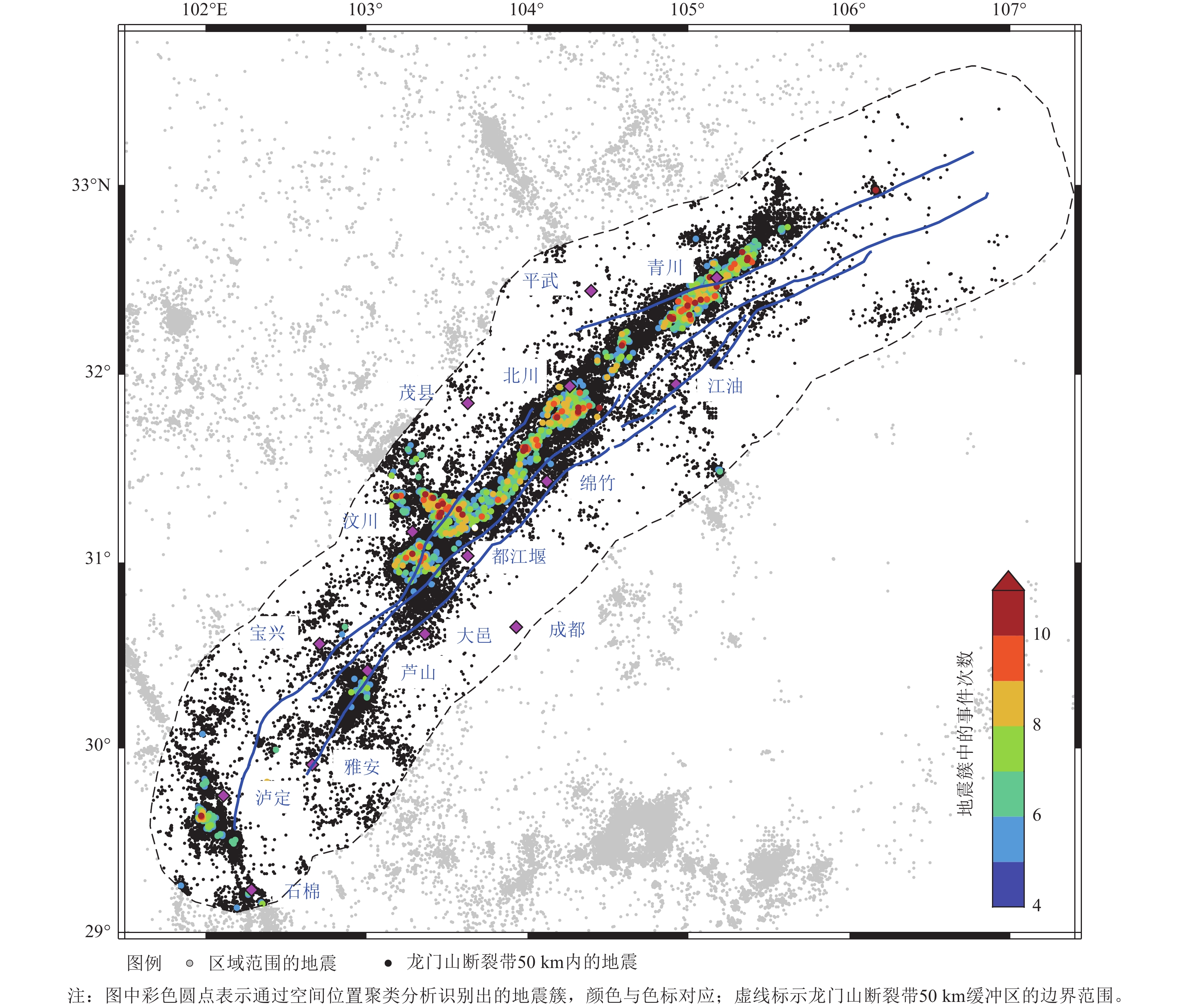
图 2 龙门山断裂带的地震重定位和空间聚类
Figure 2. Earthquake relocation and cluster analysis along the longmenshan fault zone (LMSFZ)
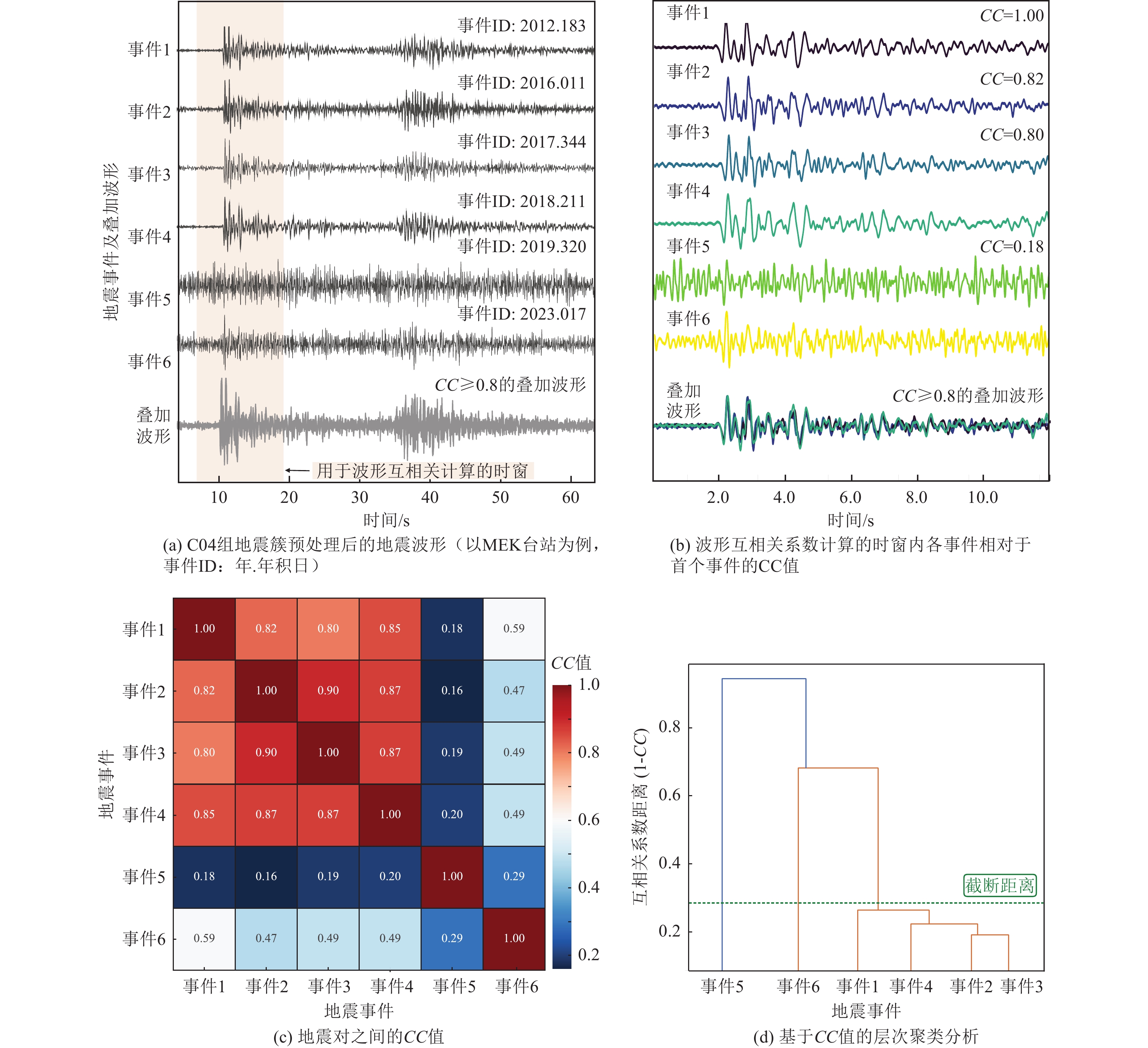
图 3 一组“相似地震”检测流程示例
Figure 3. Detection and analysis workflow for a group of similar earthquakes
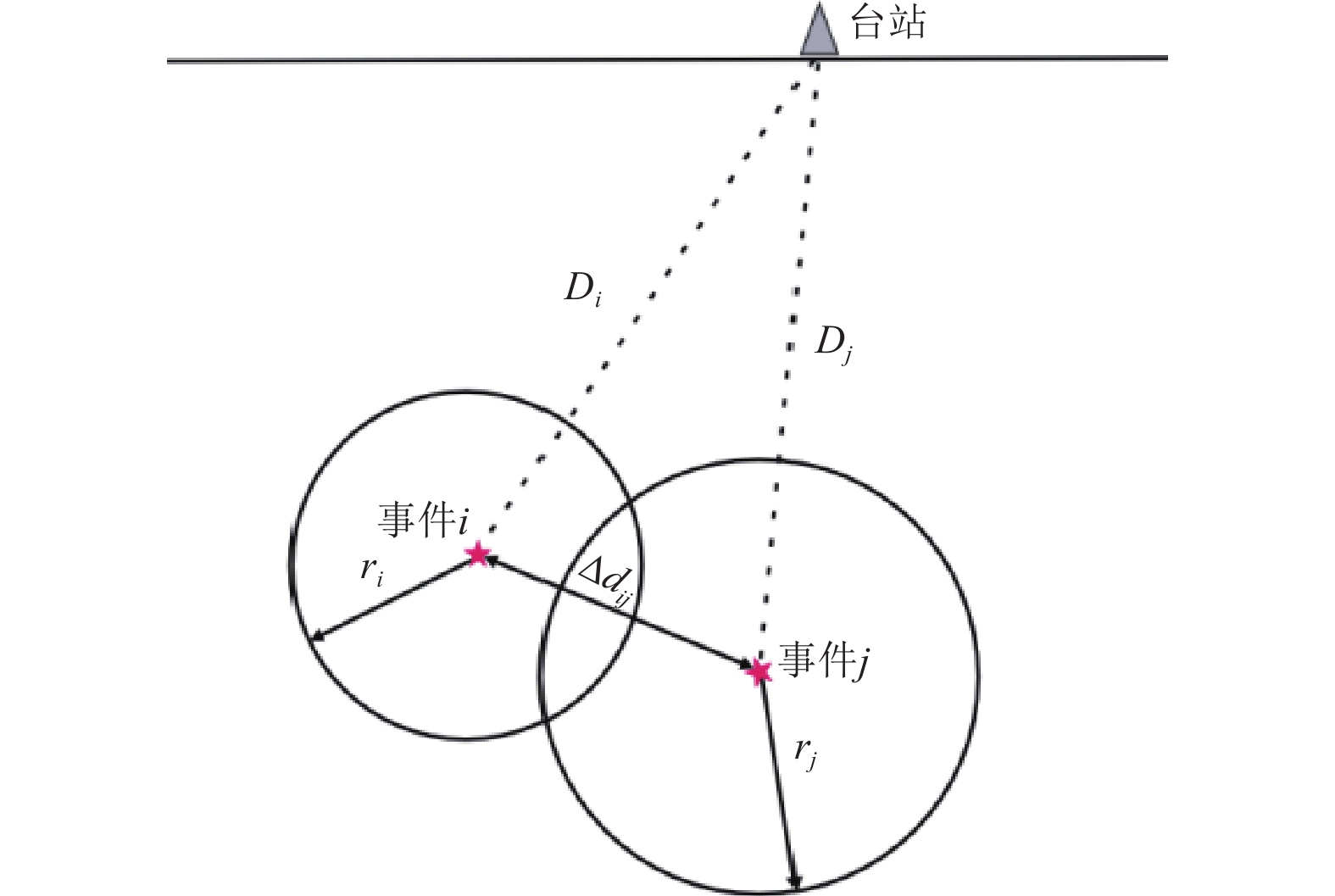
图 4 地震对的相对距离和地震破裂半径的重叠状态判定示意图改自(Li等,2011)
Figure 4. Schematic diagram for determining overlapping states based on the relative distance and rupture radius of earthquake pairs (modified from Li et al., 2011)
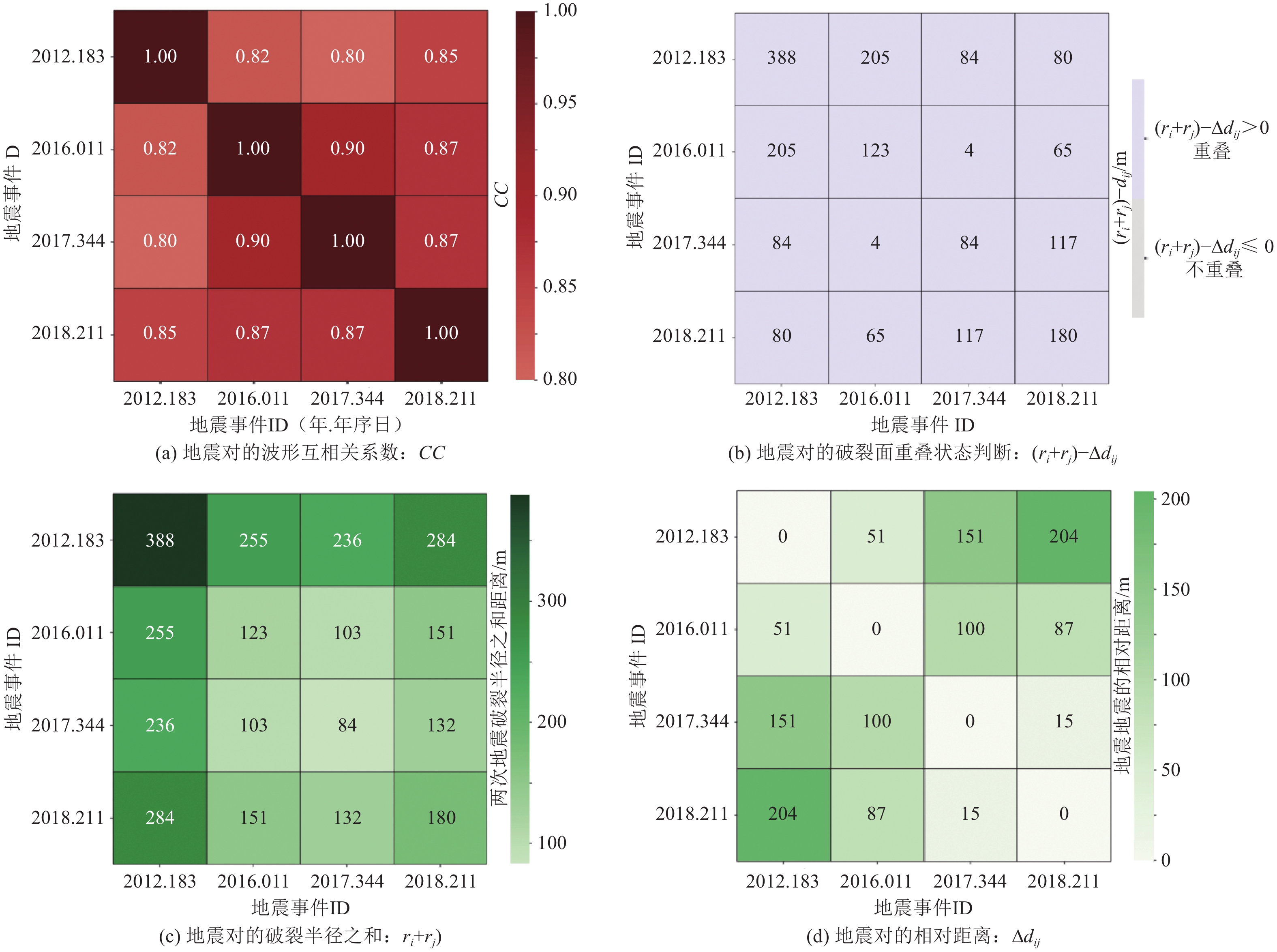
图 5 CC值与破裂面重叠状态联合确认的重复地震示例
Figure 5. Example of repeating earthquakes identified by waveform cross-correlation and rupture plane overlap analysis
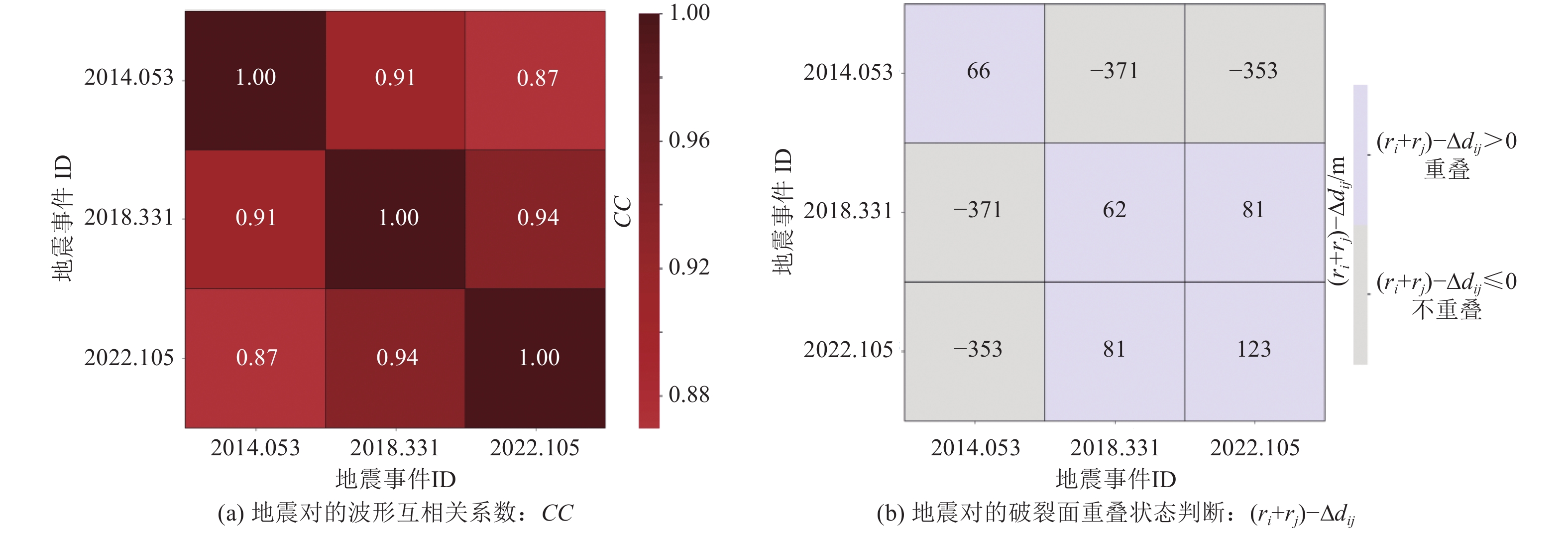
图 6 因破裂面不重叠而被排除的重复地震案例
Figure 6. Case of excluded repeating earthquakes due to rupture plane non-overlap
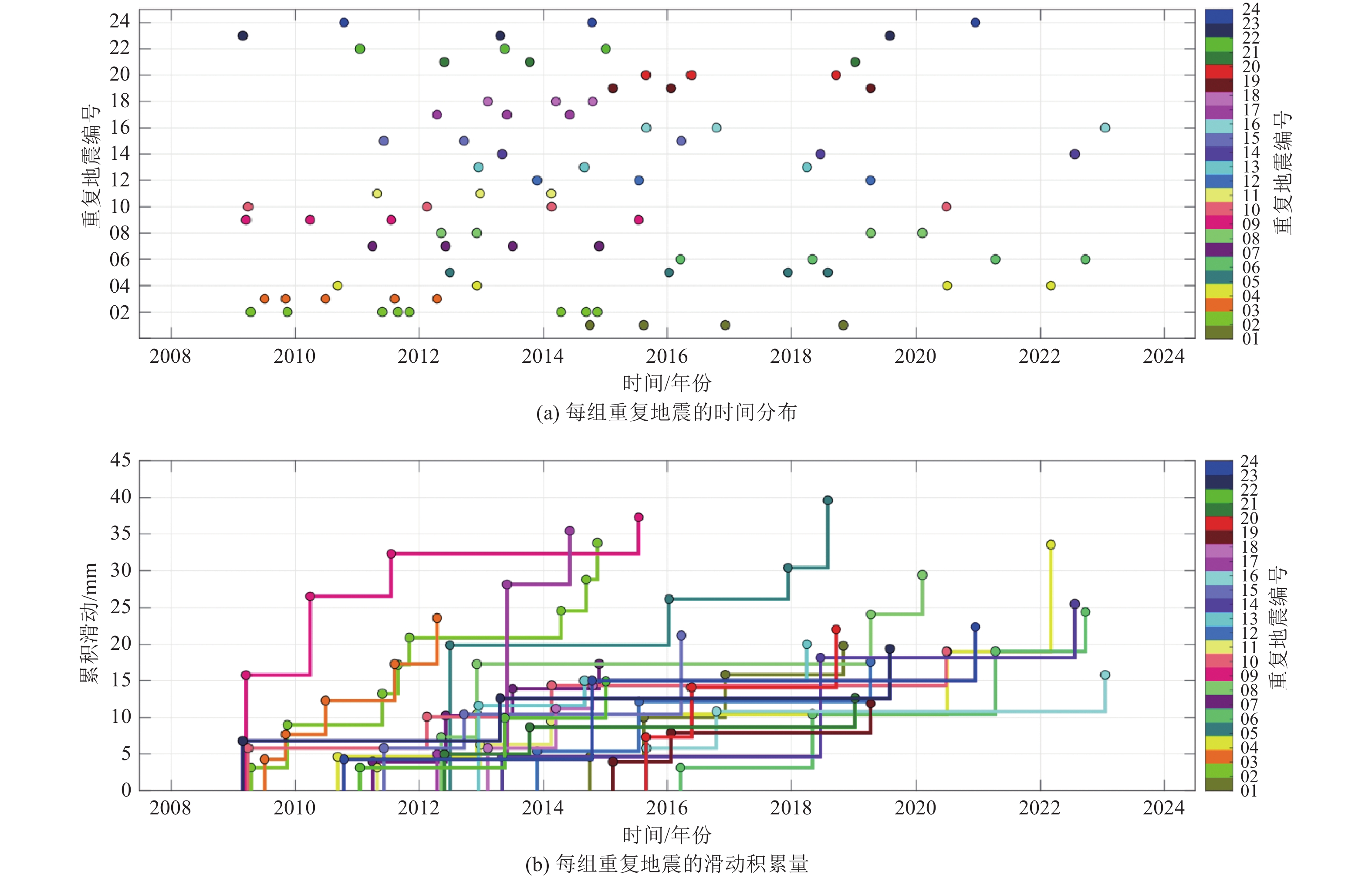
图 7 每组重复地震的时间分布和滑动积累量
Figure 7. Repeating Earthquake Clusters:Temporal distribution and cumulative slip
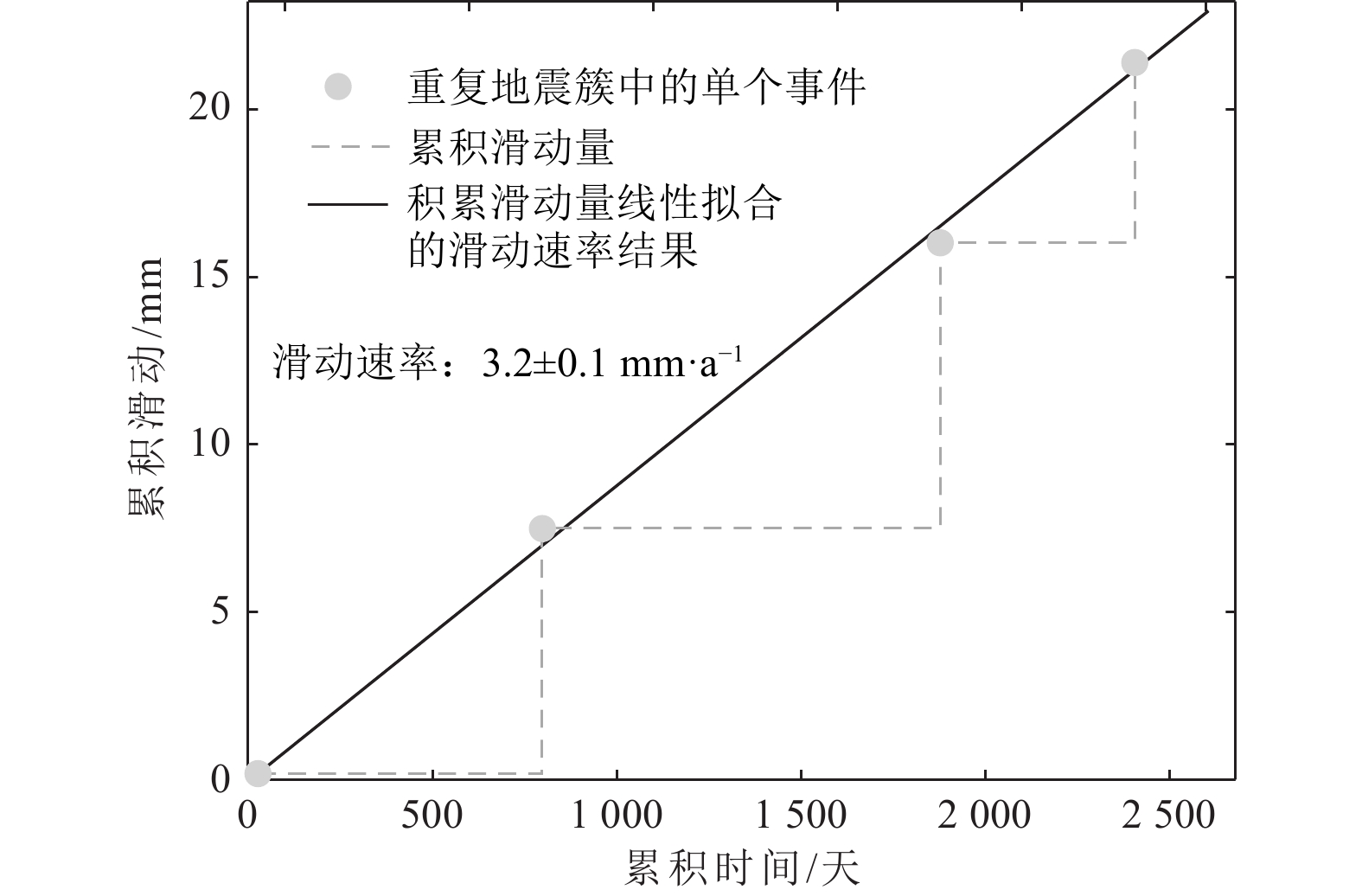
图 8 第C07组重复地震序列累积滑动量及滑动速率拟合结果
Figure 8. Cumulative slip and fitted slip rate of the C07 repeating earthquake cluster
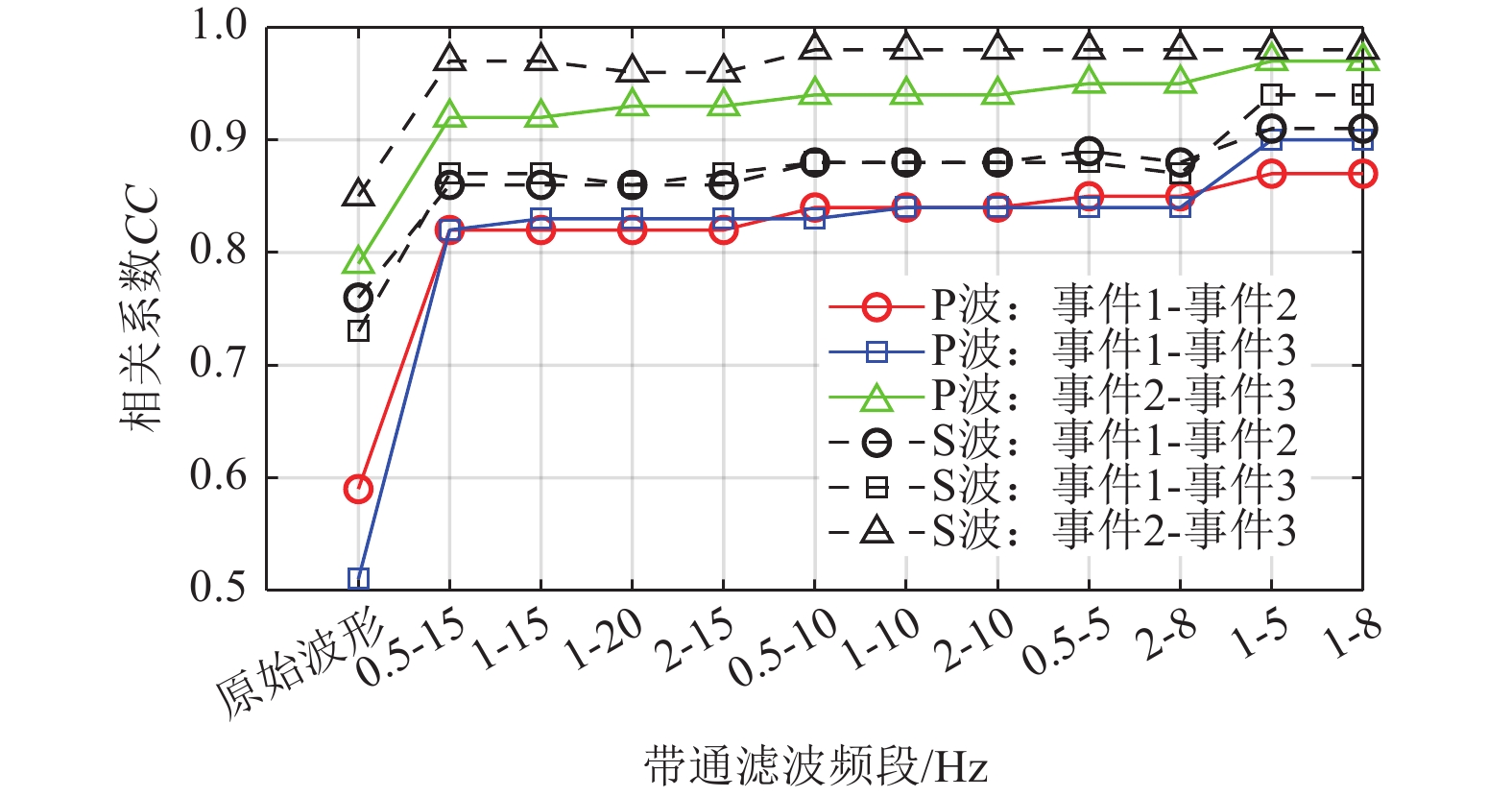
图 9 滤波频带对地震对之间CC值的影响测试
Figure 9. Testing the influence of filter bands on cross-correlation coefficients of earthquake pairs
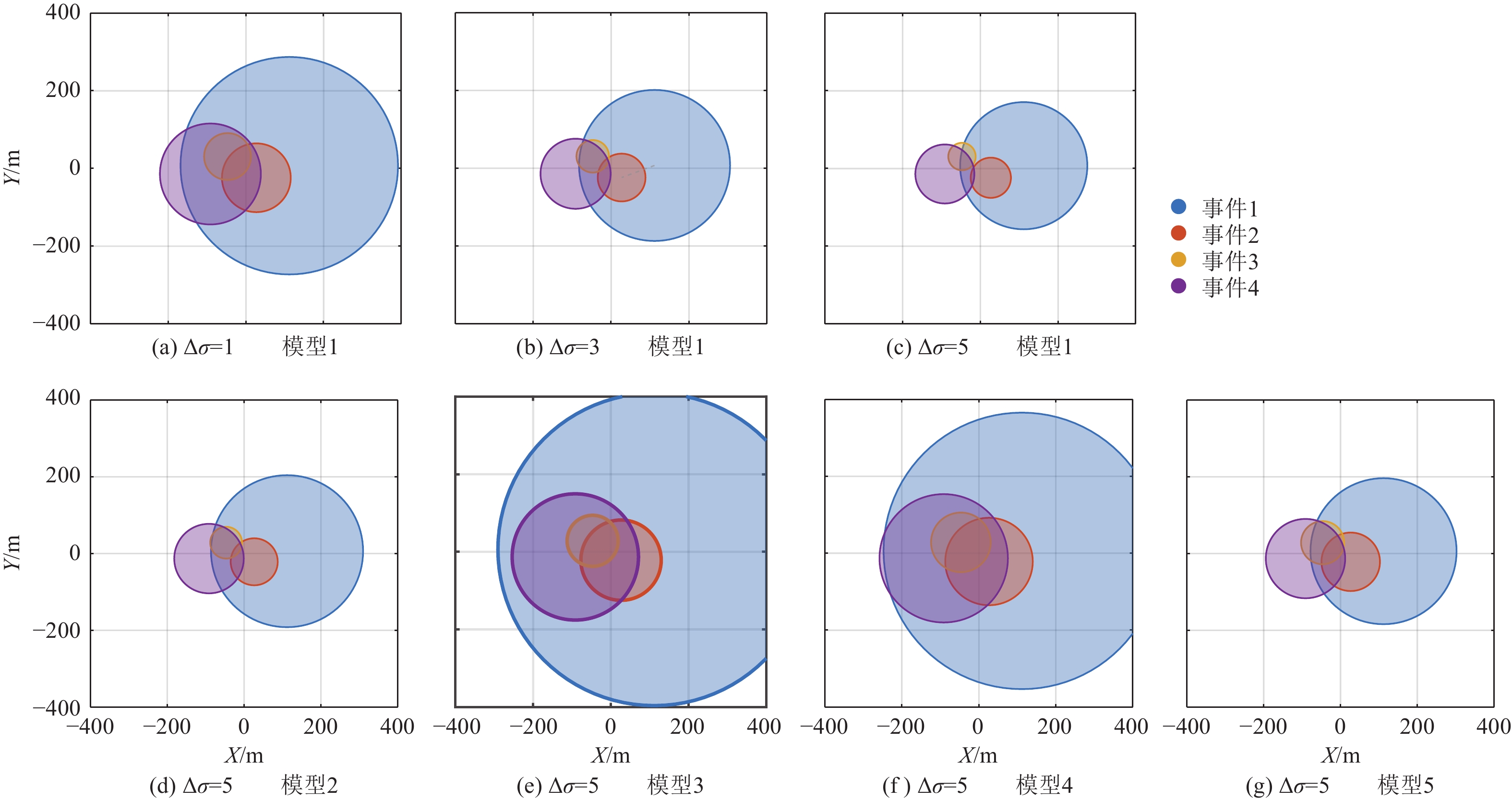
图 10 C04组重复地震在3种不同Δσ及5种不同M0计算模型下的破裂半径及破裂面交叠状态
Figure 10. Rupture area overlap of cluster C04 repeating earthquakes under three different Δσ values and five different M0 models
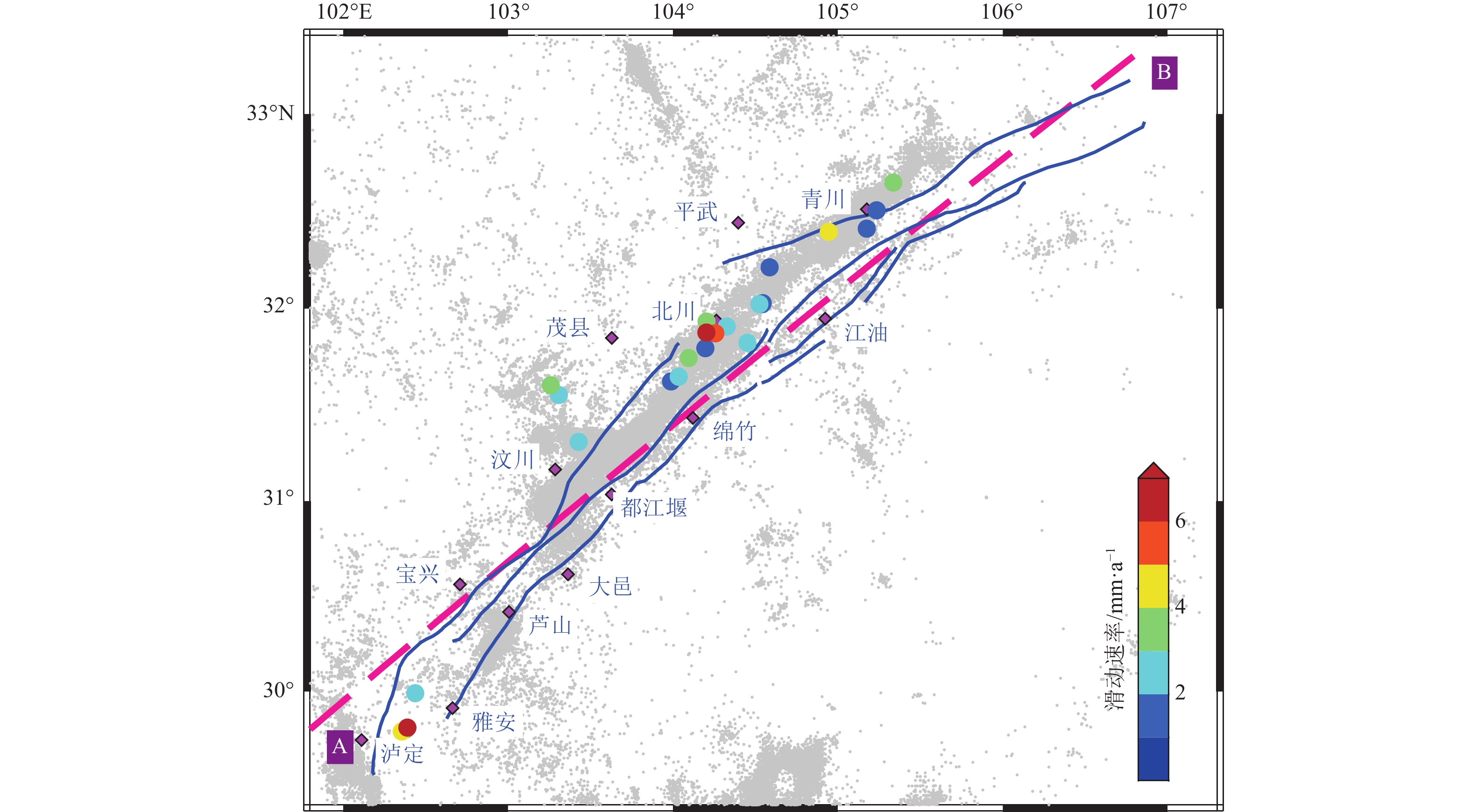
图 11 重复地震及滑动速率的沿龙门山断裂带的水平分布图
Figure 11. Along-strike distribution of repeating earthquake clusters and slip rates in the LMSFZ
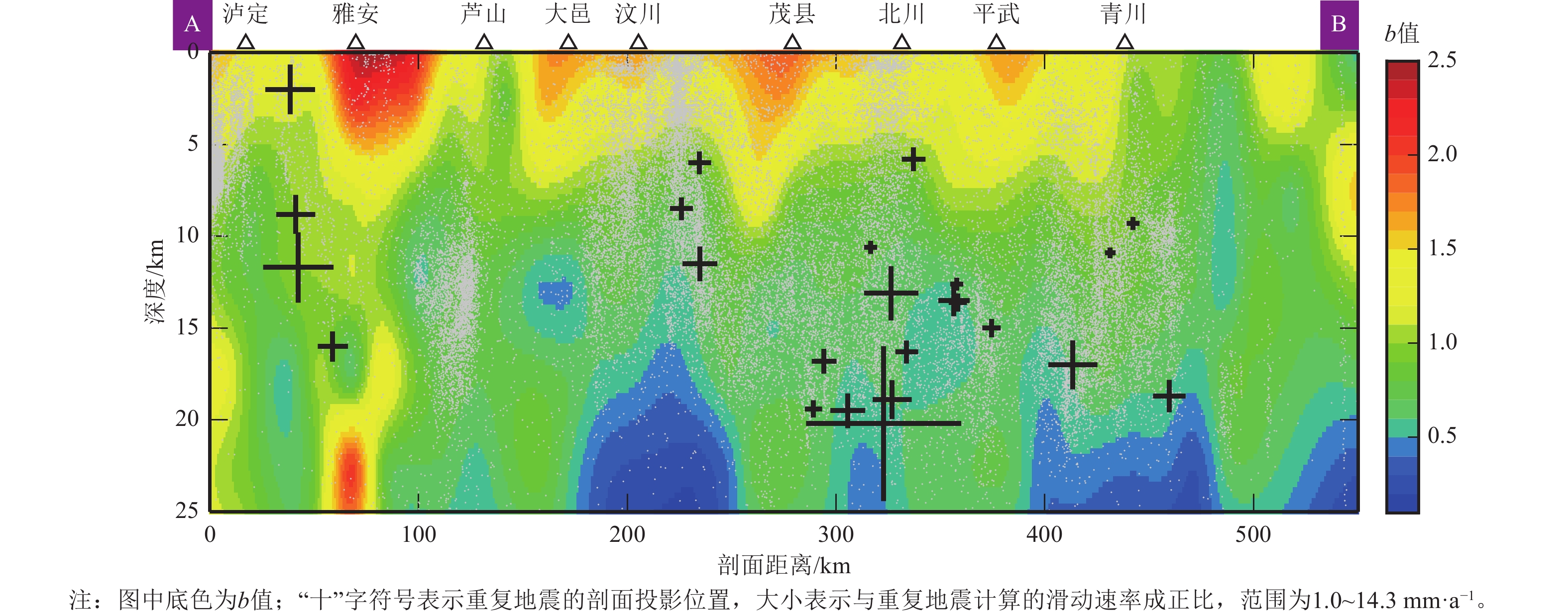
图 12 重复地震及滑动速率的沿断裂带的垂直分布
Figure 12. Vertical distribution of repeating earthquakes and slip rates along the LMSFZ
表 1 定位所使用的一维速度模型
Table 1. Velocity models used in relocation
界面深度/km 0.0 2.5 5.0 7.5 10.0 15.0 20.0 25.0 30.0 35.0 40.0 P波速度/(km∙s−1) 5.29 5.33 5.47 5.68 5.84 5.99 6.12 6.33 6.41 6.50 6.86  下载: 导出CSV
表 2 龙门山断裂带识别到的24组重复地震及对应的深部滑动速率
Table 2. 24 repeating earthquake clusters with deep slip rates in Longmen Shan Fault Zone
序号 含地震数 纬度/(°) 经度/(°) 深度 /km 震级范围 复发间隔/年 滑动速率/(mm∙a−1) 滑动积累量/mm 持续时间/年 C01 8 29.789 102.356 2.0 1.5~2.3 0.3~2.4 4.6 ± 0.5 33.8 5.58 C02 4 29.800 102.382 8.8 1.8~2.3 0.9~1.9 3.6 ± 0.6 19.8 4.09 C03 5 29.809 102.390 11.7 1.6~2.4 0.3~1.1 6.5 ± 0.5 23.6 2.79 C04 4 29.991 102.437 16.0 1.9~3.9 0.6~3.5 2.8 ± 0.9 39.6 6.08 C05 3 31.309 103.428 8.5 2.2~2.5 1.6~3.7 2.1 ± 0.6 17.5 5.37 C06 4 31.552 103.309 6.0 2.0~3.5 1.7~7.6 2.1 ± 0.6 33.6 11.48 C07 4 31.603 103.259 11.5 1.5~2.8 1.4~3.0 3.2 ± 0.1 24.4 6.52 C08 3 31.623 103.989 19.4 1.6~3.2 1.7~3.6 1.6 ± 0.1 20.0 5.29 C09 3 31.647 104.035 16.8 2.0~3.4 4.1~5.1 2.3 ± 0.2 25.5 9.23 C10 3 31.744 104.096 19.5 2.0~3.1 1.3~3.5 3.2 ± 0.1 21.2 4.81 C11 3 31.795 104.197 10.6 2.1~2.3 1.1~6.3 1.2 ± 0.5 15.8 7.40 C12 3 31.823 104.452 5.8 1.5 1.2~1.7 2.2 ± 0.2 9.4 2.81 C13 3 31.872 104.257 13.1 1.5~2.3 0.6~1.1 5.0 ± 0.1 14.3 1.69 C14 3 31.876 104.203 20.2 2.1~4.1 1.0~1.1 14.3 ± 3.9 35.4 2.14 C15 4 31.907 104.326 16.3 2.2~3.0 0.6~6.4 2.1 ± 0.7 29.4 7.74 C16 4 31.933 104.204 18.9 1.6~2.4 1.1~1.4 3.6 ± 0.5 17.3 3.65 C17 4 32.023 104.524 13.5 2.1~3.6 1.0~4.0 2.9 ± 1.1 37.3 6.32 C18 3 32.023 104.541 12.6 2.3~2.5 4.1~6.3 1.2 ± 0.1 19.4 10.42 C19 3 32.028 104.544 13.6 1.9~3.1 4.0~6.2 1.7 ± 0.4 22.3 10.17 C20 3 32.213 104.586 15.0 1.8~1.8 0.9~3.2 1.7 ± 0.5 11.9 4.16 C21 3 32.396 104.945 17.0 2.5~2.7 0.7~2.3 4.5 ± 1.1 22.0 3.06 C22 3 32.412 105.175 10.9 1.7~2.1 1.4~5.2 1.0 ± 0.3 12.6 6.62 C23 4 32.506 105.235 9.3 1.9~2.3 2.0~6.4 1.2 ± 0.2 19.0 11.25 C24 3 32.649 105.336 18.7 1.5~2.5 1.6~2.3 3.0 ± 0.0 14.9 3.96
下载: 导出CSV
-
白卓立, 张学刚, 薛二峰等, 2020. 基于GPS速度场的四川地区1999~2018年应变场特征演化分析. 地质科学, 55(4): 1315−1326.Bai Z. L., Zhang X. G., Xue E. F., et al., 2020. The characteristic evolution analysis of scale strain field in Sichuan area from 2001~2018 based on GPS velocity field. Chinese Journal of Geology, 55(4): 1315−1326. (in Chinese) 范军, 汪智, 陈银等, 2012. 四川地区震源参数和台站场地响应初步研究. 四川地震, (3): 1−8. doi: 10.3969/j.issn.1001-8115.2012.03.001Fan J., Wang Z., Chen Y., et al., 2012. Preliminary study on both earthquake source parameters and site responses of seismic stations in Sichuan Province. Earthquake Research in Sichuan, (3): 1−8. (in Chinese) doi: 10.3969/j.issn.1001-8115.2012.03.001 高朝军, 韩立波, 蒋长胜等, 2017. 博阿断裂西段重复地震识别及断层深部滑移速率研究. 地震学报, 39(3): 307−314. doi: 10.11939/jass.2017.03.001Gao C. J., Han L. B., Jiang C. S., et al., 2017. Repeating earthquake identification and deep slip rates for western Bolokenu-Aqikekuduke fault. Acta Seismologica Sinica, 39(3): 307−314. (in Chinese) doi: 10.11939/jass.2017.03.001 黄雅芬, 李红谊, 李炎臻等, 2025. 基于聚类的重复地震识别方法及应用. 地球与行星物理论评(中英文), 56(1): 94−101. doi: 10.19975/j.dqyxx.2024-020Huang Y. F., Li H. Y., Li Y. Z., et al., 2025. A clustering-based repeating earthquakes identification method and its application. Reviews of Geophysics and Planetary Physics, 56(1): 94−101. (in Chinese) doi: 10.19975/j.dqyxx.2024-020 蒋长胜, 吴忠良, 2005. 由“重复地震”给出的中国地震台网的定位精度估计. 中国地震, 21(2): 147−154. doi: 10.3969/j.issn.1001-4683.2005.02.002Jiang C. S., Wu Z. L., 2005. Estimating the location accuracy of the China national seismograph network using repeating events. Earthquake Research in China, 21(2): 147−154. (in Chinese) doi: 10.3969/j.issn.1001-4683.2005.02.002 李乐, 陈棋福, 钮凤林等, 2008. 利用“重复地震”估算丽江-宁蒗断裂带的深部滑动速率. 科学通报, 53(23): 2925−2932. doi: 10.3321/j.issn:0023-074X.2008.23.014Li L., Chen Q. F., Niu F. L., et al., 2009. Slip rate along the Lijiang-Ninglang fault zone estimated from repeating microearthquakes. Chinese Science Bulletin, 54(3): 447−455. (in Chinese) doi: 10.3321/j.issn:0023-074X.2008.23.014 李乐, 陈棋福, 钮凤林等, 2015. 鲜水河断裂带南段深部变形的重复地震研究. 地球物理学报, 58(11): 4138−4148. doi: 10.6038/cjg20151121Li L., Chen Q. F., Niu F. L., et al., 2015. Quantitative study of the deep deformation along the southern segment of the Xianshuihe fault zone using repeating microearthquakes. Chinese Journal of Geophysics, 58(11): 4138−4148. (in Chinese) doi: 10.6038/cjg20151121 李乐, 陈棋福, 钮凤林, 2021. 基于重复地震研究川滇地区主要断裂带的深部变形. 地球物理学报, 64(12): 4308−4326. doi: 10.6038/cjg2021O0516Li L., Chen Q. F., Niu F. L., 2021. Repeating microearthquakes and deep deformation along the major faults in the Sichuan-Yunnan region, China. Chinese Journal of Geophysics, 64(12): 4308−4326. (in Chinese) doi: 10.6038/cjg2021O0516 李彤霞, 钱蕊, 付聪等, 2017. 利用重复地震研究盖州震群地区介质变化. 防灾减灾学报, 33(3): 1−4. doi: 10.13693/j.cnki.cn21-1573.2017.03.001Li T. X., Qian R., Fu C., et al., 2017. Monitoring crustal media variation in Gaizhou Area of Liaoning Province by using recurrent earthquakes. Journal of Disaster Prevention and Reduction, 33(3): 1−4. (in Chinese) doi: 10.13693/j.cnki.cn21-1573.2017.03.001 李智武, 刘树根, 陈洪德等, 2008. 龙门山冲断带分段-分带性构造格局及其差异变形特征. 成都理工大学学报(自然科学版), 35(4): 440−454. doi: 10.3969/j.issn.1671-9727.2008.04.014Li Z. W., Liu S. G., Chen H. D., et al., 2008. Structural segmentation and zonation and differential deformation across and along the Lomgmen thrust belt, west Sichuan, China. Journal of Chengdu University of Technology (Science & Technology Edition), 35(4): 440−454. (in Chinese) doi: 10.3969/j.issn.1671-9727.2008.04.014 刘影, 于子叶, 张智奇等, 2023. 基于密集流动台阵构建的川滇地区高分辨率公共速度模型2.0版本. 中国科学: 地球科学, 53(10): 2407−2424.Liu Y. , Yu Z. Y. , Zhang Z. Q. , et al. , 2023. The high-resolution community velocity model V2.0 of Southwest China, constructed by joint body and surface wave tomography of data recorded at temporary dense arrays. Science China Earth Sciences, 66(10): 2368−2385. (in Chinese) 马保起, 苏刚, 侯治华等, 2005. 利用岷江阶地的变形估算龙门山断裂带中段晚第四纪滑动速率. 地震地质, 27(2): 234−242. doi: 10.3969/j.issn.0253-4967.2005.02.006Ma B. Q., Su G., Hou Z. H., et al., 2005. Late Quaternary slip rate in the central part of the Longmenshan Fault zone from terrace deformation along the Minjiang River. Seismology and Geology, 27(2): 234−242. (in Chinese) doi: 10.3969/j.issn.0253-4967.2005.02.006 秦宇龙, 毛泽斌, 詹涵钰等, 2023. 茂县-汶川断裂汶川段全新世活动证据. 震灾防御技术, 18(4): 673−682. doi: 10.11899/zzfy20230402Qin Y. L., Mao Z. B., Zhan H. Y., et al., 2023. Evidence of the Holocene seismic activity of the Wenchuan segment of the Maoxian-Wenchuan Fault. Technology for Earthquake Disaster Prevention, 18(4): 673−682. (in Chinese) doi: 10.11899/zzfy20230402 史克旭, 周聪, 张佩等, 2023. 利用重复地震研究安宁河断裂带及周边地区深部滑动速率. 地震学报, 45(4): 658−670. doi: 10.11939/jass.20220025Shi K. X., Zhou C., Zhang P., et al., 2023. Deep slip rates in the Anninghe fault and its surrounding regions according to repeating earthquakes. Acta Seismologica Sinica, 45(4): 658−670. (in Chinese) doi: 10.11939/jass.20220025 孙庆山, 李乐, 2020. 利用重复微震估算红河断裂带北段深部滑动速率. 地球物理学报, 63(2): 478−491. doi: 10.6038/cjg2020N0026Sun Q. S., Li L., 2020. Deep slip rates along the northern segment of the Red River fault zone estimated from repeating microearthquakes. Chinese Journal of Geophysics, 63(2): 478−491. (in Chinese) doi: 10.6038/cjg2020N0026 王光明, 姜金钟, 郑定昌等, 2025. 基于重复地震估算石屏−建水断裂带深部滑动速率. 地球物理学报, 68(2): 547−563. doi: 10.6038/cjg2024R0670Wang G. M., Jiang J. Z., Zheng D. C., et al., 2025. Deep slip rates along the Shiping-Jianshui fault zone estimated from repeating earthquakes. Chinese Journal of Geophysics, 68(2): 547−563. (in Chinese) doi: 10.6038/cjg2024R0670 王毛毛, 贾东, 李一泉等, 2010. 龙门山褶皱冲断带南北分段性与汶川地震的关系. 第四纪研究, 30(4): 711−720. doi: 10.3969/j.issn.1001-7410.2010.04.07Wang M. M., Jia D., Li Y. Q., et al., 2010. Segmentation of the Longmenshan fold- and thrust- belt and its relationship with the Wenchuan MS8.0 earthquake. Quaternary Sciences, 30(4): 711−720. (in Chinese) doi: 10.3969/j.issn.1001-7410.2010.04.07 王伟涛, 王宝善, 2011. 重复地震研究综述. 西北地震学报, 33(3): 305−311. doi: 10.3969/j.issn.1000-0844.2011.03.020Wang W. T., Wang B. S., 2011. Review on study of repeating earthquake. Northwestern Seismological Journal, 33(3): 305−311. (in Chinese) doi: 10.3969/j.issn.1000-0844.2011.03.020 徐锡伟, 张培震, 闻学泽等, 2005. 川西及其邻近地区活动构造基本特征与强震复发模型. 地震地质, 27(3): 446−461. doi: 10.3969/j.issn.0253-4967.2005.03.010Xu X. W., Zhang P. Z., Wen X. Z., et al., 2005. Features of active tectonics and recurrence behaviors of strong earthquakes in the western Sichuan Province and its adjacent regions. Seismology and Geology, 27(3): 446−461. (in Chinese) doi: 10.3969/j.issn.0253-4967.2005.03.010 叶庆东, 王生文, 余大新等, 2017. 龙门山断裂带科学钻探3号井孔附近微震近震震级与矩震级的关系及意义. 中国地震, 33(3): 385−395. doi: 10.3969/j.issn.1001-4683.2017.03.004Ye Q. D., Wang S. W., Yu D. X., et al., 2017. The relationship between local magnitude and moment magnitude of microearthquakes near the third bore hole of the Wenchuan earthquake fault scientific drilling(WFSD-3) and its implications. Earthquake Research in China, 33(3): 385−395. (in Chinese) doi: 10.3969/j.issn.1001-4683.2017.03.004 张培震, 徐锡伟, 闻学泽等, 2008. 2008年汶川8.0级地震发震断裂的滑动速率、复发周期和构造成因. 地球物理学报, 51(4): 1066−1073. doi: 10.3321/j.issn:0001-5733.2008.04.015Zhang P. Z., Xu X. W., Wen X. Z., et al., 2008. Slip rates and recurrence intervals of the Longmen Shan active fault zone, and tectonic implications for the mechanism of the May 12 Wenchuan earthquake, 2008, Sichuan, China. Chinese Journal of Geophysics, 51(4): 1066−1073. (in Chinese) doi: 10.3321/j.issn:0001-5733.2008.04.015 赵翠萍, 陈章立, 华卫等, 2011. 中国大陆主要地震活动区中小地震震源参数研究. 地球物理学报, 54(6): 1478−1489.Zhao C. P., Chen Z. L., Hua W., et al., 2011. Study on source parameters of small to moderate earthquakes in the main seismic active regions, China mainland. Chinese Journal of Geophysics, 54(6): 1478−1489. (in Chinese) 赵静, 刘杰, 任金卫等, 2019. 汶川、芦山地震前龙门山断裂带地壳形变特征对比分析. 地球学报, 40(1): 186−198. doi: 10.3975/cagsb.2018.110201Zhao J., Liu J., Ren J. W., et al., 2019. A contrastive analysis of crustal deformation characteristics along the Longmen Shan fault zone before the MS8.0 Wenchuan earthquake and the MS7.0 Lushan earthquake. Acta Geoscientica Sinica, 40(1): 186−198. (in Chinese) doi: 10.3975/cagsb.2018.110201 赵小麟, 邓起东, 陈社发, 1994. 龙门山逆断裂带中段的构造地貌学研究. 地震地质, 16(4): 422−428.Zhao X. L., Deng Q. D., Chen S. F., 1994. Tectonic geomorphology of the central segment of the Longmenshan thrust belt, western Sichuan, Southwestern China. Seismology and Geology, 16(4): 422−428. (in Chinese) 周龙泉, 刘桂萍, 马宏生等, 2007. 利用重复地震观测地壳介质变化. 地震, 27(3): 1−9. doi: 10.3969/j.issn.1000-3274.2007.03.001Zhou L. Q., Liu G. P., Ma H. S., et al., 2007. Monitoring crustal media variation by using repeating earthquakes. Earthquake, 27(3): 1−9. (in Chinese) doi: 10.3969/j.issn.1000-3274.2007.03.001 周水庚, 周傲英, 曹晶等, 2000. 一种基于密度的快速聚类算法. 计算机研究与发展, 37(11): 1287−1292.Zhou S. G., Zhou A. Y., Cao J., et al., 2000. A fast density-based clustering algorithm. Journal of Computer Research and Development, 37(11): 1287−1292. (in Chinese) 周永胜, 韩亮, 靖晨等, 2014. 龙门山断层脆-塑性转化带流变结构与汶川地震孕震机制. 地震地质, 36(3): 882−895. doi: 10.3969/j.issn.0253-4967.2014.03.025Zhou Y. S., Han L., Jing C., et al., 2014. The rheological structures of brittle-plastic transition in Longmenshan fault zone and seismogenic mechanism of Wenchuan earthquake. Seismology and Geology, 36(3): 882−895. (in Chinese) doi: 10.3969/j.issn.0253-4967.2014.03.025 Abercrombie R. E., 1995. Earthquake source scaling relationships from −1 to 5 ML using seismograms recorded at 2.5-km depth. Journal of Geophysical Research: Solid Earth, 100(B12): 24015−24036. doi: 10.1029/95JB02397 Beyreuther M., Barsch R., Krischer L., et al., 2010. ObsPy: a python toolbox for seismology. Seismological Research Letters, 81(3): 530−533. doi: 10.1785/gssrl.81.3.530 Chai X. C., Zhang P., Wang C., et al., 2022. Data quality analysis of China permanent seismic network by repeating earthquakes. Seismological Research Letters, 93(4): 2063−2076. doi: 10.1785/0220210303 Deng Y. F., Peng Z. G., Liu‐Zeng J., 2020. Systematic search for repeating earthquakes along the Haiyuan fault system in northeastern Tibet. Journal of Geophysical Research: Solid Earth, 125(7): e2020JB019583. doi: 10.1029/2020JB019583 Densmore A. L., Ellis M. A., Li Y., et al., 2007. Active tectonics of the Beichuan and Pengguan faults at the eastern margin of the Tibetan Plateau. Tectonics, 26(4): TC4005. doi: 10.1029/2006tc001987 Gao D. W., Kao H., Wang B., 2021. Misconception of waveform similarity in the identification of repeating earthquakes. Geophysical Research Letters, 48(13): e2021GL092815. doi: 10.1029/2021GL092815 Hanks T. C., Kanamori H., 1979. A moment magnitude scale. Journal of Geophysical Research: Solid Earth, 84(B5): 2348−2350. doi: 10.1029/JB084iB05p02348 Ji C. , 2008. Preliminary result of the May 12, 2008 MW 7.97 Sichuan earthquake. [2025-06-15]. https://ji.faculty.geol.ucsb.edu/big_earthquakes/2008/05/12/ShiChuan.html. Jin W. Z., Tang L. J., Yang K. M., et al., 2010. Segmentation of the Longmen mountains thrust belt, western Sichuan foreland basin, SW China. Tectonophysics, 485(1-4): 107−121. doi: 10.1016/j.tecto.2009.12.007 Kanamori H., Anderson D. L., 1975. Theoretical basis of some empirical relations in seismology. Bulletin of the Seismological Society of America, 65(5): 1073−1095. Li L., Chen Q. F., Cheng X., et al., 2007. Spatial clustering and repeating of seismic events observed along the 1976 Tangshan fault, North China. Geophysical Research Letters, 34(23): L23309. Li L., Chen Q. F., Niu F. L., et al., 2011. Deep slip rates along the Longmen Shan fault zone estimated from repeating microearthquakes. Journal of Geophysical Research: Solid Earth, 116(B9): B09310. Ma X. J. , Wu Z. L. , Jiang C. S. , 2014. ‘Repeating earthquakes’ associated with the WFSD-1 drilling site. Tectonophysics, 619−620: 44−50. Munafò I., Malagnini L., Chiaraluce L., 2016. On the relationship between MW and ML for small earthquakes. Bulletin of the Seismological Society of America, 106(5): 2402−2408. doi: 10.5194/egusphere-egu2020-18821 Nadeau R. M., Foxall W., McEvilly T. V., 1995. Clustering and periodic recurrence of microearthquakes on the San Andreas fault at Parkfield, California. Science, 267(5197): 503−507. doi: 10.1126/science.267.5197.503 Nadeau R. M., Johnson L. R., 1998. Seismological studies at Parkfield VI: moment release rates and estimates of source parameters for small repeating earthquakes. Bulletin of the Seismological Society of America, 88(3): 790−814. doi: 10.1785/BSSA0880030790 Niu F. L., Silver P. G., Nadeau R. M., et al., 2003. Migration of seismic scatterers associated with the 1993 parkfield aseismic transient event. Nature, 426(6966): 544−548. doi: 10.1038/nature02151 Peng Z. G., Ben-Zion Y., 2005. Spatiotemporal variations of crustal anisotropy from similar events in aftershocks of the 1999 M7.4 Izmit and M7.1 Düzce, Turkey, earthquake sequences. Geophysical Journal International, 160(3): 1027−1043. doi: 10.1111/j.1365-246X.2005.02569.x Rubin A. M., 2002. Using repeating earthquakes to correct high-precision earthquake catalogs for time-dependent station delays. Bulletin of the Seismological Society of America, 92(5): 1647−1659. doi: 10.1785/0120010180 Schaff D. P., Beroza G. C., Shaw B. E., 1998. Postseismic response of repeating aftershocks. Geophysical Research Letters, 25(24): 4549−4552. doi: 10.1029/1998GL900192 Schaff D. P., Richards P. G., 2011. On finding and using repeating seismic events in and near China. Journal of Geophysical Research: Solid Earth, 116(B3): B03309. Schmittbuhl J., Karabulut H., Lengliné O., et al., 2016. Long‐lasting seismic repeaters in the central basin of the Main Marmara fault. Geophysical Research Letters, 43(18): 9527−9534. doi: 10.1002/2016GL070505 Shen Z. K., Sun J. B., Zhang P. Z., et al., 2009. Slip maxima at fault junctions and rupturing of barriers during the 2008 Wenchuan earthquake. Nature Geoscience, 2(10): 718−724. doi: 10.1038/ngeo636 Stein S. , Wysession M. , 2003. An introduction to seismology, earthquakes and earth structure. Malden: Blackwell Publishing, 430−436. Turner R. C., Nadeau R. M., Bürgmann R., 2013. Aseismic slip and fault interaction from repeating earthquakes in the Loma Prieta aftershock zone. Geophysical Research Letters, 40(6): 1079−1083. doi: 10.1002/grl.50212 Uchida N., 2019. Detection of repeating earthquakes and their application in characterizing slow fault slip. Progress in Earth and Planetary Science, 6(1): 40. doi: 10.1186/s40645-019-0284-z Vidale J. E., ElIsworth W. L., Cole A., et al., 1994. Variations in rupture process with recurrence interval in a repeated small earthquake. Nature, 368(6472): 624−626. doi: 10.1038/368624a0 Waldhauser F., Ellsworth W. L., 2000. A double-difference earthquake location algorithm: method and application to the northern Hayward fault, California. Bulletin of the Seismological Society of America, 90(6): 1353−1368. doi: 10.1785/0120000006 Zhang L., Su J., Wang W. L., et al., 2022. Deep fault slip characteristics in the Xianshuihe-Anninghe-Daliangshan fault junction region (eastern Tibet) revealed by repeating micro-earthquakes. Journal of Asian Earth Sciences, 227: 105115. doi: 10.1016/j.jseaes.2022.105115 Zhou Y., Xu L. S., Wu J. P., et al., 2022. Seismicity of the repeating earthquake clusters in the northern Xiaojiang fault zone and its implications. Frontiers in Earth Science, 10: 917635. doi: 10.3389/feart.2022.917635 -

 点击查看大图
计量
- 文章访问数: 2
- HTML全文浏览量: 3
- PDF下载量: 0
- 被引次数: 0
