


Near-fault Ground Motion Synthesis and the Induced Seismic Response of RC Bridge Structures
-
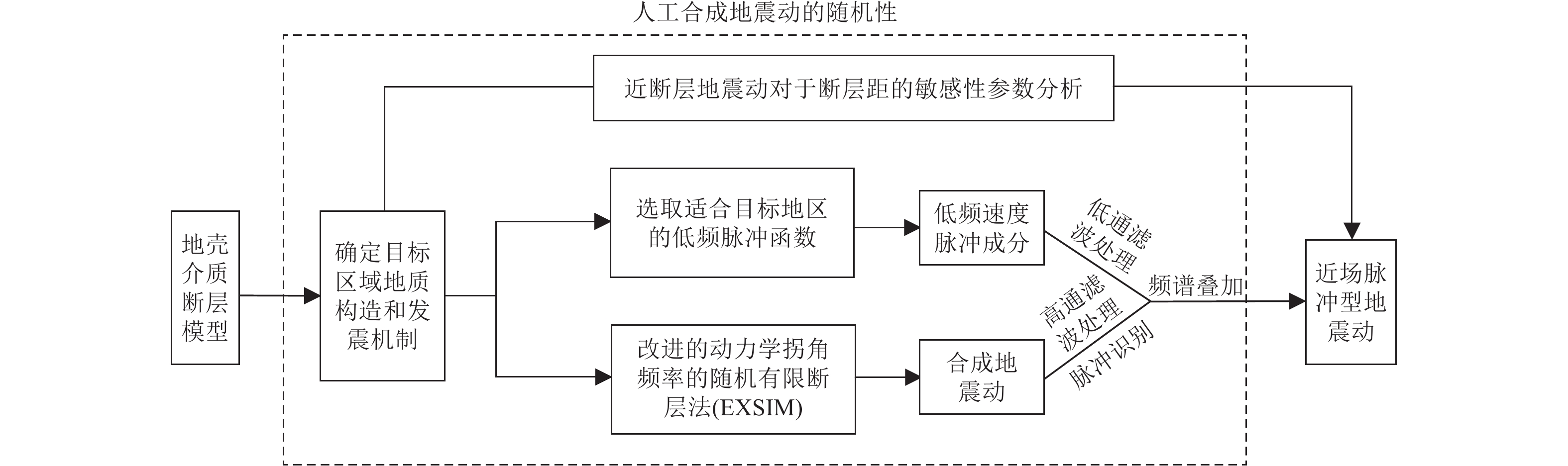
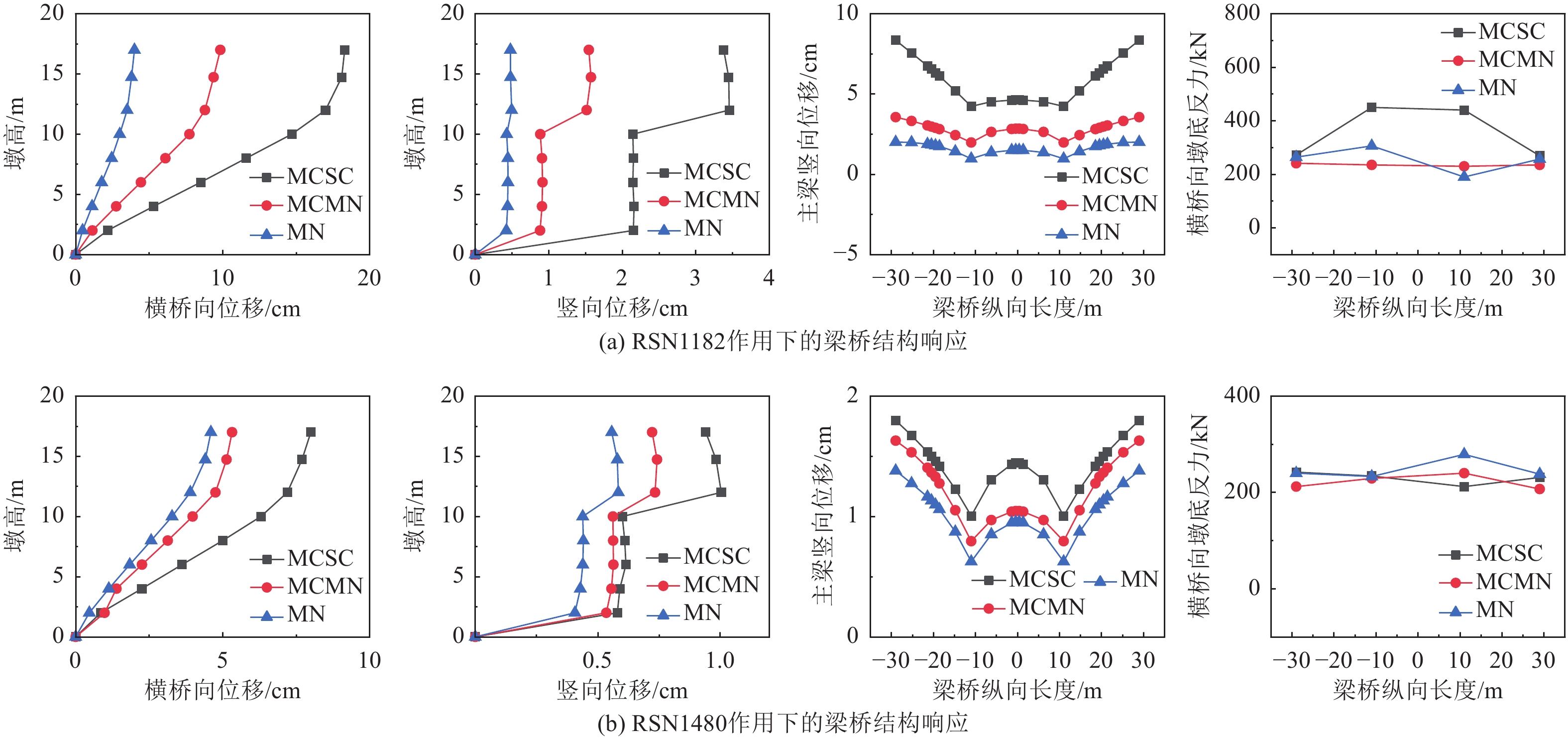
摘要: 基于四阶连续小波变换的脉冲识别方法分析近断层地震动速度脉冲特性,利用分解-叠加法纳入方向性效应脉冲等低频速度脉冲成分,考虑断层距、断层类型、地震矩、震源深度、品质因子Q和高频衰减因子kappa等参数随机性,在动力学拐角频率随机有限断层法的基础上,融合近断层地震动的低频速度脉冲特性建立完整的近场脉冲型地震动模拟模型。在EXSIM方法基础上,引入速度脉冲叠加模型,综合考虑复杂断层破裂动力学过程、地震波传播路径非线性效应,以及近场区域地震动特有的低频速度脉冲特性,对近断层强地震动物理机制进行多维度表征。本文以1999年9月21日MW 7.6台湾集集地震为例,验证该方法的正确性。然后,将模拟近断层地震动和实测地震动记录分别输入RC梁桥有限元模型中进行结构动力响应分析,验证该方法在结构地震反应分析中的适用性。结果表明:以动力学拐角频率随机有限断层法为基础,所改进的近场脉冲型地震动模拟结果与实测记录匹配良好,能有效反映近断层地震作用下RC梁桥的破坏特性,可作为近断层桥梁抗震设计的参考。Abstract: The characteristics of near-fault ground motion velocity pulse are analyzed based on the pulse identification method of fourth-order continuous wavelet transform. The low-frequency velocity pulse components such as directional effect pulse are included by the factory-stacking method, and the randomness of fault distance, fault type, seismic moment, source depth, quality factor Q and high-frequency attenuation factor kappa are considered. Based on the dynamic corner frequency random finite fault method, a complete near-field pulse ground motion simulation model is established by integrating the low-frequency velocity pulse characteristics of near-fault ground motion. Building upon the EXSIM method, this approach incorporates a velocity pulse superposition model to holistically characterize near-fault strong ground motion mechanisms through multidimensional physical modeling. It integrates complex fault rupture dynamics, nonlinear seismic wave propagation effects, and near-field low-frequency velocity pulse characteristics.The Jiji earthquake (Mw7.6) on September 21, 1999 was taken as an example to verify the correctness of the proposed method. Then, the simulated near-fault ground motion and the measured ground motion records are input into the finite element model of RC beam bridge respectively to analyze the structural dynamic response, and the applicability of this method in structural seismic response analysis is verified. The results show that the improved near-field pulse ground motion simulation results on the basis of dynamic corner frequency random finite fault method match well with the measured records, and can effectively reflect the failure characteristics of RC beam Bridges under near-fault earthquake action, and can be used as a reference for seismic design of Bridges near fault.
-
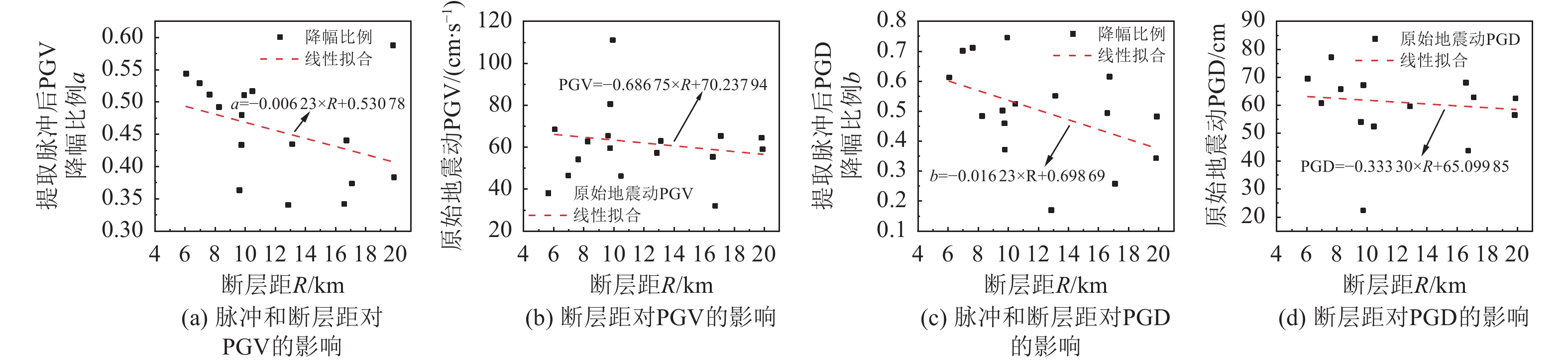
图 2 脉冲型近场地震动PGV、PGD随断层距变化规律
Figure 2. The variation of PGV and PGD of pulse- type ground motion with fault distance
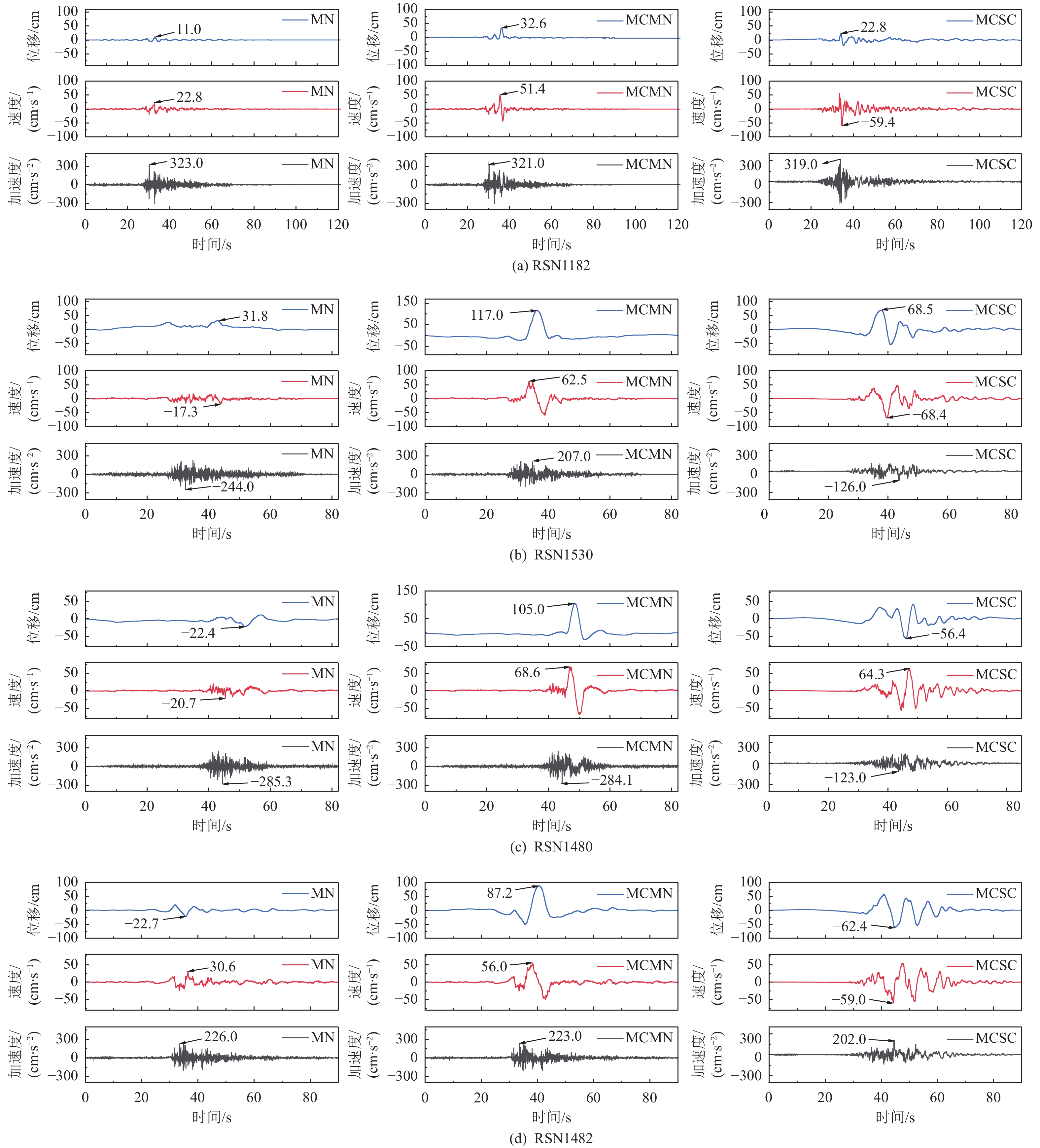
图 4 四种合成地震动与实测地震动时程曲线对比
Figure 4. Comparison between the four synthetic ground motions and the measured ground motions time history curve
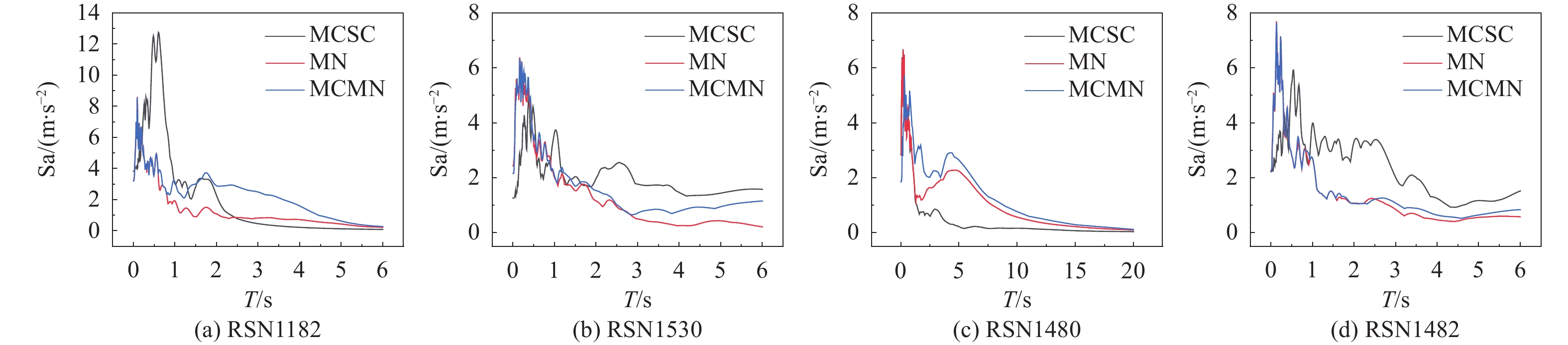
图 5 4组合成地震动与实测地震动频谱特性对比
Figure 5. Comparison of four sets of synthetic ground motions with recorded ground motion spectral characteristics
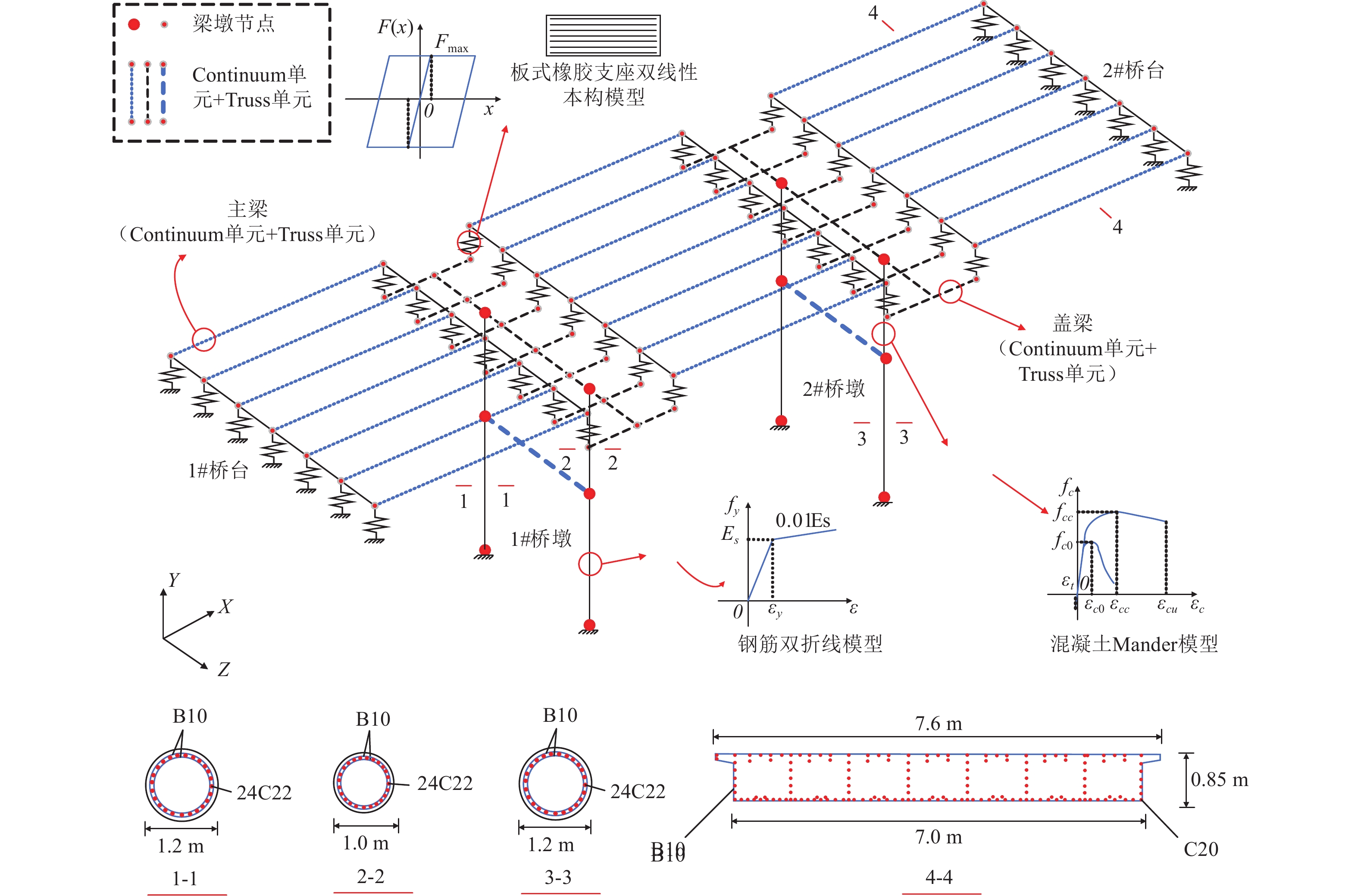
图 6 桥梁有限元模型及其参数
Figure 6. Schematic representation of the FE model of the target bridge

图 7 主梁前四阶振型分析图
Figure 7. Analysis diagram of the first four order vibration modes of the main beam
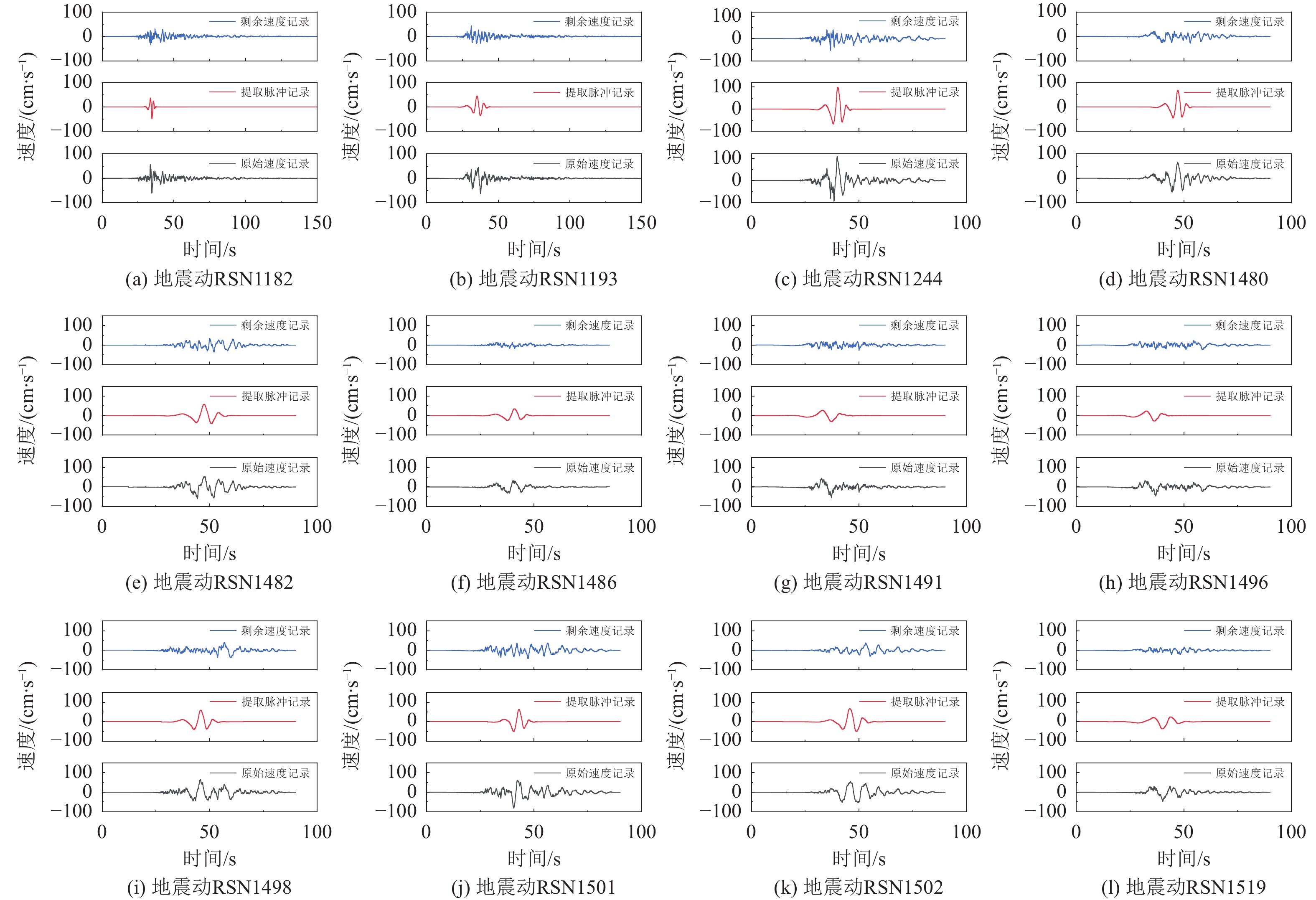
表 1 地震脉冲型地震动识别结果
Table 1. Recognition result of seismic pulse type ground motion
地震动分类 地震动编号 脉冲周期
Tpulse/s断层距
R/km峰值地面速度
PGV/(cm‧s−1)脉冲因子
PI原信号17%能量点
t17%,orig/s类脉冲5%能量点
t5%,likepulse/s分类 近场地震动 RSN1182 2.570 9.76 59.45 1.596 34.004 33.176 脉冲型 RSN1184 / 19.96 24.55 −7.226 36.476 31.896 非脉冲型 RSN1193 6.650 9.62 65.43 4.179 32.315 32.125 脉冲型 RSN1244 5.341 9.94 110.99 23.900 37.550 36.925 脉冲型 RSN1246 / 18.02 66.85 −2.092 45.504 48.928 非脉冲型 RSN1480 5.383 19.83 64.41 12.544 44.245 43.860 脉冲型 RSN1482 9.331 19.89 58.96 5.424 43.590 42.465 脉冲型 RSN1486 8.043 16.74 31.93 2.628 36.510 35.850 脉冲型 RSN1491 10.381 7.64 54.07 4.076 32.540 27.640 脉冲型 RSN1496 8.939 10.48 46.20 2.367 32.215 27.865 脉冲型 RSN1497 / 11.83 50.10 2.488 45.210 49.575 非脉冲型 RSN1498 7.784 17.11 65.29 6.018 42.890 41.365 脉冲型 RSN1501 6.552 9.78 80.46 7.670 40.310 39.385 脉冲型 RSN1502 8.456 16.59 55.26 3.089 42.385 39.905 脉冲型 RSN1506 / 19.00 61.34 −3.916 50.090 57.095 非脉冲型 RSN1519 10.395 6.98 46.41 6.957 36.090 34.275 脉冲型 RSN1530 8.687 6.08 68.45 13.200 38.355 34.690 脉冲型 RSN1531 7.189 12.87 57.20 2.663 40.655 39.515 脉冲型 RSN1548 9.023 13.13 62.87 10.479 42.195 38.280 脉冲型 RSN1550 8.882 8.27 62.71 10.908 38.844 35.248 脉冲型 中远场地震动 RSN1185 / 59.04 15.59 −9.659 46.376 111.692 非脉冲型 RSN1189 / 59.09 19.78 −6.703 50.156 46.480 非脉冲型 RSN1190 / 50.53 7.16 −6.279 34.196 34.784 非脉冲型 RSN1191 / 64.15 7.03 −6.914 42.348 40.532 非脉冲型 RSN1192 / 81.28 9.01 −7.940 43.872 76.484 非脉冲型 RSN1196 / 41.99 21.25 −6.641 42.140 42.960 非脉冲型 RSN1207 / 55.13 19.55 −5.127 48.360 61.325 非脉冲型 RSN1210 / 44.76 7.73 −6.914 43.105 42.750 非脉冲型 RSN1214 / 56.93 5.36 −7.265 40.220 40.245 非脉冲型 RSN1215 / 59.80 14.30 −7.472 45.885 57.770 非脉冲型  下载: 导出CSV
表 2 基于动力学拐角频率的随机有限断层模型参数
Table 2. Stochastic finite fault model parameters based on dynamic corner frequency
参数 取值 文献 断层尺寸/km 100×32 (陈文山,2018) 子断层尺寸/km 5×4 (陈文山,2018) 震源深度/km 8.0 (Hanks等,2002;王亮等,2016) 矩震级MW 7.6 (章文波等,2010) 地震矩M0/(dyne‧cm) 2.82×1027 (徐龙军等,2024) 应力降/bar 50 (Motazedian等,2005) 介质密度/(g/cm2) 2.8 (Motazedian等,2005) 高频衰减因子kappa /s 0.035 (毛岚等,2024) 品质因子Q(f) 171‧f 0.7 (章文波等,2010) 窗函数 Saragoni-Hart (Saragoni等,1973) 剪切波速β/(km/s) 3.7 (Motazedian等,2005) 破裂速度/(km/s) 0.8β (Motazedian等,2005) 几何扩散函数 1/R,(R≤70 km)
1/R0,(70 km<R<130 km)
1/R0.5,(R≥130 km)(Beresnev等,1998;Motazedian等,2005) 剪切模量/(dyne/cm2) 3.1×10¹¹ (Motazedian等,2005) 滑动位错分布 随机分布 (Motazedian等,2005) 地壳放大系数 Boore-Joyner普通岩石场地模型 (Boore,2003) 地震动路径持时/s T0+0.05R (Motazedian等,2005) 脉冲比例 50% (Motazedian等,2005)
下载: 导出CSV
-
艾晓秋, 李杰, 2009. 基于随机Fourier谱的地震动合成研究. 地震工程与工程振动, 29(2): 7−12. doi: 10.13197/j.eeev.2009.02.002Ai X. Q., Li J., 2009. Synthesis method of non-stationary ground motion based on random Fourier spectra. Journal of Earthquake Engineering and Engineering Vibration, 29(2): 7−12. (in Chinese) doi: 10.13197/j.eeev.2009.02.002 陈文山, 2018. 台湾集集7.6级地震之车笼埔断层活动特征及其危害. 城市与减灾, (1): 66−71. doi: 10.3969/j.issn.1671-0495.2018.01.014 李宁, 刁泽民, 李忠献, 2022. 考虑震源和场地特征的近断层地区竖向地震动合成研究. 工程力学, 39(6): 181−190. doi: 10.6052/j.issn.1000-4750.2021.03.0232Li N., Diao Z. M., Li Z. X., 2022. Study on synthesis method of vertical ground motions for near-fault regions considering the characteristics of source and site condition. Engineering Mechanics, 39(6): 181−190. (in Chinese) doi: 10.6052/j.issn.1000-4750.2021.03.0232 李帅, 张凡, 颜晓伟等, 2017. 近断层地震动合成方法及其对超大跨斜拉桥地震响应影响. 中国公路学报, 30(2): 86−97, 106. doi: 10.3969/j.issn.1006-3897.2017.02.011Li S., Zhang F., Yan X. W., et al., 2017. Synthetic method for near-fault ground motions and its influence on seismic response of super-span cable-stayed bridge. China Journal of Highway and Transport, 30(2): 86−97,106. (in Chinese) doi: 10.3969/j.issn.1006-3897.2017.02.011 李爽, 谢礼立, 2007. 近场问题的研究现状与发展方向. 地震学报, 29(1): 102−111. doi: 10.3321/j.issn:0253-3782.2007.01.012Li S., Xie L. L., 2007. Progress and trend on near-field problems in civil engineering. Acta Seismologica Sinica, 29(1): 102−111. (in Chinese) doi: 10.3321/j.issn:0253-3782.2007.01.012 罗东雨, 孙建刚, 柳春光等, 2020a. 近断层地震动对大型LNG储罐作用效应分析. 自然灾害学报, 29(4): 102−112. doi: 10.13577/j.jnd.2020.0411Luo D. Y., Sun J. G., Liu C. G., et al., 2020a. Analysis of the effect of near-fault ground motion on large LNG storage tank. Journal of Natural Disasters, 29(4): 102−112. (in Chinese) doi: 10.13577/j.jnd.2020.0411 罗东雨, 孙建刚, 柳春光等, 2020b. 近断层地震动作用下大型LNG储罐晃动效应研究. 自然灾害学报, 29(5): 99−107. doi: 10.13577/j.jnd.2020.0511Luo D. Y., Sun J. G., Liu C. G., et al., 2020b. Research on sloshing effect of large LNG storage tank under near fault ground motions. Journal of Natural Disasters, 29(5): 99−107. (in Chinese) doi: 10.13577/j.jnd.2020.0511 毛岚, 石玉成, 卢育霞等, 2024. 2023年甘肃积石山MS6.2地震随机有限断层三分向地震动模拟. 地震工程学报, 46(4): 778−790.Mao L., Shi Y. C., Lu Y. X., et al., 2024. Three-component ground motion simulation for the 2023 MS6.2 earthquake in Jishishan, Gansu, based on the stochastic finite-fault method. China Earthquake Engineering Journal, 46(4): 778−790. (in Chinese) 庞锐, 陈柯好, 宋佚博等, 2024. 近断层脉冲型随机地震动模拟方法及结构动力可靠度研究. 大连理工大学学报, 64(6): 633−640. doi: 10.7511/dllgxb202406011Pang R., Chen K. H., Song Y. B., et al., 2024. Simulation method of pulsed stochastic ground motion of near-fault and study of structural dynamic reliability. Journal of Dalian University of Technology, 64(6): 633−640. (in Chinese) doi: 10.7511/dllgxb202406011 陶夏新, 王国新, 2003. 近场强地震动模拟中对破裂的方向性效应和上盘效应的表达. 地震学报, 25(2): 191−198. doi: 10.3321/j.issn:0253-3782.2003.02.009Tao X. X., Wang G. X., 2003. Rupture directivity and hanging wall effect in near field strong ground motion simulation. Acta Seismologica Sinica, 25(2): 191−198. (in Chinese) doi: 10.3321/j.issn:0253-3782.2003.02.009 陶夏新, 陈富, 孙晓丹, 2012. 强地震动随机合成中震源谱模型的改进. 岩土工程学报, 34(3): 504−507.Tao X. X., Chen F., Sun X. D., 2012. Improvement of source spectrum model for synthesis of strong ground motion. Chinese Journal of Geotechnical Engineering, 34(3): 504−507. (in Chinese) 滕浩钧, 尹训强, 盛超, 2018. 地震动基线漂移校正方法的比较研究. 大连大学学报, 39(3): 12−16. doi: 10.3969/j.issn.1008-2395.2018.03.005Teng H. J., Yin X. Q., Sheng C., 2018. A comparative study of baseline drift correction methods on ground motion. Journal of Dalian University, 39(3): 12−16. (in Chinese) doi: 10.3969/j.issn.1008-2395.2018.03.005 王海云, 2004. 近场强地震动预测的有限断层震源模型. 哈尔滨: 中国地震局工程力学研究所.Wang H. Y. , 2004. Finite fault source model for predicting near-field strong ground motion. Harbin: Institute of Engineering Mechanics, China Earthquake Administration. (in Chinese) 王亮, 薛霆虓, 季海磊, 2016. 集集强余震震源机制解分析. 地球物理学进展, 31(5): 1998−2004. doi: 10.6038/pg20160515Wang L., Xue T. X., Ji H. L., 2016. Focal mechanisms of Taiwan ChiChi earthquake aftershocks. Progress in Geophysics, 31(5): 1998−2004. (in Chinese) doi: 10.6038/pg20160515 夏坤, 王蕾, 李方圆等, 2020. 汶川地震黄土地区地震动特征分析. 世界地震工程, 36(4): 193−199. doi: 10.3969/j.issn.1007-6069.2020.04.024Xia K., Wang L., Li F. Y., et al., 2020. Strong ground motion characteristics of loess area in Wenchuan earthquake. World Earthquake Engineering, 36(4): 193−199. (in Chinese) doi: 10.3969/j.issn.1007-6069.2020.04.024 徐国栋, 周锡元, 闫维明等, 2005. 考虑超随机特性的人工地震动合成. 地震工程与工程振动, 25(4): 11−17. doi: 10.3969/j.issn.1000-1301.2005.04.002Xu G. D., Zhou X. Y., Yan W. M., et al., 2005. The synthesis of man-made ground motion considering the super-randomness. Earthquake Engineering and Engineering Vibration, 25(4): 11−17. (in Chinese) doi: 10.3969/j.issn.1000-1301.2005.04.002 徐龙军, 吕淼, 张恒等, 2024. 1999年台湾集集MW7.6地震跨断层场地相对运动. 地震学报, 46(3): 425−441. doi: 10.11939/jass.20220170Xu L. J., Lü M., Zhang H., et al., 2024. Relative motions between cross-fault sites resultd from the 1999 MW7.6 Taiwan Chi-Chi earthquake. Acta Seismologica Sinica, 46(3): 425−441. (in Chinese) doi: 10.11939/jass.20220170 徐略勤, 袁茂均, 左英等, 2024. 近断层脉冲型地震作用下大跨拱桥动力响应分析. 振动与冲击, 43(9): 94−104, 148. doi: 10.13465/j.cnki.jvs.2024.09.012Xu L. Q., Yuan M. J., Zuo Y., et al., 2024. Dynamic response analysis of long-span arch bridge under near-fault pulse seismic motion. Journal of Vibration and Shock, 43(9): 94−104,148. (in Chinese) doi: 10.13465/j.cnki.jvs.2024.09.012 姚鑫鑫, 任叶飞, 岸田忠大等, 2025. 满足数据同一性的强震动记录去噪滤波后处理输出方法. 工程力学, 42(1): 152−163. doi: 10.6052/j.issn.1000-4750.2022.10.0903Yao X. X., Ren Y. F., Kishida T., et al., 2025. A post processing method of strong motion record filtering satisfying the compatibility. Engineering Mechanics, 42(1): 152−163. (in Chinese) doi: 10.6052/j.issn.1000-4750.2022.10.0903 张斌, 俞言祥, 2022. 近场强震动记录基线校正方法. 地球与行星物理论评, 53(2): 204−213. doi: 10.19975/j.dqyxx.2021-053Zhang B., Yu Y. X., 2022. Research progress of baseline correction for near-field strong motion accelerogram. Reviews of Geophysics and Planetary Physics, 53(2): 204−213. (in Chinese) doi: 10.19975/j.dqyxx.2021-053 章文波, 于湘伟, 2010. 1999年台湾集集大地震强地面运动的模拟. 地震工程与工程振动, 30(3): 1−11. doi: 10.13197/j.eeev.2010.03.001Zhang W. B., Yu X. W., 2010. Strong ground motion simulation of the 1999 Chi-Chi, Taiwan, earthquake. Journal of Earthquake Engineering and Engineering Vibration, 30(3): 1−11. (in Chinese) doi: 10.13197/j.eeev.2010.03.001 周继磊, 2014. 近断层强震作用下结构随机抗震分析和力学系统混沌控制. 大连: 大连理工大学.Zhou J. L. , 2014. Stochastic seismic analysis of structures subjected to near-fault strong ground motions and chaos control for mechanical systems. Dalian: Dalian University of Technology. (in Chinese) Aki K., 1967. Scaling law of seismic spectrum. Journal of Geophysical Research, 72(4): 1217−1231. doi: 10.1029/JZ072i004p01217 Aki K. , Richards P. G. , 1980. Quantitative seismology: theory and methods. San Francisco: W. H. Freeman. Baker J. W., 2007. Quantitative classification of near-fault ground motions using wavelet analysis. Bulletin of the Seismological Society of America, 97(5): 1486−1501. doi: 10.1785/0120060255 Beresnev I. A., Atkinson G. M., 1998. FINSIM-a FORTRAN program for simulating stochastic acceleration time histories from finite faults. Seismological Research Letters, 69(1): 27−32. doi: 10.1785/gssrl.69.1.27 Boore D. M., 2003. Simulation of ground motion using the stochastic method. Pure and Applied Geophysics, 160(3): 635−676. Hanks T. C., Bakun W. H., 2002. A bilinear source-scaling model for M-log A observations of continental earthquakes. Bulletin of the Seismological Society of America, 92(5): 1841−1846. doi: 10.1785/0120010148 Makris N., Chang S. P., 2000. Effect of viscous, viscoplastic and friction damping on the response of seismic isolated structures. Earthquake Engineering & Structural Dynamics, 29(1): 85−107. doi: 10.1002/(SICI)1096-9845(200001)29:1<85::AID-EQE902>3.0.CO;2-N Mavroeidis G. P., Papageorgiou A. S., 2003. A mathematical representation of near-fault ground motions. Bulletin of the Seismological Society of America, 93(3): 1099−1131. doi: 10.1785/0120020100 Motazedian D., Atkinson G. M., 2005. Stochastic finite-fault modeling based on a dynamic corner frequency. Bulletin of the Seismological Society of America, 95(3): 995−1010. doi: 10.1785/0120030207 Saragoni G. R., Hart G. C., 1973. Simulation of artificial earthquakes. Earthquake Engineering & Structural Dynamics, 2(3): 249−267. doi: 10.1002/eqe.4290020305 Shahi S. K., Baker J. W., 2014. An efficient algorithm to identify strong-velocity pulses in multicomponent ground motions. Bulletin of the Seismological Society of America, 104(5): 2456−2466. doi: 10.1785/0120130191 Somerville P. G., Smith N. F., Graves R. W., et al., 1997. Modification of empirical strong ground motion attenuation relations to include the amplitude and duration effects of rupture directivity. Seismological Research Letters, 68(1): 199−222. doi: 10.1785/gssrl.68.1.199 Wang Q., Qiao X. J., Lan Q. G., et al., 2011. Rupture of deep faults in the 2008 Wenchuan earthquake and uplift of the Longmen Shan. Nature Geoscience, 4(9): 634−640. doi: 10.1038/ngeo1210 Wells D. L., Coppersmith K. J., 1994. New empirical relationships among magnitude, rupture length, rupture width, rupture area, and surface displacement. Bulletin of the Seismological Society of America, 84(4): 974−1002. doi: 10.1785/BSSA0840040974 -

 点击查看大图
计量
- 文章访问数: 191
- HTML全文浏览量: 33
- PDF下载量: 225
- 被引次数: 0
