


Optimization Technology for Selecting Ground Motion Time History
-
摘要: 地震动时程作为结构抗震分析的输入,其合理的选择与使用直接影响抗震分析结果的可靠性。针对天然地震动选取问题,根据我国抗震规范对输入地震动时程的相关要求,本文提出了基于多参数初筛与两误差复筛的优选方法,该方法综合考虑地震动强度、频谱特性、持时等因素,并结合规范对目标谱匹配和空间相关性的要求,实现了对天然地震动三分量的有效筛选(源自不同地震事件)。研究结果表明,所选地震动时程在结构主要振型周期点处的反应谱与目标谱匹配度较高,且全周期段的均方根误差较小,满足“统计意义上相符”的要求。本文提出的方法具有较强的实用性和可操作性,为工程实践中的地震动时程选择提供了科学依据,为核电站、大型工业设施等复杂结构的抗震设计提供了重要支撑。Abstract: As the input for structural seismic analysis, the appropriate selection and use of ground motion time histories directly affect the reliability of seismic response results. Based on the requirements for input ground motion time histories in Chinese seismic design codes, this study proposes a refined optimization approach that incorporates preliminary multi-parameter screening and secondary dual-error verification. The proposed method considers ground motion intensity, spectral characteristics, and duration, while satisfying code-specified requirements for target spectrum compatibility and spatial coherence. It enables the efficient selection of three-component natural ground motions from different earthquake events. The results show that the selected ground motion time histories exhibit good spectral compatibility with the target response spectra at the predominant modal periods of the structure and maintain relatively low root-mean-square errors over the entire period range, thereby satisfying the criterion of statistical consistency. The proposed method has strong practicality and operability, provides a scientific basis for selecting ground motion acceleration records in engineering practice, and offers important support for the seismic design of complex structures, such as nuclear power plants and large industrial facilities.
-
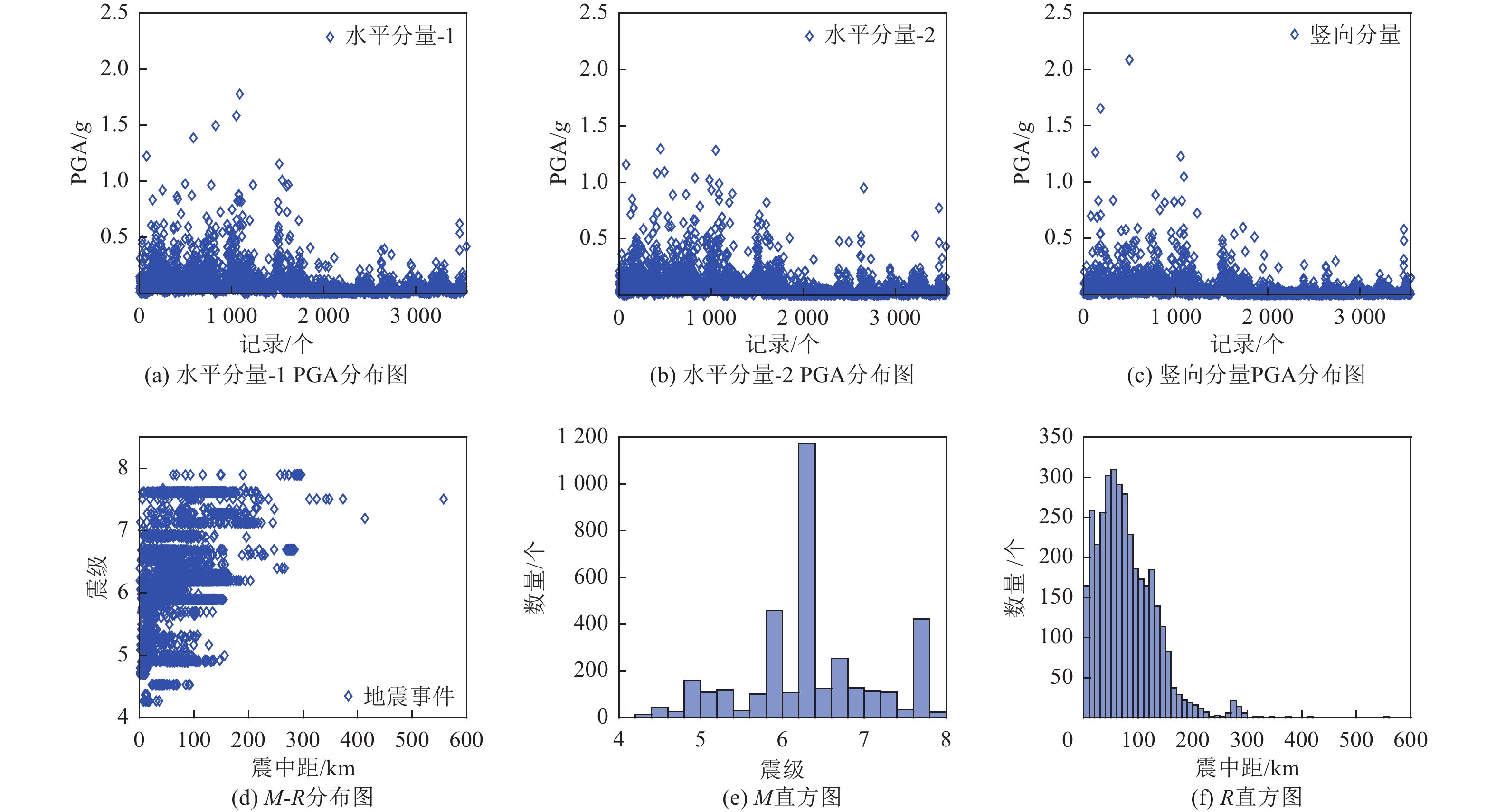
图 2
3551 个地震事件的三分量PGA和M-R分布情况Figure 2. Distribution of three component PGA and M, R for
3551 earthquake events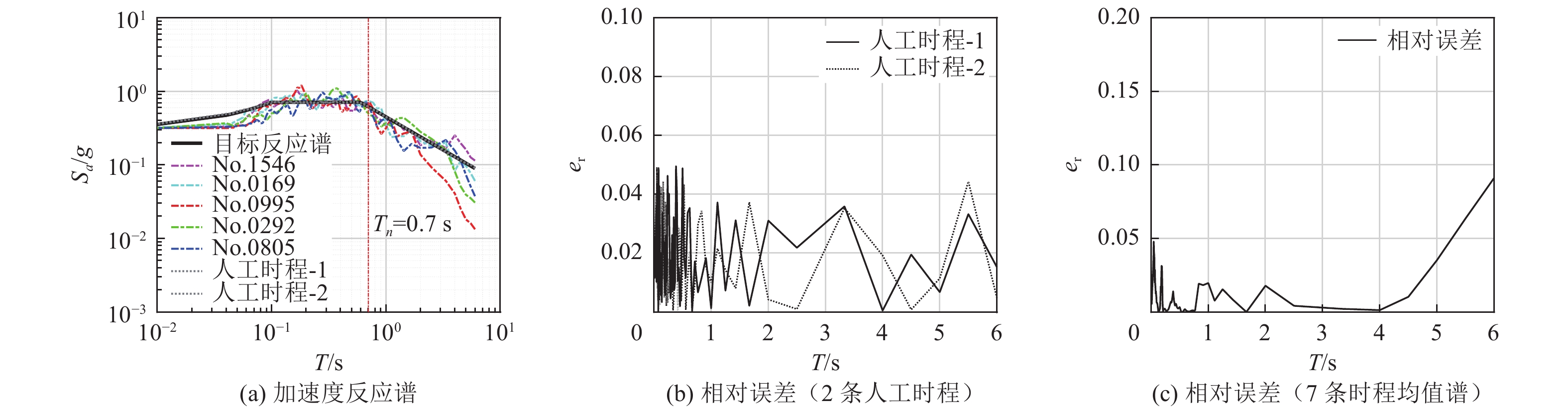
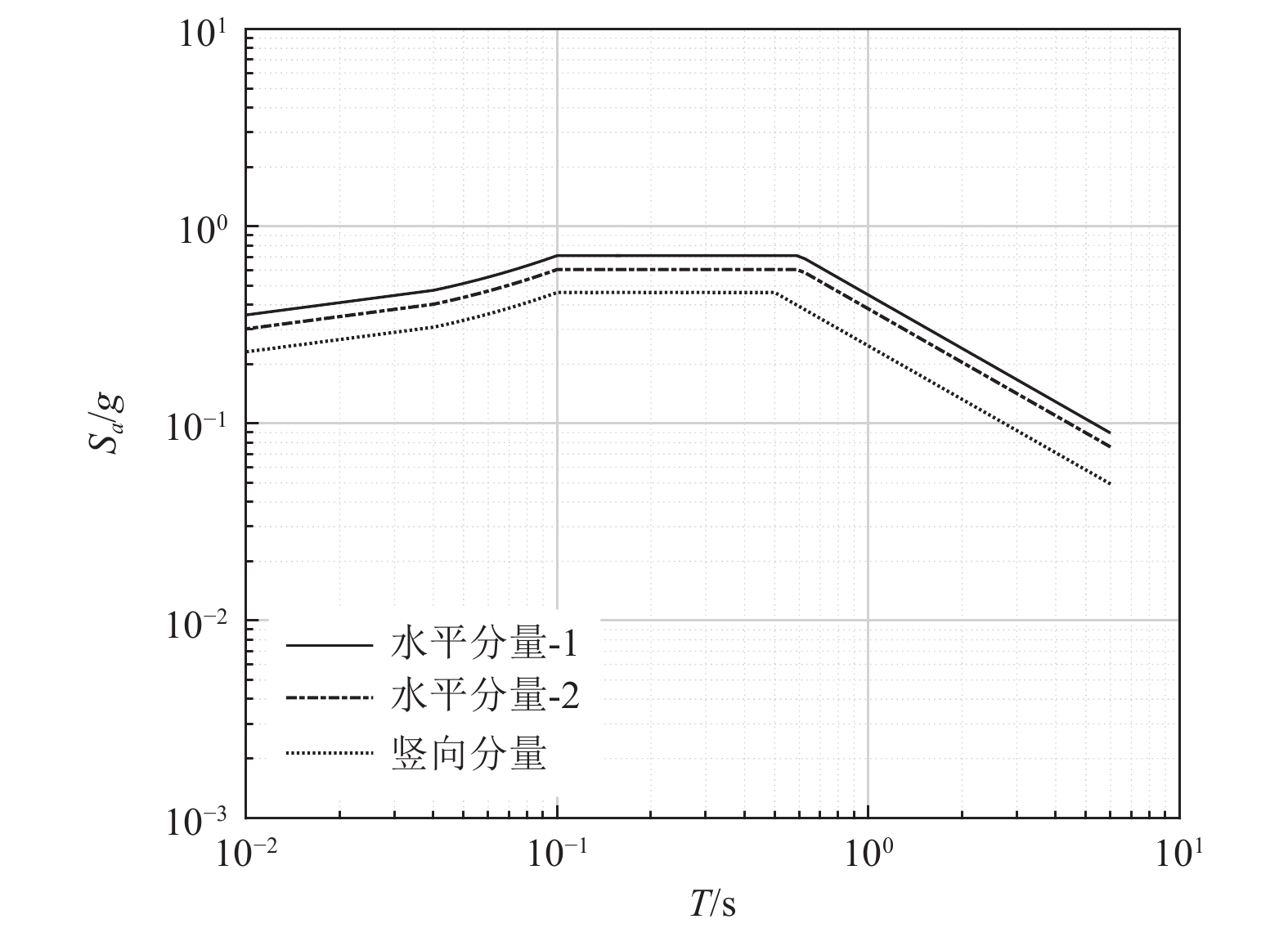
图 3 所选记录与目标设计谱的比较(水平分量-1)
Figure 3. Comparison between selected records and target design spectrum ( Horizontal-1 )
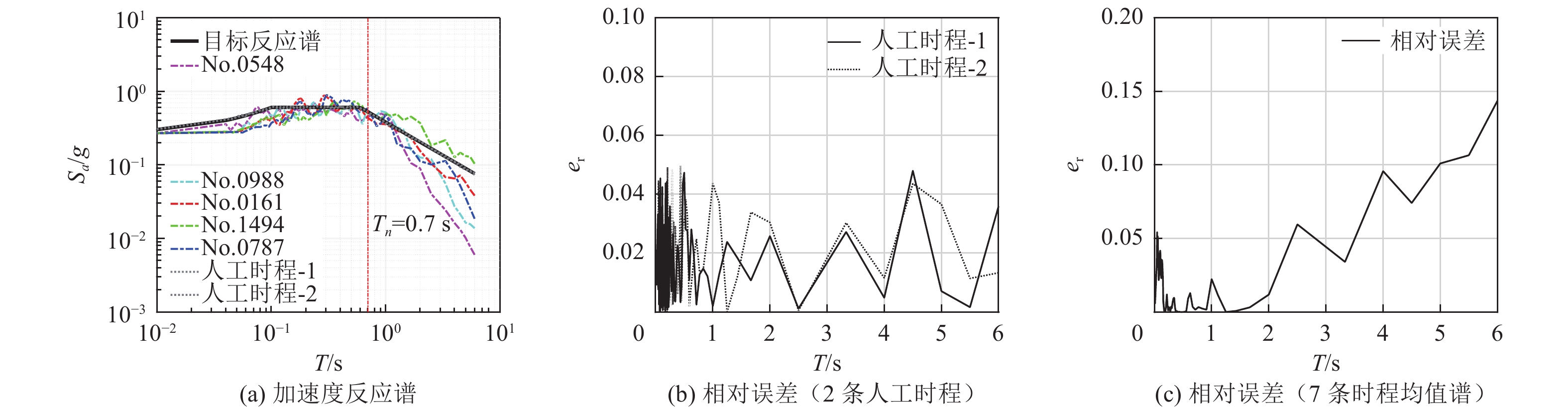
图 4 所选记录与目标设计谱的比较(水平分量-2)
Figure 4. Comparison between selected records and target design spectrum ( Horizontal-2 )
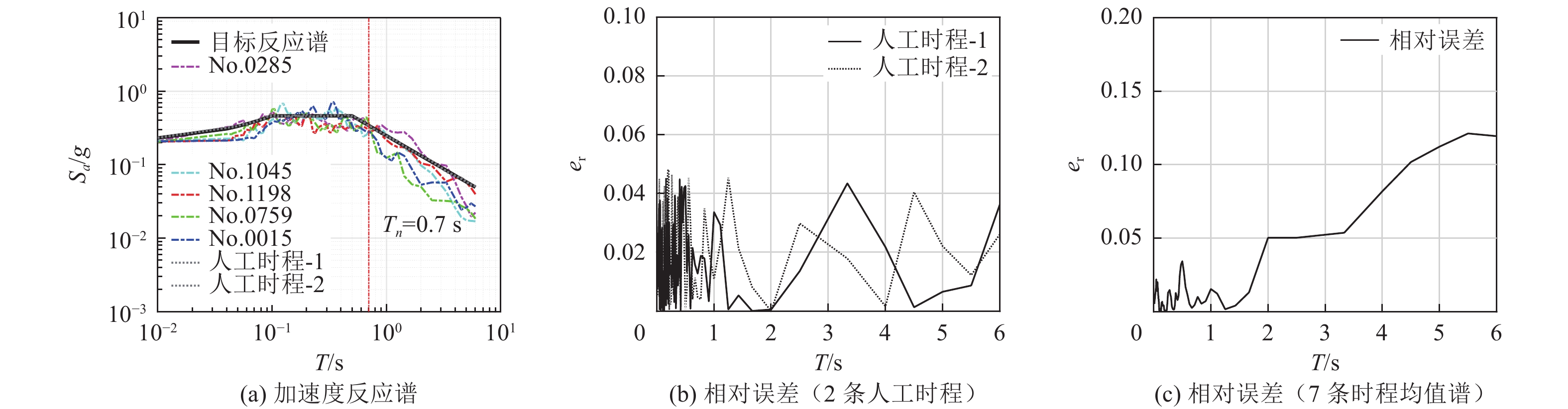
图 5 所选记录与目标设计谱的比较(竖向分量)
Figure 5. Comparison between selected records and target design spectrum ( Vertical )
表 1 水平分量-1选波结果
Table 1. Result of horizontal-1 component
序号 PEER编号 地震名称 台站名称 震级 震中距/km PGA/g 有效持时/s Tn处相对误差/% 均方根误差 1 1546 Chi-Chi, Taiwan TCU122 7.62 21.80 0.2196 48.250 0.1254 0.0972 2 0169 Imperial Valley-06 Delta 6.53 33.73 0.2378 89.620 0.1741 0.1020 3 0995 Northridge-01 LA-Hollywood Stor FF 6.69 23.61 0.2314 21.680 0.1150 0.1448 4 0292 Irpinia, Italy-01 Sturno 6.90 30.35 0.2506 30.823 0.1946 0.1461 5 0805 LomaPrieta Stanford Park. Garage 6.93 50.52 0.2538 24.120 0.0367 0.1482 注:目标谱:Amax1 = 310 cm/s2 = 0.316 g,Tg1 = 0.6 s。筛选条件:M≥5.0;20 km≤R≤200 km;PGA≥0.20 g;Te ≥ 5Tn = 3.5 s。  下载: 导出CSV
表 2 水平分量-2选波结果
Table 2. Result of horizontal-2 component
序号 PEER编号 地震名称 台站名称 震级 震中距/km PGA/g 有效持时/s Tn处相对误差/% 均方根误差 1 0548 Chalfant Valley-02 Benton 6.19 31.25 0.1774 18.670 0.1381 0.0932 2 0988 Northridge-01 LA-Century City CC North 6.69 20.22 0.2217 22.380 0.0613 0.1024 3 0161 Imperial Valley-06 Brawley Airport 6.53 43.15 0.2198 20.065 0.1728 0.1207 4 1494 Chi-Chi, Taiwan TCU054 7.62 37.64 0.1877 37.545 0.0370 0.1286 5 0787 Loma Prieta Palo Alto - SLAC Lab 6.93 51.20 0.2777 22.350 0.0543 0.1449 注:目标谱:Amax2 = 263.5 cm/s2 = 0.269 g,Tg2 = 0.6 s。筛选条件:M≥5.0;20 km≤R≤200 km;PGA≥0.17 g;Te≥5Tn = 3.5 s。
下载: 导出CSV
表 3 竖向分量选波结果
Table 3. Result of vertical component
序号 PEER编号 地震名称 台站名称 震级 震中距/km PGA/g 有效持时/s Tn处相对误差/% 均方根误差 1 0285 Irpinia, Italy-01 Bagnoli Irpinio 6.90 22.65 0.1079 26.825 0.0409 0.0721 2 1045 Northridge-01 Newhall - W Pico Canyon Rd. 6.69 21.55 0.2904 15.340 0.1557 0.0797 3 1198 Chi-Chi, Taiwan CHY029 7.62 39.70 0.1551 46.345 0.1537 0.0854 4 0759 Loma Prieta Foster City - APEEL 1 6.93 64.02 0.1044 33.145 0.1409 0.0885 5 0015 Kern County Taft Lincoln School 7.36 43.49 0.1087 48.020 0.1937 0.0950 注:目标谱:Amax3 = 201.5 cm/s2 = 0.205 g,Tg3 = 0.5 s。筛选条件:M ≥5.0;20 km≤R≤200 km;PGA ≥0.10 g;Te ≥5Tn = 3.5 s。
下载: 导出CSV
-
吕大刚, 王丛, 伊广丽, 2022. 基于我国地震区设定谱的标准地震动记录集研究. 地震工程与工程振动, 42(6): 67−75.Lv D. G., Wang C., Yi G. L., 2022. Standardized ground motion record sets based on scenario spectra of seismic areas in our country. Earthquake Engineering and Engineering Dynamics, 42(6): 67−75. (in Chinese) 马风龙, 乐风江, 王健, 2022. 地震动记录选取及其对网架屋盖动力响应的影响. 世界地震工程, 38(1): 90−98. doi: 10.19994/j.cnki.WEE.2022.0010Ma F. L., Yue F. J., Wang J., 2022. Influence of earthquake records selection on the dynamic response of grid roof. World Earthquake Engineering, 38(1): 90−98. (in Chinese) doi: 10.19994/j.cnki.WEE.2022.0010 曲哲, 叶列平, 潘鹏, 2011. 建筑结构弹塑性时程分析中地震动记录选取方法的比较研究. 土木工程学报, 44(7): 10−21.Qu Z., Ye L. P., Pan P., 2011. Comparative study on methods of selecting earthquake ground motions for nonlinear time history analyses of building structures. China Civil Engineering Journal, 44(7): 10−21. (in Chinese) 任叶飞, 尹建华, 温瑞智等, 2020. 结构抗倒塌易损性分析中地震动输入不确定性影响研究. 工程力学, 37(1): 115−125. doi: 10.6052/j.issn.1000-4750.2019.01.0042Ren Y. F., Yin J. H., Wen R. Z., et al., 2020. The impact of ground motion inputs on the uncertainty of structural collapse fragility. Engineering Mechanics, 37(1): 115−125. (in Chinese) doi: 10.6052/j.issn.1000-4750.2019.01.0042 王国新, 鲁建飞, 2012. 地震动输入的选取与结构响应研究. 沈阳建筑大学学报(自然科学版), 28(1): 15−22.Wang G. X., Lu J. F., 2012. Strong ground motion input and structural response. Journal of Shenyang Jianzhu University (Natural Science), 28(1): 15−22. (in Chinese) 王良, 戴靠山, 葛庆子等, 2023. 四川省减震结构时程分析中的输入地震记录选取. 工程抗震与加固改造, 45(6): 51−60. doi: 10.16226/j.issn.1002-8412.2023.06.007Wang L., Dai K. S., Ge Q. Z., et al., 2023. Selection of ground motion records for time history analysis of energy-dissipated structures in Sichuan Province. Earthquake Resistant Engineering and Retrofitting, 45(6): 51−60. (in Chinese) doi: 10.16226/j.issn.1002-8412.2023.06.007 王珊, 张郁山, 2017. 各类抗震设计规范对设计地震动时程规定的对比分析. 中国地震, 33(1): 56−67.Wang S., Zhang Y. S., 2017. Comparison of various seismic design codes on design ground motion time history. Earthquake Research in China, 33(1): 56−67. (in Chinese) 杨红, 任小军, 徐海英, 2010. 双向水平地震下时程分析法中输入波的选择. 华南理工大学学报(自然科学版), 38(11): 40−46. doi: 10.3969/j.issn.1000-565X.2010.11.008Yang H., Ren X. J., Xu H. Y., 2010. Selection of input waves in time-history analysis under bi-direction horizontal seismic action. Journal of South China University of Technology (Natural Science Edition), 38(11): 40−46. (in Chinese) doi: 10.3969/j.issn.1000-565X.2010.11.008 杨溥, 李英民, 赖明, 2000. 结构时程分析法输入地震波的选择控制指标. 土木工程学报, 33(6): 33−37.Yang P., Li Y. M., Lai M., 2000. A new method for selecting inputting waves for time-history analysis. China Civil Engineering Journal, 33(6): 33−37. (in Chinese) 叶献国, 王德才, 2011. 结构动力分析实际地震动输入的选择与能量评价. 中国科学: 技术科学, 41(11): 1430−1438.Ye X. G., Wang D. C., 2011. Selection of real earthquake accelerograms for structural dynamic analysis and energy evaluation. Science China Technological Sciences, 54(11): 2878−2885. (in Chinese) 翟长海, 谢礼立, 2005. 抗震结构最不利设计地震动研究. 土木工程学报, 38(12): 51−58.Zhai C. H., Xie L. L., 2005. The severest design ground motions for seismic design and analysis of structures. China Civil Engineering Journal, 38(12): 51−58. (in Chinese) 张锐, 李宏男, 王东升等, 2019. 结构时程分析中强震记录选取研究综述. 工程力学, 36(2): 1−16.Zhang R., Li H. N., Wang D. S., et al., 2019. Selection and scaling of real accelerograms as input to time-history analysis of structures: a state-of-the-art review. Engineering Mechanics, 36(2): 1−16. (in Chinese) 周颖, 唐少将, 2014. 考虑高阶振型的工程地震动选取方法. 地震工程与工程震动, 34(S1): 69−75.Zhou Y., Tang S. J., 2014. A method of engineering ground motion selection considering higher modes. Earthquake Engineering and Engineering Dynamics, 34(S1): 69−75. (in Chinese) Baker J. W., Cornell C. A., 2005. A vector-valued ground motion intensity measure consisting of spectral acceleration and epsilon. Earthquake Engineering & Structural Dynamics, 34(10): 1193−1217. doi: 10.1002/eqe.474 Bommer J. J., Scott S. G., Sarma S. K., 2000. Hazard-consistent earthquake scenarios. Soil Dynamics and Earthquake Engineering, 19(4): 219−231. doi: 10.1016/S0267-7261(00)00012-9 Catalán A., Benavent-Climent A., Cahís X., 2010. Selection and scaling of earthquake records in assessment of structures in low-to-moderate seismicity zones. Soil Dynamics and Earthquake Engineering, 30(1-2): 40−49. doi: 10.1016/j.soildyn.2009.09.003 Nau J. M., Hall W. J., 1984. Scaling methods for earthquake response spectra. Journal of Structural Engineering, 110(7): 1533−1548. doi: 10.1061/(ASCE)0733-9445(1984)110:7(1533) Shome N., Cornell C. A., Bazzurro P., et al., 1998. Earthquakes, records, and nonlinear responses. Earthquake Spectra, 14(3): 469−500. doi: 10.1193/1.1586011 Stewart J. P., Chiou S. J., Bray J. D., et al., 2002. Ground motion evaluation procedures for performance-based design. Soil Dynamics and Earthquake Engineering, 22(9-12): 765−772. doi: 10.1016/S0267-7261(02)00097-0 Watson-Lamprey J., Abrahamson N., 2006. Selection of ground motion time series and limits on scaling. Soil Dynamics and Earthquake Engineering, 26(5): 477−482. doi: 10.1016/j.soildyn.2005.07.001 Yakut A., Yılmaz H., 2008. Correlation of deformation demands with ground motion intensity. Journal of Structural Engineering, 134(12): 1818−1828. doi: 10.1061/(ASCE)0733-9445(2008)134:12(1818) -

 点击查看大图
计量
- 文章访问数: 152
- HTML全文浏览量: 87
- PDF下载量: 232
- 被引次数: 0
