


Regression Based Ground Motion Prediction Equation for Small-to-Moderate Earthquakes in Xinjiang
-
摘要: 目前已有一些研究建立了适用于我国不同地区的地震动预测方程,但针对新疆地区,鲜有利用本地强震动观测数据直接回归的地震动预测方程。随着国家强震动观测台网系统的建设,强震动数据不断丰富,通过对我国强震动数据库Flatfile中新疆地区的强震动数据进行两步法回归,得出适用于新疆地区中小震级的地震动预测方程。为了与GB 18306-2015《中国地震动参数区划图》衔接,建立了新疆地区平均轴烈度预测方程作为参考,通过转换法进一步给出了新疆地区长轴与短轴的地震动预测方程。与“区评大纲”中新疆地区长短轴的地震动预测方程相比,在远场(Repi=200 km),本文的伪加速度反应谱值整体略高,在近场(Repi=20 km),周期大于0.3 s时伪加速度反应谱略低,在中等距离条件下(Repi=50 km和Repi=100 km),二者基本吻合。Abstract: Ground motion prediction equations (GMPEs) applicable to different regions of China have been developed in previous studies. However, few GMPEs for the Xinjiang region have been directly derived from local strong-motion observation data. With the construction of the national strong-motion observation network and the continuous enrichment of strong-motion records, this study develops GMPEs suitable for small-to-moderate earthquakes in the Xinjiang region by applying a two-step regression procedure to strong-motion data from the Xinjiang subset of China’s strong-motion database flatfile. To ensure consistency with GB 18306–2015, Seismic Ground Motion Parameter Zonation Map of China, an average horizontal-component intensity prediction equation is first established for the Xinjiang region. GMPEs for the major and minor horizontal axes are then derived using a transformation method. Compared with the major- and minor-axis GMPEs for the Xinjiang region provided in the Regional Seismic Safety Evaluation Guidelines, the pseudo-acceleration response spectra predicted in this study are slightly higher in the far field (Repi=200 km), slightly lower in the near field (Repi=20 km) for periods longer than 0.3 s, and generally consistent at intermediate distances (Repi =50 and 100 km).
-
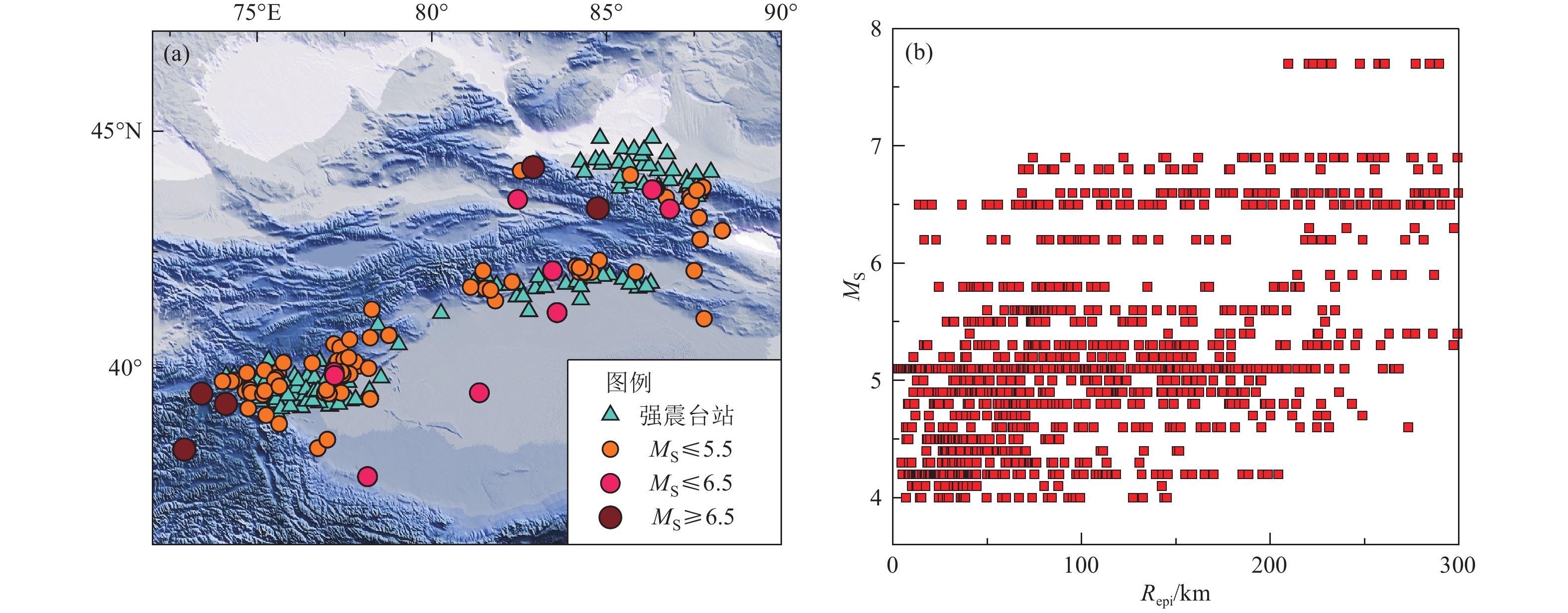
图 1 地震事件、记录台站的空间分布以及强震动记录的震级-距离分布
Figure 1. Spatial distribution of earthquake events, recording stations, and the magnitude-distance distribution of strong ground motion records
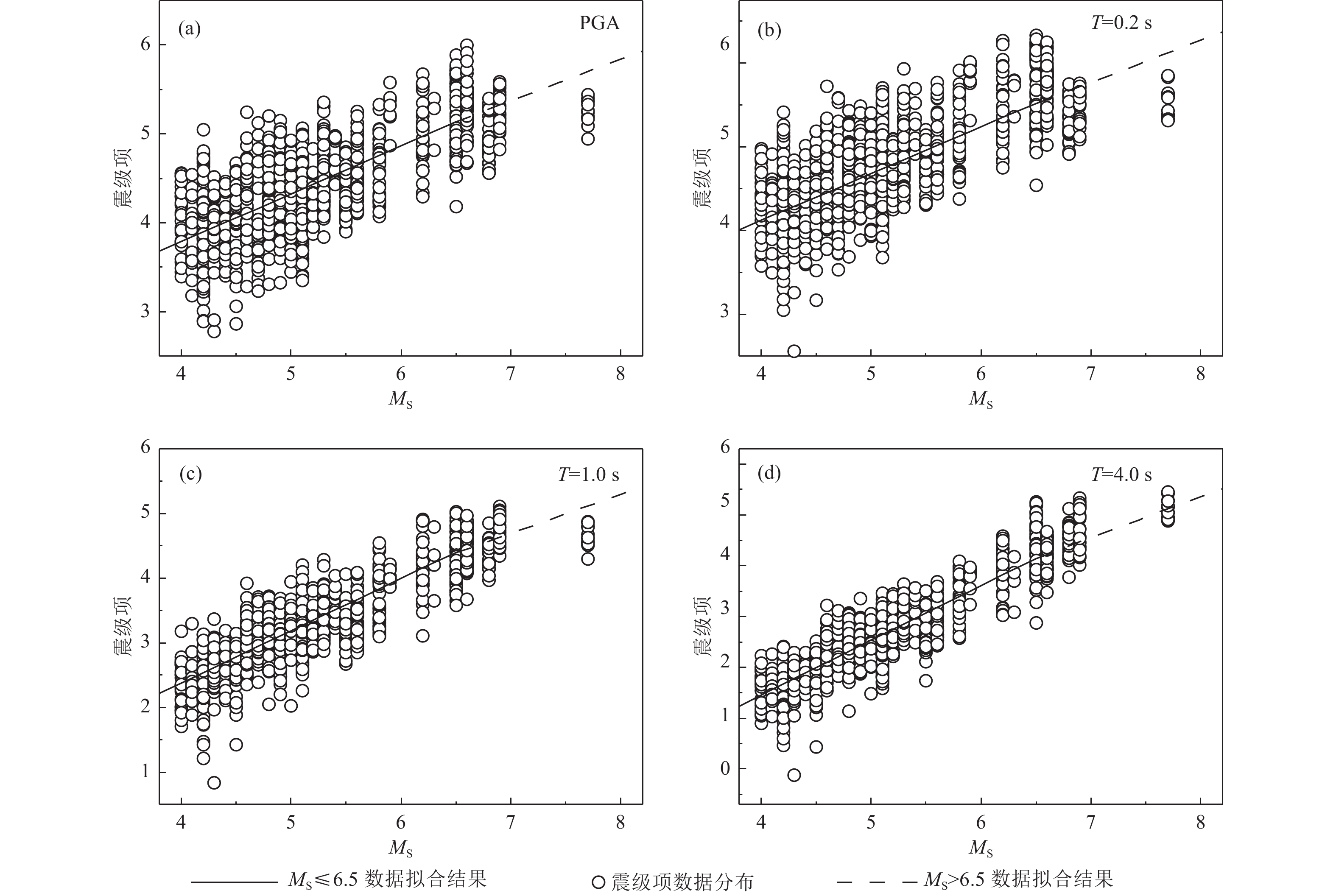
图 2 调整后PGA和PSA(T=0.2、1、4 s)的震级项回归结果
Figure 2. The adjusted regression results of the magnitude terms for PGA and PSA (T=0.2, 1, 4 s)
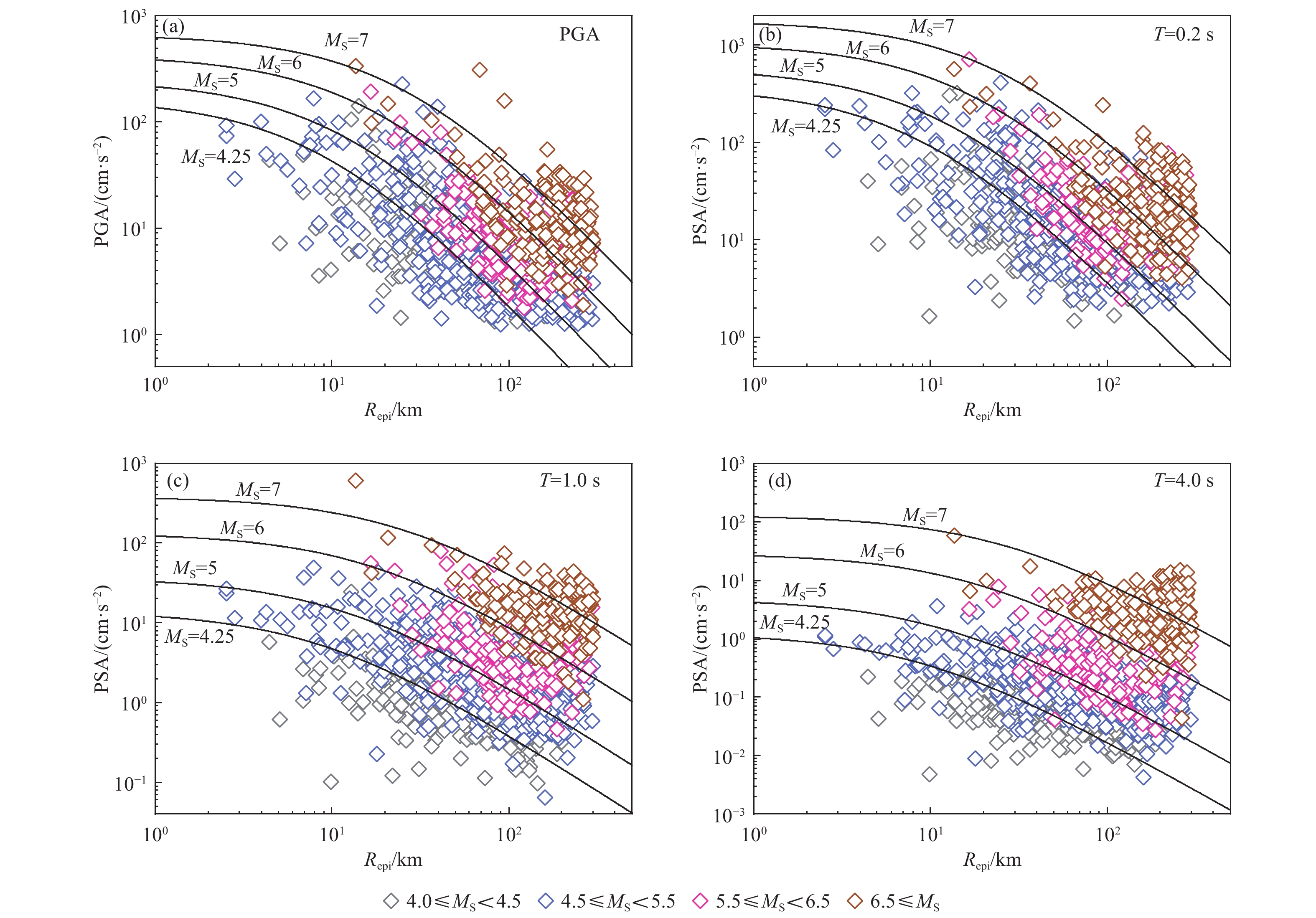
图 3 不同震级PGA与PSA(T=0.2、1、4 s)的预测值及观测值
Figure 3. Predicted and observed PGA and PSA(T=0.2, 1,4 s) values for different magnitudes
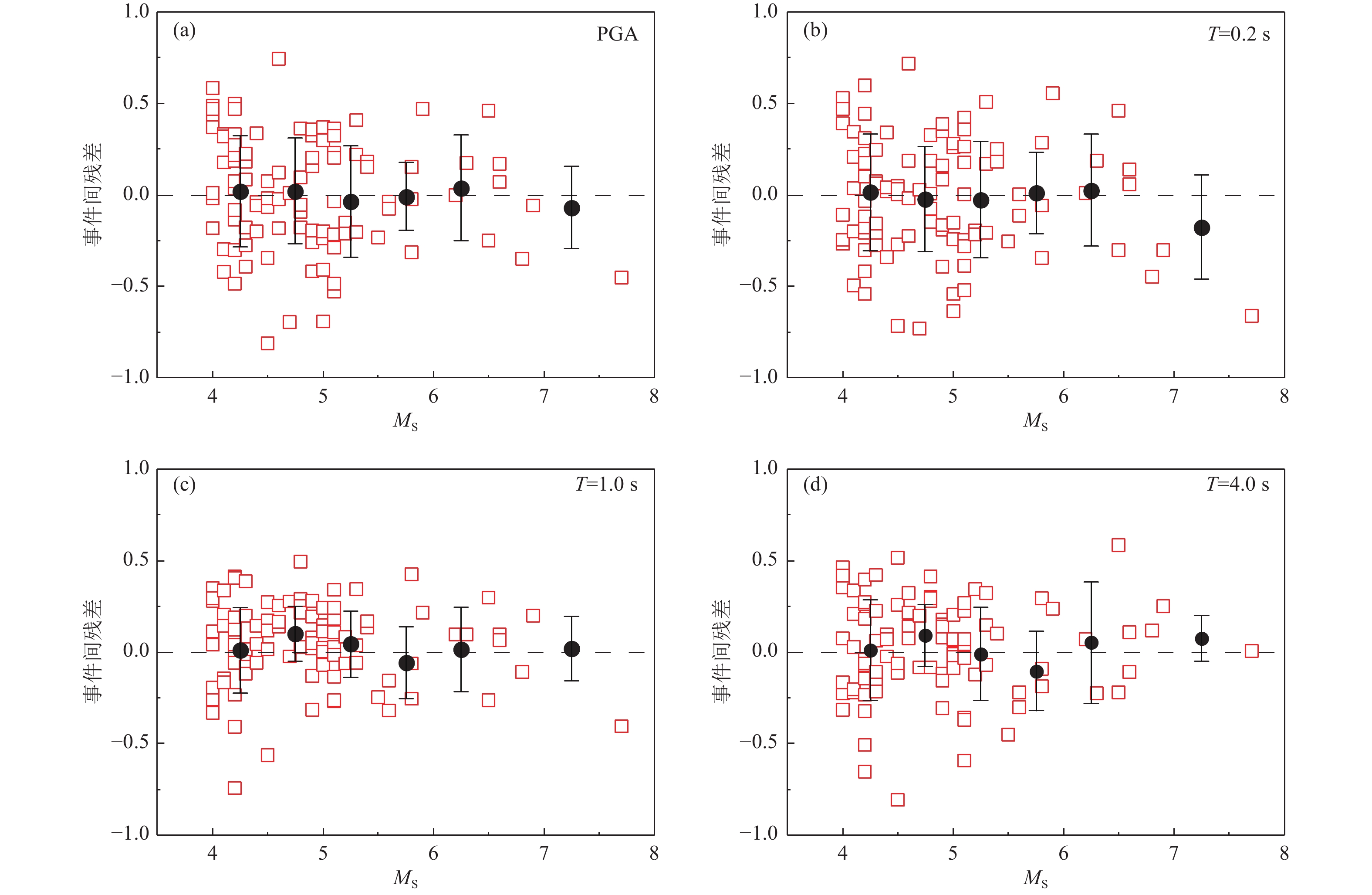
图 5 PGA和PSA(T=0.2、1 、4 s)的事件间残差
Figure 5. Inter-event residuals for PGA and PSA (T=0.2, 1, 4 s)
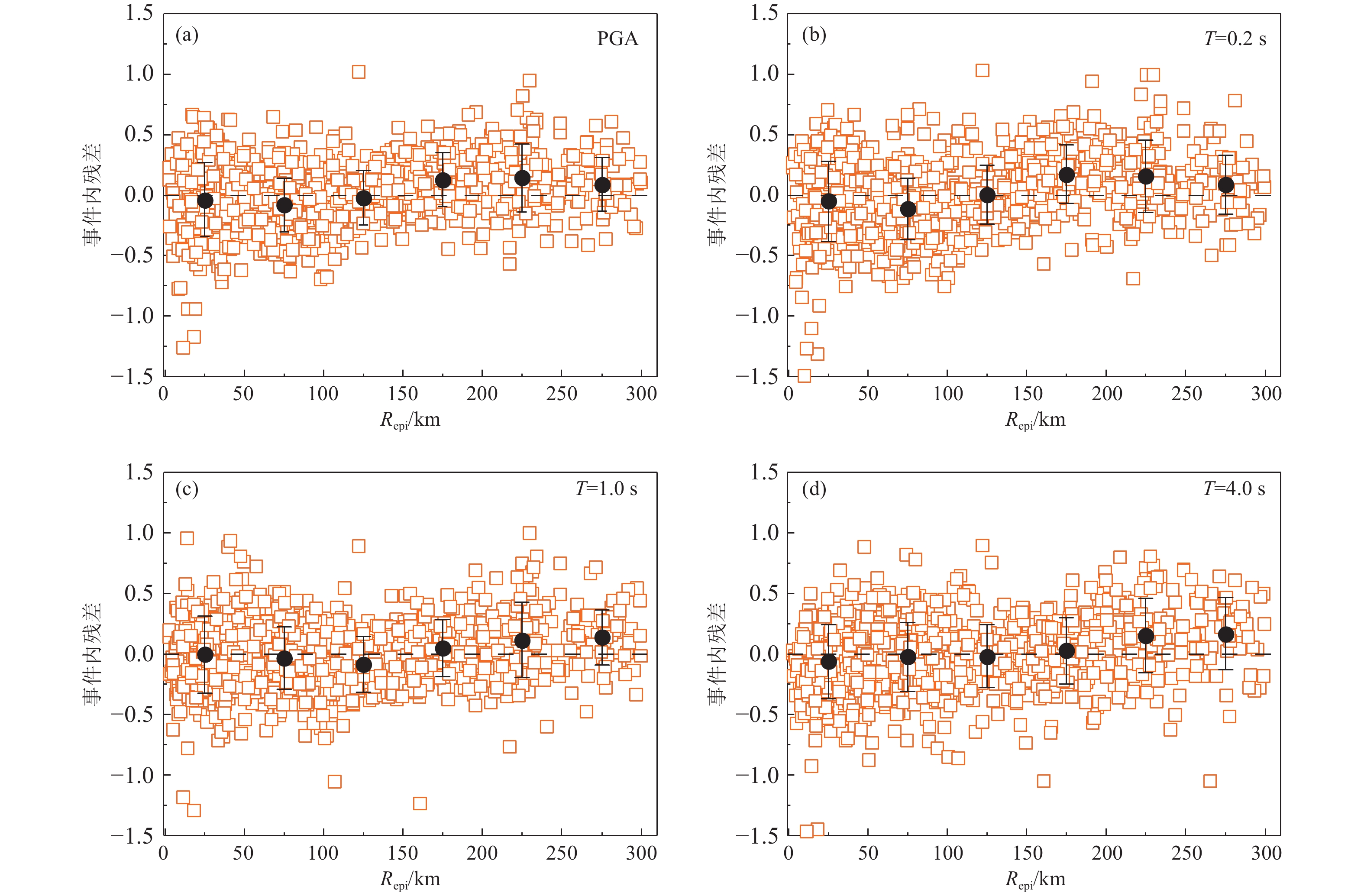
图 6 PGA和PSA (T=0.2 、1 、 4 s)的事件内残差
Figure 6. Intra-event residuals for PGA and PSA(T=0.2, 1, 4 s)
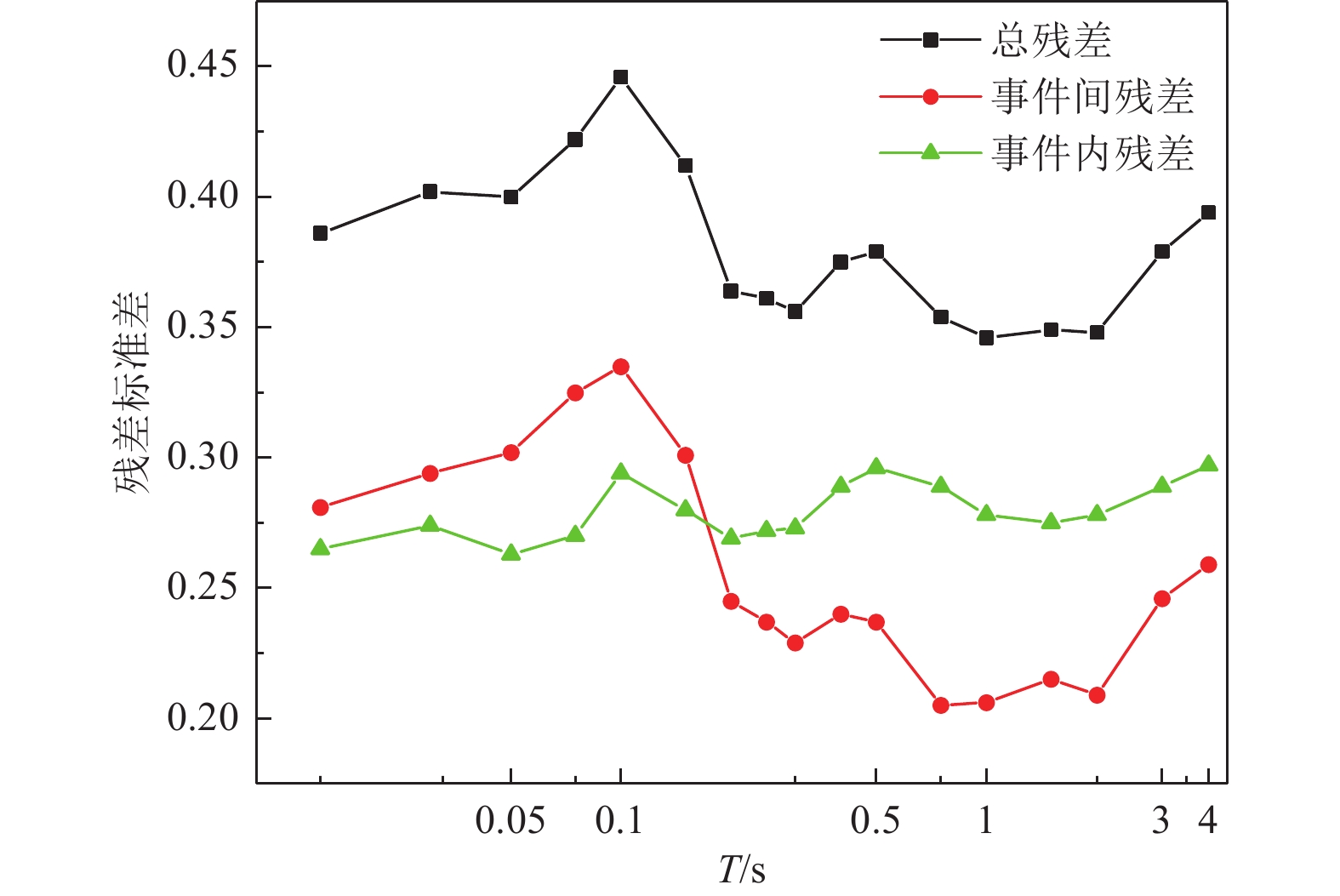
图 7 本文地震动预测方程的总标准差、事件间残差和事件内残差
Figure 7. Total, intra, and inter-event standard deviations in this paper
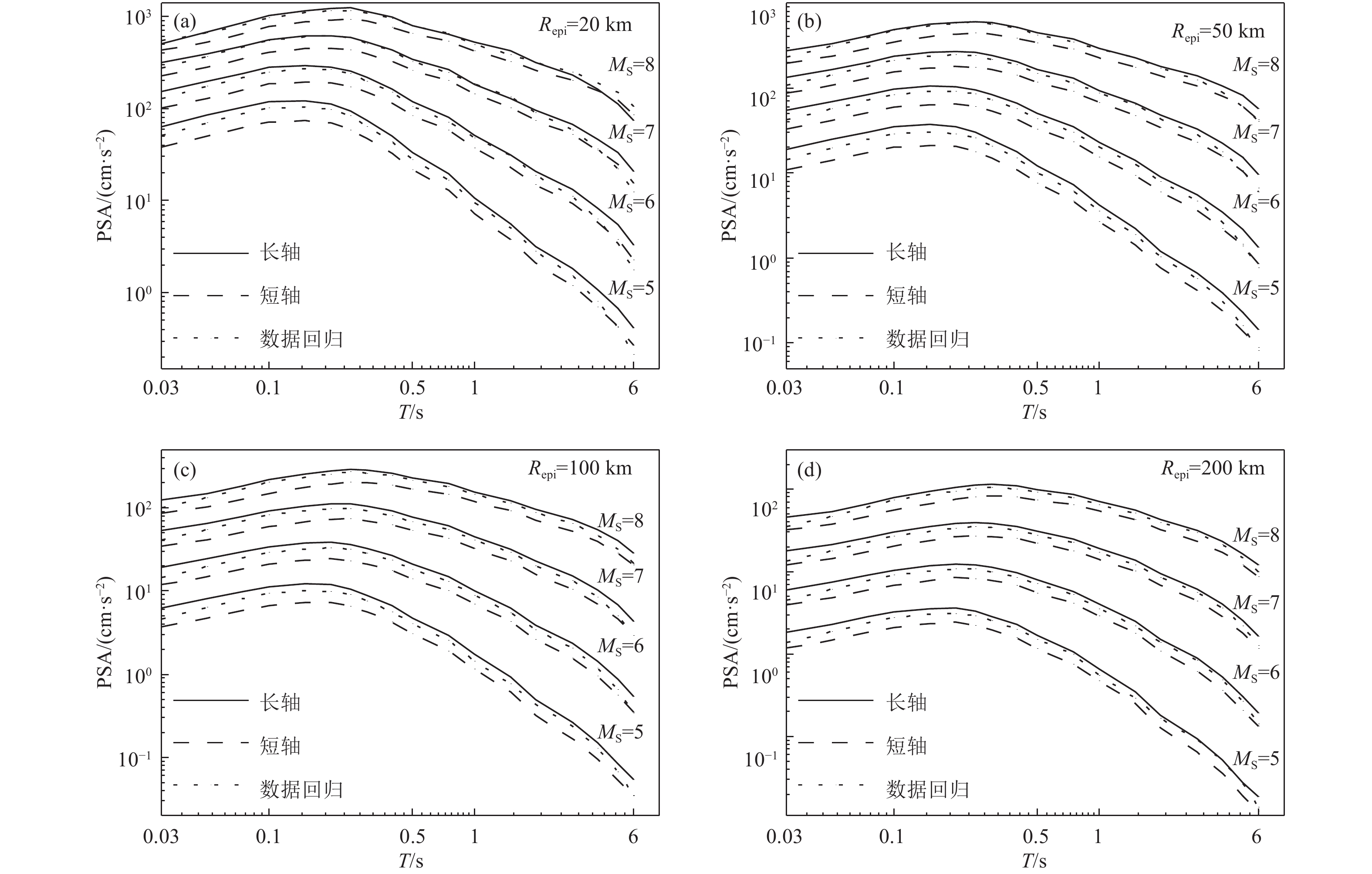
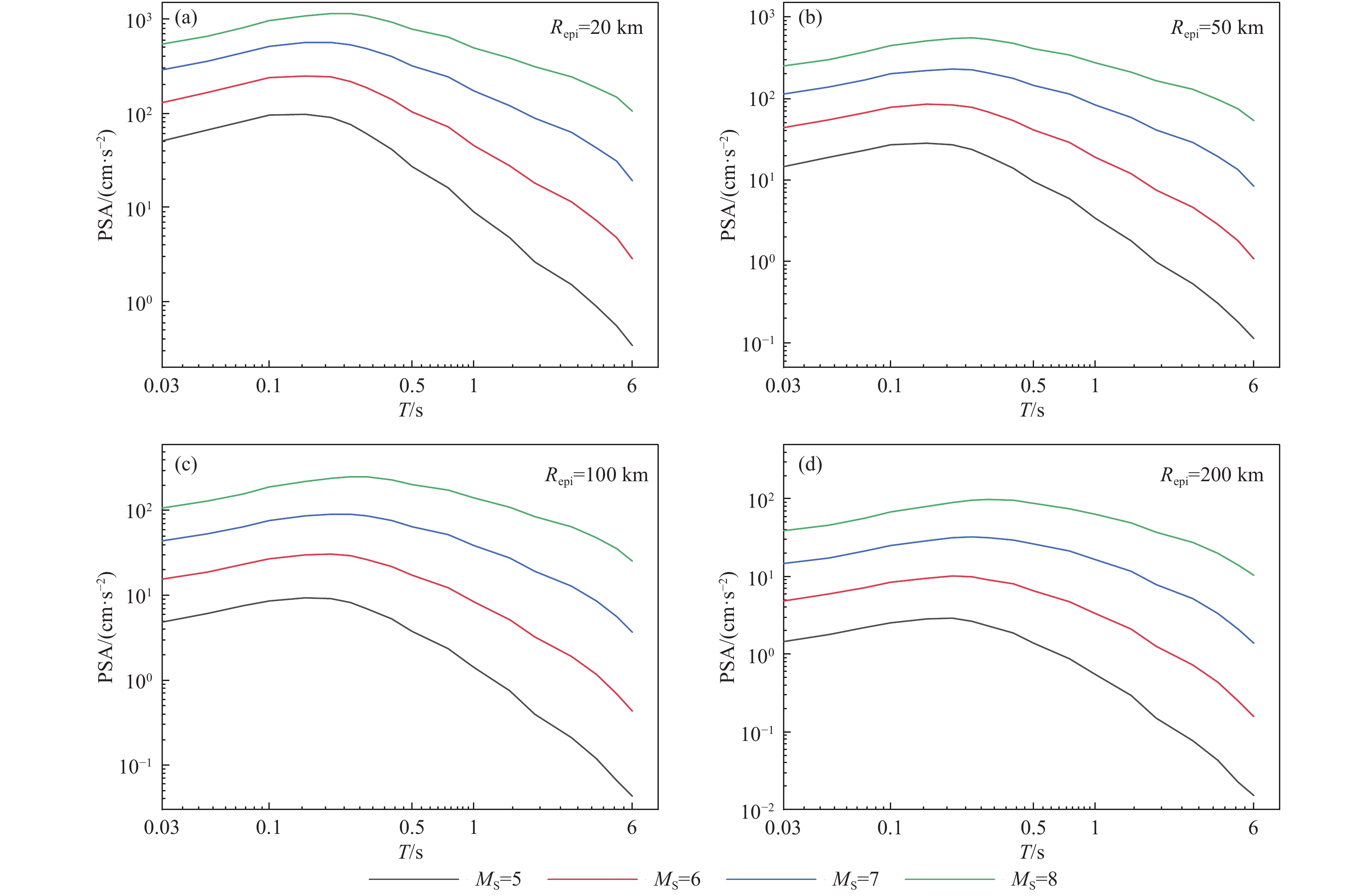
图 8 新疆地区长轴、短轴以及数据回归的PSA预测值随周期变化
Figure 8. Variation of predicted PSA with period for the major axis, minor axis, and data regression
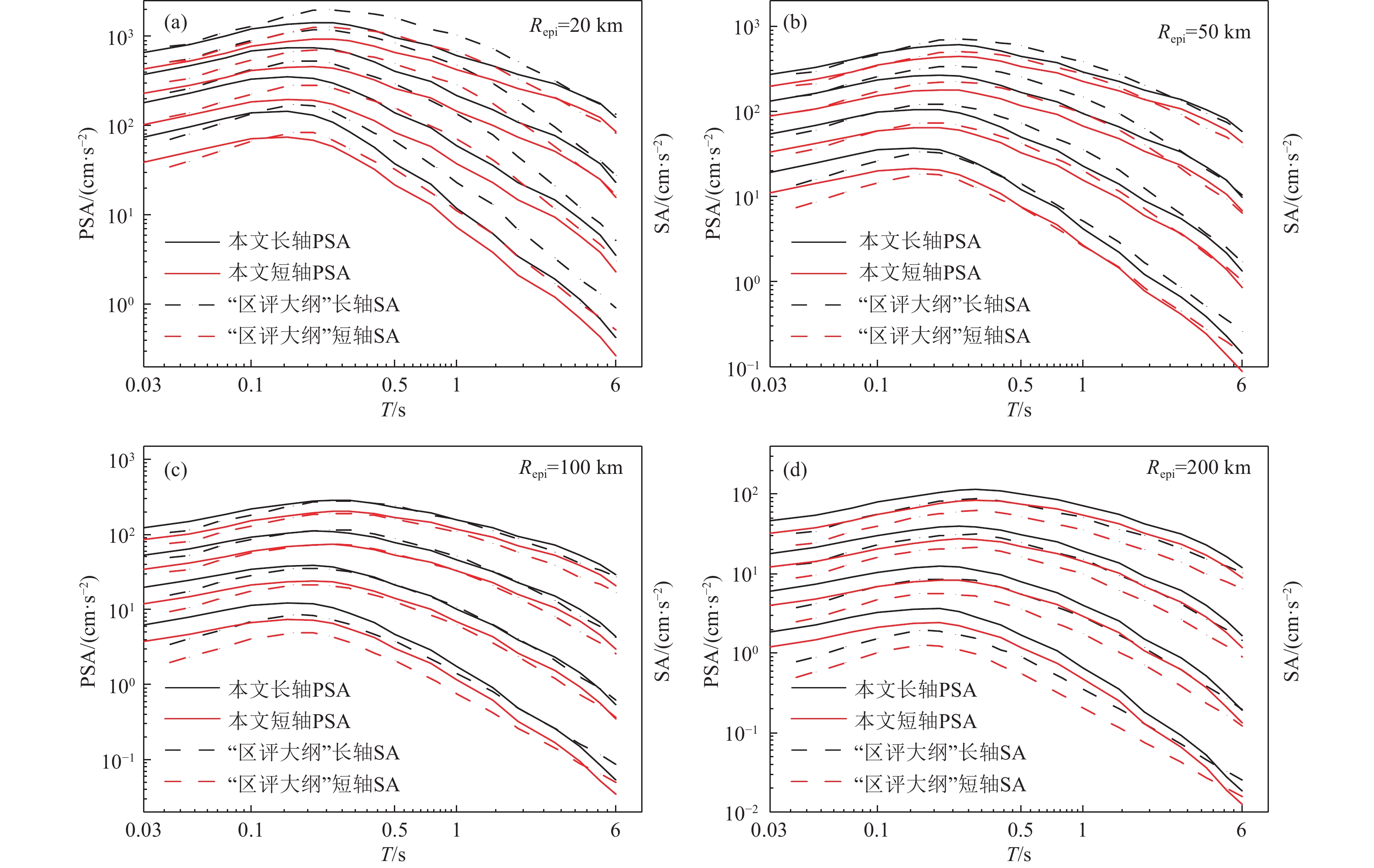
图 9 新疆长短轴PSA/SA对比
Figure 9. Comparison of major and minor axis PSA/SA in the Xinjiang region
表 1 场地调整系数
Table 1. Site adjustment coefficient
项目 fCL-I fCL-II fCL-III PGA −0.199 0.138 0.173 PSA T=0.03 s −0.184 0.129 0.156 T=0.05 s −0.170 0.121 0.141 T=0.075 s −0.158 0.124 0.168 T=0.1 s −0.185 0.124 0.197 T=0.15 s −0.233 0.112 0.208 T=0.2 s −0.283 0.091 0.210 T=0.25 s −0.318 0.068 0.229 T=0.3 s −0.322 0.024 0.283 T=0.4 s −0.330 −0.016 0.359 T=0.5 s −0.323 −0.051 0.442 T=0.75 s −0.341 −0.068 0.499 T=1 s −0.321 −0.061 0.473 T=1.5 s −0.313 −0.031 0.404 T=2 s −0.249 0.005 0.312 T=3 s −0.236 0.007 0.259 T=4 s −0.220 −0.027 0.254 T=5 s −0.242 −0.047 0.253 T=6 s −0.248 −0.053 0.255  下载: 导出CSV
表 2 新疆地区基岩地震动预测方程的回归系数
Table 2. Regression coefficients of the rock ground motion prediction equation for the Xinjiang region
项目 震级项 距离项 标准差 A1 B1 A2 B2 C D E σ PGA 1.623 0.541 2.083 0.470 −1.795 1.649 0.396 0.386 PSA T=0.03 s 1.798 0.547 2.313 0.467 −1.878 1.649 0.396 0.402 T=0.05 s 2.012 0.536 2.522 0.457 −1.905 1.649 0.396 0.400 T=0.075 s 2.100 0.535 2.585 0.460 −1.903 1.649 0.396 0.422 T=0.1 s 2.169 0.537 2.719 0.452 −1.910 1.649 0.396 0.446 T=0.15 s 2.073 0.545 2.488 0.481 −1.866 1.649 0.396 0.412 T=0.2 s 1.879 0.561 2.245 0.504 −1.813 1.649 0.396 0.364 T=0.25 s 1.596 0.588 2.116 0.508 −1.766 1.649 0.396 0.361 T=0.3 s 1.287 0.616 1.951 0.513 −1.718 1.649 0.396 0.356 T=0.4 s 0.808 0.653 1.585 0.533 −1.633 1.649 0.396 0.375 T=0.5 s 0.336 0.694 1.218 0.558 −1.575 1.649 0.396 0.379 T=0.75 s −0.238 0.753 0.846 0.586 −1.540 1.649 0.396 0.354 T=1 s −0.858 0.809 0.488 0.601 −1.482 1.649 0.396 0.346 T=1.5 s −1.490 0.876 −0.046 0.653 −1.470 1.649 0.396 0.349 T=2 s −2.008 0.943 −0.332 0.685 −1.516 1.649 0.396 0.348 T=3 s −2.452 0.999 −0.922 0.763 −1.572 1.649 0.396 0.379 T=4 s −2.769 1.027 −1.395 0.815 −1.606 1.649 0.396 0.394 T=5 s −3.032 1.060 −1.719 0.858 −1.684 1.649 0.396 0.393 T=6 s −3.189 1.040 −2.312 0.905 −1.649 1.649 0.396 0.392
下载: 导出CSV
表 3 新疆地区地震烈度衰减系数
Table 3. Seismic intensity attenuation coefficients for the Xinjiang region
地区 轴向 C1 C2 C3 R0 新疆 长轴 5.6018 1.4347 − 4.4899 25 短轴 3.6113 1.4347 − 3.8477 13 平均轴 4.5319 1.4410 − 4.1597 18
下载: 导出CSV
表 4 新疆地区长轴基岩地震动预测模型系数
Table 4. Coefficients of the rock ground motion prediction model for the major axis in the Xinjiang region
项目 震级项 距离项 标准差 A1 B1 A2 B2 C D E σ PGA 1.951 0.534 2.335 0.475 −1.869 2.213 0.396 0.386 PSA T=0.03 s 2.142 0.550 2.658 0.471 −1.984 2.213 0.396 0.402 T=0.05 s 2.361 0.540 2.839 0.466 −2.013 2.213 0.396 0.400 T=0.075 s 2.449 0.539 2.910 0.468 −2.011 2.213 0.396 0.422 T=0.1 s 2.519 0.540 2.935 0.476 −2.018 2.213 0.396 0.446 T=0.15 s 2.415 0.548 2.815 0.487 −1.971 2.213 0.396 0.412 T=0.2 s 2.211 0.564 2.648 0.497 −1.915 2.213 0.396 0.364 T=0.25 s 1.920 0.591 2.431 0.513 −1.866 2.213 0.396 0.361 T=0.3 s 1.602 0.619 2.194 0.528 −1.816 2.213 0.396 0.356 T=0.4 s 1.107 0.656 1.842 0.543 −1.726 2.213 0.396 0.375 T=0.5 s 0.625 0.697 1.515 0.560 −1.664 2.213 0.396 0.379 T=0.75 s 0.044 0.756 1.141 0.588 −1.627 2.213 0.396 0.354 T=1 s −0.586 0.811 0.675 0.617 −1.565 2.213 0.396 0.346 T=1.5 s −1.220 0.878 0.211 0.658 −1.553 2.213 0.396 0.349 T=2 s −1.730 0.946 −0.162 0.705 −1.602 2.213 0.396 0.348 T=3 s −2.163 1.002 −0.571 0.757 −1.661 2.213 0.396 0.379 T=4 s −2.474 1.030 −1.035 0.809 −1.696 2.213 0.396 0.394 T=5 s −2.723 1.064 −1.430 0.865 −1.779 2.213 0.396 0.393 T=6 s −2.886 1.044 −2.032 0.912 −1.742 2.213 0.396 0.392
下载: 导出CSV
表 5 新疆地区短轴基岩地震动预测模型系数
Table 5. Coefficients of the rock ground motion prediction model for the minor axis in the Xinjiang region
项目 震级项 距离项 标准差 A1 B1 A2 B2 C D E σ PGA 1.286 0.490 1.383 0.475 −1.553 0.931 0.446 0.386 PSA T=0.03 s 1.432 0.541 1.901 0.469 −1.751 0.931 0.446 0.402 T=0.05 s 1.641 0.530 2.072 0.464 −1.777 0.931 0.446 0.400 T=0.075 s 1.730 0.530 2.143 0.466 −1.774 0.931 0.446 0.422 T=0.1 s 1.797 0.531 2.166 0.474 −1.781 0.931 0.446 0.446 T=0.15 s 1.710 0.539 2.063 0.485 −1.740 0.931 0.446 0.412 T=0.2 s 1.525 0.556 1.917 0.495 −1.690 0.931 0.446 0.364 T=0.25 s 1.252 0.583 1.720 0.511 −1.647 0.931 0.446 0.361 T=0.3 s 0.952 0.611 1.501 0.526 −1.602 0.931 0.446 0.356 T=0.4 s 0.490 0.648 1.184 0.541 −1.523 0.931 0.446 0.375 T=0.5 s 0.029 0.689 0.880 0.558 −1.468 0.931 0.446 0.379 T=0.75 s −0.538 0.749 0.520 0.586 −1.436 0.931 0.446 0.354 T=1 s −1.146 0.804 0.078 0.616 −1.381 0.931 0.446 0.346 T=1.5 s −1.776 0.871 −0.382 0.657 −1.371 0.931 0.446 0.349 T=2 s −2.303 0.938 −0.773 0.703 −1.413 0.931 0.446 0.348 T=3 s −2.758 0.994 −1.205 0.755 −1.466 0.931 0.446 0.379 T=4 s −3.081 1.022 −1.682 0.807 −1.497 0.931 0.446 0.394 T=5 s −3.360 1.056 −2.109 0.863 −1.570 0.931 0.446 0.393 T=6 s −3.510 1.036 −2.697 0.910 −1.538 0.931 0.446 0.392
下载: 导出CSV
-
高孟潭, 2015. GB 18306−2015《中国地震动参数区划图》宣贯教材. 北京: 中国质检出版社, 中国标准出版社.Gao M. T., 2015. Publicizing materials of GB 18306−2015 Chinese ground motion parameter zoning map. Beijing: China Quality Inspection Press, Standards Press of China. (in Chinese) 胡聿贤, 张敏政, 1984. 缺乏强震观测资料地区地震动参数的估算方法. 地震工程与工程振动, 4(1): 1−11.Hu Y. X., Zhang M. Z., 1984. A method of predicting ground motion parameters for regions with poor ground motion data. Earthquake Engineering and Engineering Vibration, 4(1): 1−11. (in Chinese) 胡聿贤, 周克森, 阎秀杰. 1996 缺乏地震动加速度记录地区地震动估计的映射法. 地震工程与工程振动, (03): 1−10.Hu Y. X. , Zhou K. S. , Yan X. J. , 1996. A method for evaluation of ground motion in regions with few acceleration observation data. Earthquake Engineering and Engineering Vibration, (03): 1−10. (in Chinese) 霍俊荣, 胡聿贤, 1992. 地震动峰值参数衰减规律的研究. 地震工程与工程振动, 12(2): 1−11.Huo J. R., Hu Y. X., 1992. Study on attenuation laws of ground motion parameters. Earthquake Engineering and Engineering Vibration, 12(2): 1−11. (in Chinese) 冀昆, 温瑞智, 任叶飞等, 2016. NGA模型在芦山地震区的适用性. 岩石力学与工程学报, 35(S1): 2990−2999.Ji K., Wen R. Z., Ren Y. F., et al., 2016. Applicability of the NGA model in Lushan earthquake region. Chinese Journal of Rock Mechanics and Engineering, 35(S1): 2990−2999. (in Chinese) 雷建成, 高孟潭, 俞言祥, 2007. 四川及邻区地震动衰减关系. 地震学报, 29(5): 500−511. doi: 10.3321/j.issn:0253-3782.2007.05.007Lei J. C., Gao M. T., Yu Y. X., 2007. Seismic motion attenuation relations in Sichuan and adjacent areas. Acta Seismologica Sinica, 29(5): 500−511. (in Chinese) doi: 10.3321/j.issn:0253-3782.2007.05.007 吕红山, 赵凤新, 2007. 适用于中国场地分类的地震动反应谱放大系数. 地震学报, 29(1): 67−76.Lü H. S., Zhao F. X., 2007. Site coefficients suitable to China site category. Acta Seismologica Sinica, 29(1): 67−76. (in Chinese) 任叶飞, 姚鑫鑫, 温瑞智, 2022. 2007−2018年强震动记录信息核查−存疑台站情况. (2022-07)[2025-03-13]. http://www.gmm-cn.com/gmm-report/. 汪素云, 俞言祥, 高阿甲等, 2000. 中国分区地震动衰减关系的确定. 中国地震, 16(2): 99−106. doi: 10.3969/j.issn.1001-4683.2000.02.001Wang S. Y., Yu Y. X., Gao A. J., et al., 2000. Development of attenuation relations for ground motion in China. Earthquake Research in China, 16(2): 99−106. (in Chinese) doi: 10.3969/j.issn.1001-4683.2000.02.001 王玉石, 李小军, 周正华, 2013. 川滇地区水平向强地震动衰减关系研究. 地震学报, 35(2): 238−249.Wang Y. S., Li X. J., Zhou Z. H., 2013. Research on attenuation relationships for horizontal strong ground motions in Sichuan-Yunnan region. Acta Seismologica Sinica, 35(2): 238−249. (in Chinese) 温瑞智, 徐培彬, 任叶飞等, 2017. 强震动记录Flatfile的研究进展. 地震工程与工程振动, 37(3): 38−47.Wen R. Z., Xu P. B., Ren Y. F., et al., 2017. Development of the strong-motion Flatfile. Earthquake Engineering and Engineering Dynamics, 37(3): 38−47. (in Chinese) 肖亮, 俞言祥, 2010. 一种新的拟合地震动衰减关系的分步回归法. 地震学报, 32(6): 725−732.Xiao L., Yu Y. X., 2010. A new step-regression approach for fitting ground motion data with attenuation relation. Acta Seismologica Sinica, 32(6): 725−732. (in Chinese) 俞言祥, 汪素云, 2004. 青藏高原东北地区水平向基岩加速度峰值与反应谱衰减关系. 地震学报, 26(6): 591−600.Yu Y. X., Wang S. Y., 2004. Attenuation relations for horizontal peak ground acceleration and response spectrum in northeastern Tibetan Plateau region. Acta Seismologica Sinica, 26(6): 591−600. (in Chinese) 俞言祥, 汪素云, 2006. 中国东部和西部地区水平向基岩加速度反应谱衰减关系. 震灾防御技术, 1(3): 206−217.Yu Y. X., Wang S. Y., 2006. Attenuation relations for horizontal peak ground acceleration and response spectrum in eastern and western China. Technology for Earthquake Disaster Prevention, 1(3): 206−217. (in Chinese) 俞言祥, 李山有, 肖亮, 2013. 为新区划图编制所建立的地震动衰减关系. 震灾防御技术, 8(1): 24−33.Yu Y. X., Li S. Y., Xiao L., 2013. Development of ground motion attenuation relations for the new seismic hazard map of China. Technology for Earthquake Disaster Prevention, 8(1): 24−33. (in Chinese) 张斌, 李小军, 俞言祥等, 2020. 鲁甸地震强震动记录与地震动衰减模型的对比研究. 地球物理学报, 63(8): 2999−3014.Zhang B., Li X. J., Yu Y. X., et al., 2020. Comparison of strong ground motion records from Ludian, China, earthquake with ground-motion attenuation models. Chinese Journal of Geophysics, 63(8): 2999−3014. (in Chinese) Abrahamson N. A., Youngs R. R., 1992. A stable algorithm for regression analyses using the random effects model. Bulletin of the Seismological Society of America, 82(1): 505−510. Abrahamson N. A., Silva W. J., 1997. Empirical response spectral attenuation relations for shallow crustal earthquakes. Seismological Research Letters, 68(1): 94−127. Abrahamson, N. A. , Silva, W. J. 2008. Summary of the Abrahamson & Silva NGA ground-motion relations. Earthquake Spectra, 24(1), 67−97. Abrahamson N A, Silva W J, Kamai R. , 2014, Summary of the ASK14 ground motion relation for active crustal regions. Earthquake Spectra, 30(3): 1025-1055. Ancheta T. D., Darragh R. B., Stewart J. P., et al., 2014. NGA-West2 database. Earthquake Spectra, 30(3): 989−1005. Babaie Mahani A., Atkinson G. M., 2013. Regional differences in ground‐motion amplitudes of small‐to‐moderate earthquakes across North America. Bulletin of the Seismological Society of America, 103(5): 2604−2620. Bolt B. A., Abrahamson N. A., 1982. New attenuation relations for peak and expected accelerations of strong ground motion. Bulletin of the Seismological Society of America, 72(6A): 2307−2322. Boore D. M., Joyner W. B., Fumal T. E., 1997. Equations for estimating horizontal response spectra and peak acceleration from western North American earthquakes: a summary of recent work. Seismological Research Letters, 68(1): 128−153. Boore D. M., Atkinson G. M., 2008. Ground-motion prediction equations for the average horizontal component of PGA, PGV, and 5%-damped PSA at spectral periods between 0.01 s and 10.0 s. Earthquake Spectra, 24(1): 99−138. Boore D. M., Stewart J. P., Seyhan E., et al., 2014. NGA-West2 equations for predicting PGA, PGV, and 5% damped PSA for shallow crustal earthquakes. Earthquake Spectra, 30(3): 1057−1085. Brillinger D. R., Preisler H. K., 1984. An exploratory analysis of the Joyner-Boore attenuation data. Bulletin of the Seismological Society of America, 74(4): 1441−1450. Brillinger D. R., Preisler H. K., 1985. Further analysis of the Joyner-Boore attenuation data. Bulletin of the Seismological Society of America, 75(2): 611−614. Campbell K. W. , 1989. Empirical prediction of near-source ground motion for the Diablo Canyon power plant site, San Luis Obispo County, California. Denver: Department of the Interior, U. S. Geological Survey. Campbell K. W., Bozorgnia Y., 2008. NGA ground motion model for the geometric mean horizontal component of PGA, PGV, PGD and 5% damped linear elastic response spectra for periods ranging from 0.01 to 10 s. Earthquake Spectra, 24(1): 139−171. Campbell K. W., Bozorgnia Y., 2014. NGA-West2 ground motion model for the average horizontal components of PGA, PGV, and 5% damped linear acceleration response spectra. Earthquake Spectra, 30(3): 1087−1115. Chiou B., Darragh R., Gregor N., et al., 2008a. NGA project strong-motion database. Earthquake Spectra, 24(1): 23−44. Chiou B. S. J., Youngs R. R., 2008b. An NGA model for the average horizontal component of peak ground motion and response spectra. Earthquake Spectra, 24(1): 173−215. Chiou B. S. J., Youngs R. R., 2014. Update of the Chiou and Youngs NGA model for the average horizontal component of peak ground motion and response spectra. Earthquake Spectra, 30(3): 1117−1153. Chousianitis K., Del Gaudio V., Pierri P., et al., 2018. Regional ground‐motion prediction equations for amplitude‐, frequency response‐, and duration‐based parameters for Greece. Earthquake Engineering & Structural Dynamics, 47(11): 2252−2274. Hong H. P., Feng C., 2019. On the ground‐motion models for Chinese seismic hazard mapping. Bulletin of the Seismological Society of America, 109(5): 2106−2124. Idriss I. M., 2008. An NGA empirical model for estimating the horizontal spectral values generated by shallow crustal earthquakes. Earthquake Spectra, 24(1): 217−242. Idriss I. M., 2014. An NGA-West2 empirical model for estimating the horizontal spectral values generated by shallow crustal earthquakes. Earthquake Spectra, 30(3): 1155−1177. Joyner W. B., Boore D. M., 1981. Peak horizontal acceleration and velocity from strong-motion records including records from the 1979 Imperial Valley, California, earthquake. Bulletin of the Seismological Society of America, 71(6): 2011−2038. Kale Ö., Akkar S., Ansari A., et al., 2015. A ground‐motion predictive model for Iran and Turkey for horizontal PGA, PGV, and 5% damped response spectrum: investigation of possible regional effects. Bulletin of the Seismological Society of America, 105(2A): 963−980. Kamai R., Abrahamson N. A., Silva W. J., 2014. Nonlinear horizontal site amplification for constraining the NGA-West2 GMPEs. Earthquake Spectra, 30(3): 1223−1240. Li H. R., Wang H. W., Wen R. Z., et al., 2025. Attenuation characteristics of near‐source ground motions from temporary observations of small earthquakes in Yunnan Province, China. Seismological Research Letters, 96(1): 510−525. Megawati K., Pan T. C., 2010. Ground‐motion attenuation relationship for the Sumatran megathrust earthquakes. Earthquake Engineering & Structural Dynamics, 39(8): 827−845. Papagiannopoulos G. A., Hatzigeorgiou G. D., Beskos D. E., 2013. Recovery of spectral absolute acceleration and spectral relative velocity from their pseudo-spectral counterparts. Earthquakes and Structures, 4(5): 489−508. Sadek F., Mohraz B., Riley M. A., 2000. Linear procedures for structures with velocity-dependent dampers. Journal of Structural Engineering, 126(8): 887−895. Sadigh K., Chang C. Y., Egan J. A., et al., 1997. Attenuation relationships for shallow crustal earthquakes based on California strong motion data. Seismological Research Letters, 68(1): 180−189. Song J. W., Chu Y. L., Liang Z., et al., 2007. Estimation of peak relative velocity and peak absolute acceleration of linear SDOF systems. Earthquake Engineering and Engineering Vibration, 6(1): 1−10. Walling M., Silva W., Abrahamson N., 2008. Nonlinear site amplification factors for constraining the NGA models. Earthquake Spectra, 24(1): 243−255. Wang D., Xie L. L., Abrahamson N. A., et al., 2010. Comparison of strong ground motion from the Wenchuan, China, earthquake of 12 May 2008 with the Next Generation Attenuation (NGA) ground-motion models. Bulletin of the Seismological Society of America, 100(5B): 2381−2395. Weitzmann R., Ohsaki M., Nakashima M., 2006. Simplified methods for design of base‐isolated structures in the long‐period high‐damping range. Earthquake Engineering & Structural Dynamics, 35(4): 497−515. Wen R. Z., Xu P. B., Wang H. W., et al., 2018. Single‐station standard deviation using strong‐motion data from Sichuan region, China. Bulletin of the Seismological Society of America, 108(4): 2237−2247. Xu P. B., Wen R. Z., Wang H. W., et al., 2015. Characteristics of strong motions and damage implications of MS6.5 Ludian earthquake on August 3, 2014. Earthquake Science, 28(1): 17−24. Zhang B., Yu Y. X., Li X. J., et al., 2022. Ground motion prediction equation for the average horizontal component of PGA, PGV, and 5% damped acceleration response spectra at periods ranging from 0.033 to 8.0s in southwest China. Soil Dynamics and Earthquake Engineering, 159: 107297. -

 点击查看大图
计量
- 文章访问数: 157
- HTML全文浏览量: 121
- PDF下载量: 184
- 被引次数: 0
