


Research on Seismic Capacity of Masonry Residential Buildings in Hebei Province Based on Actual Investigation and Machine Learning
-
摘要: 河北省砖混民居房屋存量大且分布范围广,准确掌握其结构特点及抗震能力,对地震灾害评估及应急救援具有重要意义。本文基于对河北省内十个区县2 201栋砖混民居房屋的实地调查数据,总结了河北省砖混民居房屋建造与结构特征,并给出了其抗震能力指数在不同抗震设防烈度下的分布及成因。选取建造年代、横墙间距、房屋宽度、总层数、砂浆种类、有无圈梁、抗震设防烈度和墙体局部尺寸等8个特征值作为输入量。分别采用SVM(Support Vector Machine)、随机森林和XGBoost(eXtreme Gradient Boosting)3种机器学习方法对单体砖混民居房屋抗震能力指数进行预测,并对其预测结果进行分析评价。结果表明,经过超参数优化的随机森林模型预测效果最佳,其决定系数R2达到0.95。同时,通过SHAP分析对8个特征值的重要性进行排序,结果显示抗震设防烈度、砂浆种类和房屋宽度对模型的预测精度影响较高。该模型可实现对单体砖混民居房屋抗震能力的快速评估,研究成果可为河北省民居房屋的地震灾害预评估提供有价值的参考。Abstract: Brick masonry residential buildings in Hebei Province constitute a large building stock and are widely distributed. Accurate assessment of their structural characteristics and seismic capacity is therefore of great importance for earthquake disaster evaluation and emergency response. Based on field survey data from 2 201 brick masonry residential buildings across ten districts and counties in Hebei Province, this study summarizes their construction and structural characteristics and analyzes the distribution patterns and influencing factors of their seismic capacity indices under different seismic fortification intensities. Eight characteristic parameters were selected as input variables, including construction age, transverse wall spacing, building width, total number of floors, mortar type, presence of ring beams, seismic fortification intensity, and wall section dimensions. Three machine learning methods—Support Vector Machine (SVM), Random Forest, and eXtreme Gradient Boosting (XGBoost)—were employed to predict the seismic capacity index of individual buildings. The prediction results were systematically evaluated and compared. The results show that the hyperparameter-optimized Random Forest model achieved the best predictive performance, with a coefficient of determination (R2) of 0.95. Furthermore, SHAP analysis was applied to quantify the relative importance of the eight input features. The results indicate that seismic fortification intensity, mortar type, and building width are the most influential factors affecting the prediction accuracy.
-
Key words:
- Residential buildings /
- Seismic resistance /
- Actual investigation /
- Machine learning /
- Prediction
-
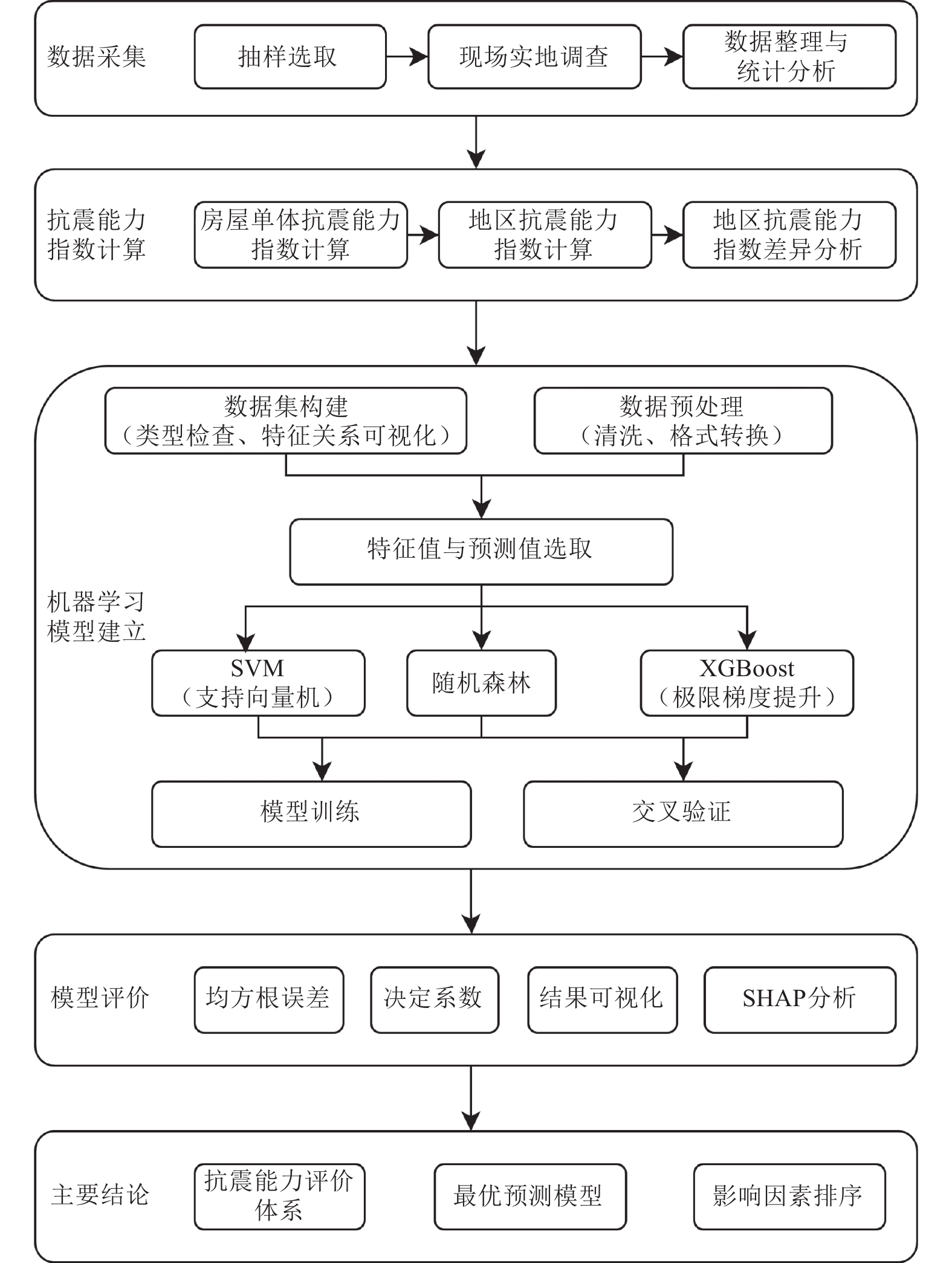
图 4 河北省砖混民居房屋抗震能力指数研究流程图
Figure 4. Flow chart of seismic capacity index of brick-concrete residential buildings in Hebei province
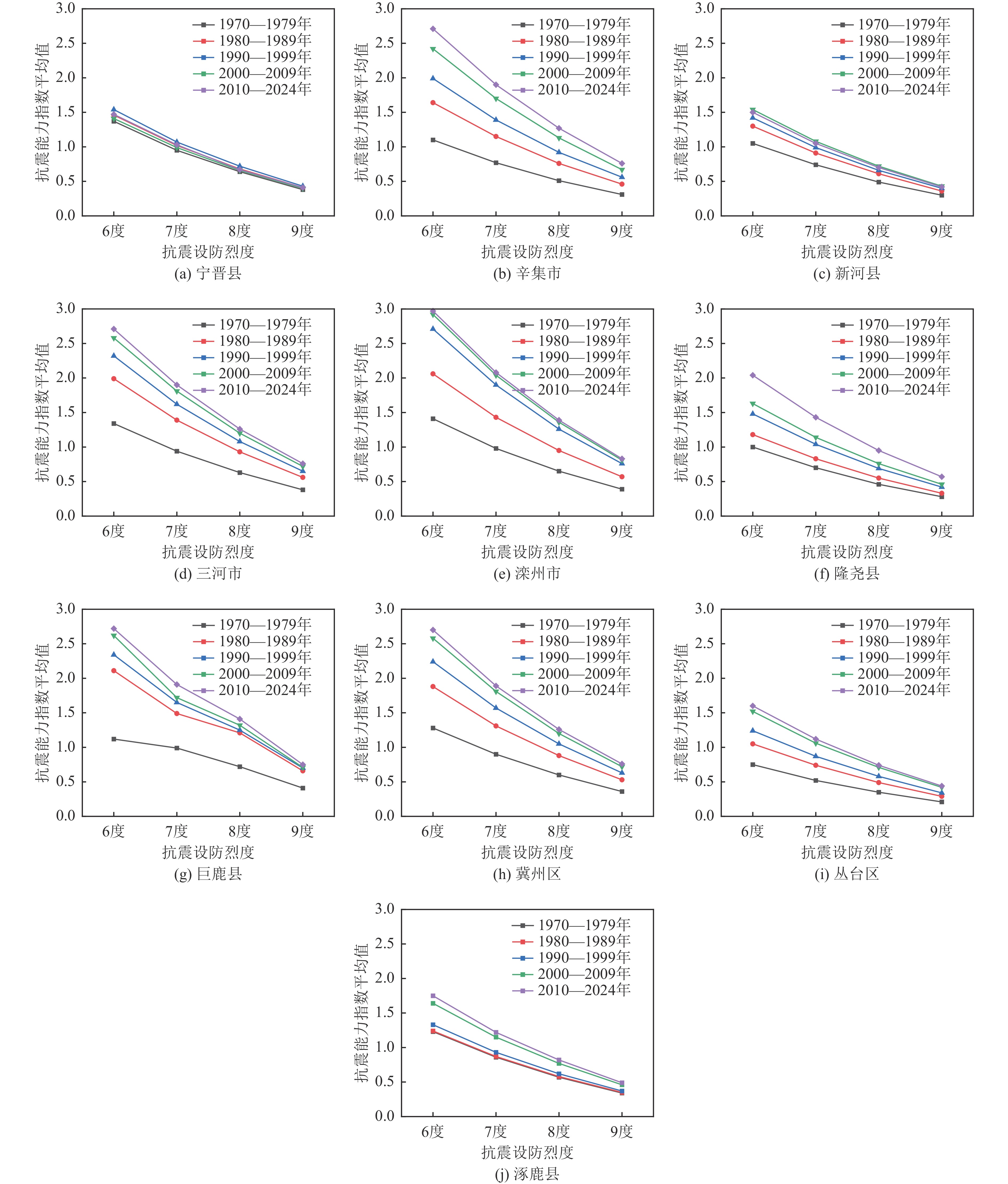
图 5 河北省10个区县抗震能力指数折线图
Figure 5. Plot of seismic capacity index of ten districts and counties in Hebei province
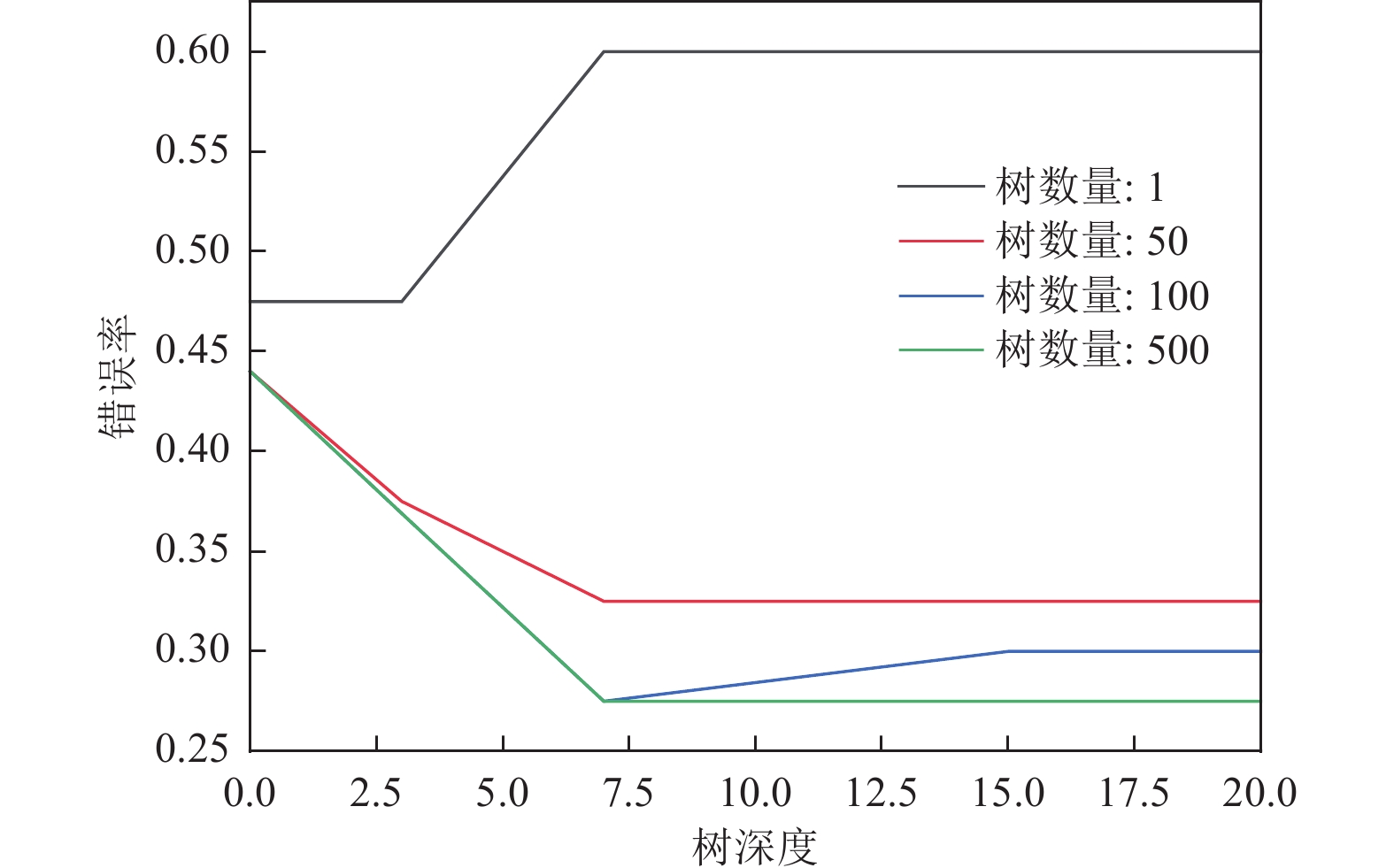
图 7 随机森林中树数量、树深度和错误率的关系图
Figure 7. The number of trees, tree depth, and error rate in a random forest
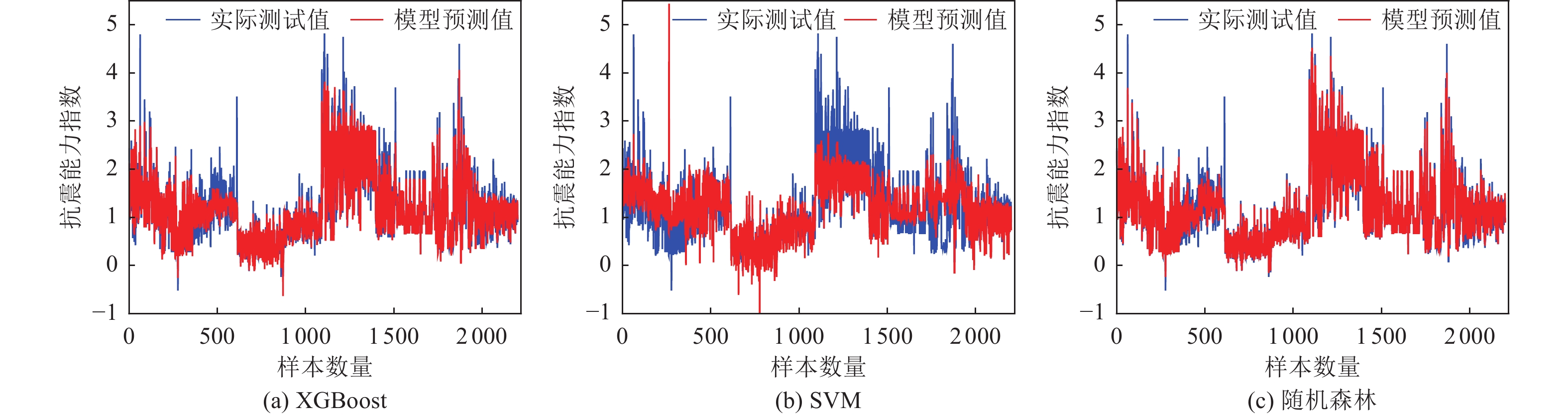
图 8 全部预测数据与实际测试数据的对比分析
Figure 8. Comparison and analysis of all forecast data with actual test data
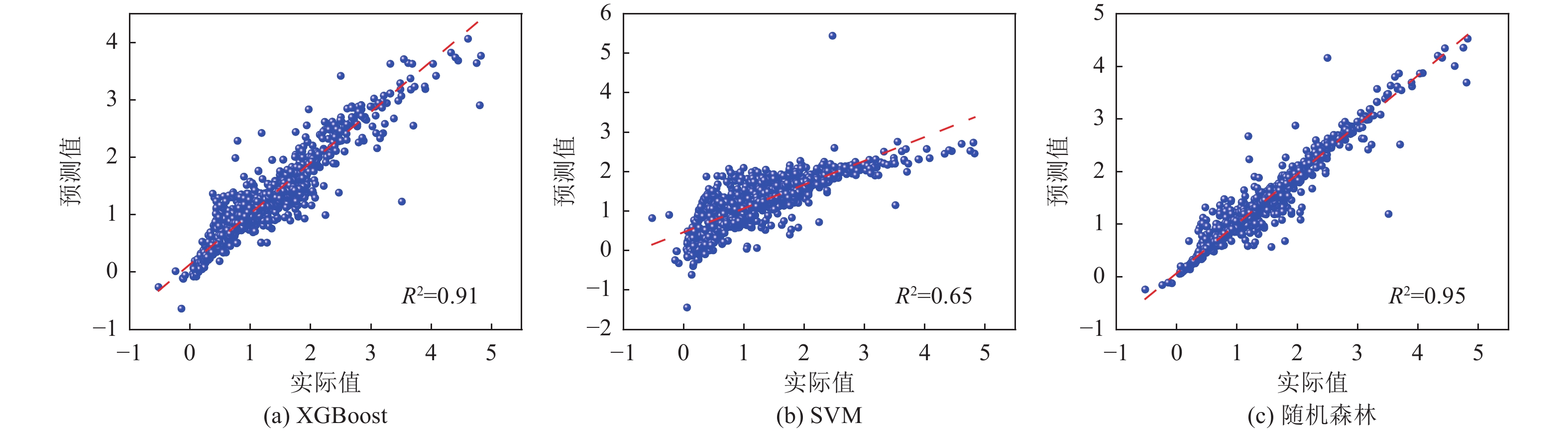
图 9 实际值与模型预测值的散点图分析
Figure 9. Scatter plot analysis of actual observations versus model predictions
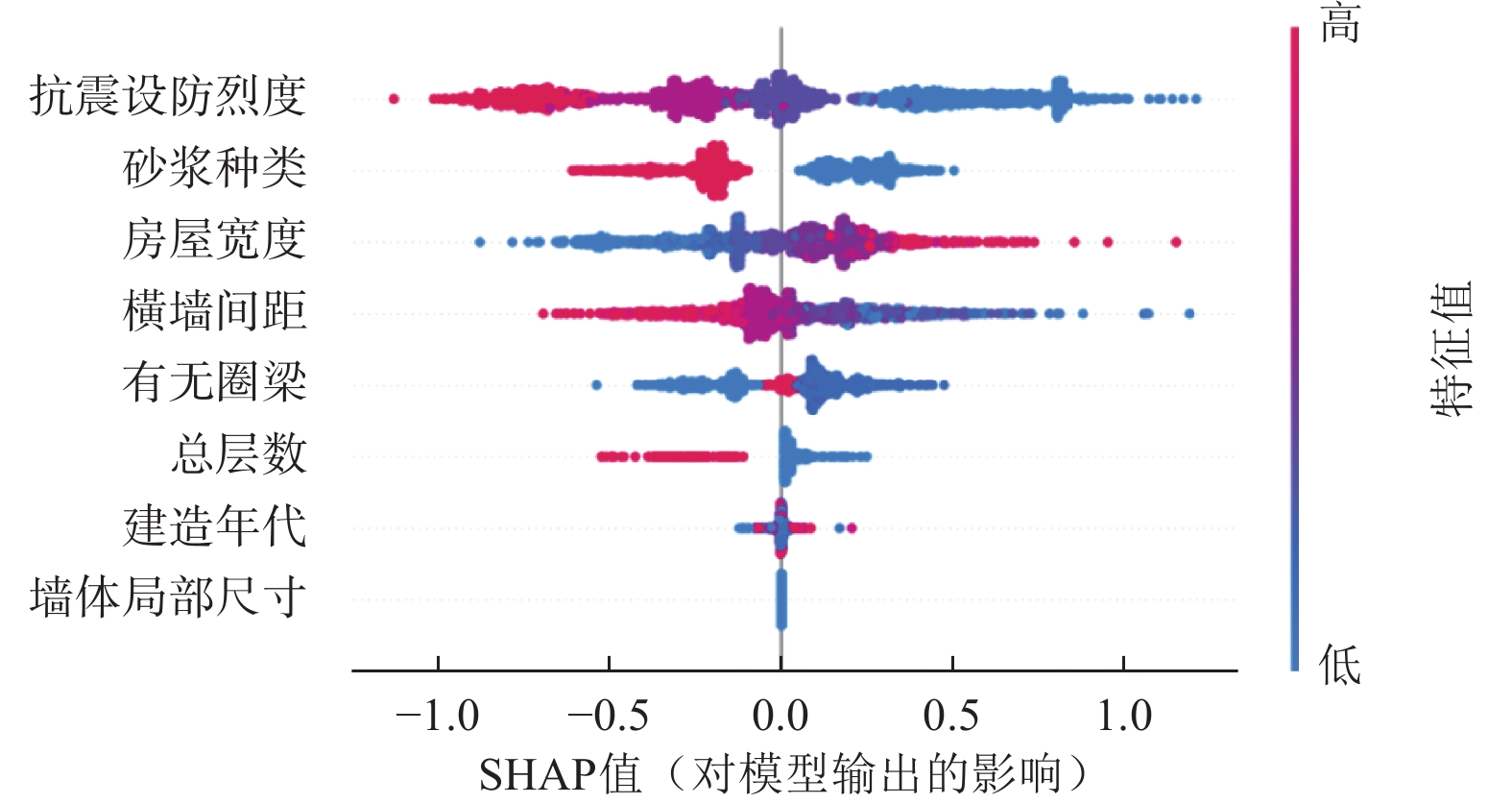
图 10 机器学习模型输入特征的SHAP分析图
Figure 10. SHAP analysis diagram of input features of machine learning model
表 1 实地走访调查点统计
Table 1. Statistics of field investigation and survey points
县(区) 所属行政区 调查点/个 样本房屋/栋 县(区) 所属行政区 调查点/个 样本房屋/栋 冀州区 衡水市 40 188 新河县 邢台市 24 123 巨鹿县 邢台市 40 200 三河市 廊坊市 43 215 隆尧县 邢台市 47 235 滦州市 唐山市 54 266 宁晋县 邢台市 58 298 涿鹿县 张家口市 56 294 辛集市 省属直管 60 260 丛台区 邯郸市 91 233  下载: 导出CSV
表 2 抗震能力指数与震害等级划分
Table 2. Seismic capacity index and seismic damage classification
抗震能力指数$ {\beta }_{\mathrm{c}i} $ 震害等级 $ {\beta }_{\mathrm{c}i}\geqslant 1.2 $ 完好 $ 1.0\leqslant {\beta }_{\mathrm{c}i}< 1.2 $ 轻微破坏 $ 0.6{\leqslant \beta }_{\mathrm{c}i}< 1.0 $ 中等破坏 $ 0.3\leqslant {\beta }_{\mathrm{c}i}< 0.6 $ 严重破坏 $ {\beta }_{\mathrm{c}i}< 0.3 $ 倒塌
下载: 导出CSV
表 3 随机森林模型参数
Table 3. Random forest model parameters
参数 设定值 n_estimator 500 max_depth 7 test_size 0.2 min_samples_split 2 max_feature None
下载: 导出CSV
-
李其廉, 陈佳尧, 敦彦茹等, 2024. 基于机器学习的水泥基灌浆料强度预测方法. 河北科技大学学报, 45(3): 308−317.Li Q. L., Chen J. Y., Dun Y R., et al., 2024. Machine learning based strength prediction method for cement-based grouting material. Journal of Hebei University of Science and Technology, 45(3): 308−317. (in Chinese) 梁梓豪, 苗鹏宇, Wang J. M., 等, 2024. 基于随机森林方法的地震损失预测. 地震学报, 46(4): 649−662.Liang Z. H., Miao P. Y., Wang J. M., et al., 2024. Earthquake loss prediction based on random forest algorithm. Acta Seismologica Sinica, 46(4): 649−662. (in Chinese) 卢建旗, 王雨佳, 李山有等, 2025. 基于XGBoost的现地PGV预测模型. 地球科学, 50(5): 1861−1874. doi: 10.3799/dqkx.2024.142Lu J. Q., Wang Y. J., Li S. Y., et al., 2025. An XGBoost-based onsite PGV prediction model. Earth Sciences, 50(5): 1861−1874. (in Chinese) doi: 10.3799/dqkx.2024.142 孙路, 刘金龙, 2025. 2022年泸定6.8级地震房屋震害及其统计分析. 地震研究, 48(1): 123−131. doi: 10.20015/j.cnki.ISSN1000-0666.2025.0013Sun L., Liu J. L., 2025. Seismic damage to buildings in the Luding MS 6.8 earthquake-hit area, Sichuan Province. Journal of Seismological Research, 48(1): 123−131. (in Chinese) doi: 10.20015/j.cnki.ISSN1000-0666.2025.0013 王洪, 2021. 青海共和地区农村民居抗震性能分析及诱发地震震害预测. 北京: 应急管理部国家自然灾害防治研究院.Wang H., 2021. Quantitative seismic-resistance capacity analysis and earthquake damage prediction of rural houses in Gonghe area of Qinghai Province. Beijing: National Institute of Natural Disaster Prevention and Control, Ministry of Emergency Management. (in Chinese) 王兰民, 王强, 2011. 西北地区农村民房现状及抗震技术研究. 华南地震, 31(4): 14−22. doi: 10.3969/j.issn.1001-8662.2011.04.002Wang L. M., Wang Q., 2011. Study on status and anti-seismic technology of rural houses in Northwest China. South China Journal of Seismology, 31(4): 14−22. (in Chinese) doi: 10.3969/j.issn.1001-8662.2011.04.002 杨玉成, 杨柳, 高云学等, 1982. 现有多层砖房震害预测的方法及其可靠度. 地震工程与工程振动, 2(3): 75−86.Yang Y. C., Yang L., Gao Y. X., et al., 1982. Method of damage prediction for existing multi-story brick buildings and its reliability. Earthquake Engineering and Engineering Dynamics, 2(3): 75−86. (in Chinese) 杨艳平, 李荣, 2025. 基于机器学习的高维数据分类特征选择. 湖南文理学院学报(自然科学版), 37(1): 23−31.Yang Y. P., Li R., 2025. Feature selection of high-dimensional data classification based on machine learning. Journal of Hunan University of Arts and Science (Science and Technology), 37(1): 23−31. (in Chinese) 姚新强, 孙柏涛, 陈宇坤等, 2019. 天津农居抗震性能调查与分析. 建筑结构, 49(16): 108−111.Yao X. Q., Sun B. T., Chen Y. K., et al., 2019. Investigation and analysis on seismic performance of rural residences in Tianjin. Building Structure, 49(16): 108−111. (in Chinese) 于浩, 贾晓东, 庞巧等, 2023. 基于无人机影像的辽宁农居建筑物提取技术与应用研究. 震灾防御技术, 18(1): 96−106.Yu H., Jia X. D., Pang Q., et al., 2023. Research on extraction technology and application of rural residential buildings in Liaoning Province based on UAV image. Technology for Earthquake Disaster Prevention, 18(1): 96−106. (in Chinese) 赵峦啸, 刘金水, 姚云霞等, 2021. 基于随机森林算法的陆相沉积烃源岩定量地震刻画: 以东海盆地长江坳陷为例. 地球物理学报, 64(2): 700−715. doi: 10.6038/cjg2021O0123Zhao L. X., Liu J. S., Yao Y. X., et al., 2021. Quantitative seismic characterization of source rocks in lacustrine depositional setting using the Random Forest method: an example from the Changjiang sag in East China Sea basin. Chinese Journal of Geophysics, 64(2): 700−715. (in Chinese) doi: 10.6038/cjg2021O0123 Huang C. S., Hung S. L., Wen C. M., et al., 2003. A neural network approach for structural identification and diagnosis of a building from seismic response data. Earthquake Engineering & Structural Dynamics, 32(2): 187−206. doi: 10.1002/eqe.219 Luo H., Paal S. G., 2021. Metaheuristic least squares support vector machine-based lateral strength modelling of reinforced concrete columns subjected to earthquake loads. Structures, 33: 748−758. doi: 10.1016/j.istruc.2021.04.048 Mangalathu S., Jeon J. S., 2019. Machine learning-based failure mode recognition of circular reinforced concrete bridge columns: comparative study. Journal of Structural Engineering, 145(10): 4019104. doi: 10.1061/(ASCE)ST.1943-541X.0002402 Nguyen H. D., Dao N. D., Shin M., 2021. Prediction of seismic drift responses of planar steel moment frames using artificial neural network and extreme gradient boosting. Engineering Structures, 242: 112518. doi: 10.1016/j.engstruct.2021.112518 Oh B. K., Glisic B., Park S. W., et al., 2020. Neural network-based seismic response prediction model for building structures using artificial earthquakes. Journal of Sound and Vibration, 468: 115109. doi: 10.1016/j.jsv.2019.115109 Sahoo D. M. , Chakraverty S. , 2018. Functional link neural network learning for response prediction of tall shear buildings with respect to earthquake data. IEEE Transactions on Systems, Man, and Cybernetics, 48(1): 1−10. -


 点击查看大图
计量
- 文章访问数: 287
- HTML全文浏览量: 207
- PDF下载量: 194
- 被引次数: 0
