


Seismic Responses of Jacket Platform and Structural Digital Twin Post Assessment Based on the Time-history Analysis
-
摘要: 为准确评估导管架平台在地震等极端工况下的结构状态,提升抗震能力,并为极端灾害发生后的加固及维修提供数据支撑,选取4组时程地震波进行计算分析。通过对比时程响应和传统反应谱分析方法的计算结果,评价二者对于实际工程的适用性。研究结果表明,由于地震的频谱特性,不同地震作用下杆件校核结果呈显著差异,多组时程计算能够更有效识别结构的薄弱部位。在时程校核统计方法中,多组地震波的时程最大值和时程平均值统计结果相较于反应谱分析方法的保证率分别为63.64%和50%。此外,由于地震载荷的不确定性,本文提出了一种基于数字孪生的结构状态后报方法,该方法以地震分析过程中的监测点数据为基础,其预测结果与时程分析数据具有良好的一致性,可为实际工程应用提供有效的技术支撑。Abstract: To accurately evaluate the structural condition of jacket platforms under extreme events such as earthquakes and to provide data support for post-disaster strengthening and maintenance, time-history analyses were conducted to calculate the dynamic structural responses using four sets of earthquake records. The results were then compared with those obtained from response spectrum analysis. Based on this comparison, the applicability of the two methods to practical engineering was evaluated. The results show that member-level safety checks differ between the two methods because of the dynamic characteristics of the structure. Time-history analyses using multiple earthquake records can effectively identify weak members in the platform structure. Statistical analysis of the results indicates that the maximum and mean responses obtained from multiple seismic inputs provide assurance rates of 63.64% and 50.00%, respectively. In addition, a digital twin analysis was performed to investigate post-event reporting methods for damaged structures. Comparison with numerical calculation results shows that the digital twin method can provide realistic predictive results and data support for practical engineering applications.
-
Key words:
- Jacket platform /
- Seismic response /
- Time-history analysis /
- Digital twin
-
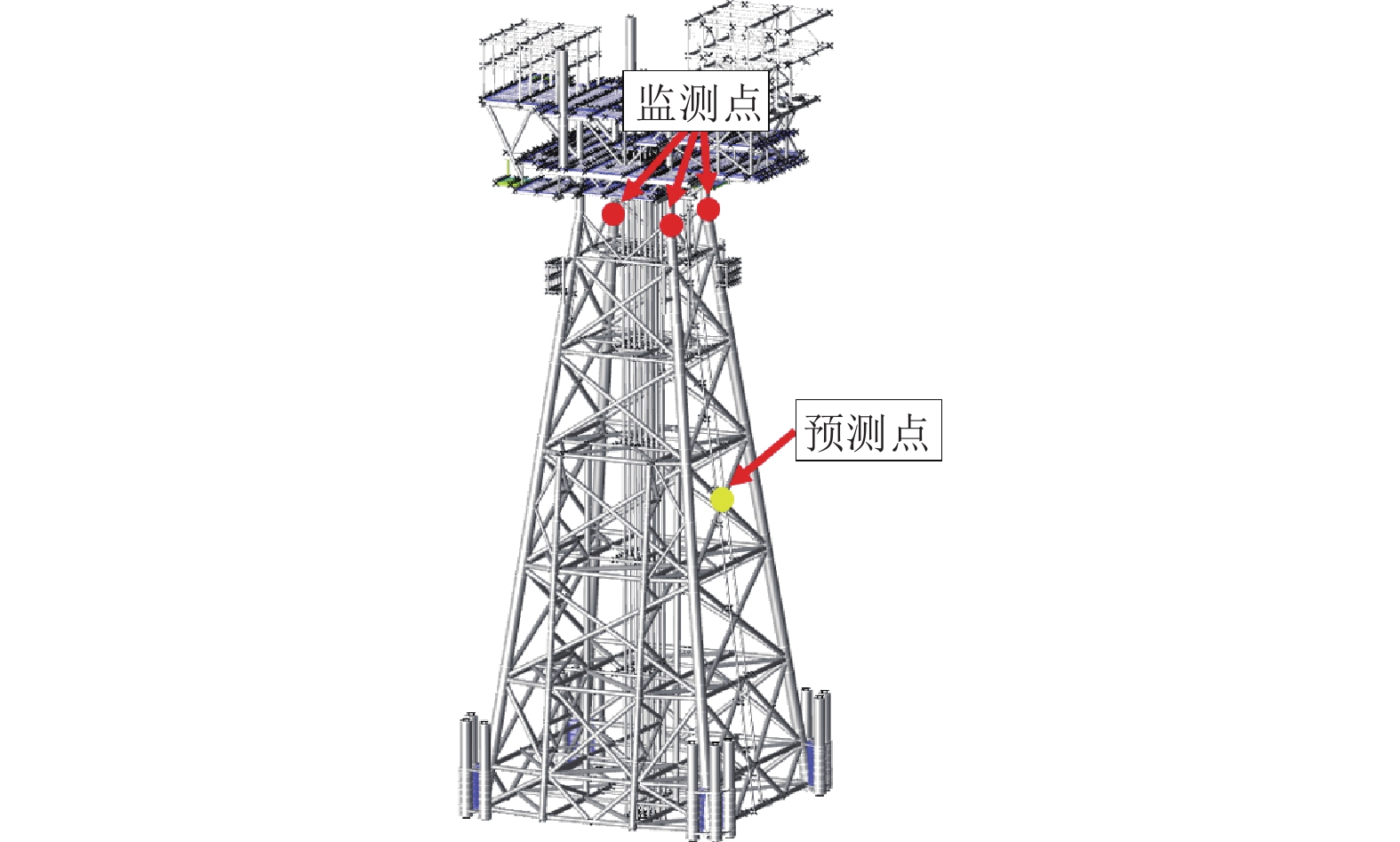
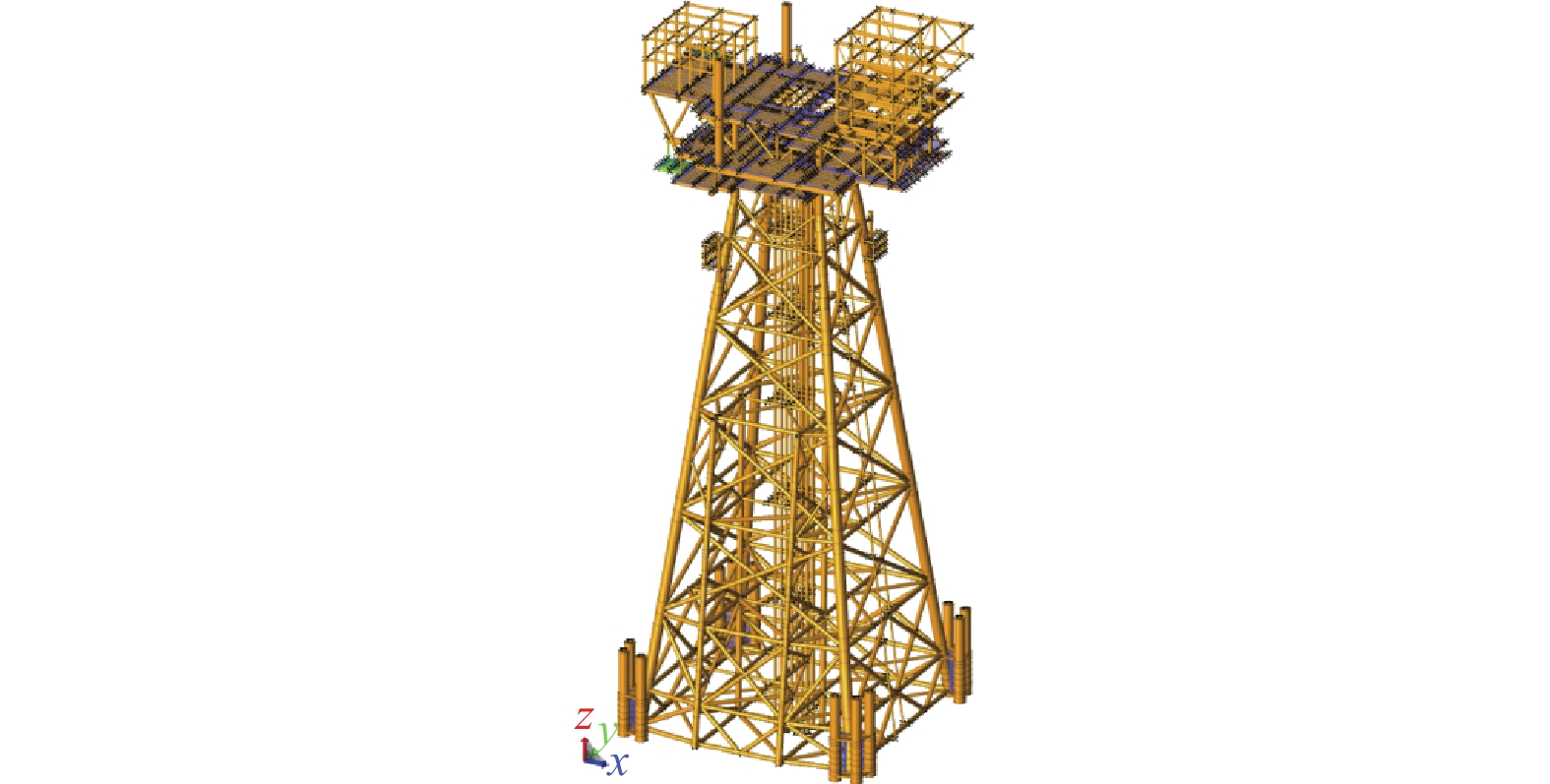
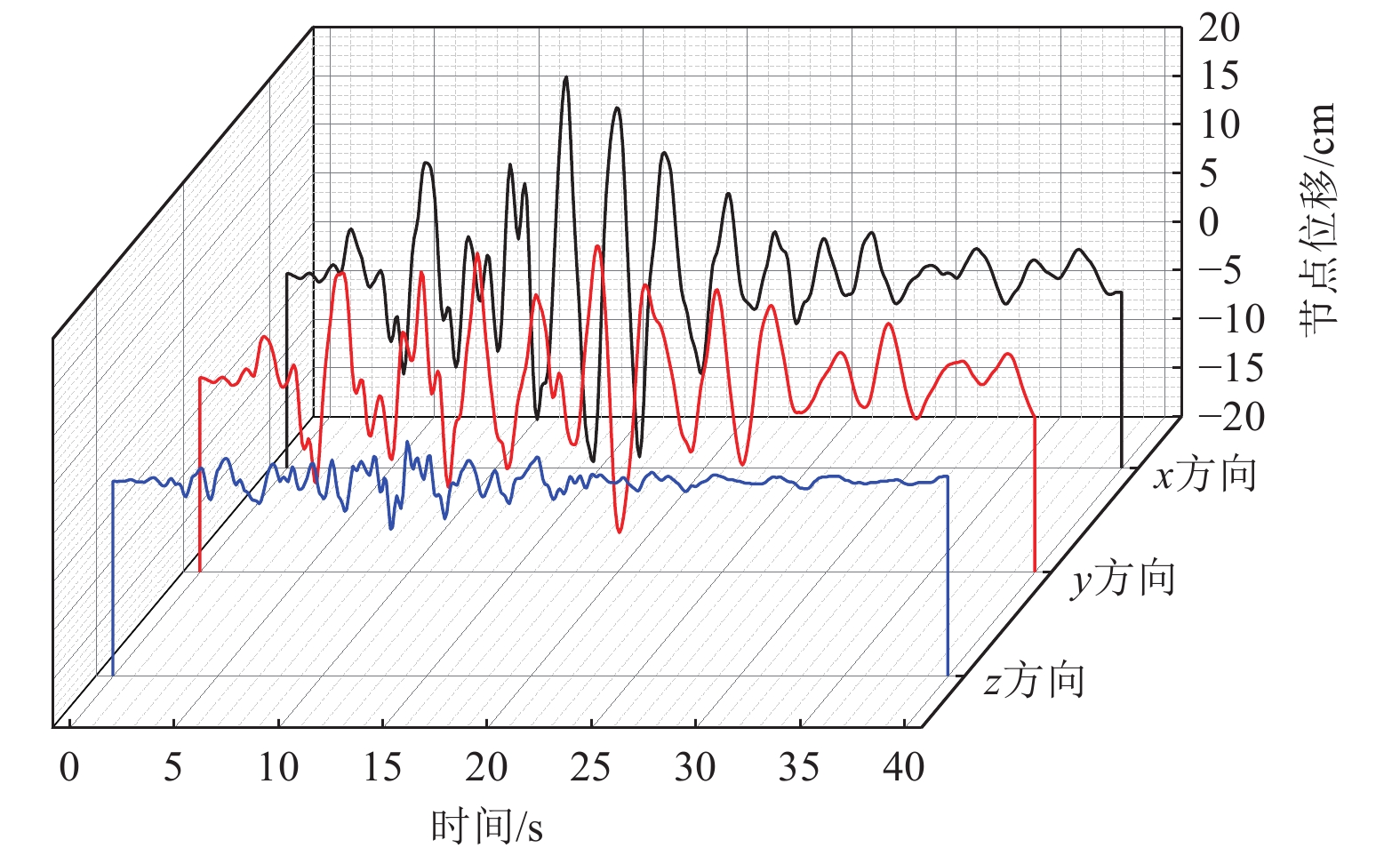
图 11 平台监测点、预测点位置示意图
Figure 11. Schematic locations of monitoring points and prediction points
表 1 某平台地震参数
Table 1. Seismic parameters of a Jacket platform
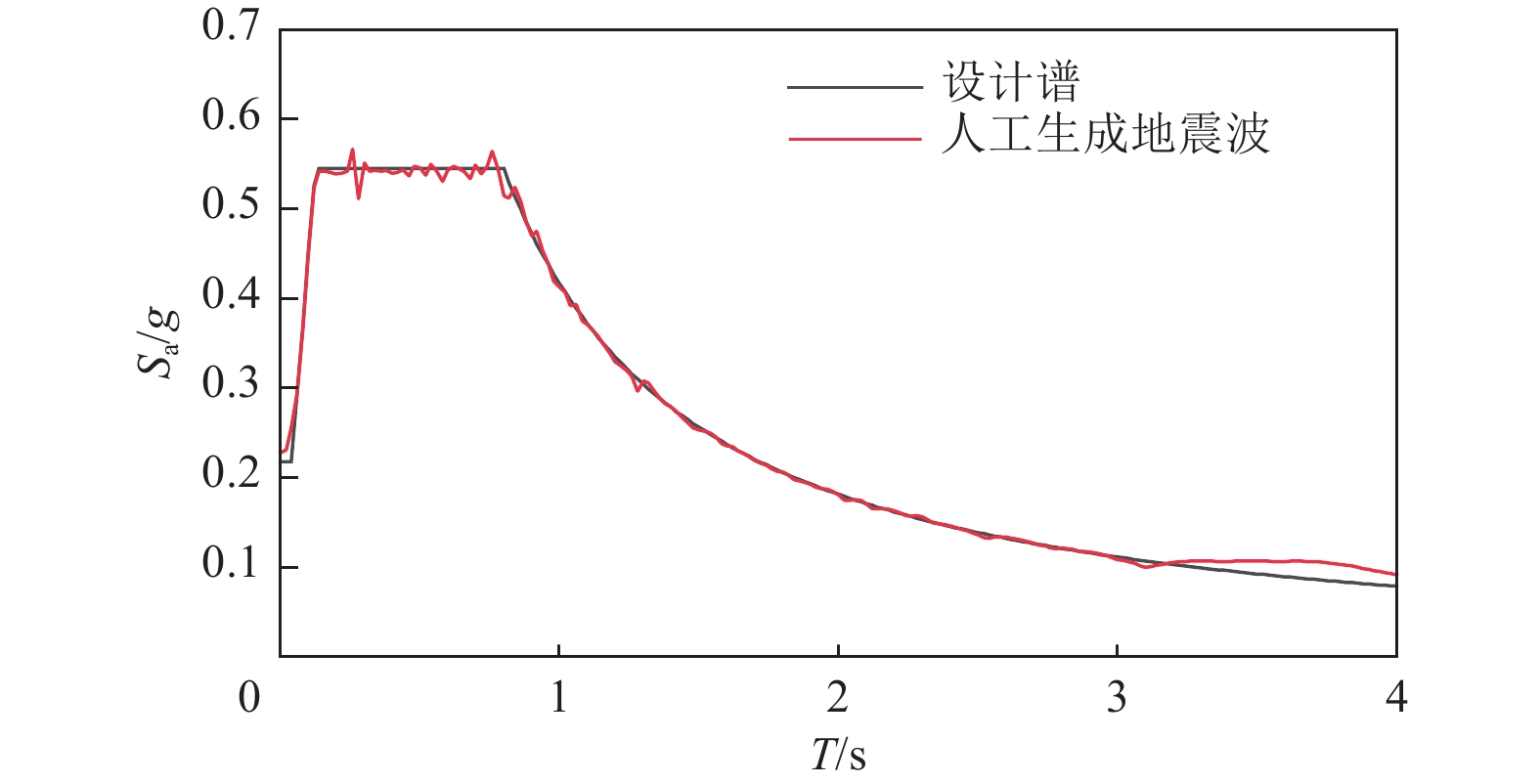
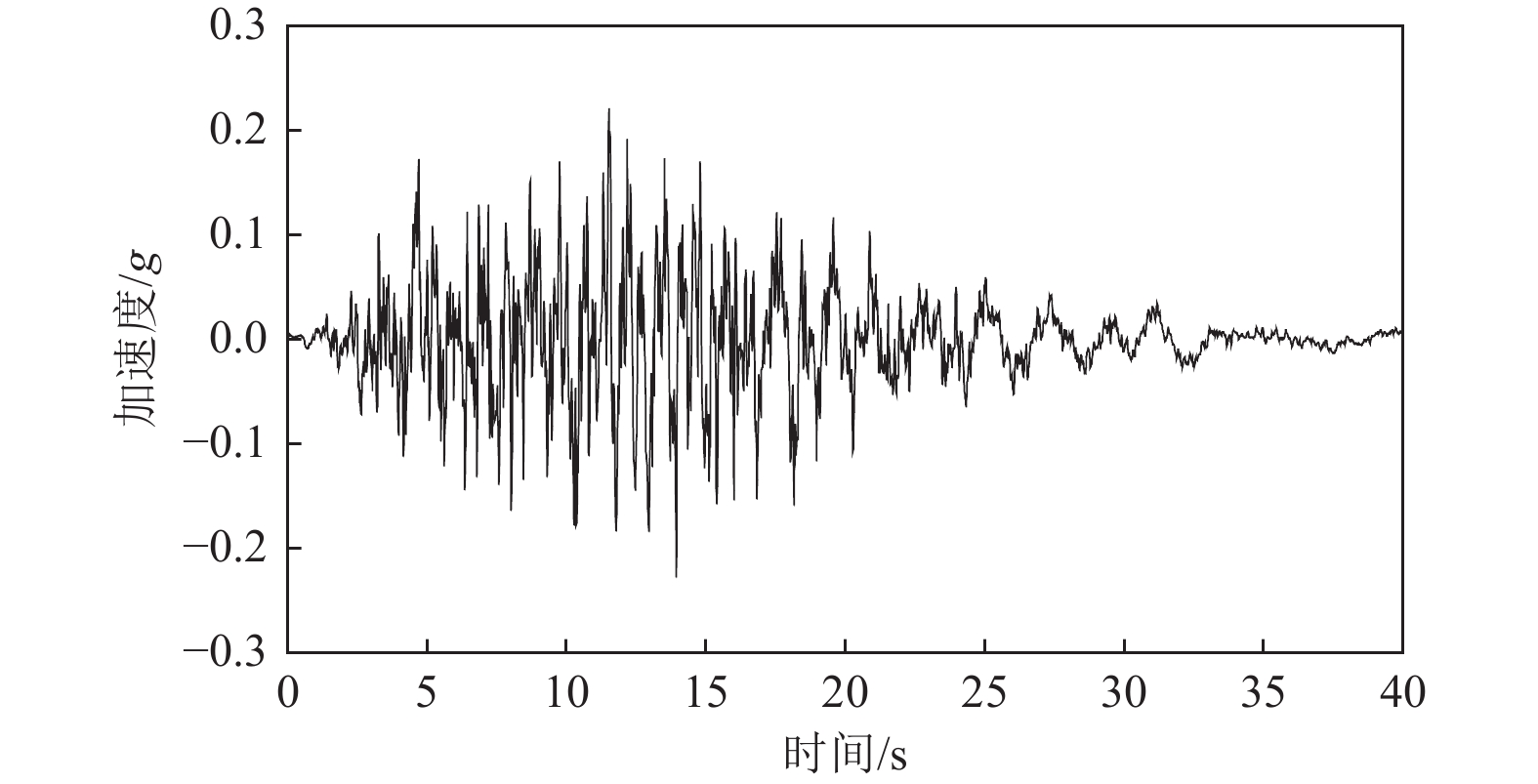
峰值加速度/g βm T0/s T1/s Tg/s C 0.218 2.5 0.04 0.125 0.8 1.2  下载: 导出CSV
表 2 地震时程数据
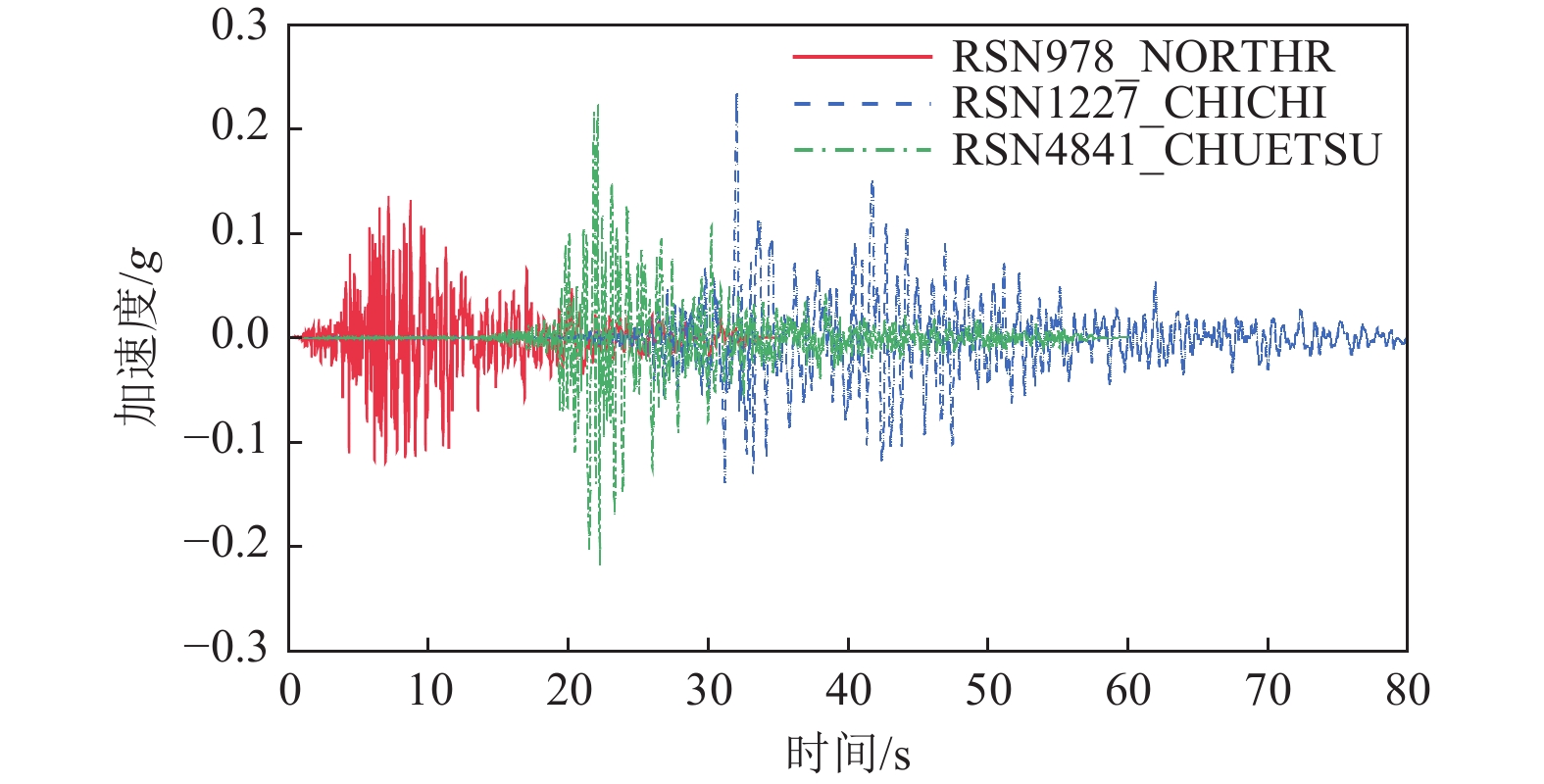
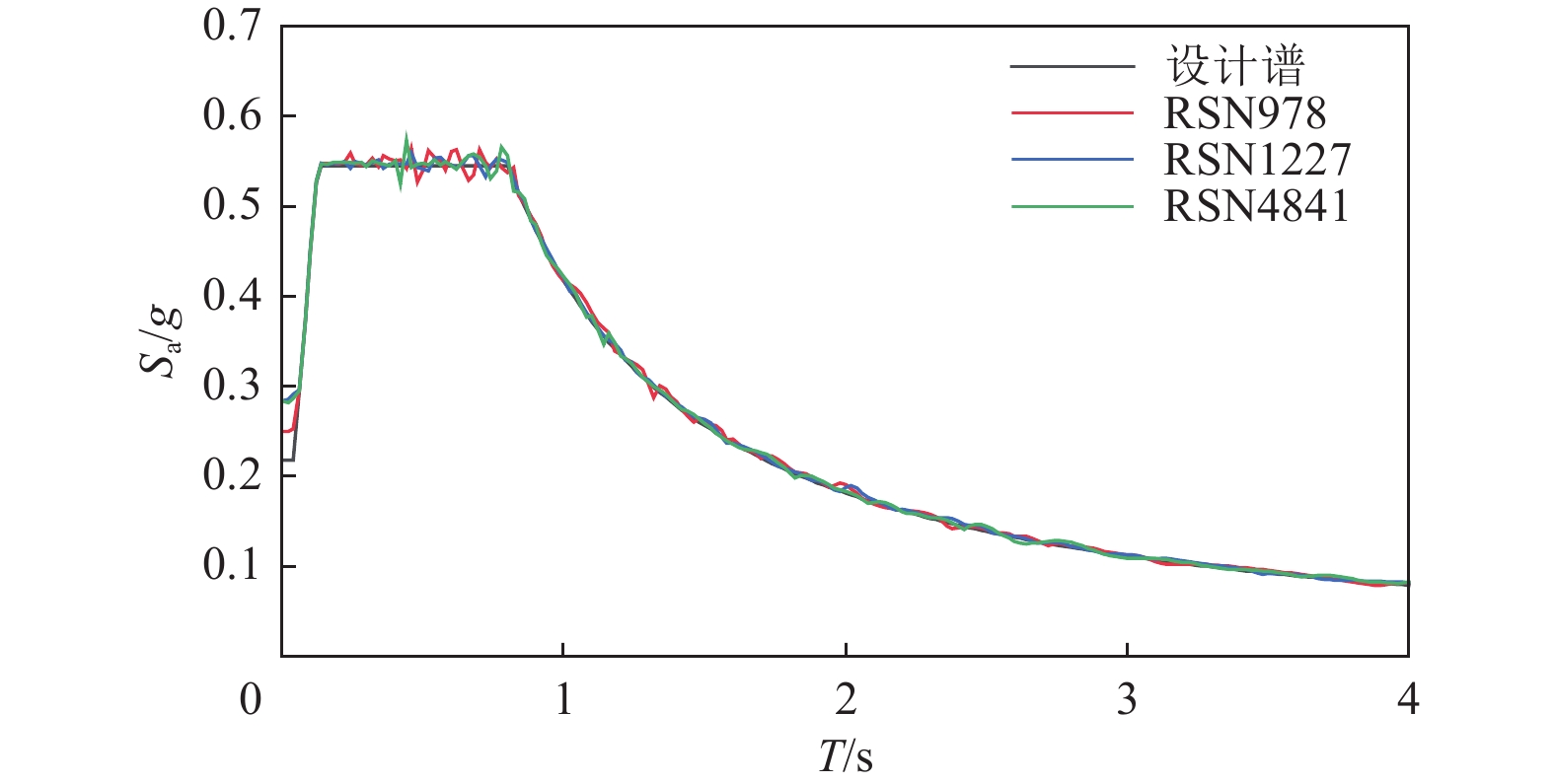
Table 2. Parameters of recorded seismic data
序号 记录编号 阿里亚斯烈度/(m·s−1) 震级 发生位置 年份 VS30/(m·s−1) Rjb/km Rrup/km 1 RSN978 0.9 6.69 日本中越冲 1994 347.7 17.82 23.07 2 RSN1227 1.1 7.62 中国台湾 1999 553.43 0.7 10.8 3 RSN4841 0.7 6.8 美国北岭 2007 655.45 20.65 25.52
下载: 导出CSV
表 3 某平台主要技术参数
Table 3. Parameters of Jacket platform
参数 数据 工作点标高/m EL(+)12.19 泥面标高/m EL(−)98.515 钢材等级 Q345 主腿尺寸/(mm×mm) 2134 ×42桩尺寸/(mm×mm) 2134 ×(50~75)入泥深度/m ~97 钢桩数量/根 4×3
下载: 导出CSV
表 4 平台结构固有周期
Table 4. Natural period of Jacket platform
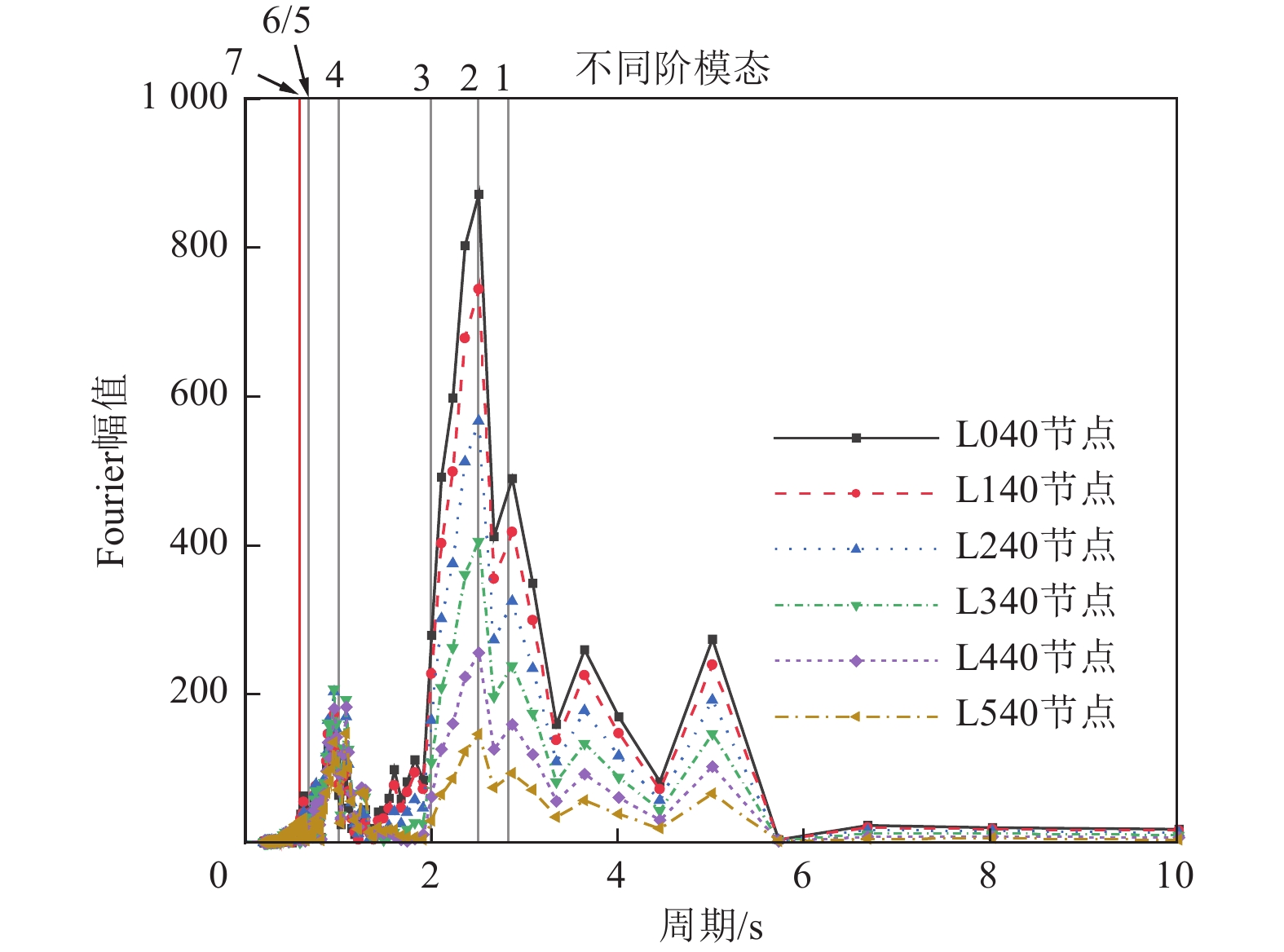
阶数 周期T/s 阶数 周期T/s 1 2.824 6 0.674 2 2.496 7 0.588 3 1.996 8 0.558 4 1.004 9 0.540 5 0.997 10 0.521
下载: 导出CSV
表 5 杆件校核结果
Table 5. Member UC under different conditions
杆件 杆件位置 杆件类型 UC值 反应谱分析 人工地震波 RSN978 RSN1227 RSN4841 L040-H134 (+)3.81 m~(+)12.19 m 斜撑 1.281 1.084 1.243 1.302 1.18 L410-X134 (−)41.77 m~(−)53.34 m 斜撑 1.332 0.92 1.315 1.373 1.034 L330-X134 (−)32.00 m~(−)41.77 m 斜撑 1.374 0.867 1.232 1.315 0.999 L030-H134 (+)3.81 m~(+)12.19 m 斜撑 1.46 1.405 1.352 1.246 1.185 L330-XB34 (−)32.00 m~(−)41.77 m 斜撑 1.008 0.846 1.498 1.129 0.859 L440-XB34 (−)41.77 m~(−)53.34 m 斜撑 1.037 0.867 1.545 1.168 0.886 L030-H116 (+)3.81 m~(+)12.19 m 斜撑 1.361 1.194 1.514 1.707 1.486 L010-H116 (+)3.81 m~(+)12.19 m 斜撑 1.326 1.179 1.818 1.385 1.298 L730-H730 (−)98.52 m 水平撑 2.209 1.219 1.178 1.158 1.071
下载: 导出CSV
表 6 节点位移特征值
Table 6. Characteristic displacement of Joins
模态 节点 坐标(x, y, z) 位移 $ \Delta x $/cm 模态 节点 坐标(x, y, z) 位移 $ \Delta x $/cm 1 L030 (−9.15, 7.62, 12.19) 1.286 5 X234 (15.88, 0, −41.73) 2.56 2 L040 (9.15, 7.62, 12.19) 1.829 6 L440 (17.34, 15.81, −53.34) 2.475 3 L020 (9.15, −7.62, 12.19) 1.975 7 X234 (15.88, 0, −41.73) 1.281 4 XB34 (0, 14.38, −41.86) 2.547 8 XA12 (0, −9.66, −4.13) 1.004
下载: 导出CSV
表 7 误差统计结果
Table 7. Error statistics results
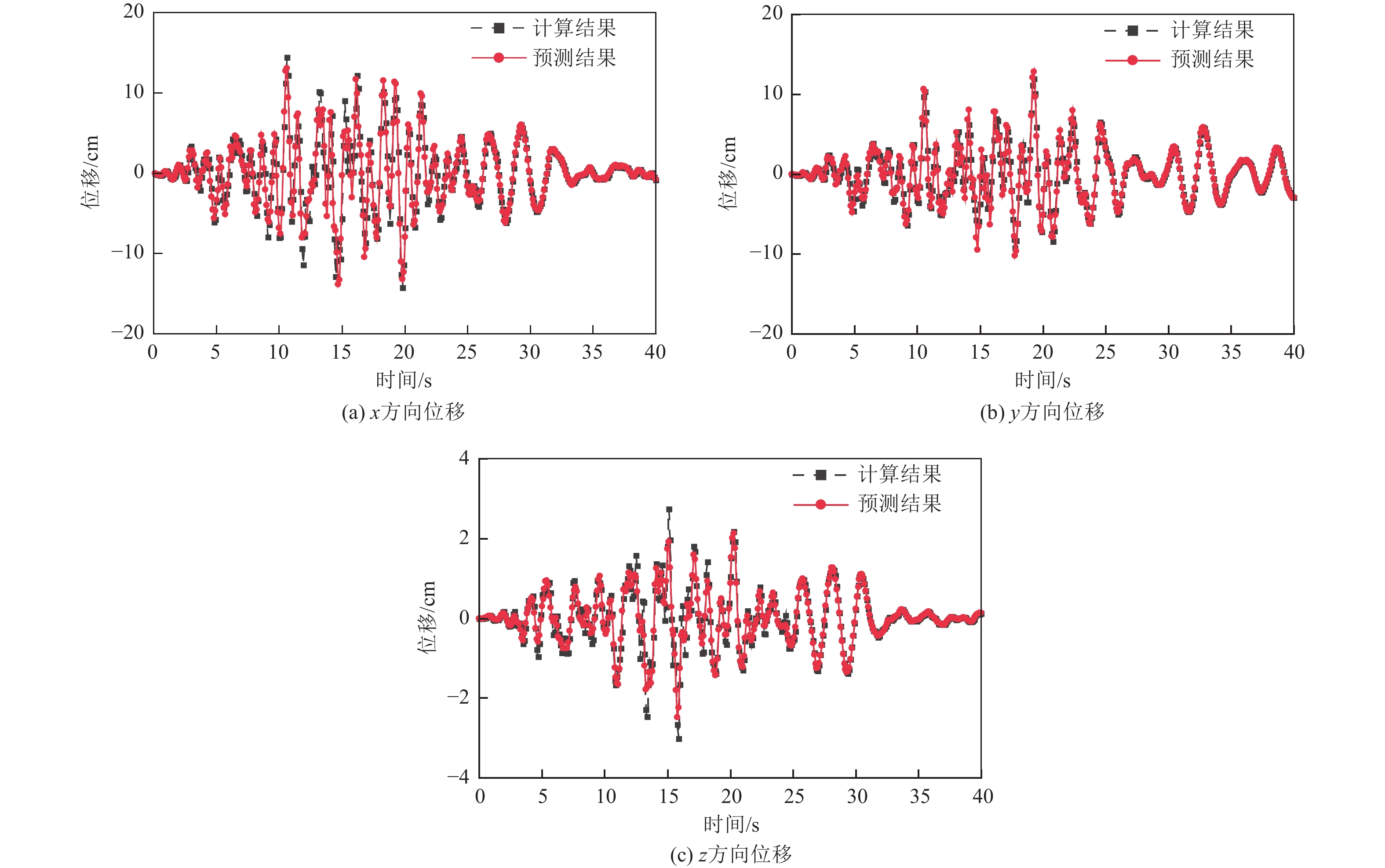
方向 平均误差 标准差 相关系数 x方向位移 ≈0 1.4651 0.9363 y方向位移 ≈0 0.9129 0.9623 z方向位移 ≈0 0.1980 0.9624
下载: 导出CSV
-
付殿福, 邵卫东, 王忠畅, 2021. 渤海固定平台非线性时程地震的抗震设计. 船海工程, 50(1): 107−111.Fu D. F., Shao W. D., Wang Z. C., 2021. Aseismic design of fixed platform based on nonlinear time domain seismic technology in Bohai. Ship & Ocean Engineering, 50(1): 107−111. (in Chinese) 金宇航, 闫培雷, 郭恩栋等, 2022. 地震-台风耦合作用下近海导管架平台动力响应分析. 震灾防御技术, 17(1): 132−142.Jin Y. H., Yan P. L., Guo E. D., et al., 2022. Dynamic response analysis of offshore jacket platform under the coupling action of the earthquake and Typhon. Technology for Earthquake Disaster Prevention, 17(1): 132−142. (in Chinese) 刘晶波, 杜修力, 2005. 结构动力学. 北京: 机械工业出版社, 35−50. 吴梦宁, 吴景健, 李翔云等, 2024. 基于地震时程法的导管架平台动力响应分析. 船舶工程, 46(2): 115−123, 137. doi: 10.13788/j.cnki.cbgc.2024.02.15Wu M. N., Wu J. J., Li X. Y., et al., 2024. Seismic dynamic response analysis of offshore jacket platforms based on the time history analysis method. Ship Engineering, 46(2): 115−123,137. (in Chinese) doi: 10.13788/j.cnki.cbgc.2024.02.15 肖辉, 关湃, 朱本瑞等, 2018. 韧性水平地震作用下导管架平台非线性时程分析. 中国海洋平台, 33(4): 66−72, 77.Xiao H., Guan P., Zhu B. R., et al., 2018. Nonlinear time history analysis of jacket platform under ductility level earthquake. China Offshore Platform, 33(4): 66−72,77. (in Chinese) 谢卓娟, 2020. 中国海域及邻区地震区划中的地震活动性研究. 哈尔滨: 中国地震局工程力学研究所. Xie Z. J. , 2020. Study on seismic activities in seismic zoning of China's seas and adjacent. Harbin: Institute of Engineering Mechanics, China Earthquake Administration. (in Chinese 闫天红, 王维刚, 赵海峰等, 2021. 现役导管架平台结构监测系统开发与数字孪生技术. 中国机械工程, 32(20): 2508−2513. doi: 10.3969/j.issn.1004-132X.2021.20.014Yan T. H., Wang W. G., Zhao H. F., et al., 2021. Development of structure monitoring systems and digital twin technology of active jacket platforms. China Mechanical Engineering, 32(20): 2508−2513. (in Chinese) doi: 10.3969/j.issn.1004-132X.2021.20.014 杨马陵, 魏柏林, 2005. 南海海域地震海啸潜在危险的探析. 灾害学, 20(3): 41−47. doi: 10.3969/j.issn.1000-811X.2005.03.009Yang M. L., Wei B. L., 2005. The potential seismic tsunami risk in South China Sea and it's surrounding region. Journal of Catastrophology, 20(3): 41−47. (in Chinese) doi: 10.3969/j.issn.1000-811X.2005.03.009 American Petroleum Institute, 2014a. Recommended practice for planning, designing and constructing fixed offshore platforms−working stress design. Washington: American Petroleum Institute. American Petroleum Institute, 2014b. Seismic design procedures and criteria for offshore structures. Washington: American Petroleum Institute. Bhat S. , Nadathur V. , Knezevic D. , et al. 2021. Structural digital twin of FPSO for monitoring the hull and topsides based on inspection data and load measurement. In: OTC, ed. , Offshore Technology Conference (OTC 2021). Houston: OTC. Bommer, J. J., Acevedo, A. B., 2004. The use of real earthquake accelerograms as input to dynamic analysis. Journal of Earthquake Engineering, 8(sup001): 43−91. doi: 10.1080/13632460409350521 Galasso C., Zhong P., Zareian F., et al., 2013. Validation of ground‐motion simulations for historical events using MDoF systems. Earthquake Engineering & Structural Dynamics, 42(9): 1395−1412. doi: 10.1002/eqe.2278 Gasparini D. A. , Vanmarcke E. H. , 1976. Simulated earthquake motions compatible with prescribed response spectra. Cambridge: MIT. Hancock J., Watson-Lamprey J., Abrahamson N. A., et al., 2006. An improved method of matching response spectra of recorded earthquake ground motion using wavelets. Journal of Earthquake Engineering, 10(sup001): 67−89. doi: 10.1080/13632460609350629 Juang J. N. , Pappa R. S. , 1985. An eigensystem realization algorithm for modal parameter identification and model reduction. Journal of Guidance, Control, and Dynamics, 8(5): 620−627. Lu Q. C., Xie X., Parlikad A. K., et al., 2020. Digital twin-enabled anomaly detection for built asset monitoring in operation and maintenance. Automation in Construction, 118: 103277. doi: 10.1016/j.autcon.2020.103277 Lyons R. G. , 2011. Understanding digital signal processing. 3rd ed. Upper Saddle River: Pearson. Tarpø M., Nabuco B., Georgakis C., et al., 2020. Expansion of experimental mode shape from operational modal analysis and virtual sensing for fatigue analysis using the modal expansion method. International Journal of Fatigue, 130: 105280. doi: 10.1016/j.ijfatigue.2019.105280 -

 点击查看大图
计量
- 文章访问数: 191
- HTML全文浏览量: 93
- PDF下载量: 166
- 被引次数: 0
