


Seismic Response and Damage Analysis of High-speed Railway Continuous Rigid-frame Bridge under Near-fault Ground Motion
-
摘要: 为研究考虑轨道约束效应对高速铁路连续刚构桥的地震反应及损伤状态的影响,本文以一座跨径为256(48+2×80+48)m的连续刚构桥为对象进行研究。通过模拟连续刚构桥的施工过程获得成桥时的真实内力状态,然后基于等效荷载法得到内力等效荷载,并将其施加于OpenSees动力分析模型中,使其处于等效内力状态。输入三维近断层脉冲型地震动进行非线性时程分析。本文首先分析了是否考虑无砟轨道约束对高墩连续刚构桥主梁和桥墩的地震响应,其次分别以曲率延性系数和支座位移作为桥墩和支座的损伤评价指标,对是否考虑轨道约束的连续刚构桥进行损伤分析。结果表明:无砟轨道为连续刚构桥提供了很大的纵向约束,会明显降低主梁各部位(梁端和跨中)沿纵桥向的位移响应,在梁端处最大可降低约1.3倍,在跨中处最大降低约1.25倍;同时沿横桥向轨道约束会降低梁端地震响应,在横桥向可降低55.3%~66.3%,在竖向可降低0.7%~4.2%,但是轨道约束会放大跨中地震峰值位移(1.04倍~1.5倍)。此外,轨道约束在一定程度上也会降低桥墩和桥台处支座的损伤。Abstract: In order to investigate the effects of track restraint on the seismic response and damage state of high-speed railway continuous rigid-frame bridges, a continuous rigid-frame bridge with a span arrangement of 256 m (48+2×80+48) is taken as the research background. First, the actual internal force state of the completed bridge is obtained by simulating the construction process of the continuous rigid-frame bridge. Then, based on the equivalent load method, the equivalent internal-force load is derived and applied to the OpenSees dynamic analysis model so that it reaches an equivalent internal force state. Nonlinear time-history analysis is subsequently performed by inputting three-dimensional near-fault pulse-like ground motions. First, the seismic response of the high-pier continuous rigid-frame bridge is analyzed with and without considering ballastless track restraint. Second, the curvature ductility coefficient and support displacement are adopted as damage evaluation indices for the piers and supports, respectively. The results show that the ballastless track provides significant longitudinal restraint to the continuous rigid-frame bridge, which markedly reduces the longitudinal displacement response of each part of the main girder (girder ends and mid-span). At the girder ends, the maximum reduction reaches approximately 1.3 times, while at the mid-span, the maximum reduction is about 1.25 times. Meanwhile, in the transverse bridge direction, track restraint reduces the seismic response at the girder ends by approximately 55.3% to 66.3% in the transverse direction and by 0.7% to 4.2% in the vertical direction. However, it amplifies the seismic response at the mid-span by 1.04 to 1.5 times. In addition, track restraint also reduces the damage to the piers and abutments to a certain extent.
-
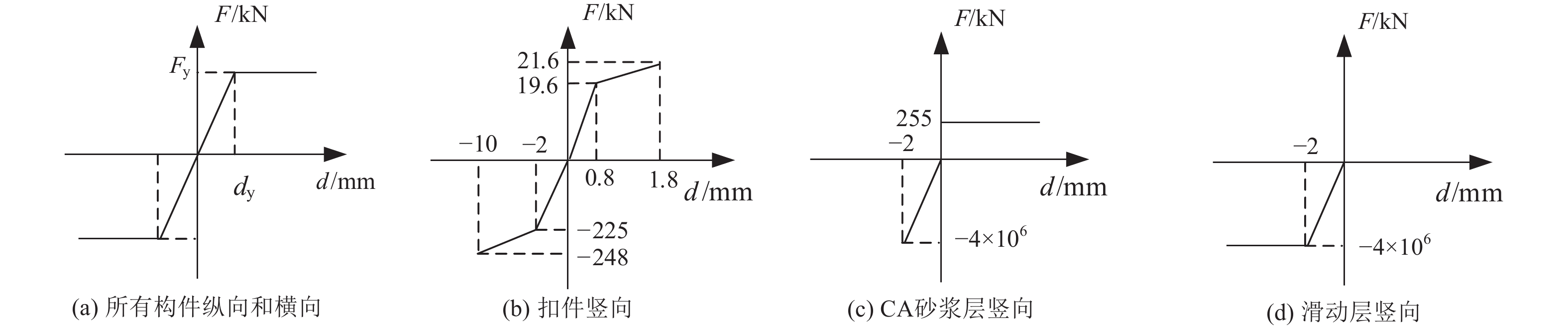
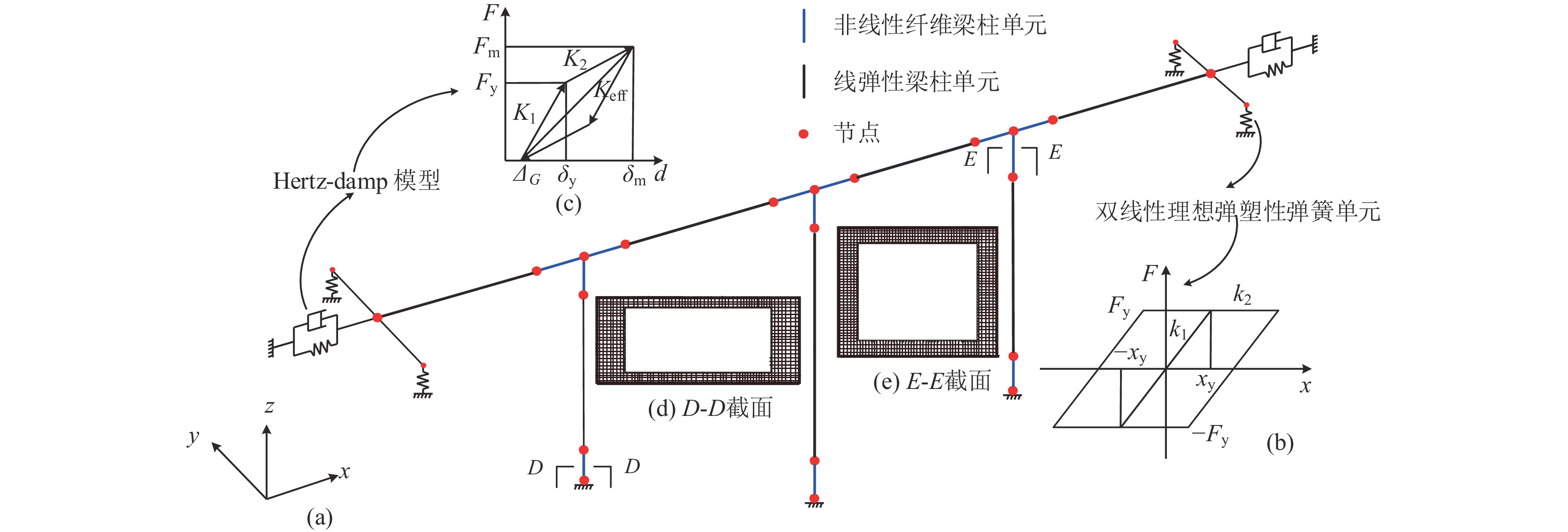
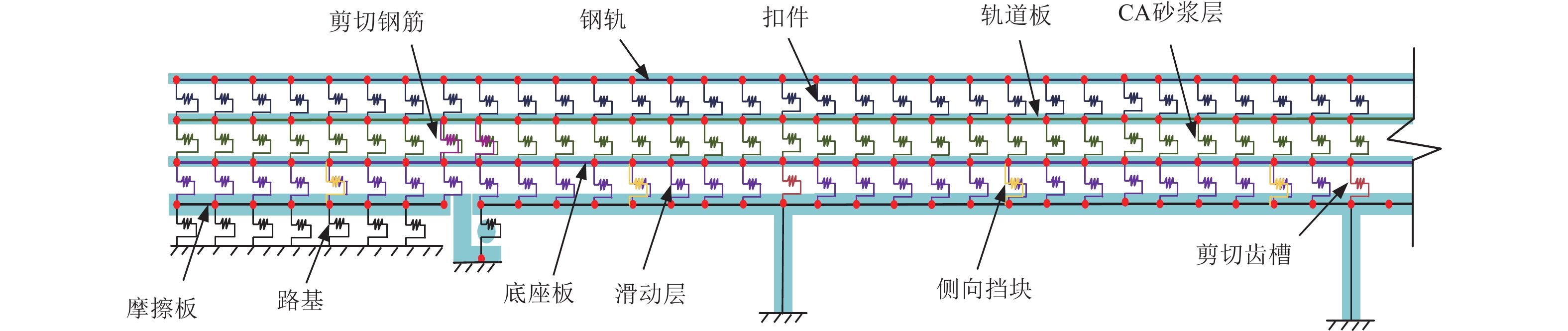
图 5 桥梁-轨道系统连接件力-位移关系
Figure 5. Force-displacement relationship of bridge-rail system connectors
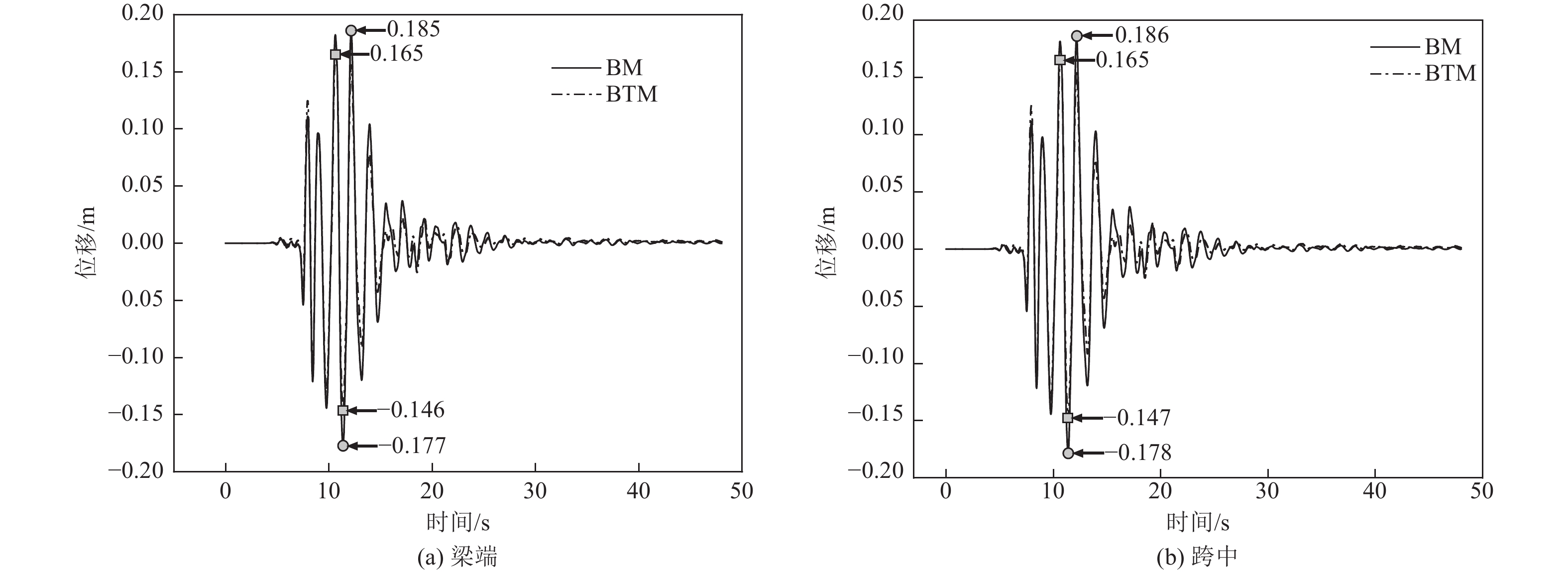
图 9 主梁沿纵桥向位移时程曲线
Figure 9. Time history curve of main girder displacement along longitudinal bridge
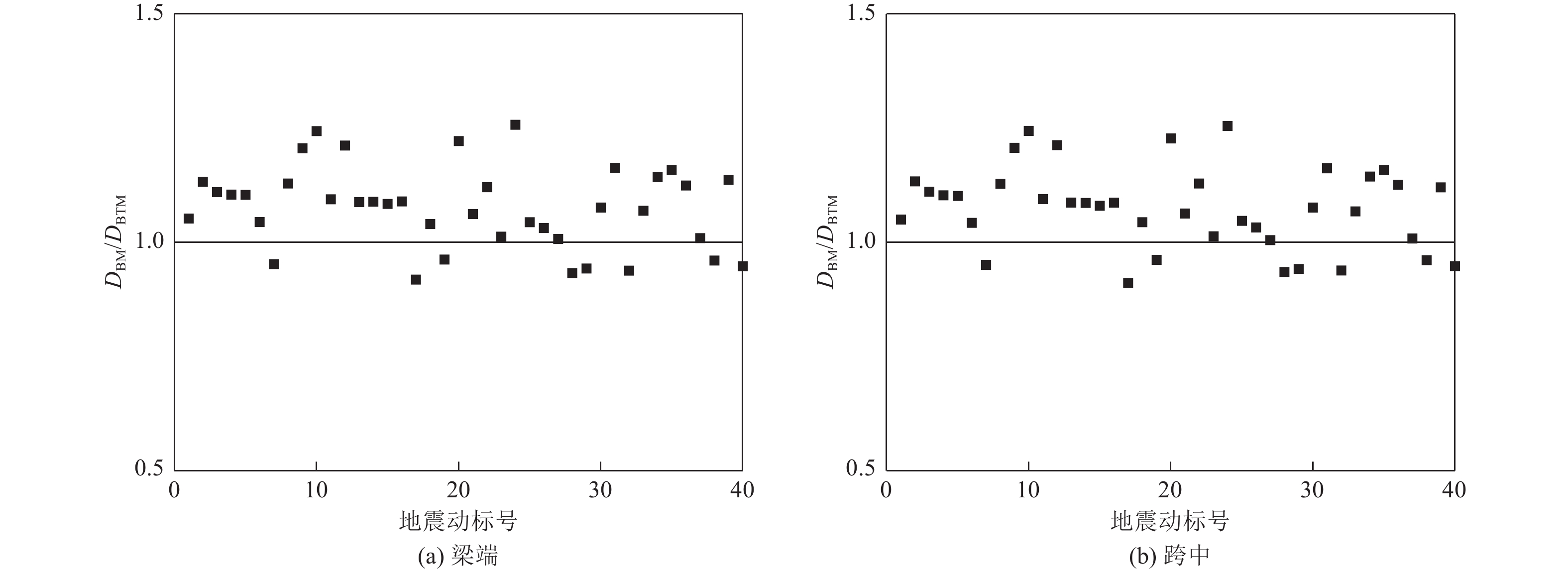
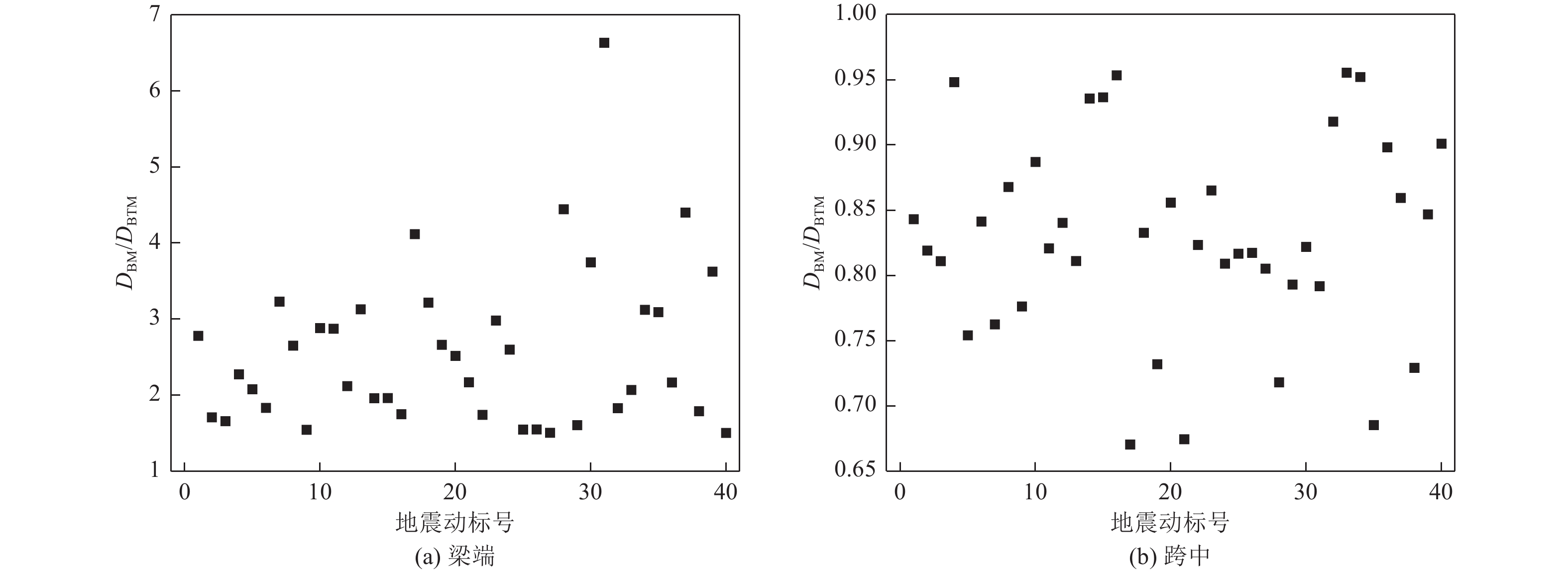
图 10 主梁沿纵桥向峰值位移比
Figure 10. Peak displacement ratio of main girder along longitudinal bridge
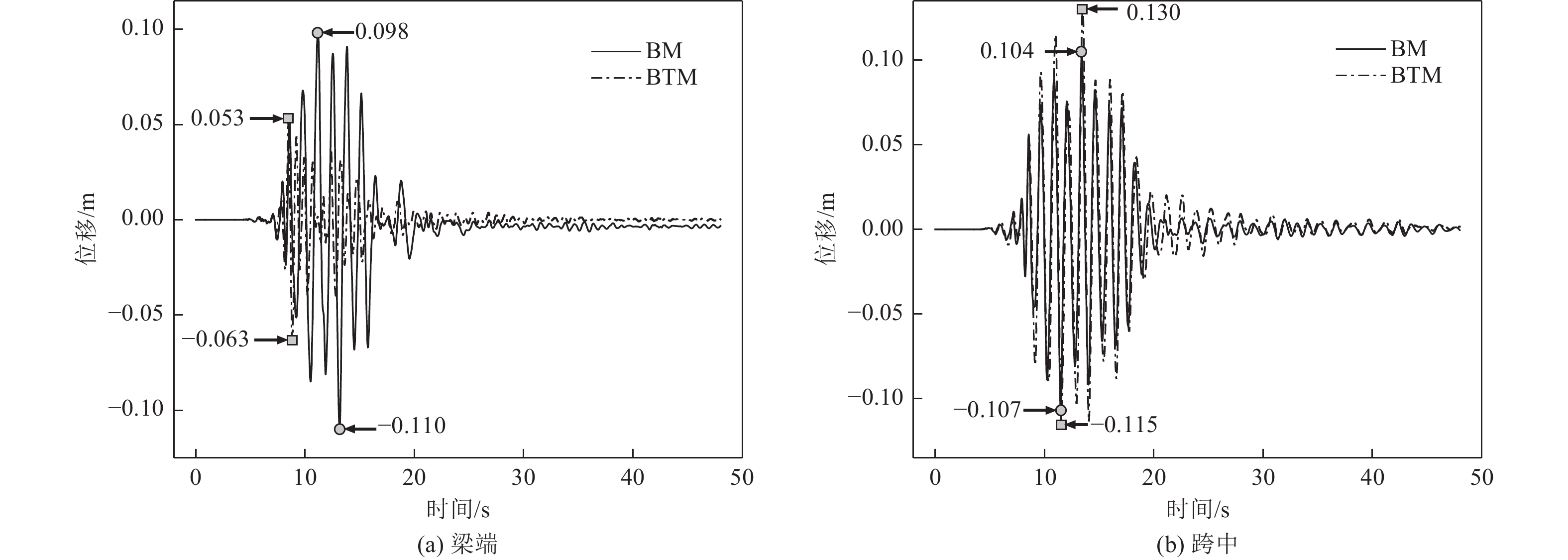
图 11 主梁沿横桥向位移时程曲线
Figure 11. Time history curve of main girder displacement along cross bridge
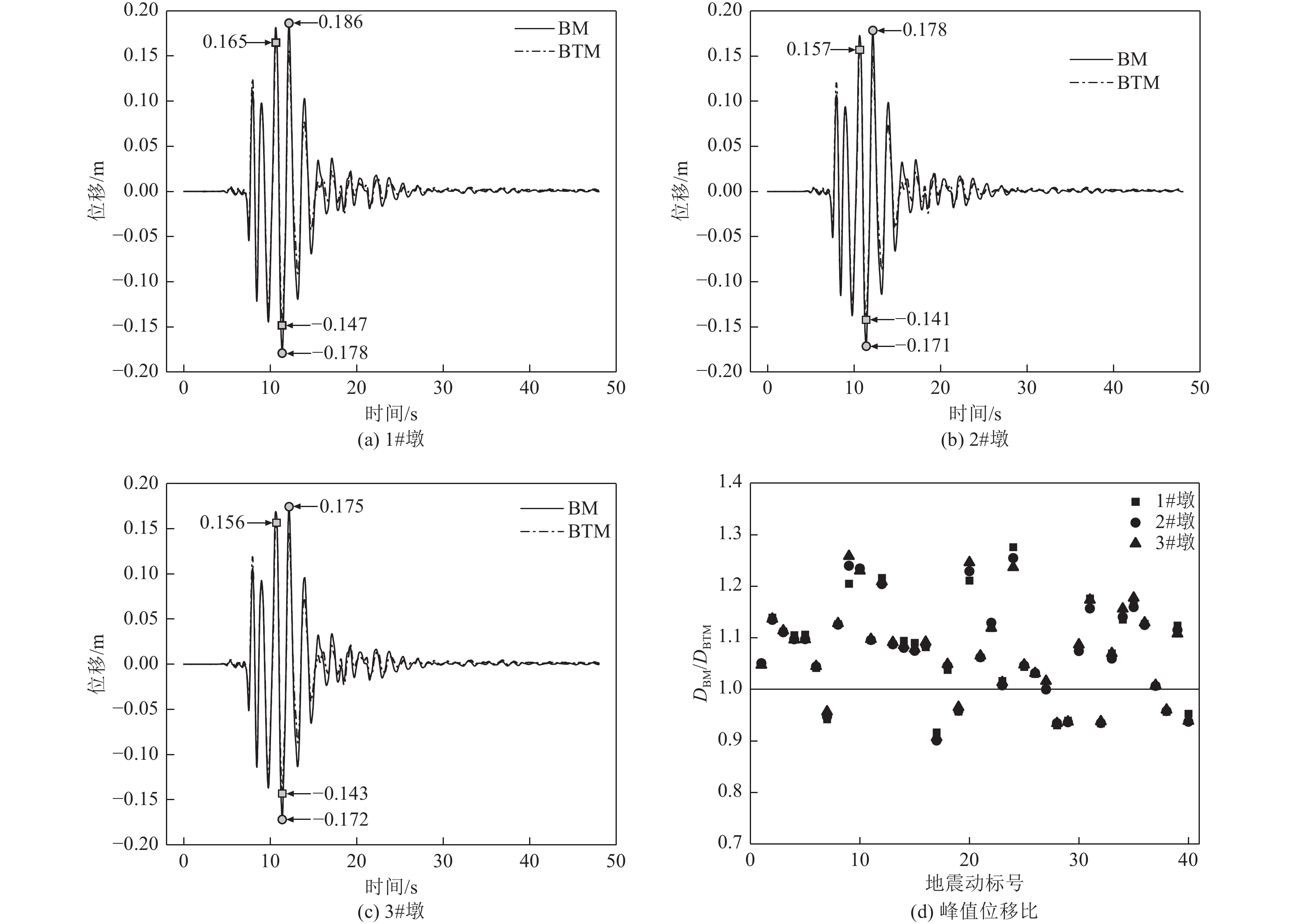
图 13 各桥墩墩顶沿纵桥向位移时程曲线及峰值位移比
Figure 13. Time history curve and peak displacement ratio of pier top displacement along longitudinal bridge
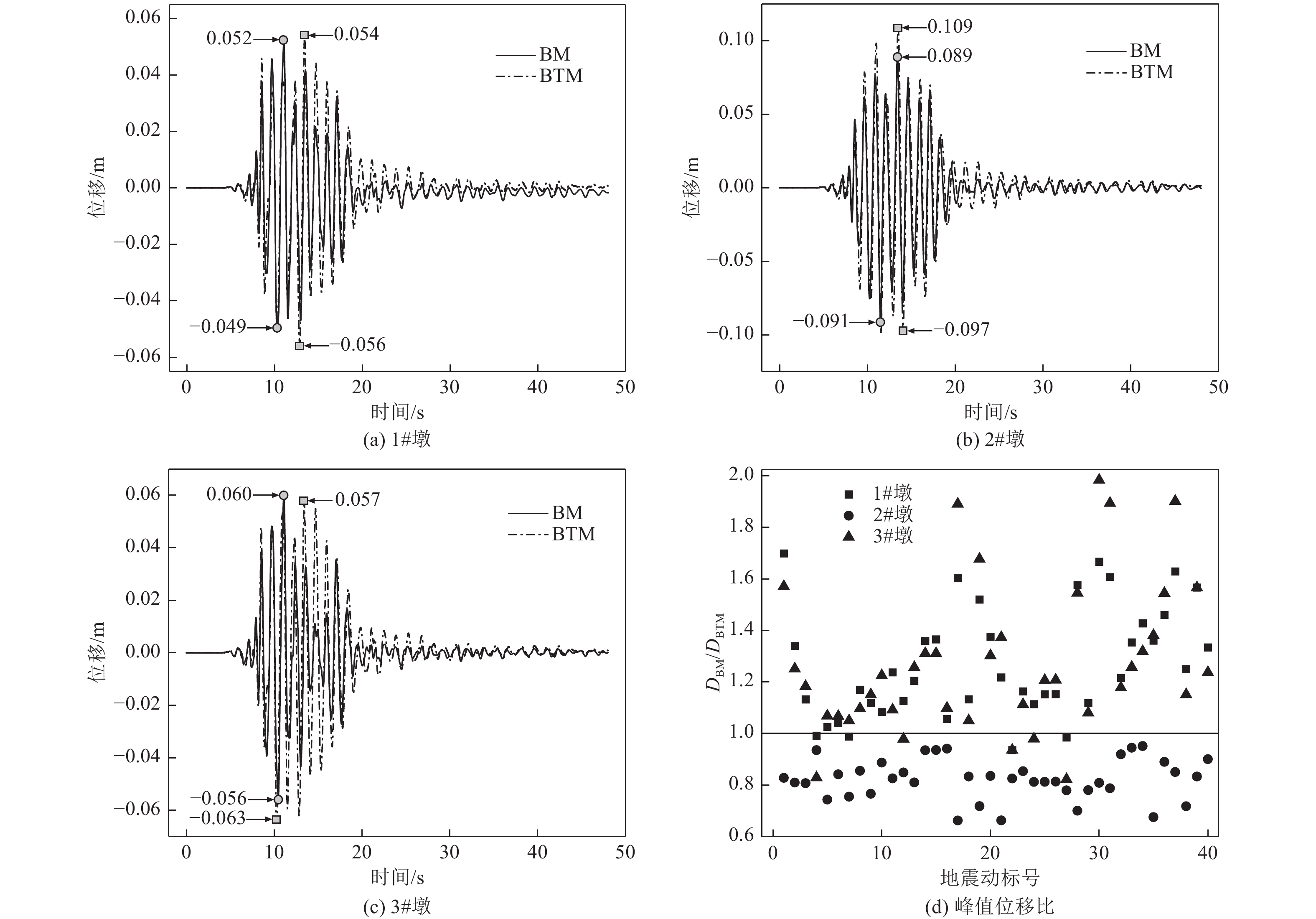
图 14 各桥墩墩顶沿横桥向位移时程曲线及峰值位移比
Figure 14. Time history curve and peak displacement ratio of pier top displacement along cross bridge
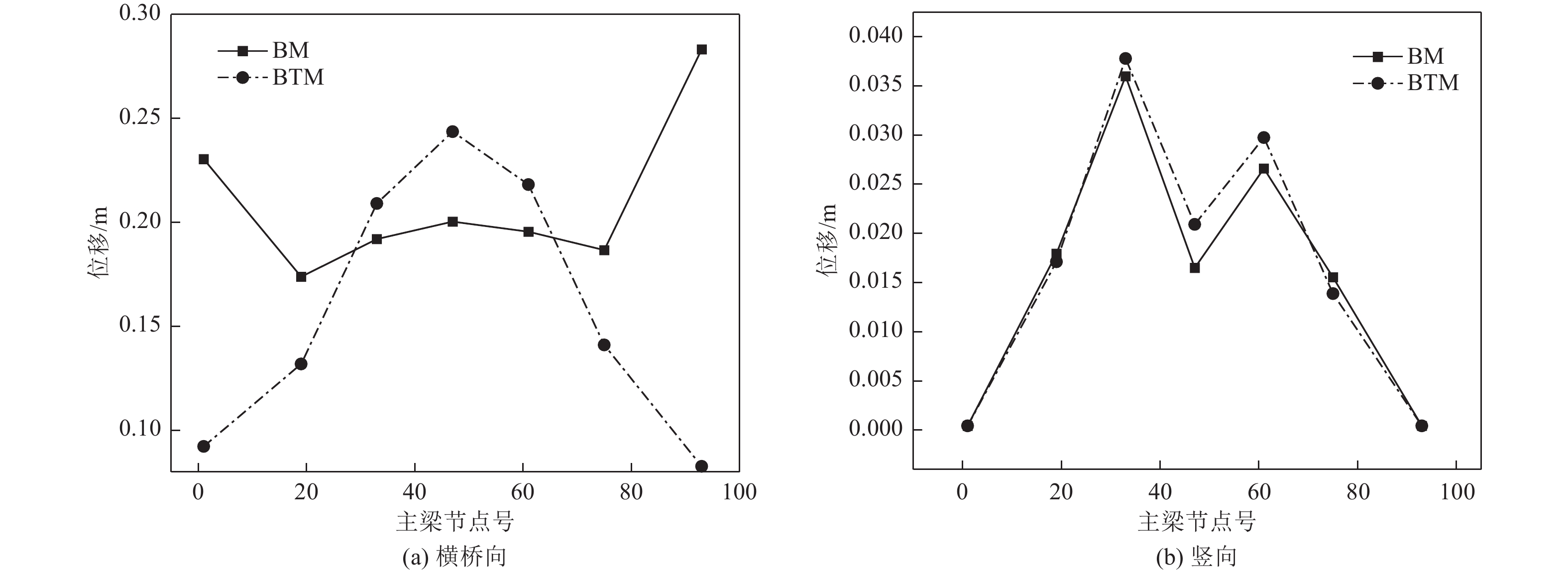
图 16 主梁沿纵桥向位移分布
Figure 16. Displacement distribution of main girder along longitudinal bridge
表 1 施工阶段分析表
Table 1. Construction phase analysis
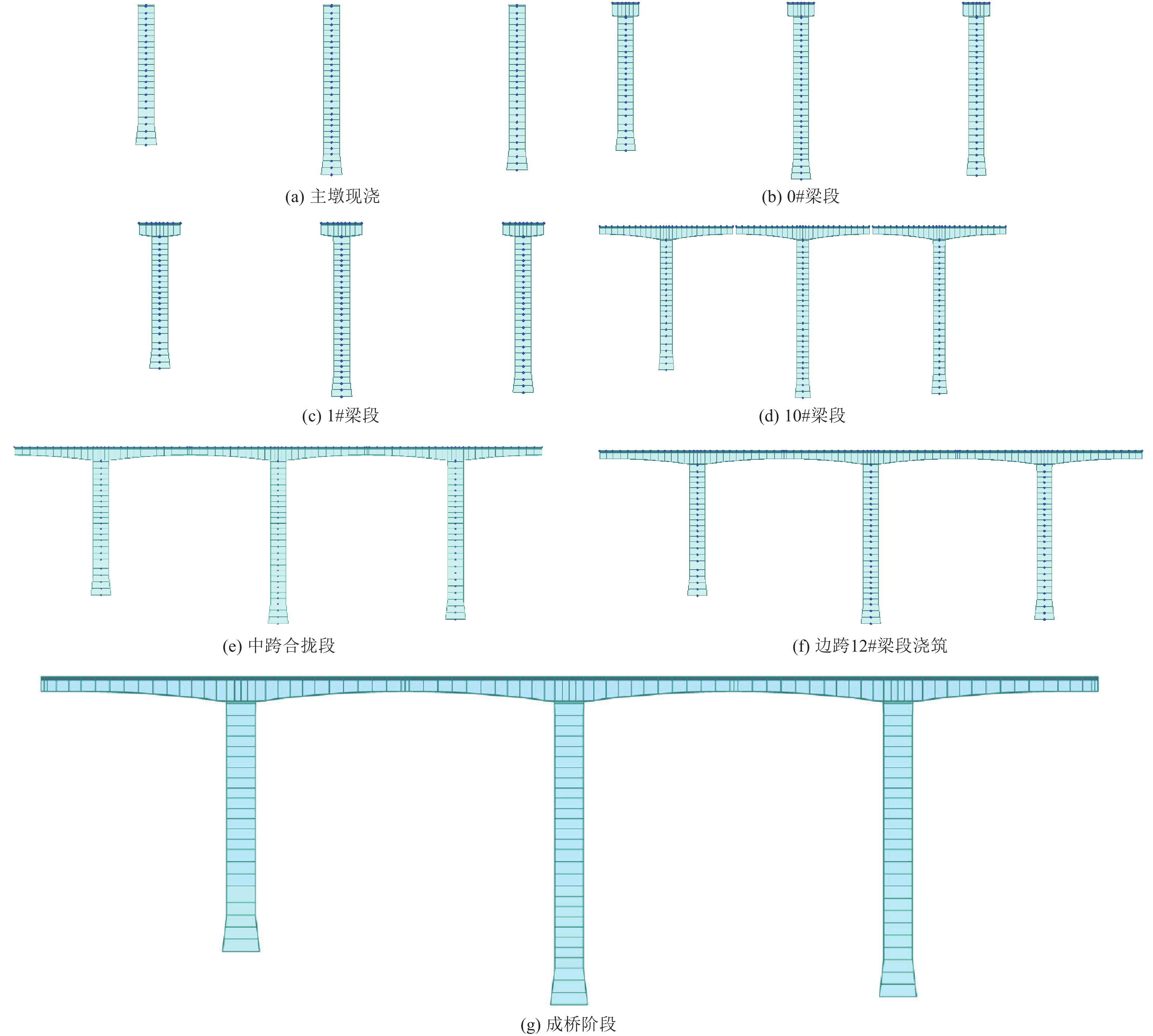
阶段编号 施工阶段 主要施工内容 加载与边界条件 1 桥墩浇筑阶段 1#~3#桥墩分段浇筑,采用滑模、翻模或组合模施工。 桥墩墩底采用固结,不考虑桩土相互作用;加载自重和二期恒载。 2 0#块浇筑 在墩顶托架上浇注0#块,形成悬臂梁施工起点。 激活0#块结构单元并加载自重和二期恒载;维持边界条件不变。 3 悬臂梁段施工 依次对称悬浇A1~A10及A1'~A10'段,使用轻型挂篮。 逐段激活新浇段的单元并加载自重、预应力荷载。 4 中跨合拢 安装中跨合拢撑架,浇筑合拢段。 加载合拢梁段的自重与二期恒载,激活对应结构单元。 5 边跨合拢 依次浇注两侧边跨的A11、A12段,完成边跨悬浇施工。 激活边跨A11、A12段单元并加载自重、二期恒载和预应力荷载。 6 边跨支架现浇 在0#桥台和4#桥台处搭建施工托架,现浇边跨A13段,完成桥梁施工。 激活A13段结构单元,加载自重和二期恒载。  下载: 导出CSV
表 2 单个纵向连续构件力学参数
Table 2. Mechanical parameters of a single longitudinal continuous member
部件 截面面积/m2 弹性模量/(N·m−2) J/m4 Iy/m4 Iz/m4 密度/(kg·m−3) 摩擦板 3.6 3.00× 10¹⁰ 0.186 62 0.048 24.3 9 360 底座板 0.561 3.00× 10¹⁰ 0.006 47 0.001 69 0.406 1496.85 轨道板 0.51 3.55× 10¹⁰ 0.006 46 0.001 7 0.276 1 370.6 轨道 0.007 75 2.06× 10¹¹ 0.0000025 0.0000325 0.00026 60.64
下载: 导出CSV
表 3 BM与BTM中主梁的峰值位移表(单位:厘米)
Table 3. Peak displacement value of main beam in BM and BTM (Unit: cm)
地震动编号 主梁沿纵桥向 地震动编号 主梁沿纵桥向 梁端 跨中 梁端 跨中 DBM DBTM D DBM DBTM D DBM DBTM D DBM DBTM D E01 31.05 29.51 1.54 30.94 29.46 1.48 E21 29.86 28.11 1.75 30.01 28.22 1.79 E02 49.66 43.83 5.83 49.69 43.83 5.86 E22 18.54 16.55 2.00 18.59 16.47 2.12 E03 29.18 26.29 2.90 29.15 26.24 2.92 E23 22.23 21.95 0.28 22.35 22.05 0.30 E04 23.46 21.24 2.22 23.43 21.24 2.19 E24 15.38 12.23 3.15 15.50 12.35 3.15 E05 27.67 25.06 2.61 27.67 25.11 2.55 E25 13.49 12.92 0.57 13.56 12.95 0.61 E06 24.99 23.92 1.06 24.96 23.93 1.03 E26 13.49 13.08 0.41 13.56 13.13 0.43 E07 9.18 9.64 −0.46 9.19 9.67 −0.48 E27 21.06 20.91 0.15 21.08 20.98 0.11 E08 17.64 15.63 2.01 17.67 15.66 2.01 E28 59.11 63.38 −4.27 58.88 62.98 −4.10 E09 7.42 6.15 1.27 7.38 6.12 1.27 E29 15.39 16.33 −0.94 15.33 16.28 −0.95 E10 12.24 9.84 2.40 12.28 9.87 2.41 E30 26.71 24.82 1.89 26.71 24.82 1.89 E11 21.52 19.66 1.86 21.51 19.64 1.87 E31 46.66 40.12 6.54 46.63 40.12 6.52 E12 15.92 13.13 2.79 15.96 13.16 2.80 E32 27.76 29.60 −1.83 27.83 29.66 −1.83 E13 42.48 39.03 3.45 42.42 39.02 3.40 E33 21.06 19.70 1.36 21.04 19.71 1.34 E14 19.85 18.23 1.62 19.78 18.20 1.57 E34 25.25 22.09 3.16 25.27 22.09 3.18 E15 19.83 18.29 1.54 19.76 18.29 1.47 E35 32.43 27.99 4.44 32.43 27.99 4.44 E16 22.76 20.89 1.87 22.60 20.79 1.81 E36 41.21 36.65 4.57 41.23 36.61 4.62 E17 38.02 41.39 −3.37 37.87 41.56 −3.69 E37 53.26 52.78 0.49 53.04 52.59 0.44 E18 29.93 28.78 1.15 29.80 28.54 1.26 E38 52.80 54.99 −2.19 52.64 54.78 −2.14 E19 25.49 26.48 −0.99 25.53 26.55 −1.02 E39 22.01 19.36 2.65 21.82 19.47 2.34 E20 12.88 10.54 2.34 12.97 10.56 2.41 E40 26.53 28.00 −1.46 26.56 28.01 −1.45 注:D=DBM−DBTM
下载: 导出CSV
表 4 不同破坏状态的描述及损伤指标
Table 4. Description and damage index at different failure states
破坏状态 无损伤 轻微损伤 中等损伤 严重损伤 完全破坏 破坏准则 $ 0 \lt {\mu }_{\phi }\leqslant \mu _{\phi \text{y}}^{\prime} $ $ \mu _{\phi \text{y}}^{\prime} \lt {\mu }_{\phi }\leqslant {\mu }_{\phi \text{y}} $ $ {\mu }_{\phi \text{y}} \lt {\mu }_{\phi }\leqslant {\mu }_{\phi \text{4}} $ $ {\mu }_{\phi \text{4}} \lt {\mu }_{\phi }\leqslant {\mu }_{\phi \text{max}} $ $ {\mu }_{\phi \text{max}} \lt {\mu }_{\phi } $
下载: 导出CSV
表 5 各桥墩在不同损伤状态下的曲率指标
Table 5. Curvature index of each pier under different damage conditions
位置 方向 $ \phi _{\text{y}}^{\prime} $/m−1 $ \phi _{\text{y}}^{} $/m−1 $ \phi _{\text{c4}}^{} $/m−1 $ \phi _{\text{m}}^{} $/m−1 1#墩 纵向 0.00030 0.00034 0.00687 0.00912 横向 0.00014 0.00016 0.00288 0.00412 2#墩 纵向 0.00030 0.00034 0.00681 0.00907 横向 0.00012 0.00014 0.00237 0.00323 3#墩 纵向 0.00030 0.00034 0.00681 0.00910 横向 0.00012 0.00014 0.00246 0.00335
下载: 导出CSV
-
蔡丽雯, 黄勇, 何静等, 2022. 2022年青海门源6.9级地震交通系统震害与启示. 地震工程与工程振动, 42(4): 8−16. doi: 10.13197/j.eeed.2022.0402Cai L. W., Huang Y., He J., et al., 2022. Earthquake damage and enlightenment from traffic system in 2022 Qinghai Menyuan MS6.9 earthquake. Earthquake Engineering and Engineering Dynamics, 42(4): 8−16. (in Chinese) doi: 10.13197/j.eeed.2022.0402 谷音, 黄怡君, 卓卫东, 2011. 高墩大跨连续刚构桥梁地震易损性分析. 地震工程与工程振动, 31(2): 91−97.Gu Y., Huang Y. J., Zhuo W. D., 2011. Study on seismic vulnerability of long-span continuous rigid frame bridge with high piers. Earthquake Engineering and Engineering Dynamics, 31(2): 91−97. (in Chinese) 蒋丽忠, 周旺保, 魏标等, 2020. 地震作用下高速铁路车-轨-桥系统安全研究进展. 土木工程学报, 53(9): 1−13. doi: 10.15951/j.tmgcxb.2020.09.001Jiang L. Z., Zhou W. B., Wei B., et al., 2020. Research progress of train-track-bridge system safety of high-speed railway under earthquake action. China Civil Engineering Journal, 53(9): 1−13. (in Chinese) doi: 10.15951/j.tmgcxb.2020.09.001 李宏男, 成虎, 王东升, 2018. 桥梁结构地震易损性研究进展述评. 工程力学, 35(9): 1−16. doi: 10.6052/j.issn.1000-4750.2017.04.0280Li H. N., Cheng H., Wang D. S., 2018. A review of advances in seismic fragility research on bridge structures. Engineering Mechanics, 35(9): 1−16. (in Chinese) doi: 10.6052/j.issn.1000-4750.2017.04.0280 李立峰, 吴文朋, 黄佳梅等, 2012. 地震作用下中等跨径RC连续梁桥系统易损性研究. 土木工程学报, 45(10): 152−160. doi: 10.15951/j.tmgcxb.2012.10.005Li L. F., Wu W. P., Huang J. M., et al., 2012. Study on system vulnerability of medium span reinforced concrete continuous girder bridge under earthquake excitation. China Civil Engineering Journal, 45(10): 152−160. (in Chinese) doi: 10.15951/j.tmgcxb.2012.10.005 石岩, 李军, 秦洪果等, 2022. 大跨高墩连续刚构桥内力状态及其对地震反应的影响. 交通运输工程学报, 22(1): 70−81.Shi Y., Li J., Qin H. G., et al., 2022. Internal force state of long-span continuous rigid-frame bridge with high-rise piers and its effect on seismic response. Journal of Traffic and Transportation Engineering, 22(1): 70−81. (in Chinese) 王东升, 冯启民, 王国新, 2004. 基于直杆共轴碰撞理论的桥梁地震反应邻梁碰撞分析模型. 工程力学, 21(2): 157−166. doi: 10.3969/j.issn.1000-4750.2004.02.027Wang D. S., Feng Q. M., Wang G. X., 2004. Analysis model of pounding between adjacent bridge girders during earthquakes based on collinear impact between rods. Engineering Mechanics, 21(2): 157−166. (in Chinese) doi: 10.3969/j.issn.1000-4750.2004.02.027 王维欢, 王文才, 尹欣欣等, 2021. 2021年青海玛多7.4级地震强震动记录及特征分析. 地震工程学报, 43(4): 883−889, 895.Wang W. H., Wang W. C., Yin X. X., et al., 2021. Strong motion records and characteristics of the Maduo M7.4 earthquake in Qinghai Province, 2021. China Earthquake Engineering Journal, 43(4): 883−889,895. (in Chinese) 吴文朋, 李立峰, 王连华等, 2012. 基于IDA的高墩大跨桥梁地震易损性分析. 地震工程与工程振动, 32(3): 117−123.Wu W. P., Li L. F., Wang L. H., et al., 2012. Evaluation of seismic vulnerability of high-pier long-span bridge using incremental dynamic analysis. Earthquake Engineering and Engineering Dynamics, 32(3): 117−123. (in Chinese) 叶列平, 2004. 体系能力设计法与基于性态/位移抗震设计. 建筑结构, 34(6): 10−14. doi: 10.19701/j.jzjg.2004.06.003Ye L. P., 2004. Structure system capacity design approach and performance/displacement-based seimic design. Building Structure, 34(6): 10−14. (in Chinese) doi: 10.19701/j.jzjg.2004.06.003 张锐, 李宏男, 王东升等, 2019. 结构时程分析中强震记录选取研究综述. 工程力学, 36(2): 1−16. doi: 10.6052/j.issn.1000-4750.2018.01.0037Zhang R., Li H. N., Wang D. S., et al., 2019. Selection and scaling of real accelerograms as input to time-history analysis of structures: a state-of-the-art review. Engineering Mechanics, 36(2): 1−16. (in Chinese) doi: 10.6052/j.issn.1000-4750.2018.01.0037 张永亮, 杨世杰, 陈兴冲, 2016. 基于线桥一体化模型的高速铁路桥梁地震反应分析. 桥梁建设, 46(4): 23−28.Zhang Y. L., Yang S. J., Chen X. C., 2016. Analysis of seismic responses of high-speed railway bridges based on integrated track and bridge model. Bridge Construction, 46(4): 23−28. (in Chinese) 郑国足, 焦应乾, 石岩, 等, 2024. 考虑墩–梁碰撞效应的连续刚构桥系统易损性与概率地震风险性分析. 工程科学与技术, 56(3): 147−159. doi: 10.15961/j.jsuese.202200981Zheng G. Z., Jiao Y. Q., Shi Y., et al., 2024. System fragility and probabilistic seismic risk of continuous rigid-frame bridge considering the pounding response between main beam and transition pier. Advanced Engineering Sciences, 56(3): 147−159. (in Chinese) doi: 10.15961/j.jsuese.202200981 周旺保, 王晓婵娟, 聂磊鑫等, 2024. 高速铁路自复位摇摆桥墩抗震性能分析. 中国铁道科学, 45(3): 38−49. doi: 10.3969/j.issn.1001-4632.2024.03.04Zhou W. B., Wang X. C. J., Nie L. X., et al., 2024. Seismic performance analysis of self-centering rocking pier of high-speed railway. China Railway Science, 45(3): 38−49. (in Chinese) doi: 10.3969/j.issn.1001-4632.2024.03.04 Baker J. W. , Lin T. , Shahi S. K. , et al. , 2011. New ground motion selection procedures and selected motions for the peer transportation research program. Berkeley: PEER Report. Guo W., Gao X., Hu P., et al., 2020a. Seismic damage features of high-speed railway simply supported bridge-track system under near-fault earthquake. Advances in Structural Engineering, 23(8): 1573−1586. doi: 10.1177/1369433219896166 Guo W., Hu Y., Gou H. Y., et al., 2020b. Simplified seismic model of CRTS II ballastless track structure on high-speed railway bridges in China. Engineering Structures, 211: 110453. doi: 10.1016/j.engstruct.2020.110453 Guo W., Ye Y. T., Hu Y., 2022. Seismic damage analysis of bridge-CRTS Ⅲ slab ballastless track system on high-speed railway. Soil Dynamics and Earthquake Engineering, 161: 107416. doi: 10.1016/j.soildyn.2022.107416 Kunnath S. K., Erduran E., Chai Y. H., et al., 2008. Effect of near-fault vertical ground motions on seismic response of highway overcrossings. Journal of Bridge Engineering, 13(3): 282−290. doi: 10.1061/(ASCE)1084-0702(2008)13:3(282) Muthukumar S., DesRoches R., 2006. A Hertz contact model with non-linear damping for pounding simulation. Earthquake Engineering & Structural Dynamics, 35(7): 811−828. doi: 10.1002/eqe.557 Qiao H., Dai Z. H., Du X. T., et al., 2023. Parametric study of topographic effect on train-bridge interaction of a continuous rigid frame bridge during earthquakes. Bulletin of Earthquake Engineering, 21(1): 125−149. doi: 10.1007/s10518-022-01532-7 Shi Y., Wang W. X., Qin H. G., et al., 2024. Nonlinear seismic response and damage analysis for continuous prestressed concrete rigid-frame bridge considering internal force state under near-fault ground motions. Structures, 61: 105993. doi: 10.1016/j.istruc.2024.105993 Taflanidis A. A., 2011. Optimal probabilistic design of seismic dampers for the protection of isolated bridges against near-fault seismic excitations. Engineering Structures, 33(12): 3496−3508. doi: 10.1016/j.engstruct.2011.07.012 Wei B., Zuo C. J., He X. H., et al., 2018. Effects of vertical ground motions on seismic vulnerabilities of a continuous track-bridge system of high-speed railway. Soil Dynamics and Earthquake Engineering, 115: 281−290. doi: 10.1016/j.soildyn.2018.08.022 Yu J., Zhou W. B., Jiang L. Z., 2022. Study on the estimate for seismic response of high-speed railway bridge-track system. Engineering Structures, 267: 114711. doi: 10.1016/j.engstruct.2022.114711 Zeng X. Z., Deng K. L., Wang Y. C., et al., 2022. Field investigation and numerical analysis of damage to a high-pier long-span continuous rigid frame bridge in the 2008 Wenchuan earthquake. Journal of Earthquake Engineering, 26(10): 5204−5220. doi: 10.1080/13632469.2020.1868361 -

 点击查看大图
计量
- 文章访问数: 273
- HTML全文浏览量: 250
- PDF下载量: 191
- 被引次数: 0
