


Smartphone-based Bridge Structural Dynamic Parameter Identification and Uncertainty Assessment Method
-
摘要: 针对桥梁结构的安全运维,结构动力参数的识别是评估结构健康状况的关键步骤。然而,传统的结构动力参数识别技术依赖于昂贵且操作复杂的传感器设备和数据采集系统,需要由专业团队和经验丰富的技术人员进行操作与分析,这些技术壁垒限制了桥梁结构健康监测与维护技术的普及。针对上述技术难题,本研究提出了一种基于智能手机的桥梁结构动力参数识别及不确定性评估方法,并在一座人行天桥上进行了应用验证试验和对比测试。结果证明,本研究提出的方法在识别精度和稳定性方面表现优异,为实际工程应用提供了坚实的理论支撑。Abstract: The identification of structural dynamic parameters is crucial for ensuring the safe operation and maintenance of bridge structures. However, traditional parameter identification techniques rely on expensive and complex sensor equipment and data acquisition systems, which require specialized teams and experienced technicians for deployment, operation, and analysis. These technological barriers hinder the widespread application of bridge health monitoring and maintenance practices. To address these challenges, this study proposes a smartphone-based method for identifying the dynamic parameters of bridge structures and evaluating the associated uncertainty. The proposed method was experimentally validated through tests on a pedestrian overpass, demonstrating excellent accuracy and stability. These results provide strong theoretical support for practical engineering applications.
-
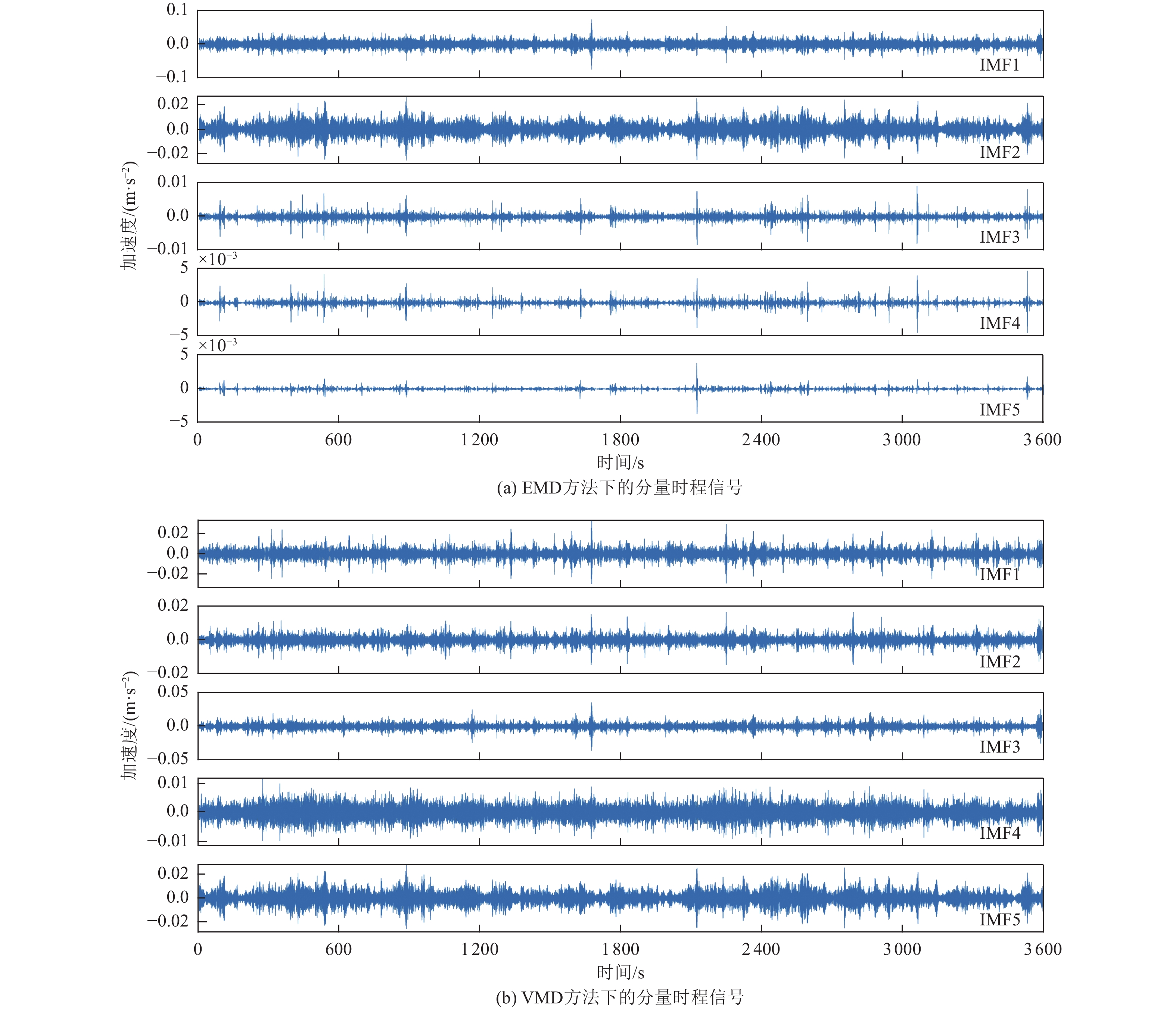
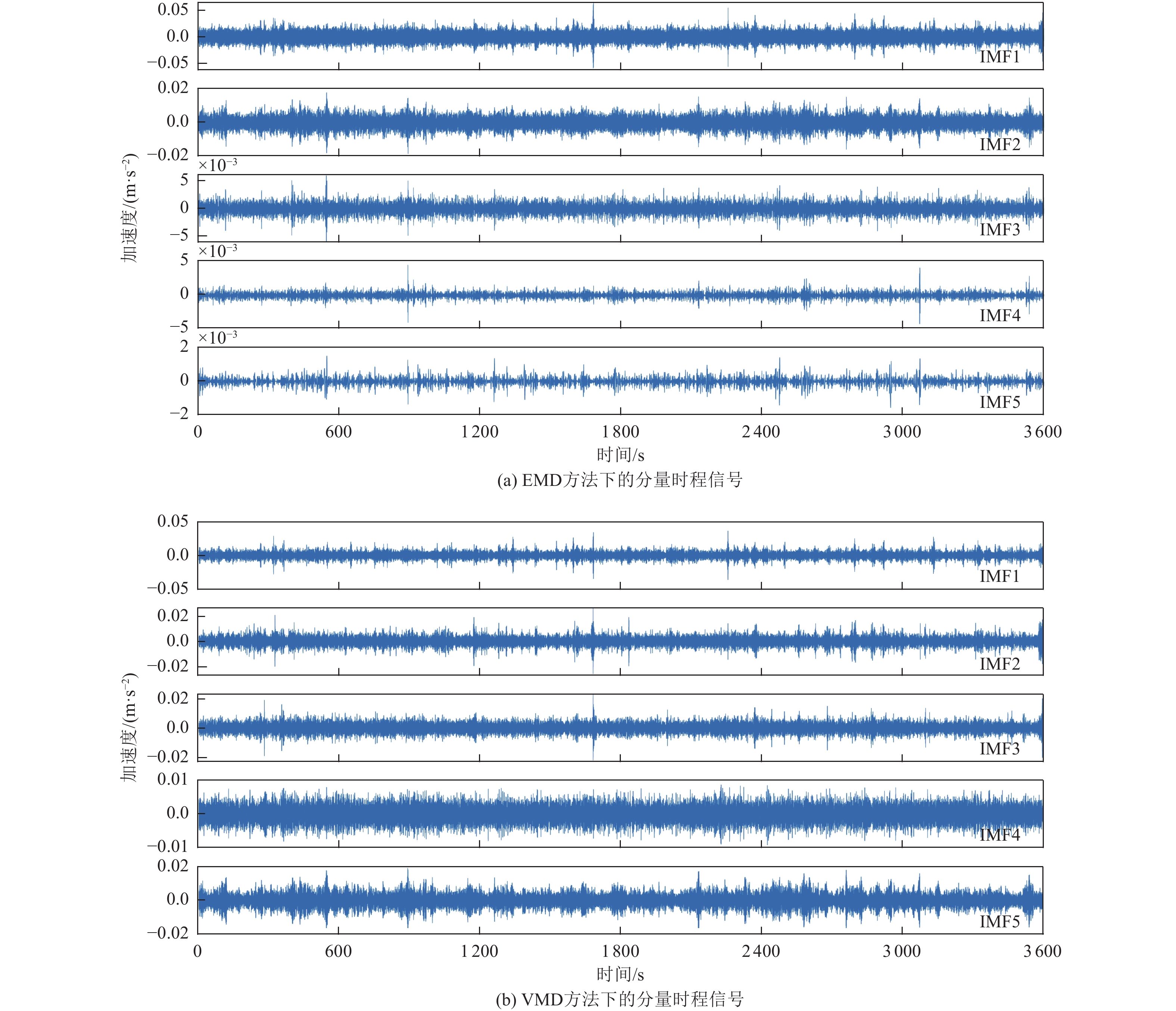
图 5 991B型拾振器监测信号的IMF分量
Figure 5. IMF component of the 991B vibration pickup monitoring signal
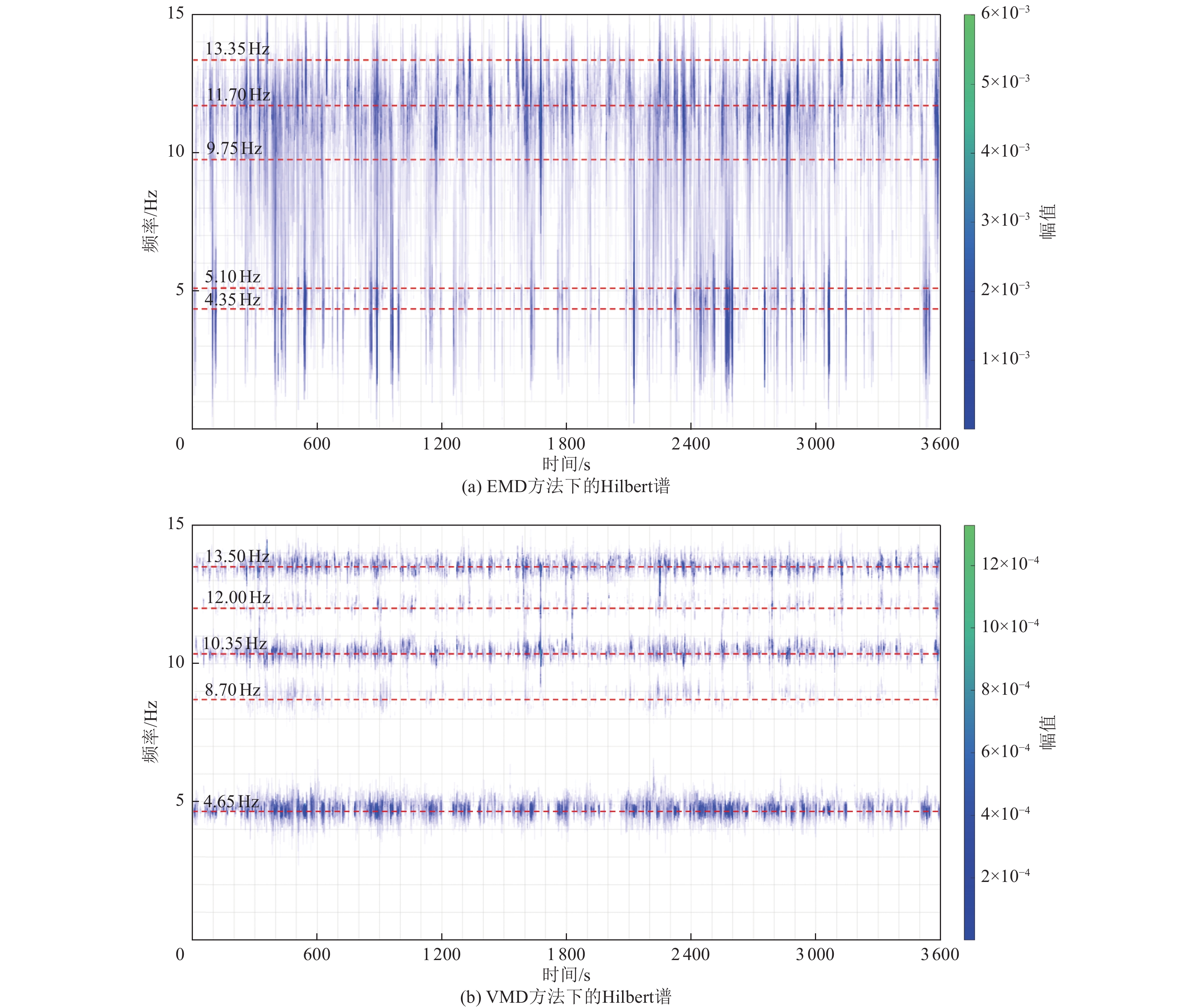
图 7 991B型拾振器监测信号的Hilbert谱
Figure 7. Hilbert spectrum of the 991B vibration pickup monitoring signals
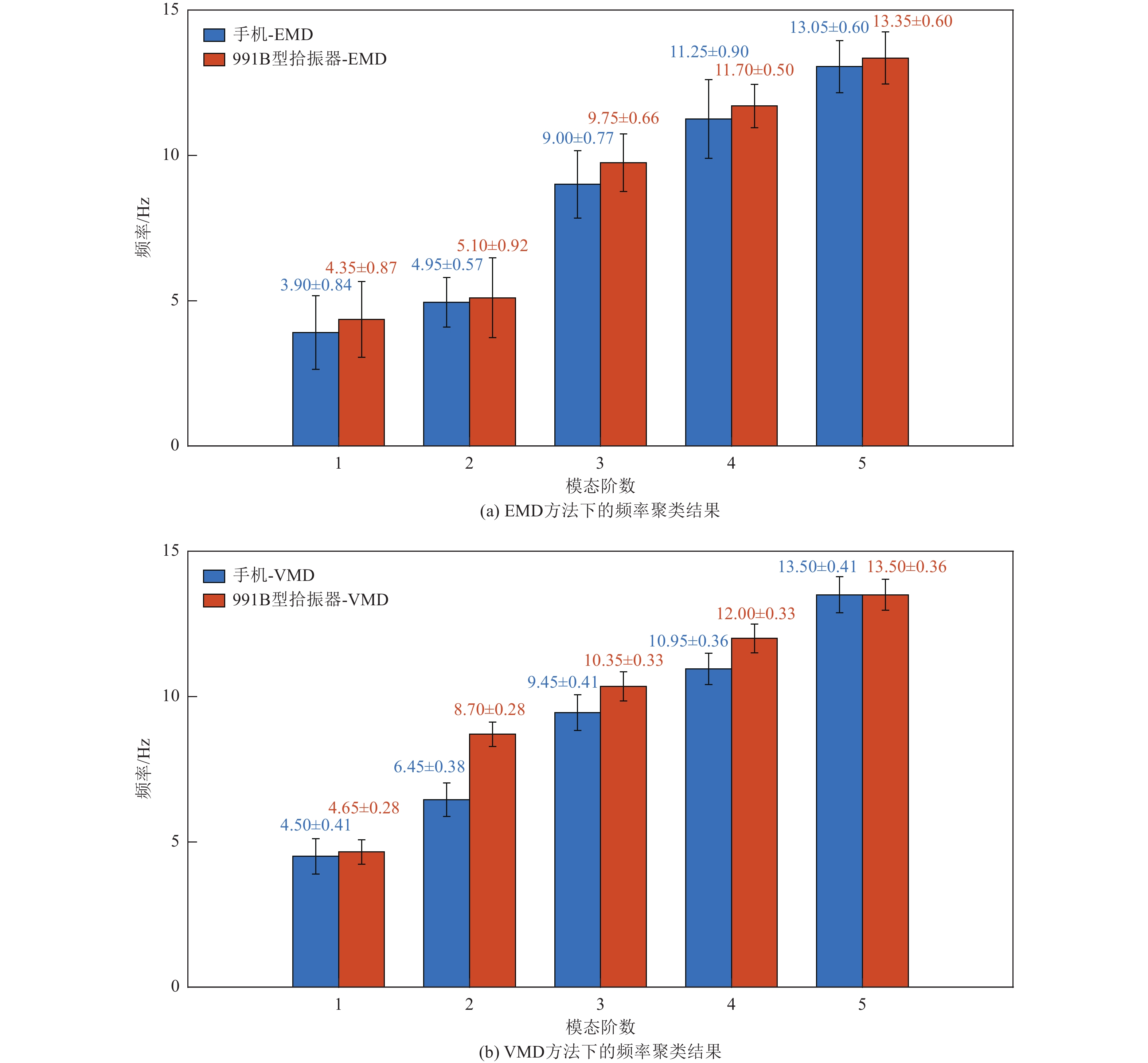
图 9 991B型拾振器和智能手机监测信号在不同方法下的频率聚类结果
Figure 9. Frequency clustering results of 991B vibration pickup and smartphone monitoring signals with different methods
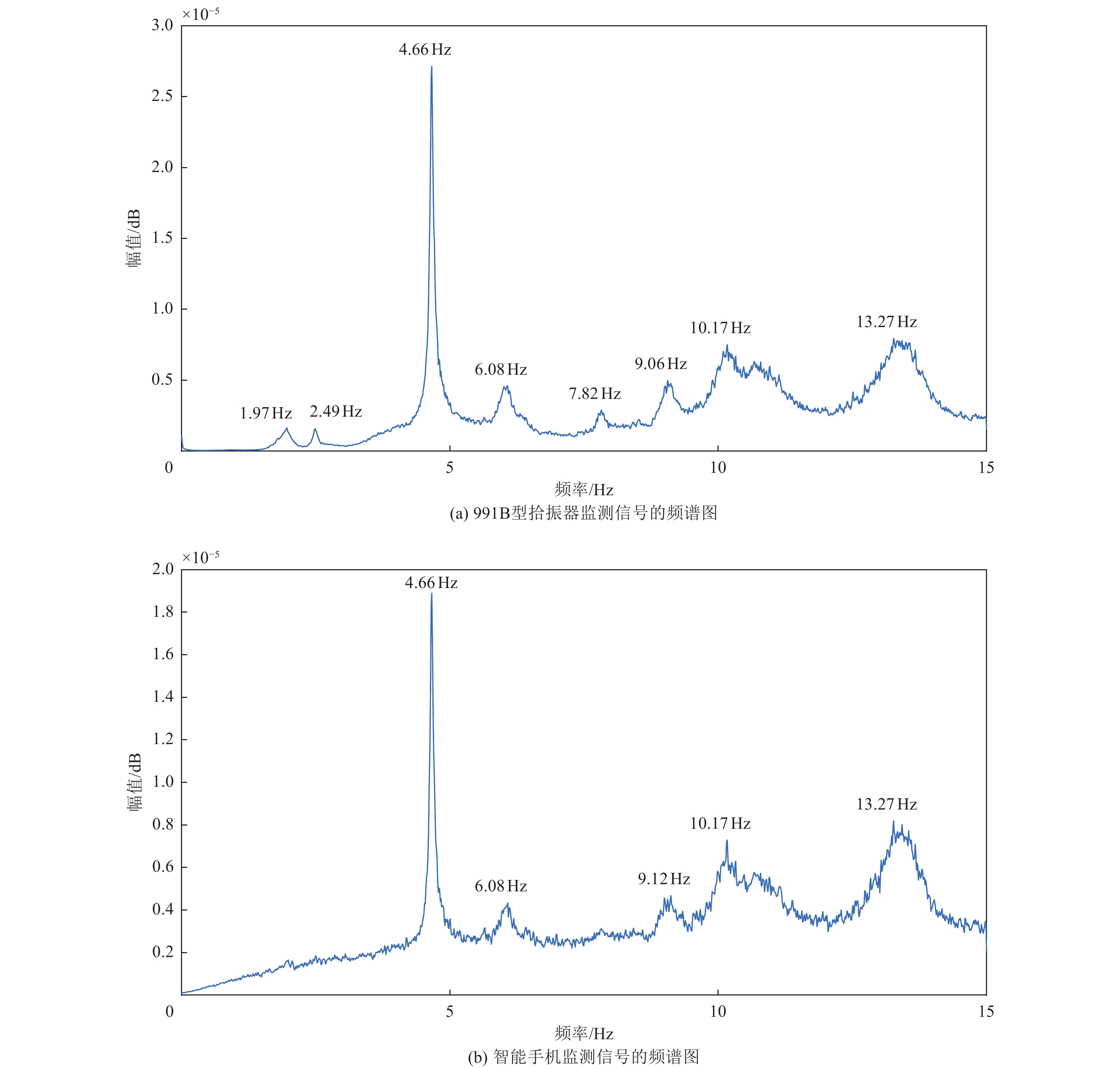
图 10 991B型拾振器和智能手机监测信号的频谱图
Figure 10. Frequency spectrum of 991B vibration pickup and the smartphone monitoring signals
表 1 智能手机主要技术指标
Table 1. Main technical indicators of smartphones
序号 项目 技术参数 ① 处理器 高通骁龙8gen3,台积电4 nm制程,最高主频为3.3 GHz ② 内存 LPDDR5X内存,最高传输速率 8533 Mbps③ 惯性传感器 品牌:瑞声科技AMA600;
全温零偏(−40 ℃到+85 ℃) 3$ \text{σ} $:1 mg;
零偏不稳定性(Allan) @25 ℃:20 μg;
速度随机游走:0.03 m·s/$ \sqrt{h} $;
标称因素非线性:100 ppm④ 加速度灵敏度$ \dfrac{V\cdot {s}^{2}}{m} $或$ \dfrac{V\cdot s}{m} $ 0.015 ⑤ 加速度最大量程/(m·s−2) 98 ⑥ 通频带(Hz,$ {}_{{-3}}^{\text{+1}}\text{ dB} $) 0~50 ⑦ 加速度分辨率/(m·s−2) 0.01~0.02  下载: 导出CSV
表 2 991B型拾振器主要技术指标
Table 2. Main technical indicators of 991B vibration pickup
序号 项目 技术参数 ① 加速度灵敏度$ \dfrac{V\cdot {s}^{2}}{m} $或$ \dfrac{V\cdot s}{m} $ 0.3 ② 加速度最大量程/(m·s−2) 15 ③ 通频带(Hz,$ {}_{\text{-3}}^{\text{+1}}\text{dB} $) 0.125~80 ④ 输出负荷电阻$ /\text{kΩ} $ 1000 ⑤ 加速度分辨率/(m·s−2) 5×10⁻⁶
下载: 导出CSV
-
焦静, 2022. 基于同轴振动特征融合的滚动轴承故障诊断研究. 北京: 北京交通大学.Jiao J., 2022. Research of rolling bearing fault diagnosis based on coaxial vibration feature fusion. Beijing: Beijing Jiaotong University. (in Chinese) 唐贵基, 王晓龙, 2016. IVMD融合奇异值差分谱的滚动轴承早期故障诊断. 振动、测试与诊断, 36(4): 700−707.Tang G. J., Wang X. L., 2016. An incipient fault diagnosis method for rolling bearing based on improved variational mode decomposition and singular value difference spectrum. Journal of Vibration, Measurement & Diagnosis, 36(4): 700−707. (in Chinese) Bao Y. Q., Chen Z. C., Wei S. Y., et al., 2019. The state of the art of data science and engineering in structural health monitoring. Engineering, 5(2): 234−242. doi: 10.1016/j.eng.2018.11.027 Daubechies I., Lu J. F., Wu H. T., 2011. Synchrosqueezed wavelet transforms: an empirical mode decomposition-like tool. Applied and Computational Harmonic Analysis, 30(2): 243−261. doi: 10.1016/j.acha.2010.08.002 Dragomiretskiy K., Zosso D., 2014. Variational mode decomposition. IEEE Transactions on Signal Processing, 62(3): 531−544. doi: 10.1109/TSP.2013.2288675 Figueiredo E., Moldovan I., Alves P., et al., 2022. Smartphone application for structural health monitoring of bridges. Sensors, 22(21): 8483. doi: 10.3390/s22218483 Hall F. E., Lombardi D., Bhattacharya S., 2018. Identification of transient vibration characteristics of pile-group models during liquefaction using wavelet transform. Engineering Structures, 171: 712−729. doi: 10.1016/j.engstruct.2018.06.028 Hu H., Yang M., Yuan Q., et al., 2024. Direct position determination of non-Gaussian sources for multiple nested arrays: discrete Fourier transform and Taylor compensation algorithm. Sensors, 24(12): 3801. doi: 10.3390/s24123801 Huang X. H., Ye Y. M., Zhang H. J., 2014. Extensions of Kmeans-type algorithms: a new clustering framework by integrating intracluster compactness and intercluster separation. IEEE Transactions on Neural Networks and Learning Systems, 25(8): 1433−1446. doi: 10.1109/TNNLS.2013.2293795 Jin X., Zhang D., Zhang J. J., et al., 2017. Study of multirate sampled acquisition of lightning current waveform based on short-time Fourier transform. Journal of Advanced Computational Intelligence and Intelligent Informatics, 21(1): 159−165. doi: 10.20965/jaciii.2017.p0159 Kong Q. K., Allen R. M., Schreier L., et al., 2016. MyShake: a smartphone seismic network for earthquake early warning and beyond. Science Advances, 2(2): e1501055. doi: 10.1126/sciadv.1501055 Li H., Ou J. P., Zhang X. G., et al., 2015. Research and practice of health monitoring for long-span bridges in the mainland of China. Smart Structures and Systems, 15(3): 555−576. doi: 10.12989/sss.2015.15.3.555 Liu T., Yan S. Z., Zhang W., 2016. Time–frequency analysis of nonstationary vibration signals for deployable structures by using the constant-Q nonstationary Gabor transform. Mechanical Systems and Signal Processing, 75: 228−244. doi: 10.1016/j.ymssp.2015.12.015 Mahgoun H., Azmedroub B., Taieb A, et al., 2024. Multiple signal classification algorithm combined with volume reflectivity models to improve accuracy of the estimated vegetation height in synthetic aperture radar tomography. Journal of the Indian Society of Remote Sensing, 52(7): 1533−1548. doi: 10.1007/s12524-024-01898-y Mandal N., Mitra R., Pramanick B, 2023. C-MEMS-derived glassy carbon electrochemical biosensors for rapid detection of SARS-CoV-2 spike protein. Microsystems & Nanoengineering, 9: 137. doi: 10.1038/s41378-023-00601-4 Ozer E., 2016. Multisensory smartphone applications in vibration-based structural health monitoring. New York: Columbia University. Pakzad S. N., Fenves G. L., Kim S., et al., 2008. Design and implementation of scalable wireless sensor network for structural monitoring. Journal of Infrastructure Systems, 14(1): 89−101. doi: 10.1061/(ASCE)1076-0342(2008)14:1(89) Pakzad S. N., Fenves G. L., 2009. Statistical analysis of vibration modes of a suspension bridge using spatially dense wireless sensor network. Journal of Structural Engineering, 135(7): 863−872. doi: 10.1061/(ASCE)ST.1943-541X.0000033 Pandey A. K., Biswas M., 1994. Damage detection in structures using changes in flexibility. Journal of Sound and Vibration, 169(1): 3−17. Shirzad-Ghaleroudkhani N., Gül M., 2020. Inverse filtering for frequency identification of bridges using smartphones in passing vehicles: fundamental developments and laboratory verifications. Sensors, 20(4): 1190. doi: 10.3390/s20041190 Sitton J. D., Rajan D., Story B. A., 2020. Bridge frequency estimation strategies using smartphones. Journal of Civil Structural Health Monitoring, 10(3): 513−526. doi: 10.1007/s13349-020-00399-z Sun L. M., Shang Z. Q., Xia Y., et al., 2020. Review of bridge structural health monitoring aided by big data and artificial intelligence: from condition assessment to damage detection. Journal of Structural Engineering, 146(5): 04020073. doi: 10.1061/(ASCE)ST.1943-541X.0002535 Xu Y., Xie X. B., Zhou L., et al., 2023. Noise characteristics and denoising methods of long-offset transient electromagnetic method. Minerals, 13(8): 1084. doi: 10.3390/min13081084 -


 点击查看大图
计量
- 文章访问数: 185
- HTML全文浏览量: 92
- PDF下载量: 186
- 被引次数: 0
