


Seismic Faults and Genesis of the 2023 Baoshan MS5.2 Earthquake Sequence in Yunnan Province
-
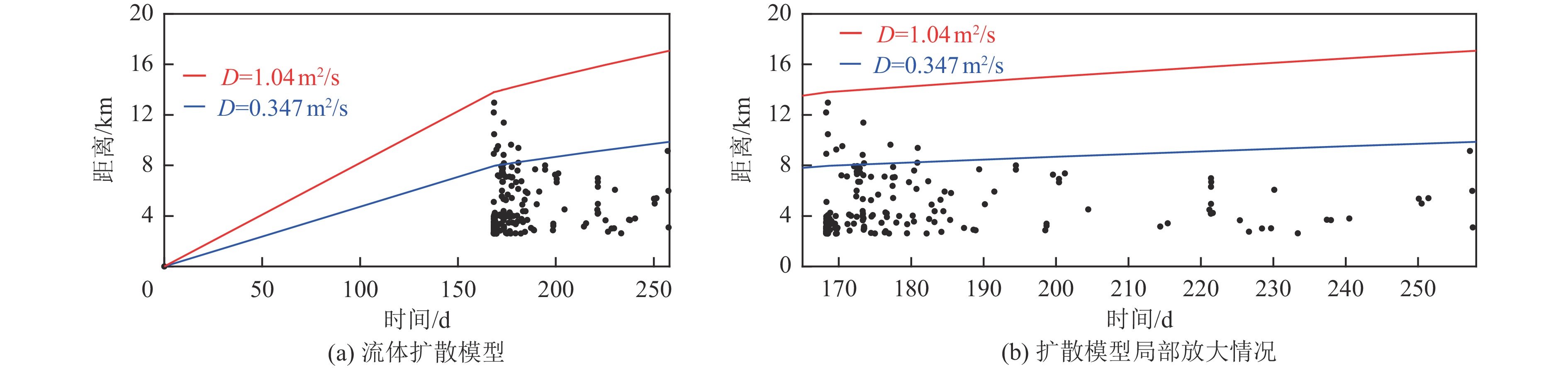
摘要: 本文基于云南省区域数字化地震监测台网地震观测报告和云南台网区域地震波形数据,结合双差定位方法、CAP方法、川滇地区高分辨率速度模型和流体扩散模型,深入分析了2023年云南保山MS5.2地震的发震断层和成因。双差重定位结果显示,云南保山MS5.2地震沿NW向呈条带状分布,震源深度主要集中在4~12 km。震源机制解反演结果表明,云南保山 MS5.2主震2个发震断层面参数为:节面Ⅰ,走向51°,倾角78°,滑动角−34°;节面Ⅱ,走向149°,倾角56.8°,滑动角−165.6°。根据流体扩散模型拟合得到水力扩散系数
$ D $ 介于0.347~1.04 m2/s之间。根据2000—2023年地震目录,证实水库蓄水在库区周边诱发了地震活动,地震多以小群形式分布在与澜沧江河床延伸方向一致的断裂带和多组断裂交汇处。综合重定位结果、震源机制解结果及附近区域的地质构造背景,推测云南保山MS5.2地震的发震构造是一条NW149°走向的走滑型断裂,小湾电站建成蓄水后,诱发了库区周边地震活动,而云南保山MS5.2地震的发生可能是长期受库水渗透而处于饱水状态的地壳卸荷触发的一次构造型水库地震。Abstract: Based on seismic observation reports and regional waveform data from the Yunnan Seismic Network, and incorporating the double-difference earthquake relocation method, the CAP (Cut-and-Paste) focal mechanism inversion technique, a high-resolution velocity model, and a fluid diffusion model for the Sichuan–Yunnan region, this study conducts a comprehensive analysis of the seismogenic faults and triggering mechanisms of the 2023 Baoshan MS5.2 earthquake sequence in Yunnan Province. Double-difference relocation results indicate that the earthquake sequence is distributed in a northwest-trending linear pattern, with focal depths predominantly concentrated between 4 and 12 km. Focal mechanism inversion of the mainshock yields two possible nodal planes: nodal plane I with a strike of 51°, dip of 78°, and rake of −34°; and nodal plane II with a strike of 149°, dip of 56.8°, and rake of −165.6°. Fluid diffusion modeling suggests a hydraulic diffusivity coefficient (D) ranging from 0.347 to 1.04 m²/s. Relocation of earthquakes occurring since 2000 in the vicinity of the epicenter confirms that seismic activity around the reservoir area has been induced following reservoir impoundment, with earthquakes primarily occurring in small clusters near fault intersections and along multiple fault sets aligned with the extension direction of the Lancang River channel. Integrating the relocation results, focal mechanism solutions, and regional geological and tectonic background, the seismogenic structure of the Baoshan MS5.2 earthquake is inferred to be a northwest-striking (approximately 149°) strike-slip fault. Seismic activity in the surrounding area was likely induced following the completion of the Xiaowan Hydropower Station. The Baoshan MS5.2 earthquake is therefore interpreted as a reservoir-triggered tectonic event, associated with long-term reservoir water infiltration and stress unloading of the crust under saturated conditions.-
Key words:
- HypoDD /
- CAP method /
- Fluid diffusion model /
- Reservoir earthquake
1)1 2https://ses-kled.cidp.edu.cn/info/1084/1467.htm -

图 1 台站、断裂和历史中强地震分布图
Figure 1. Distribution of historical earthquakes, observation stations and faults around the epicenter of 2023 Baoshan MS5.2 earthquake
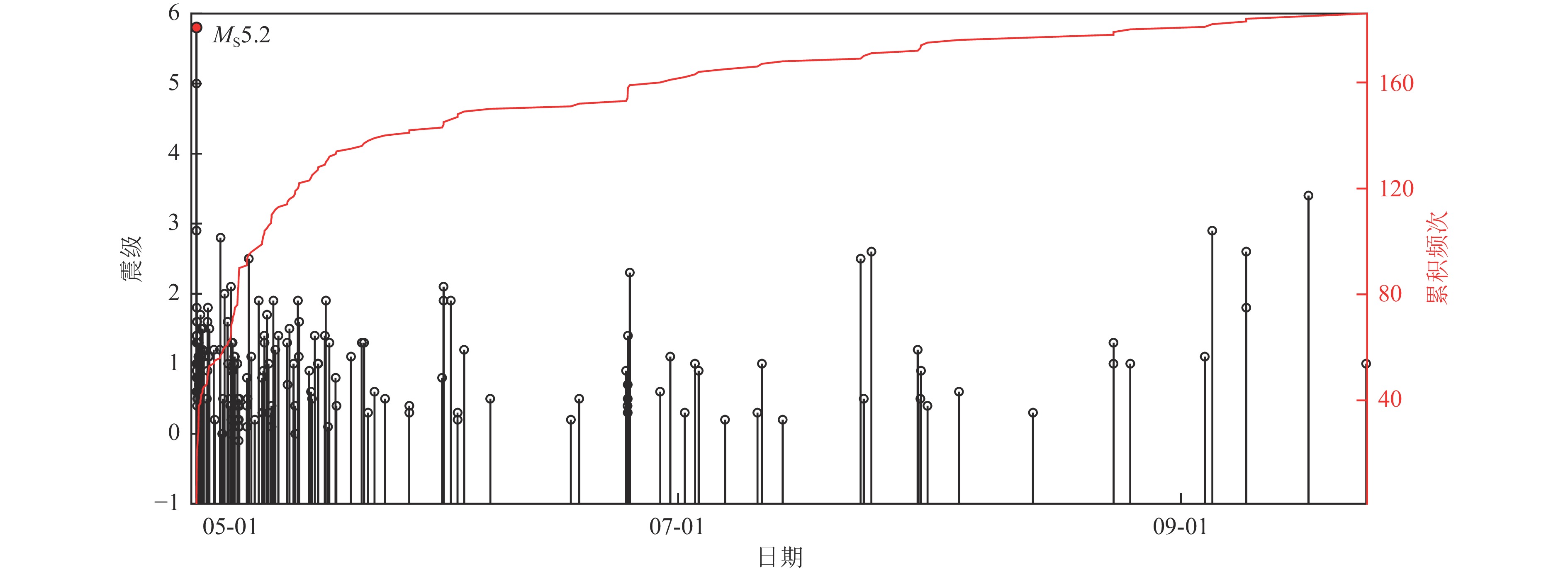
图 5 2023年云南保山 MS5.2地震序列M-T图
Figure 5. M-T plot of the earthquake sequence of the 2023 MS5.2 earthquake in Baoshan

图 8 M-T图和月频次N-T图
Figure 8. Plots of M-T and N-T(monthly frequency) in the reservoir area
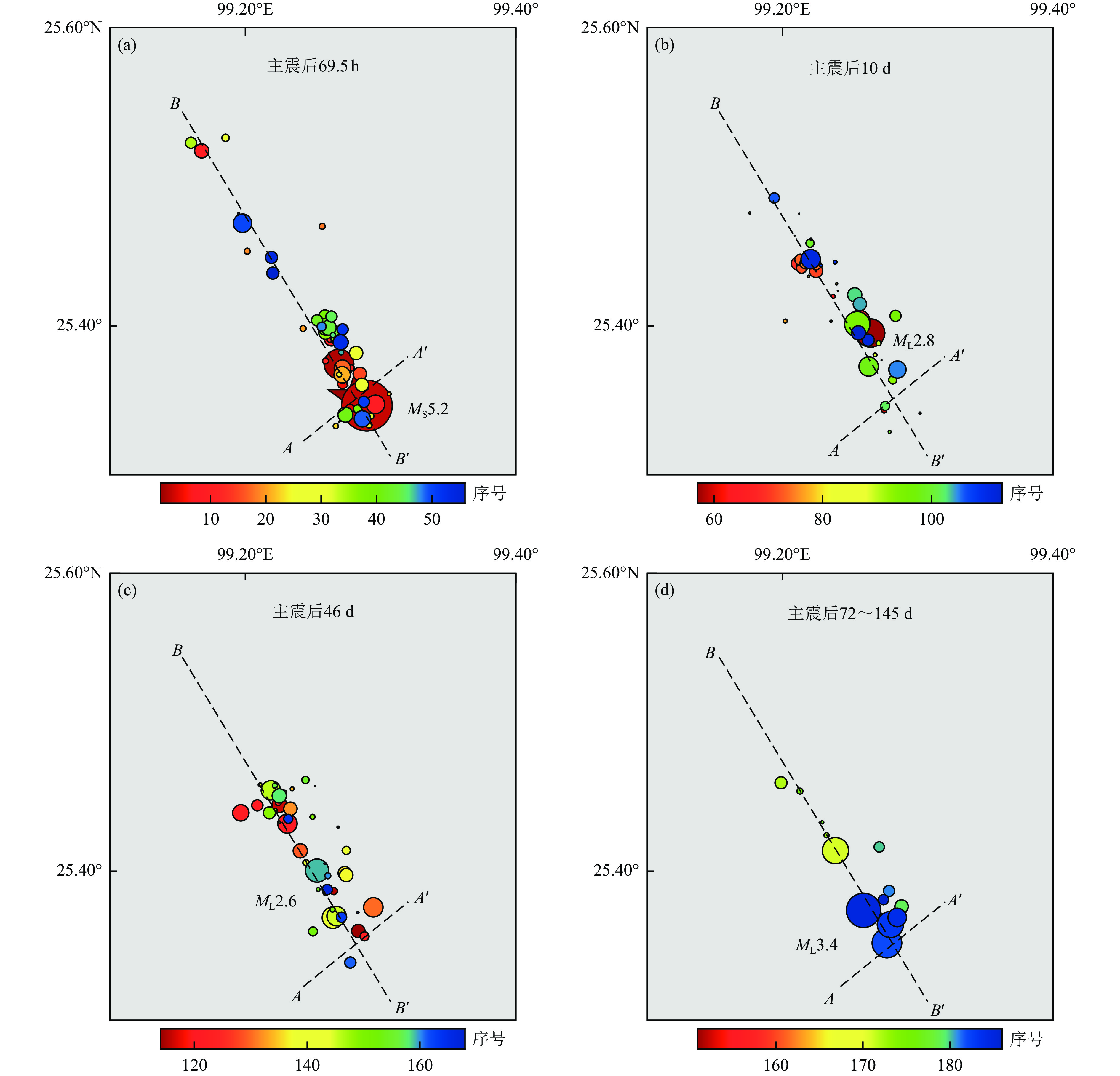
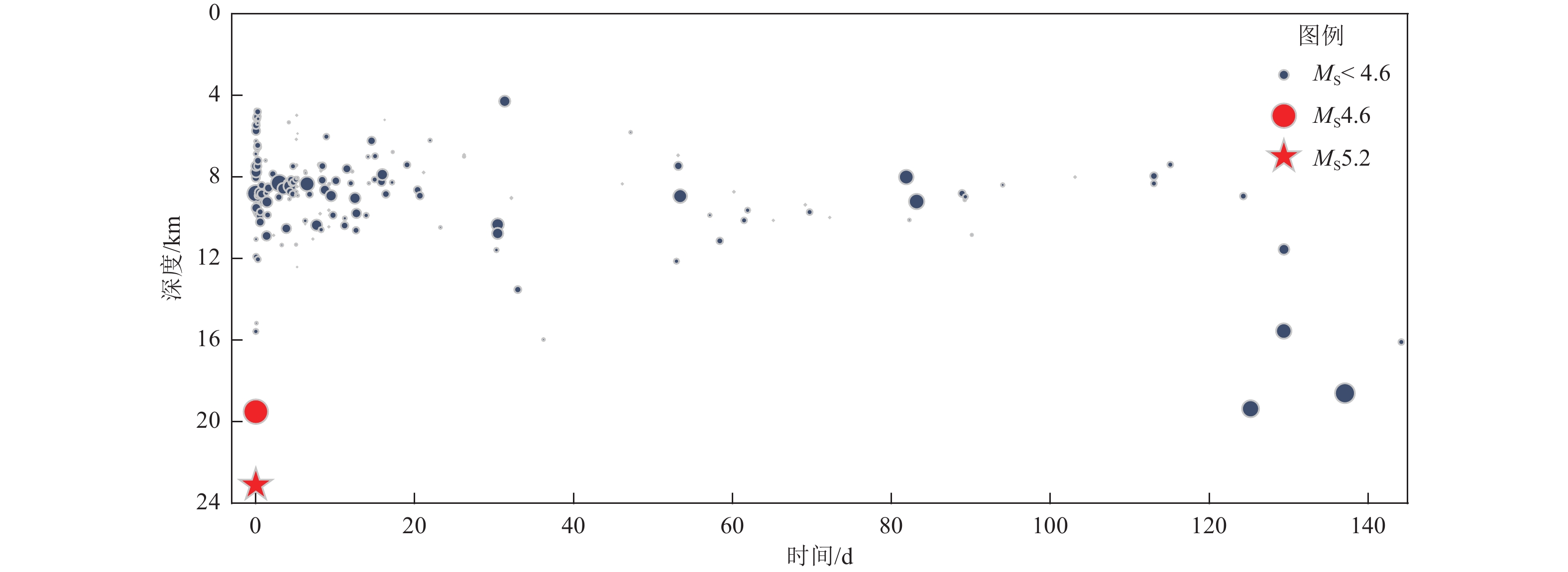
图 11 2023年云南保山MS5.2地震序列的时空迁移过程
Figure 11. Spatiotemporal migration process of Baoshan MS5.2 earthquake series in 2023
表 1 云南省区域数字化地震监测台网给出的保山MS≥3.0地震目录
Table 1. The catalogue of earthquakes with MS≥3.0 in Baoshan area from Yunnan seismic network
编号 日期 北京时间 ϕN/(°) λE/(°) 震源深度/km 震级MS 1 2023-05-02 23:27:22 25.358 99.279 20.9 5.2 2 2023-05-02 23:38:18 25.346 99.290 17.6 4.6 3 2024-07-29 22:50:48 25.402 99.243 15.7 3.6  下载: 导出CSV
表 2 利用CAP方法反演保山MS≥3.0地震的震源机制解
Table 2. Focal mechanisms of Baoshan MS≥3.0 earthquakes inverted by using CAP method
事件编号 震级MS 震源深度/km 节面Ⅰ/(°) 节面Ⅱ/(°) 走向 倾角 滑动角 走向 倾角 滑动角 1 5.2 7.6 51 78 −34 149 56.8 −165.6 2 4.6 8.0 158 49 −162 56 76.5 −42.4 3 3.6 5.5 46 81 8 314.7 82.1 170.9
下载: 导出CSV
-
安晓文, 常祖峰, 陈宇军等, 2018. 云南第四纪活动断裂暨《云南第四纪活动断裂分布图》. 北京: 地震出版社, 160−435. 薄景山, 1989. 水库诱发地震研究的回顾与展望. 世界地质, 8(1): 9−14. 蔡国军, 2008. 澜沧江小湾水电站坝基岩体结构面发育机理及其工程地质特征研究. 成都: 成都理工大学.Cai G. J., 2008. Study on genesis and engineering geological characteristics of the rock mass discontinuities in the dam foundation of Xiaowan hydropower station of Lancang river. Chengdu: Chengdu University of Technology. (in Chinese) 常廷改, 胡晓, 2018. 水库诱发地震研究进展. 水利学报, 49(9): 1109−1122.Chang T. G., Hu X., 2018. Research progress on reservoir induced earthquake. Journal of Hydraulic Engineering, 49(9): 1109−1122. (in Chinese) 陈厚群, 2011-05-23. 大坝安全与水库地震. 科学时报. 陈姝荞, 曹思远, 孙丽等, 2020. 紫坪铺水库诱发地震与构造地震波谱时频特征差异性研究. 中国地震, 36(3): 469−483. doi: 10.3969/j.issn.1001-4683.2020.03.010Chen S. Q., Cao S. Y., Sun, L., et al., 2020. Differences in time-frequency characteristics of wave spectrum between Zipingpu reservoir induced earthquakes and tectonic earthquakes. Earthquake Research in China, 36(3): 469−483. (in Chinese) doi: 10.3969/j.issn.1001-4683.2020.03.010 郭志, 高星, 路珍, 2021. 2020年1月19日新疆伽师M6.4地震的重定位及震源机制. 地震学报, 43(2): 345−356.Guo Z., Gao X., Lu Z, 2021. Relocation and focal mechanism for the Xinjiang Jiashi earthquake on 19 January, 2020. Seismology and Geology, 43(2): 345−356. (in Chinese) 侯新荣, 郭振威, 高大维等, 2024. 地震定位方法最新进展综述. 地球物理学进展, 39(3): 959−974.Hou X. R., Guo Z. W., Gao D. W., et al., 2024. Review of recent advances in seismic location methods. Progress in Geophysics, 39(3): 959−974. (in Chinese) 蒋海昆, 代磊, 侯海峰等, 2006. 余震序列性质判定单参数判据的统计研究. 地震, 26(3): 17−25. doi: 10.3969/j.issn.1000-3274.2006.03.003Jiang H. K., Dai L., Hou H. F., et al., 2006. Statistic study on the criterion index for classification of aftershock sequences. Earthquake, 26(3): 17−25. (in Chinese) doi: 10.3969/j.issn.1000-3274.2006.03.003 姜金钟, 付虹, 陈棋福, 2016. 位于构造活跃区的小湾水库地震活动特征−基于地震精定位的分析. 地球物理学报, 59(7): 2468−2485.Jiang J. Z., Fu H., Chen Q. F., 2016. Characteristics of seismicity of the Xiaowan reservoir in an area of active tectonics from double-difference relocation analysis. Chinese Journal of Geophysics, 59(7): 2468−2485. (in Chinese) 李安然, 韩晓光, 徐永键, 1987. 初探水库地震的形成机理及其诱发环境. 华南地震, 7(2): 81−89. doi: 10.13512/j.hndz.1987.02.010Li A. R., Han X. G., Xu Y. J., 1987. Preliminary study on the mechanism of reservoir earthquake and its environment factors. South China Seismological Journal, 7(2): 81−89. (in Chinese) doi: 10.13512/j.hndz.1987.02.010 李碧雄, 田明武, 莫思特, 2014. 水库诱发地震研究进展与思考. 地震工程学报, 36(2): 380−385. doi: 10.3969/j.issn.1000-0844.2014.02.0380Li B. X., Tian M. W., Mo S. T., 2014. Research progress and thoughts on reservoir-induced seismicity. China Earthquake Engineering Journal, 36(2): 380−385. (in Chinese) doi: 10.3969/j.issn.1000-0844.2014.02.0380 李姣, 姜金钟, 杨晶琼, 2020. 2017年漾濞MS4.8 和MS5.1地震序列的微震检测及重定位. 地震学报, 42(5): 527−542.Li J., Jiang J. Z., Yang J. Q., 2020. Microseismic detection and relocation of the 2017 MS4.8 and MS5.1 Yangbi earthquake sequence, Yunnan. Acta Seismologica Sinica, 42(5): 527−542. (in Chinese) 刘远征, 2014. 水库诱发地震与孔隙压力扩散系数研究−以紫坪水库为例. 北京: 中国地震局地质研究所.Liu Y. Z., 2014. Study of reservoir induced seismicity and hydraulic diffusivity - a case study of Zipingpu reservoir. Beijing: Geological Research Institute of China Earthquake Administration. (in Chinese) 孟庆筱, 姚运生, 廖武林等, 2021. 三峡蓄水进程中库首区地震活动与库水位的关联性研究. 大地测量与地球动力学, 41(7): 714−720. doi: 10.14075/j.jgg.2021.07.010Meng Q. X., Yao Y. S., Liao W. L., et al., 2021. Analysis of the Cross-Correlation between seismicity and water level at the Head area of the Three Gorges reservoir in the impoundment process. Journal of Geodesy and Geodynamics, 41(7): 714−720. (in Chinese) doi: 10.14075/j.jgg.2021.07.010 墨宏山, 2000. 水库诱发地震判别研究. 见: 第六届全国工程地质大会论文集. 中国地质学会, 485−488, 424. 乔东玉, 杨光, 陈柳等, 2024. 构造型水库诱发地震震级预测与探讨. 水利水电工程设计, 43(2): 28−32.Qiao D. Y., Yang G., Chen L., et al., 2024. Magnitude prediction and discussion of tectonic reservoir-induced earthquake. Design of Water Resources & Hydroelectric Engineering, 43(2): 28−32. (in Chinese) 唐渊, 尹福光, 王立全等, 2013. 滇西崇山剪切带南段左行走滑作用的构造特征及时代约束. 岩石学报, 29(4): 1311−1324.Tang Y., Yin F. G., Wang L. Q., et al., 2013. Structural characterization of and geochronological constraints on sinistral strike-slip shearing along the southern segment of Chongshan shear zone, western Yunnan. Acta Petrologica Sinica, 29(4): 1311−1324. (in Chinese) 王彬, 邓瑞生, 2023. 云南两千年地震全记录. 昆明: 云南科技出版社, 833−843. 王光明, 吴中海, 刘昌伟等, 2022. 2022年1月2日宁蒗MS5.5地震序列重定位与发震构造分析. 地震学报, 44(4): 581−593. doi: 10.11939/jass.20220017Wang G. M., Wu Z. H., Liu C. W., et al., 2022. Relocation and seismogenic structure analysis of the MS5.5 Ninglang earthquake sequence on January 2, 2022. Acta Seismologica Sinica, 44(4): 581−593. (in Chinese) doi: 10.11939/jass.20220017 王明振, 李珊, 高霖, 2020. 长江三峡工程库区地震活动性规律. 科学技术与工程, 20(19): 7865−7869.Wang M. Z., Li S., Gao L., 2020. The seismic activity regular on the reservoir region of Three Gorges project. Science Technology and Engineering, 20(19): 7865−7869. (in Chinese) 夏其发, 2000. 水库诱发地震评价研究. 中国地质灾害与防治学报, 11(2): 39−45.Xia Q. F., 2000. Assessment of reservoir induced earthquake. The Chinese Journal of Geological Hazard and Control, 11(2): 39−45. (in Chinese) 肖安予, 1982. 水库诱发地震若干震例的初步分析. 华南地震, (3): 28−32. 姚运生, 2006. “长江三峡水库诱发地震监测研究”项目成果介绍. 国际地震动态, (9): 67−69. doi: 10.3969/j.issn.0253-4975.2006.09.013Yao Y. S., 2006. Introduction of the program “monitoring and studies for reservoir-induced earthquakes in the Three Gorge Reservoir”. Recent Developments in World Seismology, (9): 67−69. (in Chinese) doi: 10.3969/j.issn.0253-4975.2006.09.013 张波, 张进江, 钟大赉等, 2011. 喜马拉雅东构造结东缘碧罗雪山−崇山剪切带北段构造变形特征及构造意义. 中国科学: 地球科学, 41(7): 945−959. 张金学, 徐恒, 姜勇果等, 2021. 滇西保山地块北端温泉断裂构造−岩浆带成矿系统以及铍矿化特征初探−以泸水县石缸河锡钨铍矿床为例. 地球与环境, 11(6): 729−746.Zhang J. X., Xu H., Jiang Y. G., et al., 2021. The tectono-magmatic metallogenic system of Wenquan Fault zone in the northern end of Baoshan Massif, western Yunnan, and the characteristics of beryllium mineralization−a case study of the Shiconghe tin-tungsten-beryllium deposit in Lushui. Earth and Environment, 11(6): 729−746. (in Chinese) 中国地震局监测预报司, 2017. 测震学原理与方法. 北京: 地震出版社, 447−450. 钟康惠, 刘肇昌, 舒良树等, 2004. 澜沧江断裂带的新生代走滑运动学特点. 地质评论, 50(1): 1−8. doi: 10.3321/j.issn:0371-5736.2004.01.001Zhong K. H., Liu Z. C., Shu L. S., et al., 2004. The Cenozoic strike-slip kinematics of the Lancang Jiang Fault zone. Geological Review, 50(1): 1−8. (in Chinese) doi: 10.3321/j.issn:0371-5736.2004.01.001 钟鸣, 2013. 基于关联规则和云模型的水库诱发地震风险多层次模糊综合评价. 武汉: 华中科技大学.Zhong M., 2013. Multi-lever fuzzy comprehensive evaluation of reservoir induced seismic risk based on association rules and cloud model. Wuhan: Huazhong University of Science and Technology. (in Chinese) Chen L. Y. , Talwani P. , 1998. Reservoir-induced seismicity in China. In: Talebi S, ed. , Seismicity Caused by Mines, Fluid Injections, Reservoirs, and Oil Extraction. Basel: Birkhäuser, 133−149. Herath P., Attanayake J., Gahalaut K., 2022. A reservoir induced earthquake swarm in the Central Highlands of Sri Lanka. Scientific Reports, 12(1): 18251. doi: 10.1038/s41598-022-22791-z Liu D., Jin B., Zhang S. L., 2021. Advances in the identification of reservoir-induced earthquakes. IOP Conference Series: Earth and Environmental Science, 643(1): 012157. doi: 10.1088/1755-1315/643/1/012157 Liu Y., Yu Z. Y., Zhang Z. Q., et al., 2023. The high-resolution community velocity model V2.0 of southwest China, constructed by joint body and surface wave tomography of data recorded at temporary dense arrays. Science China Earth Sciences, 66(10): 2368−2385. doi: 10.1007/s11430-022-1161-7 Saadalla H., Abdel-aal A. A. K., Mohamed A., et al., 2020. Characteristics of earthquakes recorded around the high dam lake with comparison to natural earthquakes using waveform inversion and source spectra. Pure and Applied Geophysics, 177: 3667−3695. doi: 10.1007/s00024-020-02490-4 Scholz C. H. , 2019. The mechanics of earthquakes and faulting. 3rd ed. Cambridge: Cambridge University Press, 512. Shapiro S. A., Huenges E., Borm G., 1997. Estimating the crust permeability from fluid-injection-induced seismic emission at the KTB site. Geophysical Journal International, 131(2): F15−F18. doi: 10.1111/j.1365-246X.1997.tb01215.x Talwani P., Chen L. Y., Gahalaut K., 2007. Seismogenic permeability, ks. Journal of Geophysical Research: Solid Earth, 112(B7): B07309. Waldhauser F., Ellsworth W. L., 2000. A double-difference Earthquake location algorithm: method and application to the Northern Hayward Fault, California. Bulletin of the Seismological Society of America, 90(6): 1353−1368. doi: 10.1785/0120000006 Zhang H. L., Eaton D. W., Li G., et al., 2016. Discriminating induced seismicity from natural earthquakes using moment tensors and source spectra. Journal of Geophysical Research: Solid Earth, 121(2): 972−993. doi: 10.1002/2015JB012603 Zhao L. S., Helmberger D. V., 1994. Source estimation from broadband regional seismograms. Bulletin of the Seismological Society of America, 84(1): 91−104. Zhu L. P., Helmberger D. V., 1996. Advancement in source estimation techniques using broadband regional seismograms. Bulletin of the Seismological Society of America, 86(5): 1634−1641. doi: 10.1785/BSSA0860051634 -





 点击查看大图
计量
- 文章访问数: 290
- HTML全文浏览量: 403
- PDF下载量: 77
- 被引次数: 0
