


The Characteristics of Co-seismic and Post-seismic Surface Deformation of Destructive Earthquake and Its Significance in Engineering Seismic Resistance
-
摘要: 地震地表变形会对基础设施造成巨大破坏,如何减轻其造成的破坏,成为设计人员关注的重点。本文在整理我国自1900年以来有同震地表破裂的地震案例基础上,将数据分为逆断层型、正断层型与走滑断层型3类,分别进行最小二乘法分析,得到不同断裂类型的震级与地震破裂参数及其位移量之间的关系,同时针对我国西部地区震级与地震破裂参数的回归关系式进行了讨论;并对搜集到的我国21例震后地表形变监测数据进行讨论。结果显示,同震阶段的拟合公式相关系数较大,标准偏差较小,所得经验关系更接近中国地质实际情况;震后2年内近场形变量大多位于5~7 cm、震后10 年内近场地表形变量大多位于8~10 cm;说明可以定量及半定量的分析同震、震后破裂参数,为地震易发区穿越潜在活动断层的基础设施设计以及安全性评价提供参考依据。Abstract: Surface deformation induced by earthquakes can cause severe damage to infrastructure, making its mitigation a critical concern in engineering design. Based on a self-compiled database of earthquakes with documented coseismic surface ruptures in China since 1900, this study classifies the events into three faulting types: reverse, normal, and strike-slip faults. For each fault type, least-squares regression analyses are conducted to establish empirical relationships among earthquake magnitude, surface rupture parameters, and displacement. In addition, the scaling relationships between earthquake magnitude and rupture parameters in western China are examined. Furthermore, 21 cases of post-earthquake surface deformation monitoring data from China are analyzed. The results show that the fitted empirical formulas for the coseismic stage exhibit high correlation coefficients and low standard deviations, indicating that the derived relationships are well aligned with the geological conditions of China. The analysis of post-seismic deformation reveals that, within two years after an earthquake, near-field surface deformation is generally limited to 5~7 cm, while within ten years, it typically remains within 8~10 cm. These findings demonstrate that both coseismic and post-seismic surface deformation parameters can be quantitatively and semi-quantitatively characterized, providing valuable references for the design, risk assessment, and safety evaluation of infrastructure crossing potential active faults in earthquake-prone regions.
-
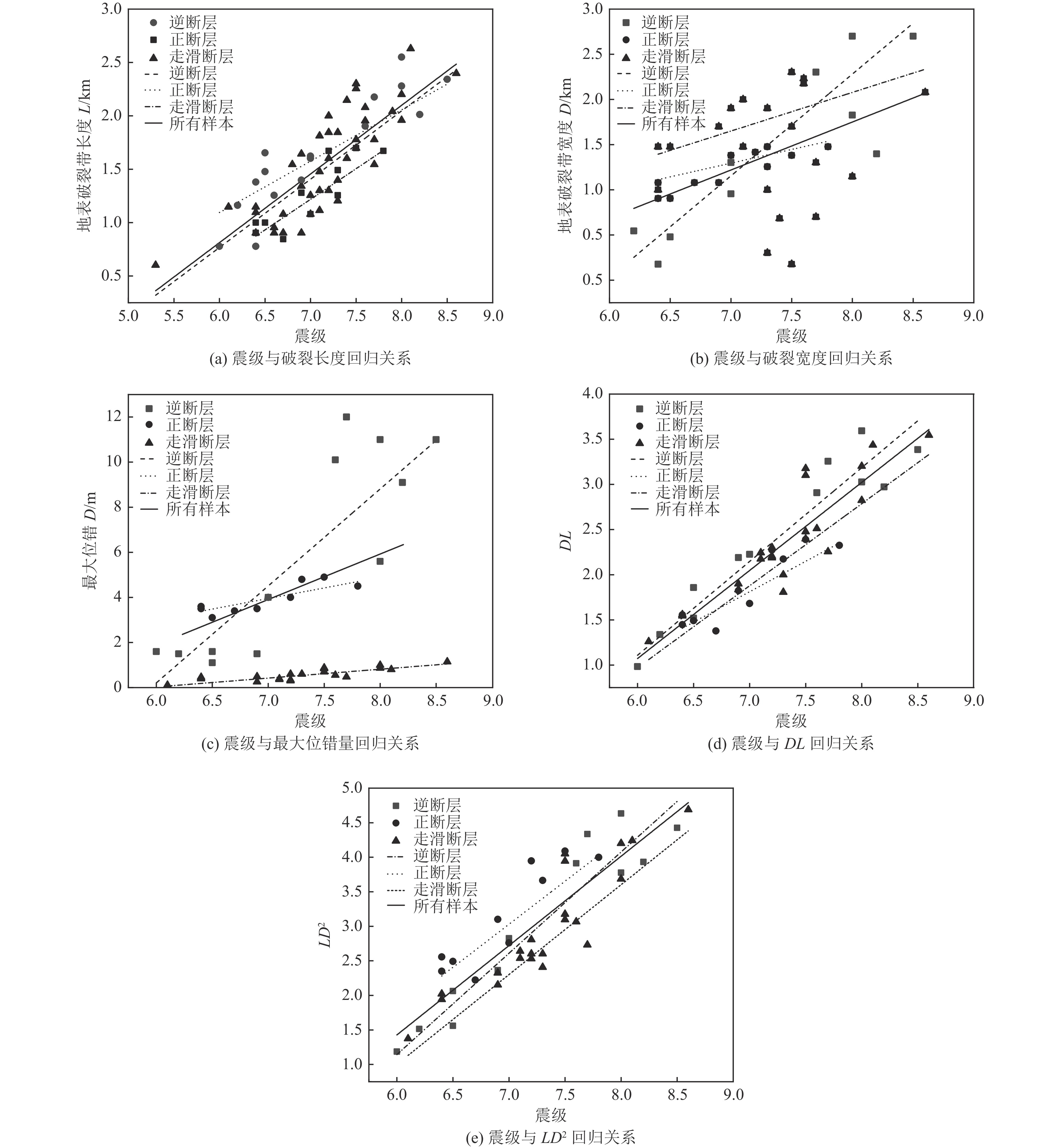
图 1 震级与各破裂参数拟合曲线图
Figure 1. The fitting curves of earthquake magnitude and various rupture parameters
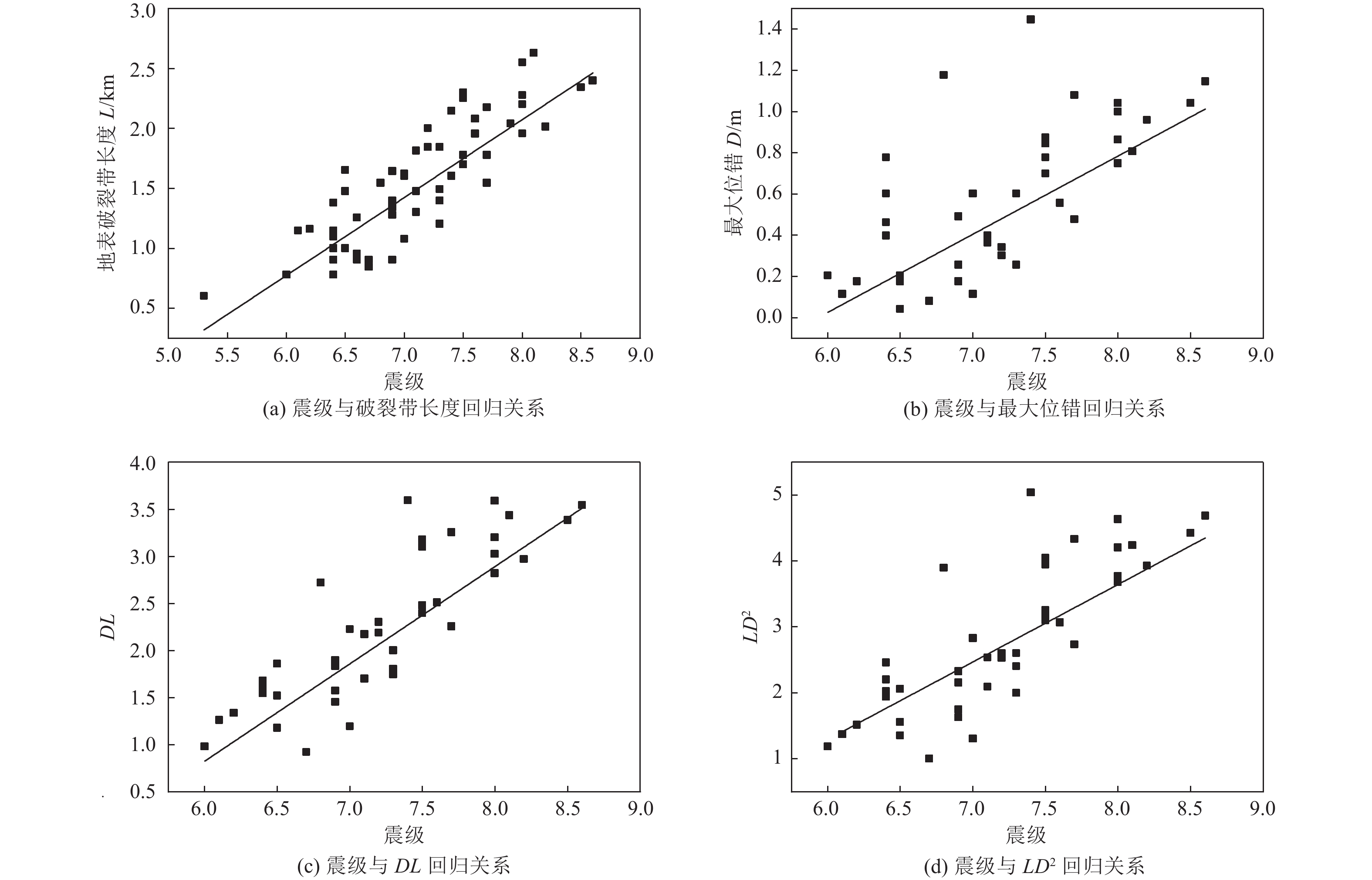
图 2 西部地区震级与各破裂参数拟合曲线图
Figure 2. The fitting curves of earthquake magnitude and various rupture parameters in the western region
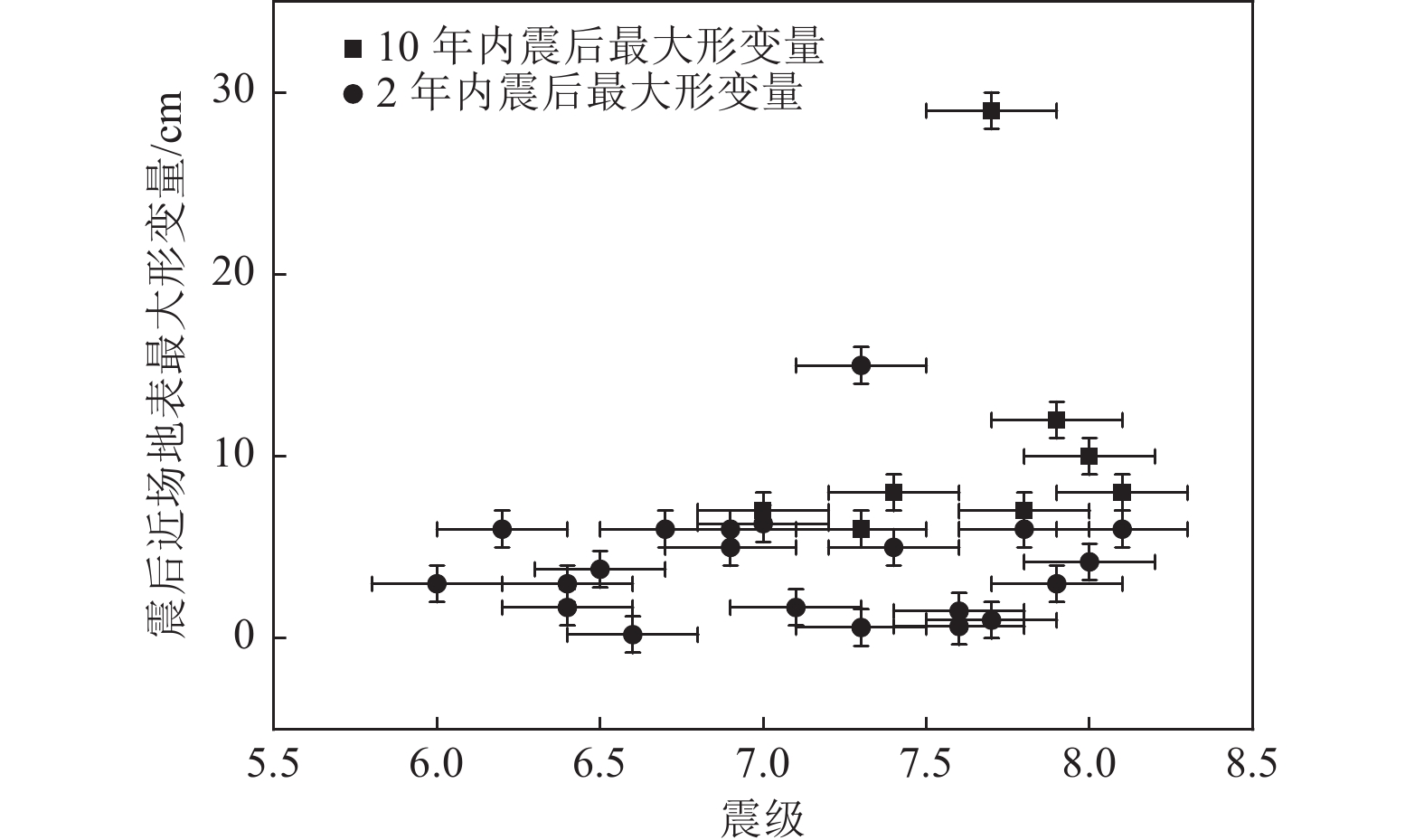
图 3 震级与震后2年内、震后10年内近场地表最大形变量关系图
Figure 3. Relationship between earthquake magnitude and maximum surface deformation in the near field within 2 years and 10 years after the earthquake
表 1 同震破裂参数经验关系回归数据表
Table 1. Regression data for empirical relationships among magnitude and co-seismic fracture parameters
回归方程形式 滑动类型 地震数目 系数和标准误差 标准偏差s 相关系数r ai (Sa) bi (Sb) $ \log L=a_1+b_1\times M_{\text{S}} $ 逆断层 16 −2.67(0.53) 0.60(0.07) 0.23 0.82 正断层 11 −2.98(0.79) 0.60(0.11) 0.16 0.76 走滑断层 42 −3.14(0.51) 0.65(0.07) 0.28 0.67 所有样本 69 −3.04(0.36) 0.64(0.05) 0.26 0.69 $ \log W=a_2+b_2\times M_{\mathrm{S}} $ 逆断层 10 −5.72(1.38) 0.97(0.18) 0.46 0.77 正断层 11 −1.67(0.52) 0.41(0.07) 0.11 0.77 走滑断层 21 0.85(2.19) 0.07(0.29) 0.69 0.002 所有样本 42 −2.49(1.09) 0.53(0.15) 0.58 0.23 $ \log D=a_3+b_3\times {M}_{\text{S}} $ 逆断层 12 −2.60(0.49) 0.44(0.06) 0.19 0.80 正断层 10 −0.24(0.18) 0.11(0.02) 0.03 0.72 走滑断层 22 −2.10(0.41) 0.36(0.05) 0.14 0.68 所有样本 44 11.06(5.20) 1.91(0.71) 3.0 0.14 $ \log (DL)=a_4+b_4\times {M}_{\text{S}} $ 逆断层 12 −4.71(0.69) 0.98(0.05) 0.26 0.91 正断层 10 −3.41(0.83) 0.75(0.11) 0.17 0.83 走滑断层 22 −4.68(0.78) 0.96(0.10) 0.28 0.80 所有样本 44 −4.77(0.46) 0.97(0.06) 0.27 0.84 $ \log (L{D}^{2})=a_5+b_5\times {M}_{\text{S}} $ 逆断层 12 −7.32(1.02) 1.41(0.14) 0.39 0.91 正断层 10 −6.59(1.61) 1.39(0.23) 0.33 0.81 走滑断层 22 −6.78(1.02) 1.32(0.13) 0.37 0.81 所有样本 44 −6.33(0.75) 1.29(0.10) 0.44 0.78  下载: 导出CSV
表 2 西部地区同震破裂参数经验关系回归数据
Table 2. Regression d ata for e mpirical r elationships among magnitude and co-seismic fracture parameters in western region
回归方程形式 地震数目 系数和标准误差 标准偏差s 相关系数r ai(Sa) bi (Sb) $ \log L=a_1+b_1\times {M}_{{\mathrm{S}}} $ 61 −3.07(0.37) 0.65(0.05) 0.27 0.72 $ \log D=a_3+b_3\times {M}_{{\mathrm{S}}} $ 42 −2.07(0.45) 0.36(0.03) 0.26 0.45 $ \log (DL)=a_4+b_4\times {M}_{{\mathrm{S}}} $ 42 −5.08(0.72) 1.01(0.09) 0.41 0.72 $ \log (L{D}^{2})=a_5+b_5{\times M}_{{\mathrm{S}}} $ 42 −7.16(1.11) 1.38(0.15) 0.65 0.66
下载: 导出CSV
-
陈达生, 1984. 地震引起的地表破裂长度与震级之间的经验关系. 华北地震科学, 2(2): 26−32. 陈树, 2018. Sentinel-1数据在同震形变和震后形变研究中的应用. 北京: 中国地震局地震预测研究所.Chen S., 2018. Application of Sentinel-1 data in co-seismic deformation and post-seismic deformation research. Beijing: Institute of Earthquake Forecasting, CEA. (in Chinese) 陈永前, 王成虎, 王仁涛, 2014. 震区地表破裂特征经验关系及其对隧道设计的意义. 工程地质学报, 22(S1): 136−141.Chen Y. Q., Wang C. H., Wang R. T., 2014. Characteristic empirical relationships of earthquake surface rupture and its significance and its significance for tunnel designCharacteristic empirical relationships of earthquake surface rupture and its significance for tunnel design. Journal of Engineering Geology, , 22(S1): 136−141. (in Chinese) 崔臻, 盛谦, 李建贺等, 2022. 蠕滑错断-强震时序作用下跨活断裂隧道变形破坏机制初步研究. 岩土力学, 43(5): 1364−1373. doi: 10.16285/j.rsm.2021.1300Cui Z., Sheng Q., Li J. H., et. al., 2022. Deformation and failure of a tunnel subjected to the coupling effect of a quasi-static faulting and seismic impact. Rock and Soil Mechanics, 43(5): 1364−1373. (in Chinese) doi: 10.16285/j.rsm.2021.1300 戴志仁, 王泽宇, 王俊等, 2023. 活动断裂区域隧道工程震后修复关键技术研究. 铁道工程学报, 40(8): 72−79. doi: 10.3969/j.issn.1006-2106.2023.08.013Dai Z. R., Wang Z. Y., Wang J., et. al., 2023. Key techniques and countermeasures for tunnel repair projects after earthquake while tunneling through active faults. Journal of Railway Engineering Society, 40(8): 72−79. (in Chinese) doi: 10.3969/j.issn.1006-2106.2023.08.013 杜方, 吴江, 梁明剑, 2021. 基于1973年炉霍MS7.6地震震后跨断层变形的地震轮回特征. 地震地磁观测与研究, 42(S1): 131−135.Du F., Wu J., Liang M. J., 2021. Analysis of seismic cycle characteristics based on the cross-fault deformation after the MS7.6 Luhuo earthquake in 1973. Seismological and Geomagnetic Observation and Research, 42(S1): 131−135. (in Chinese) 冯楚豪, 严月天, 冯万鹏等, 2022. 利用InSAR观测揭示2020年新疆于田MW6.3地震发震构造及对藏北裂谷生长的启示. 地球物理学报, 65(8): 2844−2856. doi: 10.6038/cjg2022P0310Feng C. H., Yan Y. T., Feng W. P., et Al., 2022. Seismogenic fault of the 2020 MW6.3 Yutian, Xinjiang earthquake revealed from InSAR observations and its implications for the growth of the rift in the North Tibet. Chinese Journal of Geophysics, 65(8): 2844−2856. (in Chinese) doi: 10.6038/cjg2022P0310 付博, 李志强, 陈杰等, 2018. 微型无人机在2016年11月25日阿克陶MW6.6地震中的应用探索. 地震地质, 40(3): 672−684. doi: 10.3969/j.issn.0253-4967.2018.03.012Fu B., Li Z. Q., Chen J., et al., 2018. The application of miniature unmanned aerial vehicle in 25 November 2016 Arketao MW6.6 earthquake. Seismology and Geology, 40(3): 672−684. (in Chinese) doi: 10.3969/j.issn.0253-4967.2018.03.012 付真, 张海明, 蔡永恩, 2013. 1999年台湾集集地震震后地表变形的力学机制. 地球物理学报, 56(8): 2681−2689.Fu Z., Zhang H. M., Cai Y. E., 2013. Mechanism of postseismic deformation of ground surface following the 1999 Chi-Chi earthquake, Taiwan. Chinese Journal of Geophysics, 56(8): 2681−2689. (in Chinese) 国家地震局地震测量队, 1975. 1970年云南省通海地震的地形变特征. 地球物理学报, 18(4): 240−245.The Geodetic Survey Brigade for Earthquake Research, 1975. The characteristics of the crustal deformation associated with the Tonghai earthquake, Yunnan, in January 1970. Chinese Journal of Geophysics, 18(4): 240−245. (in Chinese) 郝明, 2012. 基于精密水准数据的青藏高原东缘现今地壳垂直运动与典型地震同震及震后垂直形变研究. 北京: 中国地震局地质研究所.Hao M., 2012. Present crustal vertical movement of eastern Tibetan Plateau and Coseismic and Postseimic vertical deformation of two typical earthquakes. Beijing: Institute of Geology, China Earthquake Administration. (in Chinese) 贺克锋, 2018. 2008年汶川地震震后形变研究. 武汉: 中国地震局地震研究所.He K. F., 2018. Study on postseismic deformation following the 2008 MW7.9 Wenchuan earthquake. Wuhan: Institute of Seismology China Earthquake Administration. (in Chinese) 黄静宜, 2016. 强震地表破裂评估方法研究. 哈尔滨: 中国地震局工程力学研究所.Huang J. Y., 2016. Research on the method for evaluating the earthquake surface rupture. Harbin: Institute of Engineering Mechanics, China Earthquake Administration. (in Chinese) 黄静宜, 薄景山, 沈超等, 2016. 强震地表破裂工程评估研究的若干进展. 自然灾害学报, 25(6): 94−104. doi: 10.13577/j.jnd.2016.0612Huang J. Y., Bo J. S., Shen C., et al., 2016. Progress in research on engineering evaluation of surface ruptures in strong earthquakes. Journal of Natural Disasters, 25(6): 94−104. (in Chinese) doi: 10.13577/j.jnd.2016.0612 兰恒星, 张宁, 李郎平等, 2021. 川藏铁路可研阶段重大工程地质风险分析. 工程地质学报, 29(2): 326−341.Lan H. X., Zhang N., Li L. P., et al., 2021. Risk analysis of major engineering geological hazards for Sichuan-Tibet Railway in the phase of feasibility study. Journal of Engineering Geology, 29(2): 326−341. (in Chinese) 李传友, 张金玉, 王伟等, 2021. 2021年云南漾濞6.4级地震发震构造分析. 地震地质, 43(3): 706−721.Li C. Y., Zhang J. Y., Wang W., et al., 2021. The seismogenic fault of the 2021 Yunnan Yangbi MS6.4 earthquake. Seismology and Geology, 43(3): 706−721. (in Chinese) 李海兵, 潘家伟, 孙知明等, 2015. 2014年于田MS7.3地震地表破裂特征及其发震构造. 地质学报, 89(1): 180−194.Li H. B., Pan J. W., Sun Z. M., et al., 2015. Seismogenic structure and surface rupture characteristics of the 2014 MS7.3 Yutian earthquake. Acta Geologica Sinica, 89(1): 180−194. (in Chinese) 李进武, 武艳强, 宋成科等, 2017. 鲁甸地震同震与震后形变、重力时空分布的理论模拟. 地球物理学进展, 32(4): 1439−1446.Li J. W., Wu Y Q., Song C. K., et al., 2017. Theoretical simulation of coseismic and post earthquake deformation and gravity spatial and temporal distribution of Ludian earthquake. Progress in Geophysics, 32(4): 1439−1446. (in Chinese) 李金香, 谭明, 孙甲宁等. 2022. 新疆拜城MS5.4地震无人机遥感快速灾情获取与分析. 震灾防御技术, 17(4): 784−794.Li J. X., Tan M., Sun J. N., et al., 2022. UAV remote sensing information acquisition and analysis of MS5.4 Earthquake in Baicheng County, Xinjiang. Technology for Earthquake Disaster Prevention, 17(4): 787−794. (in Chinese) 李路伟, 余中元, 陈柏旭等, 2022. 2022年泸定MS6.8地震的同震地表变形特征及地震地质启示. 防灾科技学院学报, 24(4): 75−87. doi: 10.3969/j.issn.1673-8047.2022.04.008Li L. W., Yu Z. Y., Chen B. X., et al., 2022. Co-seismic surface deformation characteristics and seismic geological enlightenment of the Luding, Sichuan MS6.8 earthquake in 2022. Journal of Institute of Disaster Prevention, 24(4): 75−87. (in Chinese) doi: 10.3969/j.issn.1673-8047.2022.04.008 李正芳, 周本刚, 王明明等, 2011. 青藏高原区MS-L回归关系式的不确定性分析. 震灾防御技术, 6(3): 209−219. doi: 10.3969/j.issn.1673-5722.2011.03.001Li Z. F., Zhou B. G., Wang M. M., et. al., 2011. The uncertainty analysis of MS-L regression relation in the Qinghai-Tibet Plateau region. Technology for Earthquake Disaster Prevention, 6(3): 209−219. (in Chinese) doi: 10.3969/j.issn.1673-5722.2011.03.001 刘本培, 李建中, 李昌芝, 1982. 1981年道孚6.9级地震的地壳形变. 地壳形变与地震, (4): 63−71. 刘小利, 夏涛, 刘静等, 2022.2021年青海玛多MW7.4地震分布式同震地表裂缝特征. 地震地质, 44(2): 461−483.Liu X. L. , Xia T. , Liu J. , et al. , 2022. Distributed characteristics of the surface deformations associated with the 2021 MW7.4 Madoi earthquake,Qinghai,China.Seismology and Geology,44(2):461−483.(in Chinese) 刘玉权, 彭兴宽, 黄震民, 1988. 通海地震震后地形变研究. 地震研究, (4): 369−376.Liu Y. Q. , Peng X. K. , Huang Z. M. , 1998. A deformation study after Tonghai earthquake. Journal of Seismology Research, (4): 369−376. (in Chinese) 卢良玉, 1983. 海城7.3级地震的地形变过程和特征. 地震研究, 6(S1): 467−476.Lu L. Y., 1983. The process and character of land deformation of the Haicheng earthquake with magnitude 7.3. Journal of Seismology Research, 6(S1): 467−476. (in Chinese) 孟国杰, 苏小宁, 徐婉桢等, 2016. 基于GPS观测研究2010年青海玉树MS7.1地震震后地壳形变特征及其机制. 地球物理学报, 59(12): 4570−4583. doi: 10.6038/cjg20161219Meng G. J., Su X. N., Xu W. Z., et al., 2016. , Postseismic deformation associated with the 2010 Yushu, Qinghai MS7.1 earthquake by GPS observations. Journal of Geophysics, 59(12): 4570−4583. (in Chinese) doi: 10.6038/cjg20161219 冉洪流, 2011. 中国西部走滑型活动断裂的地震破裂参数与震级的经验关系. 地震地质, 33(3): 577−585.Ran H. L., 2011. Empirical relations between earthquake magnitude and parameters of strike-slip seismogenic active faults associated with historical earthquakes in western China. Seismology and Geology, 33(3): 577−585. (in Chinese) 石峰, 何宏林, 袁仁茂等, 2014. 2014年景谷地震震中附近地裂缝成因初析. 震灾防御技术, 9(4): 782−789.Shi F., He H. L., Yuan R. M., et. al., 2014. Genetic analysis of ground fissures around epicenter of 2014 Jinggu Earthquake, Yunnan Province. Disaster Prevention, 9(4): 782−789. (in Chinese) 宋龙伯, 江铁鹰, 1987. 断层破裂长度与震级关系的讨论. 地震研究, 10(1): 45−54.Song L. B., Jiang T. Y., 1987. Discussion of the relationships between the length of fault rupture and the earthquake magnitude. Journal of Seismological Research, 10(1): 45−54. (in Chinese) 孙赫, 季灵运, 朱良玉等, 2016. 新疆于田MS7.3地震同震与震后形变机制研究. 大地测量与地球动力学, 36(12): 1052−1055, 1068.Sun H., Ji L. Y., Zhu L. Y., et. al., 2016. Coseismic deformation and postseismic deformation Mechanism Yutian MS7.3 earthquake. Journal of Geodesy and Geodynamics, 36(12): 1052−1055,1068. (in Chinese) 孙银涛, 2016. 仪器烈度评定与断层破裂长度研究. 廊坊: 防灾科技学院. 唐茂云, 刘静, 邵延秀等, 2015. 中小震级事件产生地表破裂的震例分析. 地震地质, 37(4): 1193−1214. doi: 10.3969/j.issn.0253-4967.2015.04.020Tang M. Y., Liu J., Shao Y. X., et. al., 2015. Analysis about the minimum magnitude earthquake associated with surface ruptures. Seismology and Geology, 37(4): 1193−1214. (in Chinese) doi: 10.3969/j.issn.0253-4967.2015.04.020 陶双江, 蒋雅君, 2014. 汶川地震隧道震害影响因素的统计和分析. 现代隧道技术, 51(3): 15−22. doi: 10.13807/j.cnki.mtt.2014.03.003Tao S. J., Jiang Y. J., 2014. Statistics and analysis of influential factors of tunnel damage induced by the Wenchuan Earthquake. Modern Tunnelling Technology, 51(3): 15−22. (in Chinese) doi: 10.13807/j.cnki.mtt.2014.03.003 铁瑞, 王俊, 贾连军等, 2016. 强震地震数据统计及其地表破裂特性研究. 世界地震工程, 32(1): 112−116.Tie R., Wang J., Jia L. J., et al., 2016. Data statistics of strong-moderate earthquake and characteristics research of ground rupture. World Earthquake Engineering, 32(1): 112−116. (in Chinese) 王成虎, 仇文革, 陈永前等, 2014. 震区同震地表破裂统计经验关系及其对隧道抗震设计的意义. 现代隧道技术, 51(5): 1−8. doi: 10.13807/j.cnki.mtt.2014.05.001Wang C. H., Qiu W. G., Chen Y. Q., et al., 2014. Statistical empirical relationship of coseismic surface rupture and aseismic tunnel design. Modern Tunnelling Technology, 51(5): 1−8. (in Chinese) doi: 10.13807/j.cnki.mtt.2014.05.001 王运生, 许强, 赵伟华等, 2023. 青海玛多7.4级地震发震断裂继承性及新生性探讨. 灾害学, 38(1): 57−62, 71.Wang Y. S., Xu Q., Zhao W. H., et al., 2023. Inheritance and regeneration of seismogenic faults of the Maduo 7.4 earthquake in Qinghai Province. Journal of Catastrophology, 38(1): 57−62,71. (in Chinese) 吴熙彦, 徐锡伟, 于贵华等, 2018. 国家川滇实验场地震地表破裂带分布图编制. 地震地质, 40(1): 27−41. doi: 10.3969/j.issn.0253-4967.2018.01.003Wu X. Y., Xu X. W., Yu G. H., et al., 2018. Map preparation of earthquake surface ruptures in the national experimental field of earthquake monitoring and prediction in Sichuan and Yunnan Province. Seismology and Geology, 40(1): 27−41. (in Chinese) doi: 10.3969/j.issn.0253-4967.2018.01.003 谢曦霖, 2017. InSAR约束下的2008年尼玛−改则地震震后形变研究. 武汉: 武汉大学.Xie X. L., 2017. Post-seismic motion following the 2008 Nima-Gaize(Tibet) earthquake constrained by InSAR observations. Wuhan: Wuhan University. (in Chinese) 徐锡伟, 江国焰, 于贵华, 2014. 鲁甸6.5级地震发震断层判定及其构造属性讨论. 地球物理学报, 57(9): 3060−3068.Xu X. W., Jiang G. Y., Yu G. H., et al., 2014. Discussion on seismogenic fault of the Ludian MS6.5 earthquake and its tectonic attribution. Chinese Journal of Geophysics, 57(9): 3060−3068. (in Chinese) 阎渊, 2023. 青海门源MS6.9地震同震破裂的隧道破坏效应与启示. 地质力学学报, 29(6): 869−878.Yan Y., 2023. The tunnel damage effects and implications of the coseismic rupture of the Menyuan MS6.9 Earthquake in Qinghai, China. Journal of Geomechanics, 29(6): 869−878. (in Chinese) 姚远, 李涛, 刘奇等, 2021. 2020年1月19日新疆伽师MW6.0地震震中区地质灾害特点. 地震地质, 43(2): 410−429. doi: 10.3969/j.issn.0253-4967.2021.02.010Yao Y., Li T., Liu Q., et al., 2021. Characteristics of geological hazards in the epicenter of the Jiashi MW6.0 earthquake on January 19, 2020. Seismology and Geology, 43(2): 410−429. (in Chinese) doi: 10.3969/j.issn.0253-4967.2021.02.010 叶文华, 徐锡伟, 汪良谋, 1996. 中国西部强震的地表破裂规模与震级、复发时间间隔关系的研究. 地震地质, 18(1): 37−44.Ye W. H., Xu X. W., Wang L. M., 1996. Quantitative relationship between surface rupture parameter, earthquake magnitude and recurrence interval for surfacerupturing-earthquakes in West China. Seismology and Geology, 18(1): 37−44. (in Chinese) 余建胜, 赵斌, 谭凯等, 2018. 汶川地震震后GNSS形变分析. 测绘学报, 47(9): 1196−1206.Yu J. S., Zhao B., Tan K., et al., 2018. Analysis of GNSS postseismic deformation of Wenchuan earthquake. Acta Geodaetica et Cartographica Sinica, 47(9): 1196−1206. (in Chinese) 袁道阳, 谢虹, 苏瑞欢等, 2023. 2022年1月8日青海门源MS6.9地震地表破裂带特征. 地球物理学报, 66(1): 229−244. doi: 10.6038/cjg2022Q0093Yuan D. Y., Xie H., Su R. H., et al., 2023. Characteristics of co-seimic surface rupture zone of Menyuan MS6.9 earthquake in Qinghai Province on January 8, 2022 and seismogenic mechanism. Chinese Jouranl of Geophysics, 66(1): 229−244. (in Chinese) doi: 10.6038/cjg2022Q0093 袁兆德, 刘静, 李雪等, 2021. 2014年新疆于田MS7.3地震地表破裂带精细填图及其破裂特征. 中国科学: 地球科学, 51(2): 276−298.Yuan Z. D., Liu J., Li X., et al., 2021. Detailed mapping of the surface rupture of the 12 February 2014 Yutian MS7.3 earthquake, Altyn Tagh fault, Xinjiang, China. Science China Earth Sciences, 64(1): 127−147. (in Chinese) 张晁军, 石耀霖, 马丽, 2009. 昆仑山大地震震后形变反映的地壳岩石流变特性. 岩土力学, 30(9): 2552−2558. doi: 10.3969/j.issn.1000-7598.2009.09.002Zhang C. J., Shi Y. L., Ma L., 2009. Numerical simulation of crust rheological property reflected by post-seiemic deformations of Kunlun large earthquake. Rock and Soil Mechanis, 30(9): 2552−2558. (in Chinese) doi: 10.3969/j.issn.1000-7598.2009.09.002 张军龙, 贡秋卓玛, 次仁多吉等, 2023. 2021年西藏双湖MS5.8地震地表破裂及地震烈度初析. 地震, 43(1): 65−73. doi: 10.12196/j.issn.1000-3274.2023.01.006Zhang J. L., Gongqiu Z. M., Ciren D. J., et al., 2023. Preliminary analysis of surface rupture and seismic intensity of the 2021 MS5.8 Shuanghu earthquake in Qinghai-Tibet Plateau. Earthquake, 43(1): 65−73. (in Chinese) doi: 10.12196/j.issn.1000-3274.2023.01.006 张培震, 2008. 中国地震灾害与防震减灾. 地震地质, 30(3): 577−583. doi: 10.3969/j.issn.0253-4967.2008.03.001 张学朋, 蔡跃, 蒋宇静等, 2020. 隧道震害和地表变形相关性的实例分析. 哈尔滨工业大学学报, 52(2): 82−88.Zhang X. P., Cai Y., Jiang Y. J., et al., 2020. A case study of correlation between seismic damages of mountain tunnel and ground deformation. Journal of Harbin Institute of Technology, 52(2): 82−88. (in Chinese) 张宇, 汪建军, 刘洋等, 2024. 2021年青海玛多MW7.4地震震后余滑研究. 大地测量与地球动力学, 44(4): 405−409. doi: 10.14075/j.jgg.2023.06.160Zhang Y., Wang J. J., Liu Y., et al., 2024. Research on afterslip after the 2021 MW7.4 Maduo earthquake in Qinghai province. Journal of Geodesy and Geodynamics, 44(4): 405−409. (in Chinese) doi: 10.14075/j.jgg.2023.06.160 赵密, 陈晓晖, 黄景琦等, 2022. 走滑断层同震位移作用下隧道结构响应分析. 应用基础与工程科学学报, 30(5): 1296−1309. doi: 10.16058/j.issn.1005-0930.2022.05.019Zhao M., Chen X. H., Huang J. Q., et al., 2022. Research on tunnel Sesponse under Coseismic displacement due to strike-slip fault. Journal of Basic Science and Engineering, 30(5): 1296−1309. (in Chinese) doi: 10.16058/j.issn.1005-0930.2022.05.019 朱治国, 秦姗兰, 李杰等, 2019. 基于GPS技术的2016年呼图壁MS6.2地震形变特征研究. 内陆地震, 33(2): 97−104.Zhu Z. G., Qin S. L., Li J., et al., 2019. Deformation characteristics of 2016 Hutubi MS6.2 Earthquake based on GPS observation. Inland Earthquake, 33(2): 97−104. (in Chinese) Bagnardi M. , Hooper A. , 2018. Inversion of surface deformation data for rapid estimates of source parameters and uncertainties: a Bayesian approach. Geochemistry, Geophysics, Geosystems, 19(7): 2194−2211. Bonilla M. G., Mark R. K., Lienkaemper J. J., 1984. Statistical relations among earthquake magnitude, surface rupture length, and surface fault displacement. Bulletin of the Seismological Society of America, 74(6): 2379−2411. Iida, K. , 1959. Earthquake energy and earthquake fault. Journal of Earth Sciences, Nagoya University, 7(2): 98−107. Ingleby T., Wright T. J., 2017. Omori‐like decay of postseismic velocities following continental earthquakes. Geophysical Research Letters, 44(7): 3119−3130. doi: 10.1002/2017GL072865 King G. C. P. , 1978. Geological faults: fracture, creep and strain. Philosophical Transactions of the Royal Society A: Mathematical, Physical and Engineering Sciences, 288(1350): 197−212. Kuo Y. T., Wang Y., Hollingsworth J., et al., 2019. Shallow fault rupture of the Milun Fault in the 2018 MW6.4 Hualien Earthquake: a high‐resolution approach from optical correlation of Pléiades satellite imagery. Seismological Research Letters, 90(1): 97−107. doi: 10.1785/0220180227 Peltzer G., Crampe F., King G., 1999. Evidence of nonlinear elasticity of the crust from the MW7.6 Manyi (Tibet) Earthquake. Science, 286(5438): 272−276. doi: 10.1126/science.286.5438.272 Petersen M. D., Dawson T. E., Chen R., et al., 2011. Fault displacement hazard for strike-slip faults. Bulletin of the Seismological Society of America, 101(2): 805−825. doi: 10.1785/0120100035 Qu W., Liu B. H., Zhang Q., et al., 2021. Sentinel-1 InSAR observations of co- and post-seismic deformation mechanisms of the 2016 MW5.9 Menyuan Earthquake, northwestern China. Advances in Space Research, 68(3): 1301−1317. doi: 10.1016/j.asr.2021.03.016 Tocher D., 1958. Earthquake energy and ground breakage. Bulletin of the Seismological Society of America, 48(2): 147−153. doi: 10.1785/BSSA0480020147 Wells D. L., Coppersmith K. J., 1994. New empirical relationships among magnitude, rupture length, rupture width, rupture area, and surface displacement. Bulletin of the Seismological Society of America, 84(4): 974−1002. doi: 10.1785/BSSA0840040974 Wen Y. M., Li Z. H., Xu C. J., et al., 2012. Postseismic motion after the 2001 MW7.8 Kokoxili earthquake in Tibet observed by InSAR time series. Journal of Geophysical Research: Solid Earth, 117(B8): B08405. Zhang X. P., Jiang Y. J., Hirakawa Y., et al., 2019. Correlation between seismic damages of Tawarayama tunnel and ground deformation under the 2016 Kumamoto earthquake. Rock Mechanics and Rock Engineering, 52(7): 2401−2413. doi: 10.1007/s00603-018-1704-x -

 点击查看大图
计量
- 文章访问数: 238
- HTML全文浏览量: 240
- PDF下载量: 68
- 被引次数: 0
